

A single sanitary compliance lapse can trigger anchorage detentions and Canal transit cancellations costing upwards of $45,000 to $65,000 per day. Securing a valid ship sanitation certificate in Panama isn’t just routine paperwork; it’s the decisive gatekeeper to your vessel’s transit schedule. With maritime authorities actively enforcing international health standards, there’s no margin for error once your vessel reaches Canal breakwaters.
You already understand the logistical friction of coordinating health inspectors across Pacific and Atlantic anchorages while juggling overlapping demands between MINSA and the Panama Canal Authority. Wondering whether your vessel qualifies for a 30-day extension or requires a full onboard re-inspection shouldn’t put your transit slot at risk. In this guide, you’ll discover how to secure, renew, or extend your certification to ensure zero transit delays, eliminate administrative bottlenecks, and maintain complete maritime compliance.
From mandatory pre-arrival declarations in VUMPA to streamlined physical audits coordinated through trusted local ship agency partners, here is your operational roadmap for stress-free port health clearance.
Key Takeaways
- Understand the statutory differences between exemption (SSCEC) and control (SSCC) documentation under the WHO International Health Regulations framework.
- Master the mandatory pre-arrival reporting protocols and timelines required to secure your ship sanitation certificate Panama authorities mandate before Canal queue entry.
- Identify the critical onboard inspection zones, from galley sanitization to potable water treatment logs, that MINSA port health surveyors target during audits.
- Determine whether your vessel qualifies for a single 30-day extension or requires an immediate physical re-inspection at Balboa or Cristóbal.
- Discover how delegating port health logistics and launch boat synchronization to an experienced local ship agency eliminates costly administrative bottlenecks.
Understanding the Ship Sanitation Certificate in Panama Waters
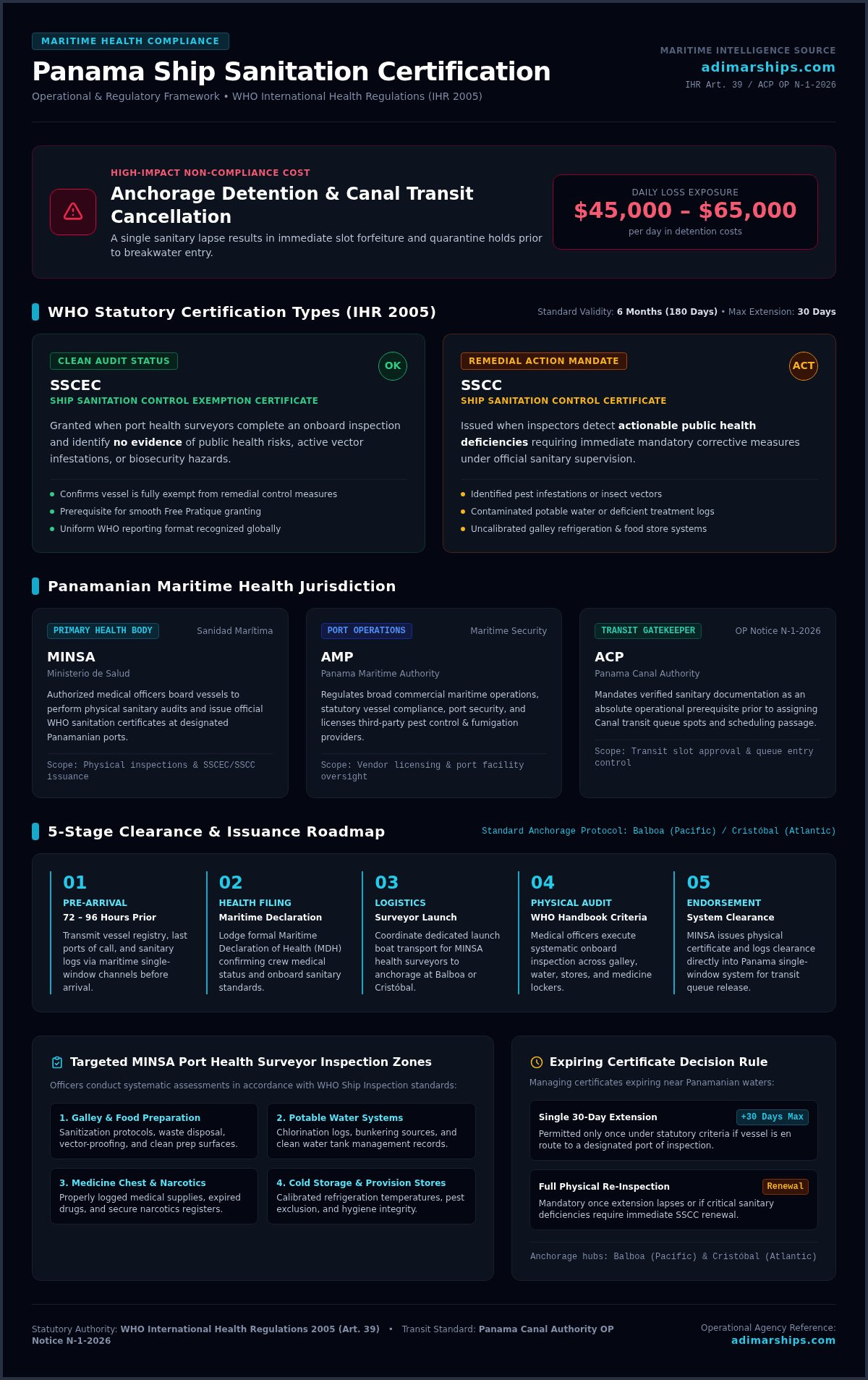
Every commercial vessel entering Panamanian territorial waters or scheduling a Canal transit must satisfy rigorous international public health standards. Under Article 39 of the World Health Organization International Health Regulations (IHR 2005), the primary statutory requirement is the Ship Sanitation Certificate, which replaced legacy deratting documents. Securing a valid ship sanitation certificate panama port health officers recognize is mandatory for securing Free Pratique. Standard certificates maintain a strict validity period of six months (180 days) across all international jurisdictions before requiring renewal or official extension.
SSCEC vs. SSCC: Key Regulatory Distinctions
Port health authorities evaluate vessels against uniform international criteria, issuing one of two specific documents based on physical audit findings:
- Ship Sanitation Control Exemption Certificate (SSCEC): Granted when health surveyors complete an onboard inspection and identify no evidence of public health risks, active vector infestations, or biosecurity hazards. This confirms the vessel remains exempt from remedial control measures.
- Ship Sanitation Control Certificate (SSCC): Issued when inspectors detect actionable public health deficiencies, such as pest infestations, contaminated potable water supplies, or uncalibrated refrigeration stores. It documents the mandatory corrective measures applied under official supervision before clearance is granted.
Both documents follow identical WHO reporting templates. They verify that shipboard hygiene, waste management, and disease vector controls comply with global standards.
Regulatory Authorities Governing Maritime Health in Panama
Coordinating maritime health compliance in Panamanian waters involves three distinct entities, each maintaining clear operational jurisdiction:
- Ministerio de Salud (MINSA): Operating through the Department of Maritime Health (Sanidad Marítima), MINSA is the primary public health body. Its authorized medical officers board vessels to perform sanitary audits and issue official certificates at designated ports.
- Panama Maritime Authority (AMP): Regulates broad commercial maritime operations, statutory compliance, and port security. The AMP also licenses authorized third-party pest management and fumigation providers.
- Panama Canal Authority (ACP): Mandates verified sanitary documentation as an operational prerequisite under OP Notice to Shipping N-1-2026. The ACP requires uploaded health clearance before assigning Canal transit booking slots.
Because these entities operate independently, clear coordination between your command team and on-the-ground representatives prevents procedural misunderstandings and transit holds.
How to Obtain or Renew a Ship Sanitation Certificate in Panama
Securing a renewal or new issuance requires navigating a defined operational sequence before your vessel enters Canal waters. Missing a filing deadline risks quarantine, financial penalties, and forfeited transit reservations. The process follows five practical stages:
- Pre-Arrival Submission: Transmit vessel registry data, last port calls, and sanitary logs through official maritime channels at least 72 to 96 hours before arrival.
- Health Declaration Filing: Lodge the formal Maritime Declaration of Health (MDH) confirming crew medical status and onboard sanitary conditions.
- Logistics Dispatch: Coordinate launch boat transport for MINSA health surveyors to the designated anchorage.
- Physical Shipboard Audit: Medical officers conduct a systematic assessment based on the WHO Handbook for Inspection of Ships and Issuance of Ship Sanitation Certificates.
- Endorsement and System Logging: MINSA validates compliance, issues the physical certificate, and logs clearance into Panama’s single-window platform.
Pre-Arrival Documentation and Agent Notification
Accurate digital paperwork prevents delays long before the anchor drops. Operators must provide their local representative with the expiring certificate, the narcotics and medicine chest log, crew vaccination records, and the completed MDH. Health authorities review these files against port databases before clearing boarding teams.
Partnering with a reliable ship agency Panama operators depend on allows your team to pre-clear paperwork directly with MINSA officers, avoiding last-minute documentation queries. Delegating this administrative phase to seasoned local partners lets masters focus entirely on safe approach navigation.
Managing Physical Inspections at Balboa and Cristobal
Physical inspections take place at designated anchorages off Balboa on the Pacific side or Cristóbal on the Atlantic side. Conducting renewals at anchor avoids expensive berth dockage fees. However, it demands precise marine transport coordination. Vessels must provide safe pilot ladder or gangway access meeting international safety standards.
Inspections typically average three hours. The Master, Chief Cook, and Medical Officer must escort the surveyors throughout the walk-through. Having clean documentation, water treatment logs, and crew medical files laid out in the ship’s office ensures an efficient audit. Once the inspection concludes without discrepancies, MINSA issues your updated ship sanitation certificate panama document, freeing the vessel for transit scheduling.
If your vessel approaches Panama with an expiring certificate, coordinating your husbandry and boarding logistics through adimarships.com ensures prompt inspector attendance and seamless health clearance.
Shipboard Areas Evaluated During Panamanian Sanitation Inspections
Port health auditors from MINSA conduct deep, rigorous examinations across 11 to 12 designated shipboard operational zones. To renew or secure your ship sanitation certificate panama authorities require total transparency and impeccable physical housekeeping. Surveyors cross-reference physical conditions with shipboard logs, checking whether crew routines align with Panama Canal Authority Notices to Shipping and World Health Organization biosecurity criteria. Identifying actionable defects can immediately trigger mandatory pest control interventions or administrative fines starting at $15,000.
Galley, Provision Stores, and Catering Hygiene
Galley audits begin with basic hygiene and food handling safety. Inspectors look for standing grease under ranges, clean food contact surfaces, and properly operating dishwasher thermal cycles.
- Cold storage calibration: Freezers and chill rooms must maintain required temperatures, supported by verified logbook entries. Meat, fish, and dairy require strict physical separation.
- Vector proofing: Galleys, mess rooms, and pantries must display zero traces of cockroach, fly, or rodent activity. Insect screens on portholes and exhaust cowls must remain intact.
- Dry provision stores: All dry stores must rest elevated on pallets at least six inches off deck plates and clear of bulkheads to prevent pest nesting and simplify floor washing.
Potable Water, Sewage Systems, and Medical Facilities
Water quality and waste containment face heightened scrutiny in tropical Panamanian waters. Surveyors inspect bunkering manifolds, check backflow preventers, and review daily chlorination logs. Microbiological analysis records must prove your fresh water supply remains pathogen-free.
Black and grey water management requires equal diligence. The Sewage Treatment Plant (STP) must operate without bypass valves open or untreated holding tank leaks. On exterior decks, rat guards measuring at least three feet in diameter must be properly clamped onto every mooring line. Meanwhile, ship hospitals and medicine chests must hold current, unexpired pharmaceuticals, with controlled narcotics logs signed off by the Master.
Handling these technical requirements during brief anchorage stops can stretch crew capacity. Operators frequently streamline these tasks by scheduling waste disposal and potable water testing through professional husbandry services during their port call. Bundling maintenance with sanitary clearance keeps your vessel compliant while preserving your transit schedule.
Managing Expiring Certificates: Renewal vs. 30-Day Extension
Operating with an expired certificate immediately halts commercial activity in Panamanian waters. Port health surveyors will deny Free Pratique, and Canal authorities will reject transit clearance. When facing an impending expiry date, operators must determine whether their operational window permits a full re-inspection or if the vessel qualifies for a temporary extension. Choosing the right path protects your schedule and prevents expensive anchorage delays.
Criteria for Securing a One-Month SSCEC Extension
Under Article 39 of the International Health Regulations, port health authorities can grant a single 30-day extension. However, this administrative relief is not automatic. MINSA grants extensions strictly under defined conditions:
- En route status: The vessel must be proceeding to an authorized port of call where a complete inspection can realistically take place.
- Documented health standards: The Master must supply verified logs showing zero active vector activity, valid water treatment records, and an uncompromised medical locker.
- Strict timing: The application must reach MINSA before the original 180-day certificate expires at midnight. Once expired, the vessel loses extension eligibility and must undergo a mandatory audit.
- Single-use limitation: Consecutive extensions are prohibited under Port State Control rules.
While an extension offers short-term breathing room, a full renewal yields six months of unrestricted international voyage compliance. If your vessel has sufficient dwell time at anchor, completing a complete renewal is the superior operational choice.
Mitigating Transit Disruption and Demurrage Risks
Coordinating an audit during a fast-moving panama canal transit window requires strategic timing. Losing an assigned Canal transit reservation triggers severe demurrage and slot cancellation penalties that disrupt downstream charter commitments. The most efficient operators schedule MINSA boarding teams to coincide with routine bunkering, technical servicing, or crew transfers at Pacific or Atlantic anchorages.
Clear communication between your shipboard command and the panama canal authority guarantees your validated ship sanitation certificate panama submission uploads directly to the EDCS platform without endangering your transit queue. Delegating this documentation pipeline to an on-the-ground agent eliminates friction between port health bodies and Canal schedulers.
To evaluate whether your vessel qualifies for an immediate extension or requires a comprehensive renewal at anchor, contact our operations team at adimarships.com to secure your port health clearance smoothly.
Coordinating Port Health Logistics with an Experienced Panama Ship Agent
Managing maritime health protocols across the Isthmus doesn’t have to stall your voyage. Coordinating directly with MINSA officials, launch operators, and Canal schedulers requires continuous local vigilance. Even minor administrative discrepancies or delayed pilot boats can push your ship out of its scheduled transit window. Delegating these intricate tasks to a specialized local partner eliminates friction, protecting your commercial timetable and providing your operations team with total peace of mind.
Streamlined Agency Coordination and MINSA Liaison
Dispatching health inspectors to outer anchorages off Balboa or Cristóbal demands exact logistical timing. Dedicated boarding agents manage authorized launch transport, synchronizing inspector boarding windows directly with vessel arrival times. This proactive approach prevents costly waiting hours at anchor.
Before surveyors step aboard, experienced agency personnel perform a comprehensive pre-audit of your vessel’s paperwork. By verifying the Maritime Declaration of Health, medicine chest records, and crew vaccination lists in advance, local agents resolve documentation gaps before authorities flag them. Throughout the inspection, your agent provides real-time updates to charterers, technical managers, and port captains, ensuring complete transparency from anchor drop to final clearance.
Protecting Vessel Interests with Dedicated Local Representation
When charterers control the primary agency appointment, owners often lack direct oversight over critical port health decisions. Appointing an independent owner’s nominated agency safeguards your vessel’s operational interests throughout the entire certification process. A dedicated protective agent acts as your eyes and ears on the water, overseeing the sanitary audit, clarifying inspector requests, and preventing arbitrary administrative delays.
Securing your ship sanitation certificate panama documentation without operational disruption requires proven local relationships and rigorous adherence to international compliance standards. By partnering with Adimar Shipping, Inc., vessel operators gain an experienced on-the-ground advocate dedicated to smooth husbandry coordination, prompt authority clearance, and seamless Canal transits.
Secure Seamless Sanitary Clearance for Your Next Canal Transit
Maintaining maritime sanitary compliance protects your bottom line and safeguards your operational schedule. From pre-clearing electronic health filings in VUMPA to ensuring galley and potable water systems pass muster, managing your ship sanitation certificate panama requirements demands prompt, precise execution. Knowing whether your voyage qualifies for a single 30-day extension or requires an immediate physical audit at Balboa or Cristóbal keeps your vessel moving without unexpected anchorage detentions.
You don’t have to manage port health bureaucracy alone. Backed by decades of specialized expertise as dedicated Panama Canal ship agents, our team handles comprehensive husbandry and transit clearance operations across both Pacific and Atlantic terminals. We provide reliable on-the-ground representation, directly coordinating inspector launches and shielding shipowners from costly transit delays.
Ready to eliminate logistical friction and protect your voyage timetable? Coordinate your ship sanitation inspection with Adimar Shipping and proceed through the waterway with total confidence.
Frequently Asked Questions
What is a Ship Sanitation Certificate in Panama?
A ship sanitation certificate panama authorities issue is a statutory public health document under the World Health Organization International Health Regulations (IHR 2005). Mandatory for obtaining Free Pratique and Canal transit clearance, it verifies that your vessel is free from biological hazards and disease vectors. The document certifies that galleys, provision stores, potable water, medical areas, and waste systems pose no threat to local ports or crews.
How long is a Ship Sanitation Certificate valid for?
A standard Ship Sanitation Certificate remains valid for a maximum period of six months (180 days) from its issuance date globally. Once this window closes, the vessel must undergo a physical renewal audit or secure an official extension. Because international maritime authorities enforce this six-month timeline strictly, operators should track expiration dates closely to coordinate surveys well before arrival at Canal anchorages.
Can a vessel transit the Panama Canal with an expired sanitation certificate?
No, the Panama Canal Authority strictly prohibits vessels with expired certificates from commencing transit operations. ACP Notice to Shipping N-1-2026 mandates a valid SSCEC, SSCC, or authorized 30-day extension before assigning a transit reservation slot. Arriving with expired paperwork risks immediate detention at outer anchorages, administrative fines exceeding $15,000, and daily delay costs reaching $45,000 to $65,000 from lost transit bookings and demurrage.
Where do ship sanitation inspections take place in Panama?
Ship sanitation inspections take place primarily at designated anchorages off Balboa on the Pacific terminus and Cristóbal on the Atlantic terminus. Authorized health surveyors board vessels via launch boat while at anchor, allowing operators to complete audits without paying expensive terminal dockage fees. In specific operational circumstances, authorized inspections can also occur alongside working port berths at these designated terminals or at Charco Azul.
What is the difference between an SSCEC and an SSCC?
An SSCEC (Ship Sanitation Control Exemption Certificate) indicates an inspection found no evidence of infection, contamination, or disease vectors, exempting the vessel from remedial control measures. In contrast, an SSCC (Ship Sanitation Control Certificate) is issued when inspectors detect public health risks, such as active pests or contaminated water systems. It specifies the mandatory corrective actions, such as professional fumigation, executed under official health supervision.
Can an existing Ship Sanitation Certificate be extended in Panama?
Yes, an existing certificate can receive a single 30-day extension under Article 39 of the IHR 2005 regulations. MINSA considers extension requests only if submitted before the original certificate expires and if the vessel is en route to a port where a full inspection can occur. You must provide clean sanitary logs demonstrating zero active vector activity. Consecutive extensions are strictly prohibited under maritime guidelines.
Which authority conducts ship sanitation inspections in Panamanian ports?
The Ministry of Health (Ministerio de Salud, or MINSA), through its Department of Maritime Health (Sanidad Marítima), holds sole statutory authority to conduct audits and issue the ship sanitation certificate panama requires. While the Panama Maritime Authority oversees statutory vessel registration and the Panama Canal Authority enforces transit rules, only MINSA medical officers board vessels to perform sanitary evaluations, inspect health logs, and endorse official clearance certificates.