

A vessel’s standard International Tonnage Certificate means virtually nothing to the Panama Canal Authority. When securing transit slots and budgeting voyage disbursements, relying on standard gross or net figures instead of properly calculating panama canal net tonnage is a direct path to expensive lockside surprises. You shouldn’t have to deal with unexpected admeasurement adjustments, SIDMAR filing bottlenecks, or the anxiety of missed transit windows caused by preventable volumetric discrepancies.
Mastering the canal’s measurement rules protects both your operating schedule and your bottom line. In this guide, you’ll learn the formulas, documentation standards, and inspection procedures required to verify your vessel’s Panama Canal Universal Measurement System (PC/UMS) net tonnage well before arriving at the locks. We’ll examine the core mathematical calculations, explain how to prepare your plans for boarding admeasurers, and share proactive checkpoints to ensure prompt ACP clearance without administrative friction.
Key Takeaways
- Understand why standard international tonnage certificates do not apply in canal waters, where one PC/UMS net ton equals 100 cubic feet of enclosed earning space.
- Learn the step-by-step mathematical formulas and coefficients required for accurately calculating panama canal net tonnage before submitting official transit declarations.
- Recognize vessel-specific measurement nuances across container ships, liquid bulk tankers, and dry bulk carriers to prevent unexpected tariff assessments.
- Assemble mandatory engineering drawings, including General Arrangement and Capacity plans, to pass ACP boarding inspections without scheduling setbacks.
- Leverage dedicated on-the-ground ship agency representation in Panama to verify preliminary admeasurement data and protect your voyage disbursements.
What Is Panama Canal Net Tonnage (PC/UMS)?
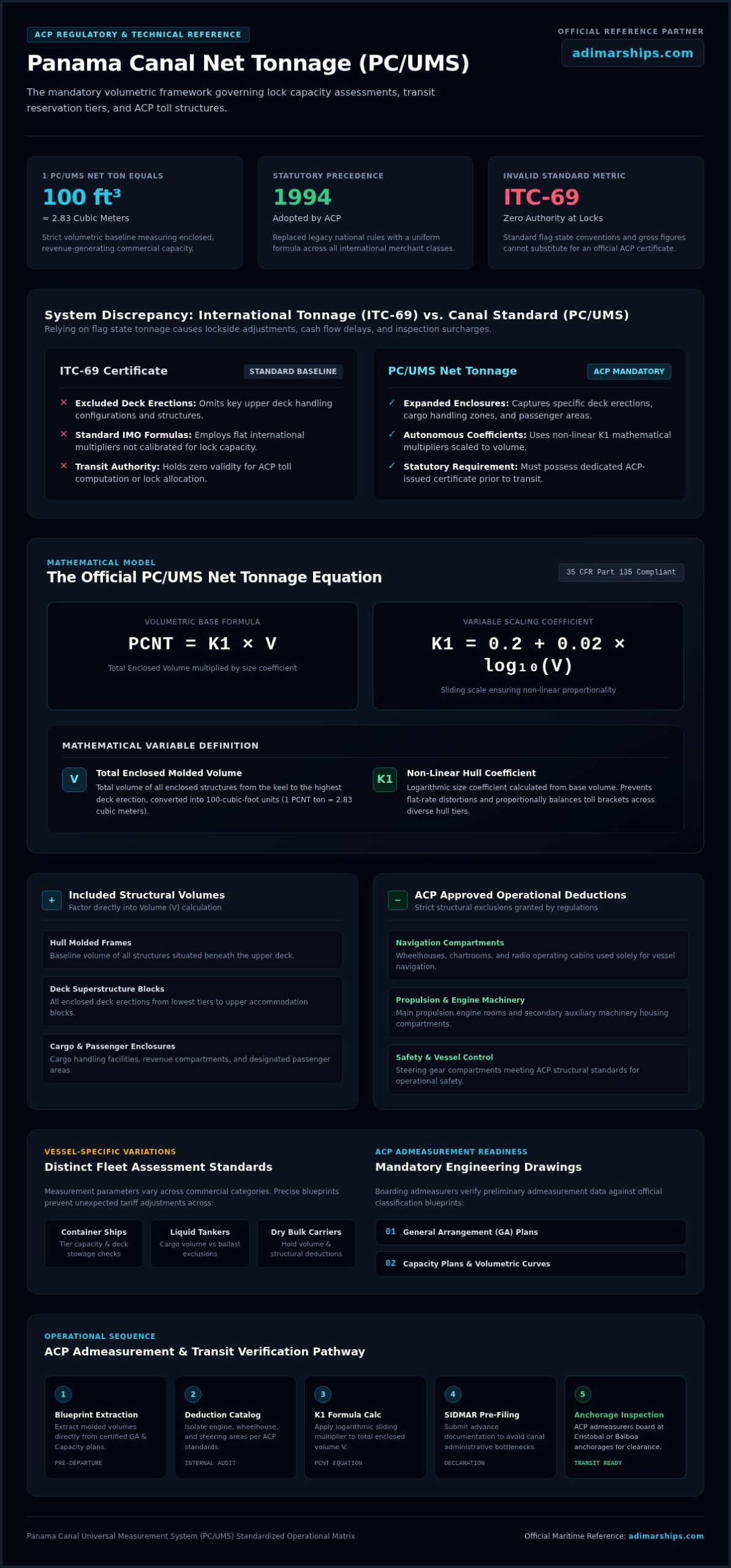
Every vessel scheduling a transit through the Panama Canal faces a distinct volumetric standard. The Panama Canal Authority (ACP) does not rely on deadweight, displacement, or gross tonnage to assess basic lock utilization. Instead, the authority determines canal fees through the Panama Canal/Universal Measurement System (PC/UMS). Under this framework, one PC/UMS net ton equals exactly 100 cubic feet (approximately 2.83 cubic meters) of enclosed, revenue-generating cargo space.
Accurate canal budgeting begins here. Because tolls, reservation brackets, and variable ancillary fees peg directly to this admeasurement, calculating panama canal net tonnage correctly establishes your entire voyage proforma. An error in measuring these enclosed volumes leads to revised transit invoices, cash flow discrepancies, and administrative holds upon arrival at the locks.
The Origins and Purpose of the PC/UMS System
The ACP adopted PC/UMS in 1994 to establish an equitable, transparent baseline across diverse merchant fleets. Historical admeasurement systems relied on fragmented national rules that often produced conflicting volumetric results for identical vessel classes. PC/UMS replaced these legacy standards with a mathematical formula based on total enclosed volume. This system ensures every ship pays tolls proportional to its true revenue-earning capacity, creating a predictable pricing structure across global shipping lines.
PCNT vs. International Net Tonnage (ITC-69)
Many operators assume their International Tonnage Convention 1969 (ITC-69) certificate satisfies canal authorities. It does not. While ITC-69 provides a universally recognized baseline for flag state documentation and port dues, the ACP maintains autonomous admeasurement rules specifically calibrated for lock capacity.
- Enclosed Space Rules: The ACP includes specific spaces that ITC-69 excludes, such as certain deck erections, cargo handling areas, and passenger spaces.
- Custom Coefficients: PCNT calculations apply distinct mathematical multipliers to total enclosed volume rather than standard IMO formulas.
- Mandatory Verification: Vessels cannot transit on an ITC-69 certificate alone; they must possess an official ACP-issued PC/UMS certificate.
Mastering these volumetric differences protects your transit schedule. Without a pre-calculated PCNT assessment vetted against current ACP criteria, vessels risk sudden admeasurement re-inspections at Cristobal or Balboa anchorages, delaying transit sequences and triggering avoidable lock surcharges.
How to Calculate Panama Canal Net Tonnage: Mathematical Formulas and Variables
Converting structural blueprints into an ACP-approved volume requires strict adherence to mathematical models. When calculating panama canal net tonnage, technical teams must extract the total molded volume of all enclosed structures rather than simply pulling numbers from classification certificates. The calculation bridges physical ship dimensions with the canal’s statutory earning metrics.
The Fundamental PC/UMS Volumetric Formula
The core equation defined in the official PC/UMS Net Tonnage calculation formula relies on total enclosed volume:
PC/UMS Net Tonnage = K1 × V
In this formula, V represents the total volume of all enclosed spaces in cubic meters, which converts into 100-cubic-foot units (one ton equals 2.83 cubic meters). The variable coefficient K1 scales non-linearly with ship size:
K1 = 0.2 + 0.02 × log10(V)
This sliding scale ensures that larger hulls reflect a mathematically proportional assessment rather than a flat multiplier across all vessel tiers.
Calculating Cargo and Non-Cargo Enclosed Spaces
Determining total volume V requires cataloging every compartment from the keel to the highest enclosed deck erection. Molded frames below the upper deck form the baseline, but superstructure blocks also count toward the total. ACP regulations grant specific deductions for operational areas, provided they meet strict structural standards:
- Navigation Spaces: Wheelhouses, chartrooms, and radio operating cabins qualify for exclusion when used solely for vessel navigation.
- Propulsion and Safety: Main engine rooms, auxiliary machinery spaces, and steering gear compartments are excluded from commercial earning volume.
- Crew Accommodations: Mess rooms, galleys, and sanitary spaces receive defined allowances, whereas passenger staterooms remain fully assessable.
Accounting for On-Deck Cargo Carrying Capacity
Vessels configured to carry freight above the weather deck face additional volume accounting. For breakbulk carriers, project cargo ships, and timber vessels, the ACP measures the volume of the cargo envelope secured to the deck. Inspectors compare your declared deck stowage against maximum permissible load lines and certified cargo securing plans. Partnering with an experienced Panama Canal ship agency to review these preliminary volumetric calculations ensures your declarations align with canal standards before your ship drops anchor.
Vessel-Specific PCNT Calculation Variations
Different vessel designs create distinct admeasurement challenges. While the baseline PC/UMS formula applies universally, the Panama Canal Authority implements specific criteria depending on hull geometry, cargo containment systems, and deck configurations. Accurately calculating panama canal net tonnage requires understanding how your specific vessel class fits within these specialized admeasurement provisions.
Containerships: Volumetric PCNT vs. Total TEU Allowance
Container vessels operate under a dual-tier measurement framework. While the enclosed hull and deck structures establish the ship’s base volumetric PCNT, canal assessments heavily factor in maximum twenty-foot equivalent unit (TEU) carrying capacity. The ACP cross-references certified cargo securing manuals against physical container slot layouts, both below deck and exposed above the weather deck. When calculating panama canal net tonnage for container carriers, operators must reconcile physical deck tiers with lock visibility requirements. Discrepancies between certified intake and declared slot plans can quickly delay boarding admeasurement clearance.
Tankers and Gas Carriers: Segregated Ballast Adjustments
Liquid bulk vessels, crude tankers, and chemical parcel carriers benefit from dedicated segregated ballast tank (SBT) exemptions under the Panama Canal Authority Maritime Regulations. Dedicated clean ballast spaces designed solely for stability and trim qualify for volumetric deductions, provided they feature independent pumping systems and complete isolation from cargo manifolds. For LNG and LPG carriers, admeasurers evaluate specialized cargo containment barriers, insulation layers, and boil-off handling spaces. Accurately documenting these non-cargo areas significantly lowers your vessel’s assessed net tonnage.
Dry Bulk and Multi-Deck Vehicle Carriers
Dry bulk carriers rely on straightforward molded hold dimensions minus non-cargo machinery voids. Conversely, pure car and truck carriers (PCTC) and roll-on/roll-off (Ro-Ro) ships present massive enclosed superstructures. Because multi-deck garages are completely enclosed, canal admeasurers incorporate every vehicle deck into the primary volume equation, resulting in high PCNT ratings relative to deadweight. Ensuring structural deck plans are properly cataloged before scheduling your Panama Canal transit prevents unexpected admeasurement disputes and keeps your voyage on schedule.
Preparing for ACP Admeasurement: Documentation and Boarding Inspection
Flawless calculations mean very little if your engineering documentation fails official canal verification. The admeasurement process is an exacting audit where ACP technical inspectors board the vessel to reconcile submitted plans with physical construction. When calculating panama canal net tonnage prior to arrival, your shore-based technical team must assemble a comprehensive drawing package that satisfies canal admeasurers at first glance.
Mandatory Engineering Drawings for First-Time Transit
Vessels transiting for the first time, or those lacking an existing PC/UMS certificate, must upload approved technical drawings into the canal portal well in advance of arrival. The admeasurement division of the Panama Canal Authority mandates specific structural plans:
- General Arrangement (GA): Complete profile and deck plans showing all enclosed spaces, cargo compartments, and deck gear.
- Capacity Plan: Tank soundings, cargo hold volumes, and clean ballast allocations marked with official structural scales.
- Lines Plan and Hydrostatic Curves: Detailed hull geometry curves stamped and verified by an authorized classification society.
- Midship Section Plan: Transverse structural framing detailing plate thicknesses and molded frame offsets.
What ACP Admeasurers Inspect During Boarding
Upon anchoring at Balboa or Cristobal, official ACP admeasurers board to physically confirm the ship’s actual layout against submitted drawings. Inspectors examine compartment boundaries, measure newly enclosed shelter decks, and verify that non-cargo ballast lines remain strictly segregated. Ship crews must ensure unobstructed access to void spaces, steering flats, and pump rooms. Any unrecorded structural modification detected during this physical walkthrough immediately halts the admeasurement clearance, putting your assigned transit window at serious risk.
Handling Vessel Alterations and Re-Admeasurement
Structural modifications directly impact your vessel’s established PC/UMS baseline. Retrofitting exhaust gas scrubbers, installing ballast water treatment modules, or adding deck cranes changes the ship’s enclosed volume profile. Failing to report these physical alterations before transit leads to mandatory re-admeasurement, heavy regulatory fines, and slot cancellations. If your fleet requires assistance preparing technical plans, verifying calculation sheets, or coordinating boarding inspectors, you can consult our Panama ship agency team to ensure seamless document vetting before your vessel reaches canal waters.
Optimizing Transit Expenses: How a Dedicated Ship Agent Protects Your Bottom Line
Mathematical precision on paper does not automatically guarantee a frictionless canal transit. Even minor interpretation differences between your technical staff and ACP inspectors can lead to unexpected toll re-evaluations or costly delays at anchor. Local representation bridges this gap. That is why a Panama Canal ships agent is your most valuable asset when managing the operational and financial demands of canal transit.
Pre-Arrival Plan Vetting and SIDMAR Submission
A proactive agency acts as your local technical vanguard long before your ship drops anchor. Dedicated agents review your engineering plans and preliminary data sheets, identifying potential calculation red flags prior to formal submission. By uploading vetted documentation into ACP systems early, your agent resolves ambiguous bulkhead positions or compartment volumes directly with canal admeasurers. This preventative review eliminates administrative holds that could compromise reserved transit slots.
Resolving On-Site Admeasurement Discrepancies
Physical inspections at Balboa or Cristobal require swift, informed coordination. When ACP admeasurers board your vessel, having your agent on site provides crucial operational support. Local agents assist the master during inspections, answering structural inquiries and clarifying compartment designations in real time. Fast on-the-ground communication prevents misunderstandings from escalating into formal holds or re-inspections. Partnering with specialized ship agency Panama experts ensures your vessel secures admeasurement clearance without losing valuable queue positions.
Financial Reconciliation and Toll Verification
The agency’s role extends well past physical inspection clearance into post-transit accounting. When calculating panama canal net tonnage, technical teams anticipate specific volumetric credits, such as segregated ballast tank allowances. An experienced agent audits your final ACP billing against initial calculation models, verifying that every statutory deduction is properly applied. If discrepancies arise, your agent advocates directly with canal authorities to adjust disbursements and safeguard owner funds.
Protect your transit schedule and voyage disbursements from preventable admeasurement delays. Contact Adimar Shipping to coordinate your vessel’s documentation, admeasurement clearance, and full port agency services in Panama.
Secure Accurate Admeasurement and Smooth Canal Transit
Accurate admeasurement separates a profitable voyage from an administrative headache. Precision in calculating panama canal net tonnage ensures your vessel arrives with verified enclosed volumes, full credit for segregated ballast, and structural drawings that satisfy ACP standards on day one. Preempting discrepancies before reaching the locks protects your booked transit reservations and eliminates sudden toll recalculations.
Local vigilance turns demanding canal regulations into a predictable, smooth operation. Based directly in Panama City, Adimar Shipping serves as your dedicated, licensed Panama Canal ship agency. Our specialists review your engineering drawings early, coordinate directly with ACP boarding admeasurers, and audit canal disbursement statements to guarantee your proforma figures match official tolls. When you need complete confidence in your canal compliance and voyage expenses, secure Adimar Shipping’s agency services for expert local representation across every lock.
Frequently Asked Questions
Can a vessel use its standard international gross or net tonnage for Panama Canal tolls?
No, the Panama Canal Authority rejects standard International Tonnage Convention 1969 (ITC-69) figures for toll determination. The ACP mandates its own volumetric standard, PC/UMS. ITC-69 calculations exclude compartments that canal rules count toward earning capacity, including specific deck enclosures and passenger spaces. Relying on an ITC-69 certificate without an official canal measurement leads to transit holds until ACP admeasurers evaluate the ship.
What is the mathematical definition of one Panama Canal Net Ton under PC/UMS?
One Panama Canal Net Ton equals exactly 100 cubic feet (approximately 2.83 cubic meters) of enclosed volumetric capacity. The ACP calculates this through the formula PCNT = K1 × V, where V is total enclosed volume in cubic meters and K1 is a logarithmic coefficient scaling with ship size. The resulting product translates into 100-cubic-foot units, establishing the primary volumetric parameter for canal tariff brackets.
What happens if a ship has structural alterations that change its internal volume?
Structural modifications invalidate an existing PC/UMS certificate and require mandatory re-admeasurement by ACP inspectors. Retrofits like exhaust gas scrubber installations, new ballast water treatment rooms, or deck crane additions change the vessel’s enclosed volume profile. Operators must submit revised drawings through official ACP portals before arrival. Failing to declare these changes risks severe compliance fines, admeasurement holds, and canceled lock reservations.
How long does the official ACP admeasurement process take during first-time transit?
The physical admeasurement boarding inspection typically takes between two and four hours at anchor. ACP admeasurers board at Balboa or Cristobal to cross-check compartments against submitted plans. However, administrative processing and certificate generation take additional time. Having your ship agent vet plans in advance and escort admeasurers on board prevents physical inspection delays, ensuring your vessel clears into the transit schedule without losing its booked slot.
Can segregated ballast tanks be deducted when calculating Panama Canal Net Tonnage?
Yes, clean segregated ballast tanks (SBT) qualify for significant volumetric deductions under official ACP rules. When calculating panama canal net tonnage for tankers and gas carriers, dedicated ballast tanks solely piped and pumped for water ballast are subtracted from chargeable volume. Your engineering drawings must prove complete structural isolation from cargo spaces. Your ship agency audits the final ACP billing to ensure these statutory deductions are fully credited.
What documents must be submitted to the ACP before admeasurement can occur?
Operators must submit certified General Arrangement, Capacity, Lines, and Midship Section plans approved by their classification society. These drawings must clearly display official scales, bulkhead locations, tank soundings, and hydrostatic data. For container or project vessels, certified cargo securing manuals and deck stowage arrangements are also mandatory. Submitting these digital plans through official canal portals well ahead of arrival allows admeasurers to review calculations before boarding.
How do on-deck container tiers affect final Panama Canal billing assessments?
On-deck container stacks add direct capacity charges on top of the vessel’s base volumetric admeasurement. When calculating panama canal net tonnage and voyage disbursements for container-carrying vessels, the ACP evaluates total loaded and empty TEU slots above the weather deck. Non-container vessels carrying deck boxes face dedicated TEU surcharges. Ensuring accurate visibility declarations and stowage plans prevents unexpected lockside fees and keeps disbursements strictly aligned with your voyage proforma.