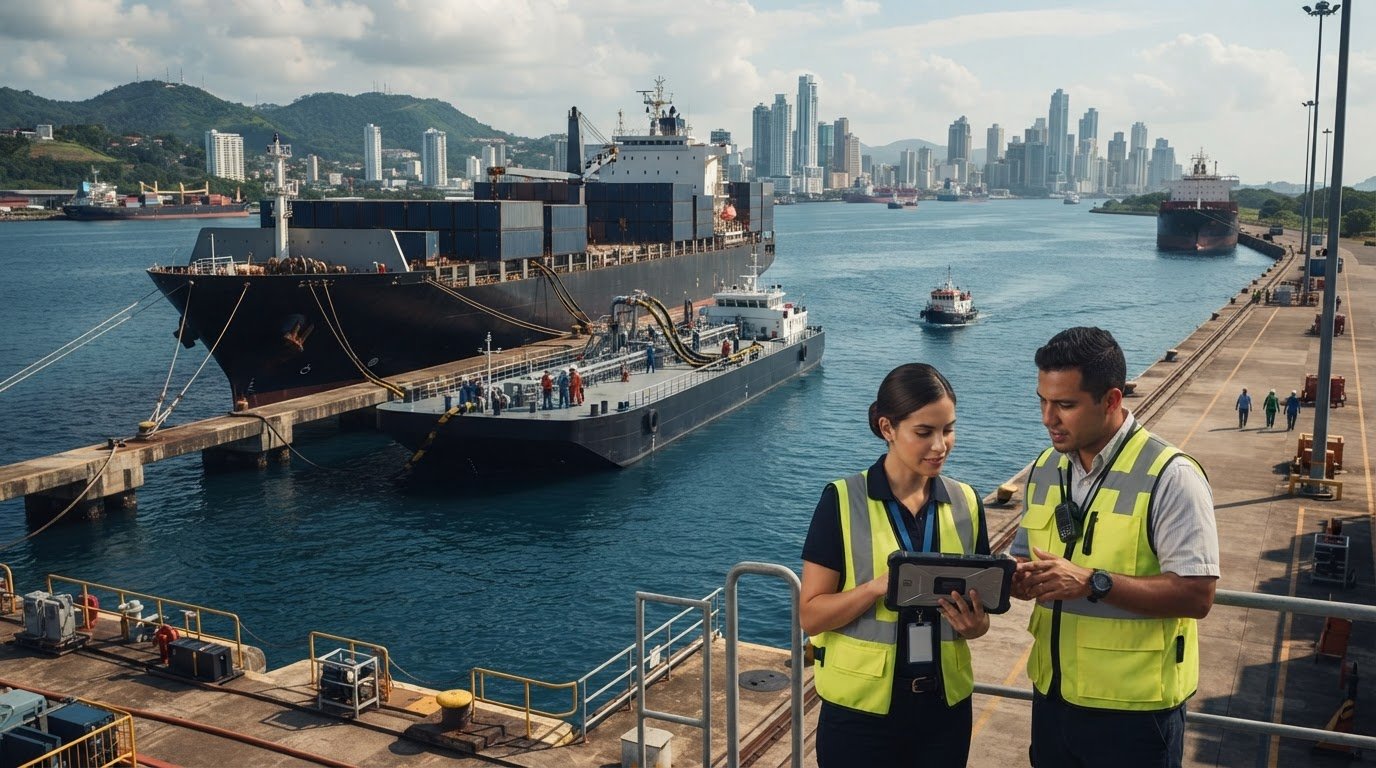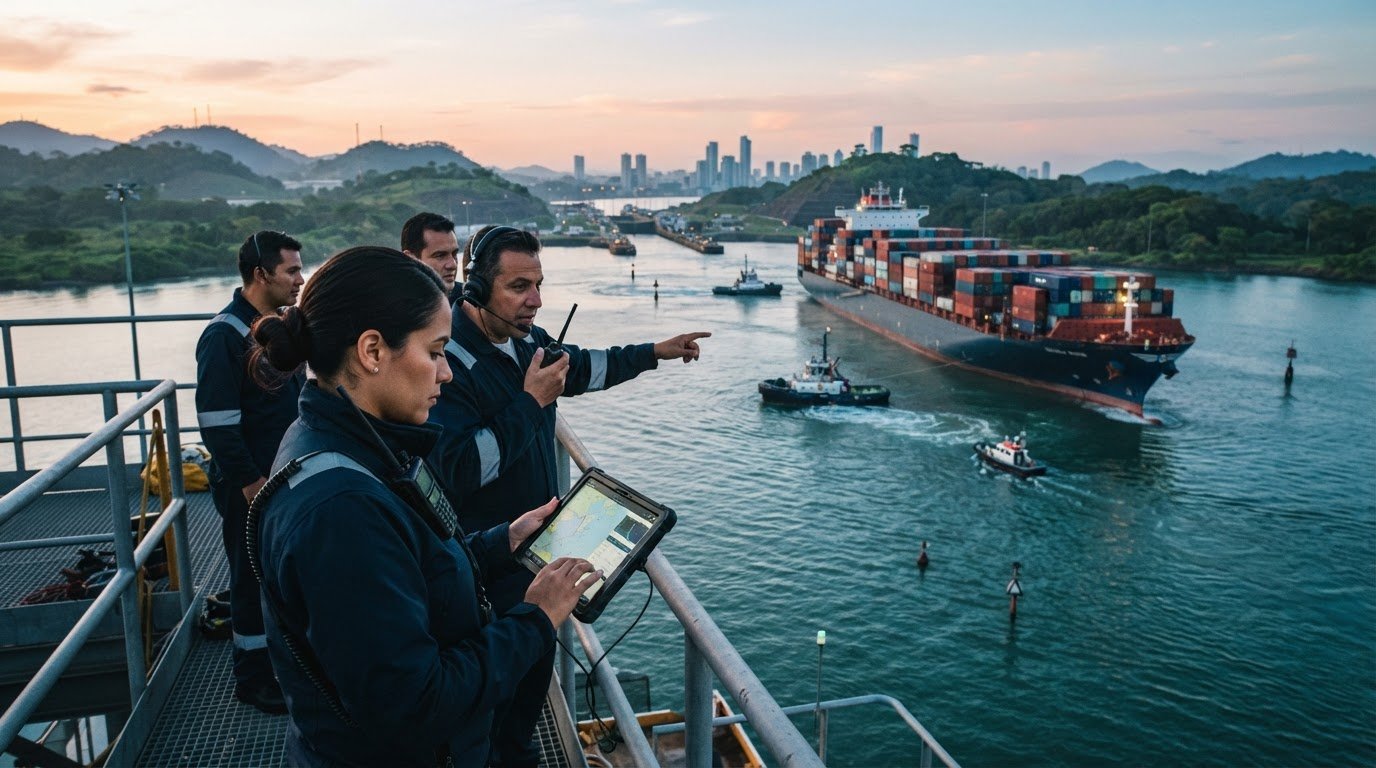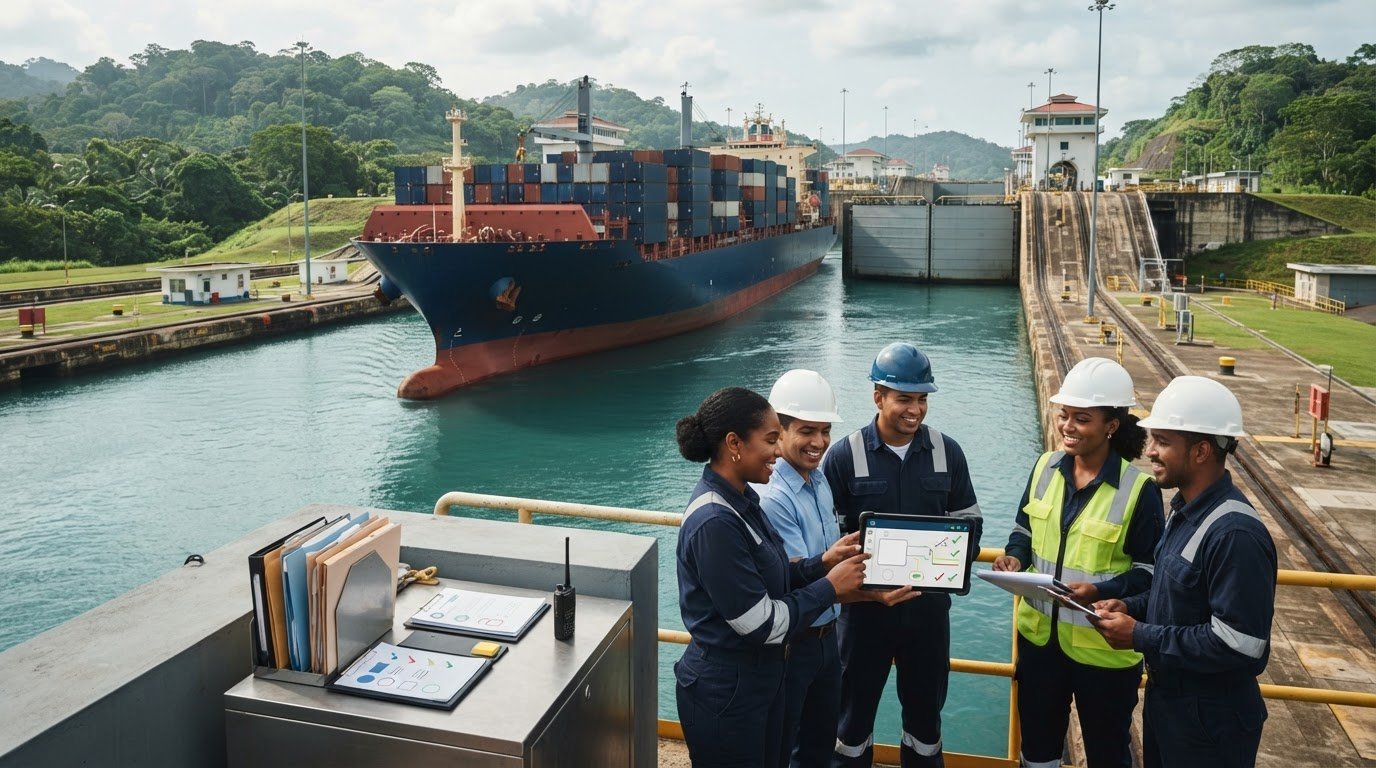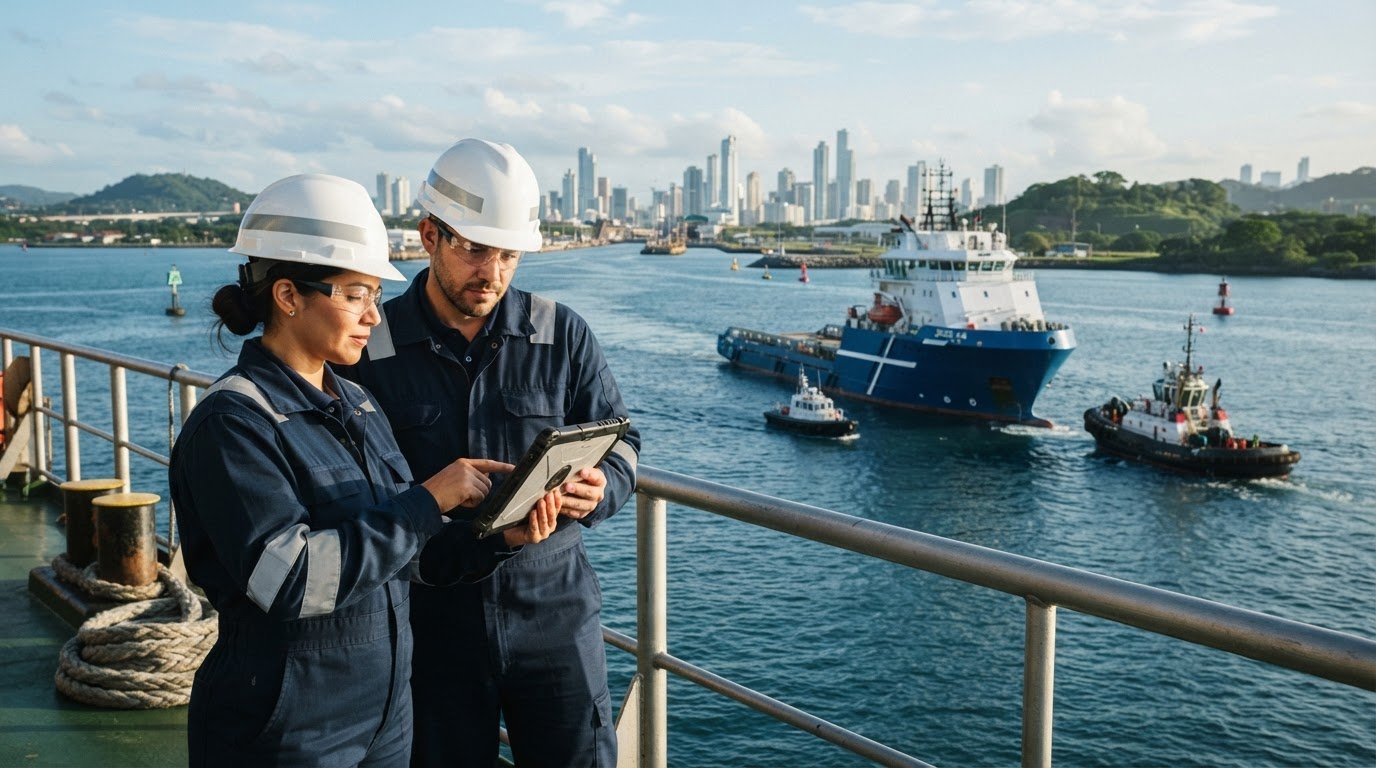

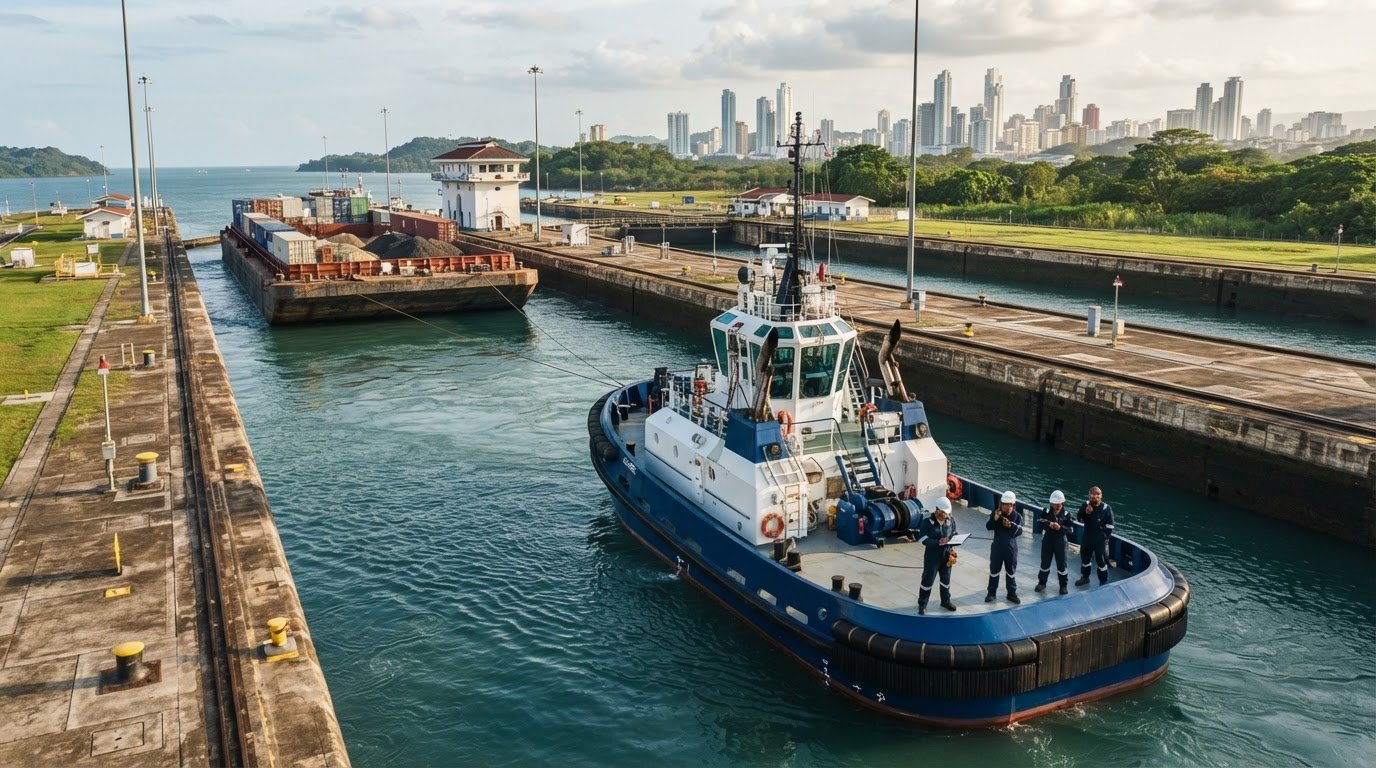
For anyone searching “ship agent for tugs and barges panama,” the key question is not just who can coordinate the transit, but who is responsible for each detail. Tow configuration and the planned movement affect what needs to be confirmed. Unclear responsibilities or incomplete documents can create avoidable uncertainty.
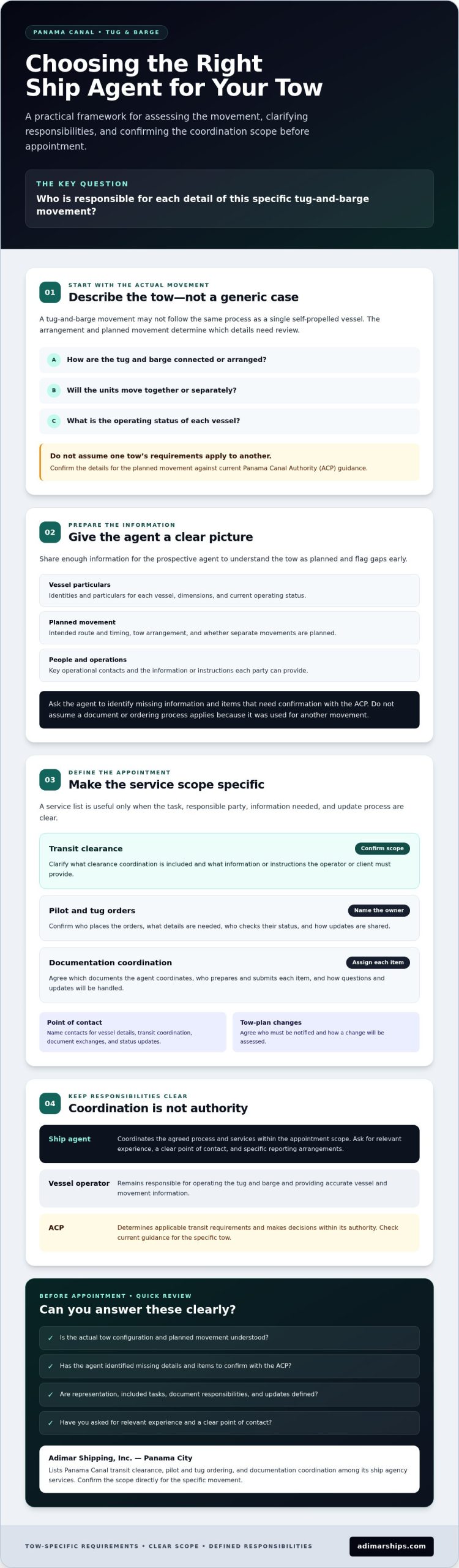
A local agent should understand the Panama Canal process and communicate clearly, but requirements for a tug-and-barge movement must be checked against the specific arrangement and current Panama Canal Authority requirements. Before appointing an agent, owners, charterers, and operators need to know what coordination is included, who the agent represents, what information is needed, and how updates will be shared.
This 2026 guide explains how to assess an agent’s fit for your planned transit, clarify the scope of representation, and prepare for a practical conversation before appointment. It also outlines how Adimar Shipping, Inc., based in Panama City, coordinates transit clearance, pilot and tug orders, and documentation, without assuming every tow has the same requirements.
Key Takeaways
- Assess the actual tug-and-barge configuration before discussing transit coordination. Requirements should be confirmed for the planned movement.
- Choose a ship agent for tugs and barges panama by how clearly they define scope, representation, communication, and reporting.
- Ask prospective agents for evidence of relevant experience and a clear point of contact, rather than relying on broad service claims.
- Prepare vessel and tow details, then ask the agent to identify missing information and requirements that need confirmation with the Panama Canal Authority.
- Compare your coordination needs with the agent’s confirmed services, including transit clearance, pilot and tug ordering, and documentation coordination.
Ship Agent for Tugs and Barges in Panama: What Does the Movement Require?
A ship agent is the local representative appointed to coordinate agreed vessel and transit requirements. For a tug-and-barge movement, start by describing the actual tow instead of assuming it follows the same process as a single self-propelled vessel. The connection between tug and barge, whether the units move together or separately, and the operating status of each can affect which details need review.
A ship agent for tugs and barges panama should be able to discuss the planned configuration and identify questions that need confirmation. The agent is not the vessel operator or the authority deciding whether a transit can proceed. The operator remains responsible for providing accurate vessel and movement information, while transit decisions and applicable requirements belong to the relevant authorities. Check current Panama Canal Authority (ACP) guidance for the specific tow and planned transit rather than relying on assumptions. The International Maritime Organization (IMO) provides broader international maritime context, but it does not replace ACP requirements for a Panama Canal movement.
Which details about the tug and barge should you provide?
Give the prospective agent enough information to understand the tow as planned. Prepare identities and particulars for each vessel, dimensions, current operating status, intended route and timing, and key operational contacts. Describe how the tug and barge will be arranged, including whether the plan involves separate movements. These details help the agent identify gaps early instead of treating the tow as a standard case.
Flag anything that depends on the configuration and needs confirmation. Don’t assume a requirement, document, or ordering process applies just because it was used for another vessel or movement. Ask the agent to identify missing information and items that need checking against current ACP guidance.
What does the local ship agent coordinate?
Depending on the appointment terms and the movement’s needs, ship agency coordination may include transit clearance, pilot and tug ordering, and inbound or outbound documentation coordination. Confirm in writing which tasks are included, who is responsible for supplying each document or instruction, and who will provide status updates.
Keep responsibilities clear. The agent coordinates the agreed process; the ACP determines applicable transit requirements and makes decisions within its authority. The vessel operator remains responsible for operating the tug and barge and providing accurate information. Adimar Shipping, Inc., based in Panama City, lists Panama Canal transit clearance, pilot and tug ordering, and documentation coordination among its ship agency services. Owners or charterers considering an appointment should confirm the scope for their specific movement directly with the agent.
Which Panama Agency Services Should Your Tug-and-Barge Transit Include?
Define the agency scope before appointment. A service list is useful only when it’s clear who performs each task, who supplies the information, and who keeps relevant parties informed. For a tug-and-barge movement, name a point of contact for vessel details, transit coordination, document exchanges, and status updates. If the tow plan changes, agree who must be notified and how the change will be assessed.
Confirm who is responsible for pilot and tug orders instead of assuming the operator, agent, or another party will place them. Ask what information the agent needs to coordinate the orders, who confirms their status, and how updates will reach the owner, charterer, and vessel contacts. The scope should reflect the actual configuration and appointment terms.
For broader context on the transit process, see this Panama Canal transit guide. A prospective ship agent for tugs and barges panama should explain how its confirmed services fit the planned movement and distinguish coordination from decisions made by the Panama Canal Authority (ACP).
How do transit clearance and documentation fit into the scope?
Agree which documentation the agent will coordinate and which records or instructions the vessel operator or client must provide. Clarify who prepares and submits each item, what review points are included in the agency appointment, and which communication channel will be used for questions and updates.
Don’t rely on a checklist from a different tow or a previous transit without checking whether it applies. Ask the agent to flag missing details and verify current documentation expectations for this movement with the relevant authority. Adimar Shipping, Inc. lists Panama Canal transit clearance and inbound and outbound documentation coordination among its ship agency services. Confirm the precise scope before appointment.
When might nominated agency or PCSOPEP support matter?
Make representation explicit. Establish whether the owner or charterer is appointing the agent, whose interests the agent represents, and how instructions from other parties will be handled. Adimar provides both owner’s and charterer’s nominated agency services, so the appointing party can clarify the intended representation when discussing the appointment.
Ask whether PCSOPEP authorized person services are relevant to the vessel’s circumstances, and confirm applicable requirements rather than assuming they apply to every movement. For background, consult the PCSOPEP authorized person guide. To discuss how Adimar’s confirmed agency services may fit your planned movement, visit Adimar Shipping’s website.
How to Compare Panama Ship Agents for a Tug-and-Barge Movement
Compare agents on how they’ll manage your specific movement, not on broad claims about local expertise. A useful discussion should show how the agent will handle unknowns about the tug-and-barge configuration: what needs checking, who will confirm it, and how the result will be communicated. Ask for relevant experience or examples that can be substantiated, while keeping the focus on your transit requirements.
Use this framework to assess each prospective ship agent for tugs and barges panama:
| Comparison point | What to confirm |
|---|---|
| Local presence | Where the agency is based and who will handle your movement locally. |
| Defined scope | Which tasks are included, excluded, or dependent on another party, including transit coordination and documentation. |
| Communication | Your named contact, agreed update cadence, communication channels, and escalation route if information or plans change. |
| Reporting and handoffs | How the agent will record task status, pass instructions between parties, and flag open questions or decisions. |
A clear answer doesn’t have to promise a particular transit outcome. It should explain what happens next when a tow detail is incomplete or a requirement needs confirmation. Ask how the agent will check applicable requirements for the stated arrangement, who will seek clarification from the relevant authority, and how you’ll be told if the plan or supporting information needs attention.
What questions reveal an agent’s operational fit?
Ask the agent to walk through a change, such as an updated tow arrangement or a missing document. Who receives the information? Who assesses whether it affects the agreed scope? Who escalates an unresolved question? Confirm these responsibilities, along with any tasks that depend on third parties, before appointment. Specific, practical answers are more useful than a general assurance that everything will be handled.
How can owners and charterers clarify representation?
Identify who is appointing the agent and whose instructions should guide the representation. Agree how approvals will work for disbursements, documentation, and operational decisions, including what requires client authorization and how conflicting instructions will be addressed. Owners considering this arrangement can read the owner’s nominated agency guide for more context. Put the agreed scope, contacts, and approval process in writing so each party understands the handoffs.
What to Confirm Before Appointing a Panama Tug-and-Barge Agent
A careful appointment starts with complete information and ends with a written scope. Use this checklist to identify gaps before responsibilities are divided. Ask the prospective agent to distinguish what it can coordinate from what requires operator input, action by a third party, or confirmation by the Panama Canal Authority (ACP). An agent cannot guarantee transit timing or an authority decision.
- Assemble vessel and tow particulars. Prepare accurate identities and particulars for the tug and barge, their dimensions, operating status, and planned tow arrangement. Include relevant vessel and shore-side contact details so the agency team knows who can clarify each item.
- Describe the planned movement. Share the intended route, timing, and known schedule constraints. Identify details that are provisional, such as an arrangement or timing still awaiting confirmation. This helps the agent assess the actual case instead of assuming a standard process.
- Request a gap check. Ask what additional information is needed for the proposed scope. Have the agent flag incomplete or unclear details and identify which configuration-specific requirements must be verified against current ACP guidance or with another relevant party.
- Record the appointment and representation. State who is appointing the agent, whether it represents the owner or charterer, and which contacts are authorized to give instructions or approvals. This reduces confusion if different parties give conflicting directions.
- Write down the scope and handoffs. List the agreed agency tasks, what is excluded, who supplies and coordinates documents, and where third parties are involved. Confirm how changes to the tow plan or scope will be raised, assessed, and approved before additional work proceeds.
- Set communication expectations. Name the primary contact and agree on channels and update cadence. Define how the agent will report schedule changes, document issues, unanswered questions, and operational handoffs, including how to escalate an issue that needs a decision.
Before appointment, ask the agent to summarize open items and assign a responsible party to each one. For example, identify a missing vessel detail as awaiting operator information, and mark an uncertain transit requirement for confirmation with the authority. This keeps coordination transparent without implying that an agent controls ACP decisions or vessel operations.
Adimar Shipping, Inc. is based in Panama City and provides ship agency services that include Panama Canal transit clearance, pilot and tug ordering, and inbound and outbound documentation coordination. Confirm the exact scope for your movement directly. To discuss your requirements with a ship agent for tugs and barges panama, contact Adimar Shipping about your planned transit.
Discuss Your Panama Tug-and-Barge Transit with a Local Ship Agent
The right agency fit depends on the details of your movement, not a general promise of support. Before appointing an agent, make sure the tug-and-barge configuration is understood, the proposed scope is clear, and each party knows its responsibilities. Agree how the agent will communicate updates and identify items that still need confirmation against current Panama Canal Authority requirements.
Adimar Shipping, Inc. is based in Panama City and provides ship agency services for Panama Canal transits. Its coordination includes transit clearance, pilot and tug ordering, and inbound and outbound documentation. These services may be relevant to a tug-and-barge movement, but discuss the precise scope and applicability for the specific arrangement. An agent coordinates agreed tasks; it doesn’t make authority decisions or guarantee transit timing or outcomes.
How can Adimar support a Panama Canal transit?
Owners and charterers can also discuss nominated agency options when representation is needed and clarify whose interests the appointed agent will represent. Adimar’s Panama City presence offers a local point of contact to discuss the planned movement and outstanding questions. Confirm communication channels and responsibilities directly rather than assuming a particular update schedule or result.
What should you include in an agency inquiry?
Give the agent a practical starting brief. Include:
- Tug and barge identities, particulars, dimensions, and tow arrangement.
- The planned route and expected timing, noting anything provisional.
- Your role as owner, charterer, operator, or representative, and who can provide instructions.
- The services you’re seeking, such as transit clearance or documentation coordination.
- Any unresolved operational or compliance questions, including items that may need confirmation with the authority.
This information helps the agency discuss whether its confirmed services fit the movement and identify what else it needs to assess the proposed scope. A clear initial exchange can also surface questions about document responsibilities, contacts, and changes to the plan before appointment.
If you’re assessing a ship agent for tugs and barges panama, share the tow details and ask for a movement-specific discussion of scope, responsibilities, and open requirements. Discuss your Panama transit with Adimar Shipping.
Set Up Your Panama Transit with a Clear Agency Scope
A suitable ship agent for tugs and barges panama should understand the planned tow configuration, explain which coordination tasks are included, and make responsibilities and communication clear. Before appointment, share accurate tug and barge details, identify open questions, and confirm applicable requirements for the specific movement with the Panama Canal Authority.
Adimar Shipping, Inc. is based in Panama City and coordinates Panama Canal transit clearance, pilot and tug ordering, and inbound and outbound documentation. It also offers owner’s and charterer’s nominated agency services, helping the appointing party clarify whose interests the agent represents. Discuss the precise scope for your movement instead of assuming every tow has the same requirements or outcome.
Share your vessel particulars, planned timing, role, requested services, and unresolved questions to start a focused conversation. Discuss your Panama tug-and-barge transit with Adimar Shipping and take the next step with a clearer view of what needs coordination. Identifying responsibilities and open items early can help your team move forward with greater confidence.
Frequently Asked Questions
Do tugs and barges need a ship agent for Panama Canal transit?
A ship agent can coordinate agreed local transit tasks, documentation, and communications, but don’t assume every movement legally requires a particular agent. The vessel operator should confirm current Panama Canal Authority (ACP) requirements for the tug, barge, tow arrangement, and planned transit, and agree on the agency scope. The agent coordinates assigned work; the ACP makes authority decisions, while the operator remains responsible for vessel operations.
What does a ship agent do for a tug-and-barge transit in Panama?
A Panama ship agent may coordinate transit clearance, pilot and tug ordering, and inbound or outbound documentation, depending on the appointment and movement. Before engagement, put in writing which party supplies each document, who makes operational decisions, and who communicates schedule changes or unresolved questions. For a tow, confirm the tasks against its actual configuration. Agency coordination doesn’t replace operator responsibilities or decisions reserved to the relevant authority.
How do I choose a ship agent for tugs and barges in Panama?
Choose a ship agent for tugs and barges panama by comparing local presence, a written scope, communication and reporting arrangements, and evidence supporting relevant experience. Ask how the agent will confirm requirements for your exact tow instead of relying on general assurances. Clarify the named contact, escalation path, represented party, approval process, and any third-party dependencies. Compare specific written answers, not just claimed experience or a broad service list.
What information should I send a Panama ship agent before a tug-and-barge transit?
Send accurate particulars for both vessels, their tow configuration, planned movement and expected timing, along with operator and client contacts. Include known constraints, and clearly label estimates or details still awaiting confirmation. Ask the agent what additional information or documents its proposed scope requires and what needs checking with the ACP. Update the agent if material details change so everyone is working from the current movement plan.
Can a Panama ship agent order pilots and tugs for a barge movement?
Adimar Shipping, Inc.’s stated ship agency services include pilot and tug ordering as part of transit coordination. Whether and how those orders apply to a particular barge movement depends on its configuration and current requirements. Confirm the exact scope with the prospective agent and relevant authority. Ask who places each order, what information is needed, and how confirmations or changes will be communicated to the vessel operator.
What is the difference between an owner’s and charterer’s nominated agent?
An owner’s nominated agent represents the owner’s interests, while a charterer’s nominated agent represents the charterer’s interests. In either arrangement, agree on the scope, authorized instructions, approvals, contacts, and reporting expectations before appointment. For a tug-and-barge transit, also clarify how the agent will coordinate with other parties involved in the movement. Adimar Shipping, Inc. offers both owner’s and charterer’s nominated agency services.