
A single clerical error on your pre-arrival documentation can now trigger a $15,000 fine before your vessel even reaches the locks. Under the updated OP NOTICE TO SHIPPING N-12-2026, the Panama Canal Authority (ACP) has intensified its scrutiny of every VUMPA submission through real-time database validation. You likely already feel the weight of these high stakes, where missing the strict 96-hour notification window results in immediate financial sanctions. Avoiding PCSOPEP non-compliance penalties Panama Canal is no longer just about completing paperwork; it requires constant local vigilance and technical precision.
We understand that managing these logistical hurdles is stressful for busy ship owners and operators. This 2026 guide provides a clear roadmap to navigate these complex regulations and avoid the $50,000 penalty for arriving without an approved plan. You’ll learn how to correctly classify your vessel within the Tier 1 to Tier 4 system and secure the necessary ACP-approved representation. We also explain why delegating these tasks to a reliable local partner ensures a seamless transit while protecting your vessel from the risk of costly slot forfeitures.
Key Takeaways
- Learn how to avoid the $50,000 administrative penalty for arriving without an approved plan and the $15,000 fine for minor clerical errors.
- Identify your vessel’s specific Tier classification to ensure accurate tariff payments and the mobilization of required oil pollution response resources.
- Understand why a standard MARPOL SOPEP is insufficient and how to appoint a resident Authorized Person (AP) to meet Panama Canal legal requirements.
- Follow a proven roadmap to mitigate PCSOPEP non-compliance penalties Panama Canal by strictly adhering to the 96-hour pre-arrival notification window.
- Discover the operational benefits of delegating complex ACP documentation to a local expert who provides 24/7 coordination and vigilant on-the-ground oversight.
The Financial Risks of PCSOPEP Non-Compliance in 2026
Vessels approaching the Panama Canal face a regulatory environment that is stricter than ever. If your ship has an oil carrying capacity of 400 metric tons or more, you must have a Panama Canal Shipboard Oil Pollution Emergency Plan (PCSOPEP) in place. This requirement isn’t just a suggestion; it’s a mandatory legal standard. While many operators are familiar with the standard Shipboard Oil Pollution Emergency Plan (SOPEP) required by MARPOL, the ACP demands a localized version that addresses Panama’s specific environmental and legal framework. This plan must be verified and acknowledged by the Authority long before your vessel reaches the breakwater.
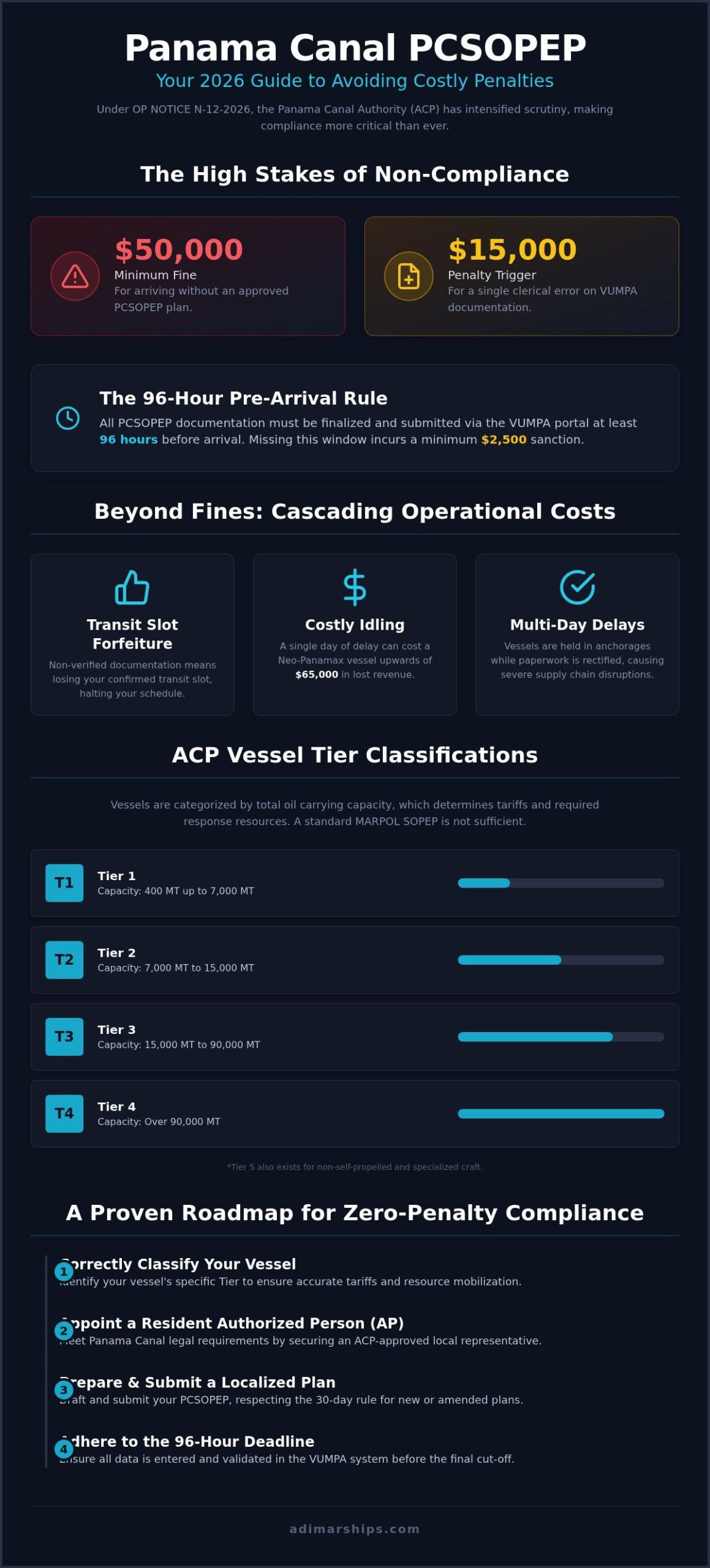
Failure to meet these standards leads to immediate PCSOPEP non-compliance penalties Panama Canal. The baseline administrative fine for minor clerical errors on documentation starts at $15,000. If a vessel arrives without an approved plan entirely, that fine jumps to a minimum of $50,000. These figures represent direct costs, but they’re often just the beginning of the financial fallout for a shipping company. The ACP maintains a zero-tolerance policy, and even a single missing signature can halt your transit schedule indefinitely.
Direct Fines vs. Indirect Transit Costs
The ACP doesn’t just issue a ticket and let you pass. A rejected plan or a late submission triggers a cascade of operational failures that impact your bottom line. To avoid PCSOPEP non-compliance penalties Panama Canal, operators must look beyond the initial fine and calculate the cost of a stalled supply chain. Consider these frequent financial traps:
- Administrative surcharges: Minimum sanctions of $2,500 apply for late notifications or missing the mandatory data entry window.
- Transit Slot Forfeiture: If your documentation isn’t verified, you lose your slot. For a Neo-Panamax vessel, a single day of idling can cost upwards of $65,000 in lost revenue.
- Congestion at Miraflores: Vessels with non-compliant plans are often held in designated anchorages, causing multi-day delays while a local representative scrambles to rectify the paperwork.
Drafting a plan under these high-pressure conditions is expensive and risky. It’s much safer to have a verified plan, which remains valid for four years, settled well in advance.
The 96-Hour Pre-Arrival Notification Rule
Timing is everything in canal logistics. The ACP requires all PCSOPEP documentation to be finalized and submitted through the VUMPA portal at least 96 hours before arrival. This window allows the ACP to validate certificate numbers against international databases in real-time using automated systems. If your vessel is already in transit and requires a plan update, you must still respect the 30-day submission rule for new or amended plans to ensure they’re active by the time you hit the 96-hour mark.
The 96-hour rule is the absolute deadline for ACP data entry. Missing this window almost guarantees a minimum sanction of $2,500 and puts your transit schedule at the mercy of the Authority’s inspectors. By delegating this coordination to a local expert, you ensure that every timestamp is met and every document is machine-validated before it reaches the ACP’s desk.
Decoding ACP Tier Classifications and Requirements
The Panama Canal Authority (ACP) uses a tiered system to categorize vessels based on their potential environmental impact. This isn’t just a bureaucratic exercise; it determines the specific response resources you must have on standby. While international maritime pollution regulations provide a global framework for spill prevention, the ACP’s localized tiers are much more stringent. Miscalculating your vessel’s tier is a fast track to PCSOPEP non-compliance penalties Panama Canal, as each level carries different tariff rates and operational requirements.
As of 2026, the ACP classifies vessels into four primary tiers based on their total oil carrying capacity. Tier 1 covers vessels with a capacity of 400 MT up to 7,000 MT. Tier 2 includes larger vessels ranging from 7,000 MT to 15,000 MT. Tier 3 is reserved for ultra-large vessels with capacities between 15,000 MT and 90,000 MT, while Tier 4 applies to any vessel exceeding 90,000 MT. Additionally, Tier S is used for non-self-propelled craft and specialized small vessels. Each jump in tier increases your transit tariffs, ranging from $660 for Tier 1 to $2,000 for Tier 4 per transit.
Calculating Your Total Oil Carrying Capacity
Accurate data entry is the only way to avoid unnecessary fines. You must calculate the sum of all oil on board, including fuel oil, lube oil, and any petroleum-based cargo. Many operators make the mistake of only counting cargo, but the ACP views every drop as a potential spill risk. The Panama Canal Authority (ACP) cross-references your VUMPA submissions with your vessel’s technical blueprints in real-time. If there’s a discrepancy between your reported tonnage and your actual capacity, the resulting clerical error fine can start at $15,000.
Equipment and Personnel Readiness for Each Tier
Higher tiers require more than just higher fees; they demand proof of response readiness. For Tier 2 and Tier 3 vessels, you must have active contracts with local Oil Spill Response Organizations (OSROs) that have equipment stationed within Panama. Your PCSOPEP must detail how these personnel will be mobilized within the canal’s specific geography, including the locks and Gatun Lake. Securing expert local coordination ensures your response plan is fully compliant with the latest 2026 standards, protecting you from transit denials. Our team acts as your vigilant eyes on the ground, verifying that every contractual requirement is met before your vessel enters canal waters.
Why Your Global MARPOL SOPEP Is Not Enough
Many technical managers assume that a standard MARPOL-compliant SOPEP covers their needs globally. This is a dangerous misconception when approaching the Isthmus. While a global plan handles general high-seas emergencies, the Panama Canal Authority (ACP) requires a localized response strategy known as the PCSOPEP. Relying solely on a global plan is a primary cause of PCSOPEP non-compliance penalties Panama Canal, as the ACP demands proof of immediate, on-the-ground resource availability that a standard SOPEP simply doesn’t provide.
The ACP’s requirements focus on the unique ecological sensitivity of the canal’s freshwater locks. Because the canal is a critical source of drinking water for the local population, the margin for error is zero. You must demonstrate access to localized response resources, including pre-contracted clean-up organizations (OSROs) with equipment stationed within Panama’s borders. The ACP also mandates specific localized funding mechanisms and financial guarantees to ensure that any emergency expenditure is authorized instantly without waiting for overseas wire transfers.
Key Differences in Notification Protocols
Standard MARPOL protocols usually focus on notifying the nearest coastal state. However, a Panama Canal transit involves a much more complex and specialized communication chain. Your plan must include the ACP Operations Center as a primary contact and outline how the Vessel Master will coordinate with local authorities during a spill. Failure to include these specific contacts in your documentation will result in a rejected filing.
For 2026, the ACP has updated its mandatory contact lists. Your PCSOPEP must reflect these changes to pass the machine-validation stage of the VUMPA portal. Every emergency drill conducted on board must now explicitly include the ACP Operations Center to ensure that your crew is familiar with the localized reporting structure. This level of detail is what separates a compliant plan from one that triggers costly delays.
The Necessity of a Panama-Based Authorized Person
The most significant gap in a standard SOPEP is the absence of an Authorized Person (AP). The ACP requires every vessel to appoint a resident of Panama who holds the legal authority to act on behalf of the ship owner. This individual or agency serves as the 24/7 liaison between the Vessel Master and the ACP during an incident. They’re your vigilant representative on the ground, ensuring that communication remains transparent and efficient.
A pcsopep authorized person isn’t just a name on a document. They must have the financial authority to authorize emergency expenditures immediately. Without a qualified, Panama-based AP, your vessel will be denied entry, triggering the PCSOPEP non-compliance penalties Panama Canal that can derail your entire operational budget. Delegating this role to an experienced local partner provides the security needed to navigate these technical requirements with total confidence.
A 5-Step Roadmap to Secure Your Approved PCSOPEP
Securing approval for your oil pollution plan is a technical process that demands absolute precision. While the previous sections established the financial risks and tier requirements, this roadmap outlines the specific actions needed to ensure your vessel is cleared for transit. Following these steps systematically is the most effective way to avoid PCSOPEP non-compliance penalties Panama Canal and keep your operations on schedule.
- Step 1: Data Gathering: Collect all necessary vessel identity documents, including the International Tonnage Certificate (ITC-69) and the International Oil Pollution Prevention (IOPP) certificate. You’ll also need detailed vessel blueprints to facilitate spill trajectory modeling.
- Step 2: Appoint an Authorized Person: You must secure a local partner in Panama to act as your legal representative. This individual or agency must be resident in Panama and have the authority to authorize emergency response expenditures.
- Step 3: Plan Drafting: Your response protocols must be customized to your specific vessel Tier. A Tier 3 vessel, for instance, requires much more extensive resource mobilization plans than a Tier 1 craft.
- Step 4: ACP Submission: All documentation is uploaded through the VUMPA digital filing system. The ACP’s automated tools validate your data against international registries in real-time.
- Step 5: Confirmation and Fee Settlement: Once the ACP issues a “Notice of Acknowledgement,” you must settle the required tariffs. These range from $660 to $2,000 depending on your classification.
Documentation Required for a Successful Submission
The ACP’s verification process is rigorous. Beyond basic vessel stats, you must provide signed Authorized Person acceptance letters that include 24-hour contact details. The Authority also requires specific technical drawings that show the location of all oil tanks. If these blueprints are outdated or missing, your submission will be rejected, potentially triggering the PCSOPEP non-compliance penalties Panama Canal associated with late filings. Accuracy at this stage prevents the $15,000 clerical error fine discussed earlier.
The Timeline for Approval and Renewal
Starting this process early is critical. Industry best practice is to begin data gathering at least 30 days before your scheduled arrival. This buffer allows for any necessary plan amendments or document clarifications. Once approved, your plan’s Notice of Acknowledgement remains valid for four years, provided there are no significant changes to the vessel’s oil carrying capacity. Partnering with an experienced ship agency in Panama accelerates this approval process by ensuring every document meets local standards on the first attempt. If you need immediate assistance with your 2026 filings, you can contact our specialized team to secure your Authorized Person representation today.
Partnering with Adimar Shipping, Inc. for Zero-Penalty Compliance
Delegating your compliance tasks to a regional expert eliminates the uncertainty of canal transit. Adimar Shipping, Inc. provides end-to-end management of the PCSOPEP process, from the initial technical drafting to the final ACP submission. We act as your vigilant representative in Panama City, ensuring your vessel meets every technical requirement of the 2026 regulations. By integrating this oversight with our broader husbandry services, we create a unified transit strategy that prioritizes operational speed and regulatory safety. Our “zero-clerical-error” philosophy is designed specifically to protect your fleet from the avoidable $15,000 fines that often plague less experienced operators.
Our team serves as your resident Authorized Person (AP), providing the 24/7 legal liaison required by the Authority. This role is a critical safeguard. We maintain the financial authority and technical knowledge to authorize emergency responses instantly, preventing the PCSOPEP non-compliance penalties Panama Canal that arise from communication delays. We function as a seamless extension of your own team, monitoring every VUMPA update to ensure your vessel’s status remains “Approved” well before it reaches the breakwater.
Why Experience Matters in Panama Canal Compliance
Decades of localized expertise in Chapter IX maritime regulations allow us to navigate ACP disputes with total confidence. We have a proven track record of managing complex response plans for Tier 2 and Tier 3 ultra-large vessels, which face the highest levels of scrutiny. Our deep roots in the Panama maritime sector mean we maintain direct, professional communication with ACP authorities. This relationship allows us to resolve documentation discrepancies quickly, often before they escalate into formal sanctions or transit denials. We understand the high stakes of the industry and the financial importance of maintaining your scheduled slot.
Secure Your 2026 Transit Compliance Today
Preparing for the 2026 regulatory shift requires proactive planning rather than reactive fixes. You can request a comprehensive PCSOPEP audit for your fleet to identify potential gaps in your current documentation or Tier classifications. Onboarding your vessel with Adimar Shipping, Inc.’s Authorized Person services is a straightforward process designed to alleviate the stress of logistical coordination. Let our experts handle the technical burden of ACP filings while you maintain your operational freedom. Our goal is to provide the security and reliability you need for a smooth transit every time.
Secure Your PCSOPEP Compliance with Adimar Shipping, Inc.
Secure Your Transit with Expert Local Vigilance
Navigating the Panama Canal in 2026 demands more than just operational skill; it requires a proactive approach to localized environmental regulations. Avoiding PCSOPEP non-compliance penalties Panama Canal isn’t just about paperwork. It’s about recognizing that a standard global SOPEP won’t meet the ACP’s strict Chapter IX standards. You must accurately classify your vessel’s Tier and strictly adhere to the 96-hour notification window to prevent $15,000 clerical error fines or costly transit delays. Delegating these complex technical filings to a resident expert ensures your documentation is machine-validated and ACP-compliant long before you reach the breakwater.
Adimar Shipping acts as your vigilant eyes on the ground. We provide ACP-recognized Authorized Person services backed by a zero-clerical-error guarantee and 24/7 emergency response coordination. Our team simplifies the technical burden, allowing you to focus on your core maritime operations while we manage the legal and financial liaison with the Authority. Secure Your PCSOPEP Compliance with Adimar Shipping and ensure your next transit is efficient, secure, and entirely penalty-free. We’re ready to protect your interests in Panama.
Frequently Asked Questions
Can I use my standard MARPOL SOPEP for a Panama Canal transit?
No, you can’t use a standard MARPOL SOPEP as a substitute for the localized PCSOPEP. The Panama Canal Authority (ACP) requires a plan specifically tailored to the canal’s geography, including local emergency contacts and pre-contracted response resources. Relying on a global plan is a frequent cause of PCSOPEP non-compliance penalties Panama Canal, as it lacks the mandatory local Authorized Person (AP) designation.
What is the exact fine for a missing PCSOPEP plan in 2026?
Arriving in canal waters without an approved plan triggers a minimum administrative fine of $50,000. Beyond this initial penalty, the ACP imposes sanctions starting at $15,000 for minor clerical errors or documentation discrepancies. These fines are designed to ensure total compliance with environmental safety standards before a vessel is allowed to enter the locks.
Does the Authorized Person (AP) have to be a resident of Panama?
Yes, the Authorized Person must be a resident of Panama with full legal authority to act on your behalf. This individual or agency serves as your 24/7 liaison with the ACP and must be fluent in English or Spanish. Crucially, they must have the financial authority to authorize immediate emergency expenditures for spill response without waiting for overseas approval.
How do I determine if my ship is Tier 1, Tier 2, or Tier 3?
Your classification is determined by the vessel’s total oil carrying capacity, which includes fuel oil, lube oil, and petroleum cargo. Tier 1 covers vessels from 400 MT up to 7,000 MT. Tier 2 applies to capacities between 7,000 MT and 15,000 MT, while Tier 3 is for vessels between 15,000 MT and 90,000 MT. Anything above 90,000 MT falls into Tier 4.
What is the 96-hour rule for PCSOPEP submission?
The 96-hour rule is the mandatory deadline for submitting all PCSOPEP documentation through the VUMPA portal before your vessel arrives in canal waters. The ACP uses this window to machine-validate your data against international databases. Missing this submission window results in a minimum sanction of $2,500 and often leads to the forfeiture of your scheduled transit slot.
How long is an approved PCSOPEP plan valid for?
An approved plan’s Notice of Acknowledgement is valid for four years from the date of issue. You don’t need to resubmit the entire plan for every transit unless there are changes to the vessel’s ownership, name, or oil carrying capacity. We recommend a documentation audit every two years to ensure your contact lists remain current with 2026 regulatory updates.
What happens if my vessel’s oil capacity changes mid-transit?
If your capacity changes due to modifications or operational shifts, you must submit an amended plan to the ACP. These amendments must be filed at least 30 days before the vessel intends to transit under the new configuration. Arriving with a plan that doesn’t match your vessel’s actual capacity is considered a serious documentation error and triggers PCSOPEP non-compliance penalties Panama Canal.
Can my Panama Canal ship agent also serve as my Authorized Person?
Yes, your ship agent can serve as your Authorized Person if they are recognized by the ACP and meet all residency and financial requirements. Adimar Shipping provides this integrated service to simplify your coordination. We act as your proactive partner on the ground, managing your husbandry needs while ensuring your pollution response plan is fully compliant and ready for inspection.