

A single administrative oversight in your 96-hour pre-arrival notification can trigger an immediate $2,500 fine and halt your vessel’s transit before it even begins. You likely feel the mounting pressure of meeting these rigid deadlines while managing complex maritime regulations. It’s frustrating to navigate the gap between a standard SOPEP and the specific, mandatory requirements of the Panama Canal Authority. You need more than just a contact name on a document; you need a proactive partner on the ground who understands the high stakes of your schedule.
That is why choosing a PCSOPEP authorized person who acts as your vigilant local guardian is the most critical decision you’ll make before reaching the locks. In this guide, you will learn how to select a reliable representative to ensure full compliance and avoid the financial sting of transit-halting errors. We will examine the 2026 regulatory updates, the strict residency requirements for authorized persons, and how a dedicated local expert secures your operational freedom by handling all technical communication with the ACP on your behalf.
Key Takeaways
- Understand why vessels with an oil capacity of 400 MT or more need a Panama-resident representative to comply with ACP Notice N-12-2026.
- Streamline the process of choosing a PCSOPEP authorized person by looking for a partner with a proven local network and immediate response times.
- Protect your bottom line by avoiding $2,500 fines and costly delays through strict adherence to the 96-hour pre-arrival submission deadline.
- Learn how a vigilant local agent acts as an extension of your team, handling all technical coordination to ensure zero delays during transit.
- Move beyond basic compliance to achieve operational freedom by delegating complex logistical tasks to a specialist with deep local knowledge.
Understanding the PCSOPEP Authorized Person (AP) Role
The Authorized Person (AP) serves as your vessel’s legal and operational anchor in the Republic of Panama. Under the Panama Canal Authority (ACP) regulations, specifically Notice to Shipping N-12-2026, every commercial vessel meeting certain criteria must appoint a resident representative. This individual or entity acts as the primary point of contact for all matters relating to the Panama Canal Shipboard Oil Pollution Emergency Plan (PCSOPEP). When choosing a PCSOPEP authorized person, you’re securing a partner who handles the legal liability of spill response coordination and ensures your documentation meets the ACP’s exacting standards. While many owners are familiar with the standard MARPOL SOPEP, the Panama Canal requirements are far more stringent and geographically specific. The PCSOPEP framework mirrors the rigorous standards established by the Oil Pollution Act of 1990, ensuring that any potential incident within the Canal’s delicate ecosystem is met with immediate action.
Why the ACP Requires a Local Representative
The ACP mandates a local representative because distance is the enemy of effective emergency response. When an incident occurs, the ACP requires a liaison who is physically present in Panama and available 24/7/365. This person isn’t merely a messenger; they’re legally empowered to activate the shipboard plan and coordinate with local response organizations. Key responsibilities include:
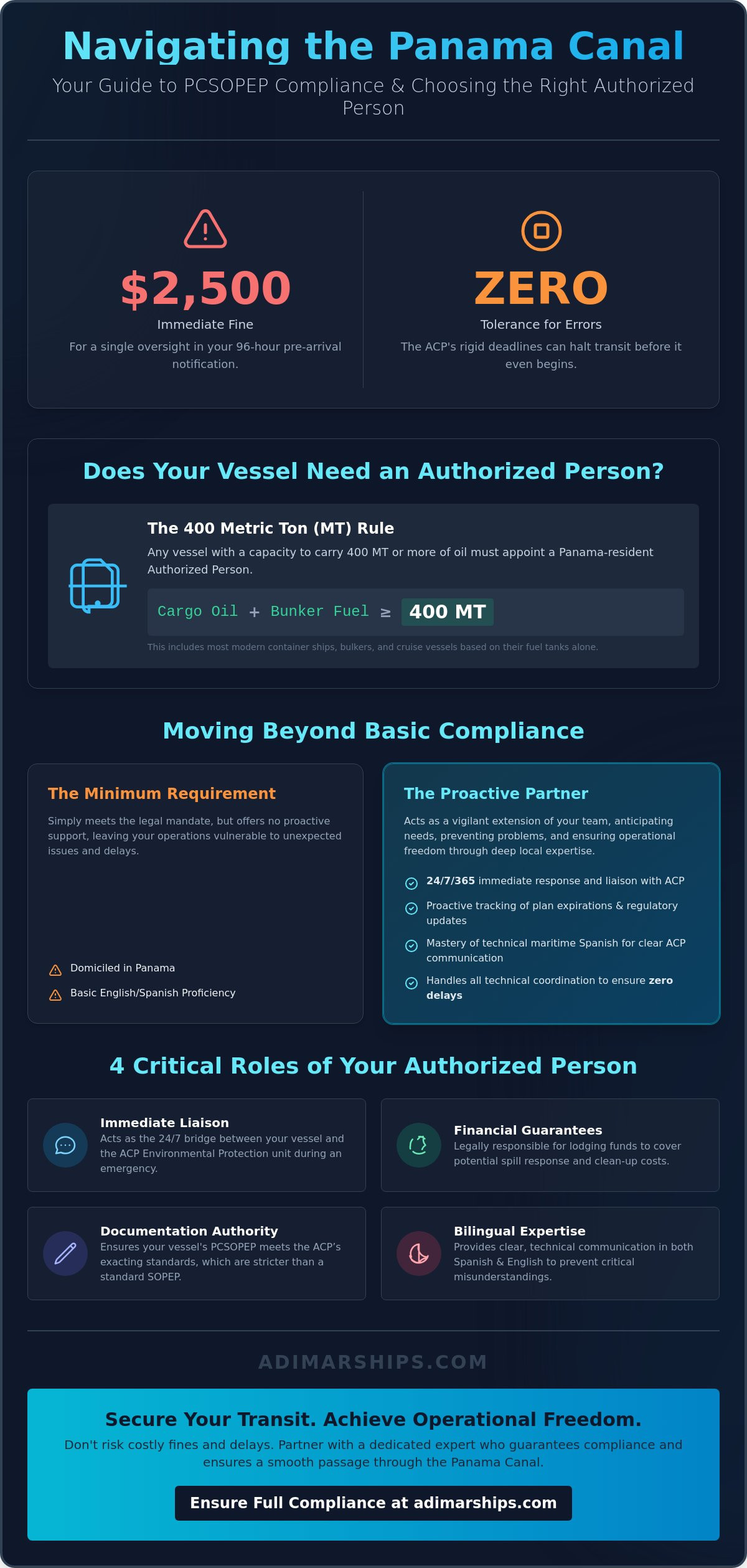
- Immediate Liaison: Acting as the bridge between the vessel’s master and the ACP Environmental Protection unit during an emergency.
- Financial Guarantees: Responsibility for lodging the necessary financial guarantees to cover spill response and clean-up costs.
- Bilingual Proficiency: Ensuring clear, technical communication in both Spanish and English to prevent misunderstandings with Canal authorities.
The 400 MT Rule: Does Your Vessel Qualify?
Many owners mistakenly believe that only tankers carrying bulk oil cargo need an Authorized Person. This is a costly misconception. The ACP applies the 400 metric ton (MT) threshold to any vessel with a carrying capacity of 400 MT or more of oil, which includes both cargo and bunker fuel. Most modern container ships, bulkers, and cruise vessels easily exceed this limit based on their fuel tanks alone. The process of choosing a PCSOPEP authorized person requires a clear understanding of these capacity limits to ensure your vessel remains compliant before reaching Canal waters. The 400 MT threshold serves as the definitive trigger for the mandatory appointment of an Authorized Person and the submission of a verified PCSOPEP.
Mandatory Qualifications vs. Operational Excellence
The process of choosing a PCSOPEP authorized person involves evaluating more than just a business license. Meeting the legal minimum is only the starting point for a secure transit. While the Panama Canal Authority (ACP) requires your Authorized Person (AP) to be domiciled in the Republic of Panama and proficient in both English and Spanish, these basic qualifications don’t guarantee a smooth passage. Operational excellence requires a partner who understands the nuances of the latest ACP Notices to Shipping and maintains a 24/7/365 response capability. In a high-stakes environment where a single delay can cost upwards of $65,000 in lost revenue, your representative must be more than just a name on a document. They must be a proactive expert who anticipates regulatory shifts before they impact your schedule.
Beyond the Regulatory Minimum
Simply “being local” isn’t enough to manage the complexities of modern maritime logistics. When you’re choosing a PCSOPEP authorized person, you’re looking for a vigilant partner who acts as a seamless extension of your own operations team. A superior AP doesn’t wait for you to ask about compliance; they provide proactive notifications regarding plan expirations or changes in vessel Tier classifications. Since a PCSOPEP Notice of Acknowledgement is typically valid for four years, a reliable partner tracks these dates meticulously to prevent last-minute transit forfeitures. This level of oversight ensures that your vessel remains in full compliance with the ACP’s automated tracking systems, such as the Maritime Service Portal (VUMPA).
The Importance of Bilingual Expertise
Effective communication in the maritime sector goes beyond basic conversation. It requires a deep mastery of technical Spanish terminology used by ACP environmental and port authorities. During an incident or a routine audit, details can easily be lost in translation, leading to administrative friction or unnecessary fines. Your AP must bridge the gap between international ship owners and local Panamanian officials with precision. This bilingual proficiency is essential for navigating the 2026 regulatory changes, including the revised initial incident notification forms that require specific data fields. By delegating these complex interactions to a specialist, you gain the operational freedom to focus on your core business. If you’re looking for a partner with this level of local expertise, consider how a dedicated ship agency can simplify your compliance journey.
4 Critical Factors for Choosing Your PCSOPEP Authorized Person
When you’re choosing a PCSOPEP authorized person, you need a vetting framework that goes beyond a simple price comparison. A low-cost provider often lacks the infrastructure to handle the high-stakes coordination required during a transit emergency. You’re not just buying a signature; you’re securing a vigilant partner who understands the nuances of the Panama Canal Authority (ACP) regulations. To ensure your vessel moves through the locks without administrative friction, evaluate potential partners against these four critical pillars of service.
- Local Reputation and Network: Does the firm have established, professional relationships with ACP officials? A well-connected representative can resolve minor documentation discrepancies before they escalate into formal sanctions.
- Response Speed: Time is your most expensive commodity. A reliable Authorized Person (AP) should respond to technical inquiries within the same business day, ensuring your team isn’t left waiting for clarification on 2026 regulatory updates.
- Integrated Service Portfolio: Efficiency improves when your AP can also handle husbandry and agency duties. This holistic approach reduces the number of parties involved in your transit logistics.
- Ethical Standards: Transparency in fee structures and compliance management is non-negotiable. Ethical conduct ensures that your vessel’s reputation remains intact with Panamanian authorities.
Vetting the Local Network
The role of the AP extends far into the local maritime ecosystem. Your representative must coordinate seamlessly with certified Oil Spill Removal Organizations (OSRO) to ensure that response equipment is ready if needed. They also act as a bridge to local port facility security, managing the complex logistics of personnel and supply movements. Choosing a PCSOPEP authorized person with a broad service reach allows you to consolidate your needs. For instance, finding an expert who understands this local landscape is easier when you consult a guide on ship husbandry services in Panama to see how these roles overlap for maximum efficiency.
Evaluating Administrative Efficiency
Administrative speed is a safety feature, not just a convenience. The ACP’s strict 96-hour rule for plan submission means that even a small delay in paperwork can lead to a forfeited transit slot. A proactive AP maintains a systematic tracking system for your vessel’s International Oil Pollution Prevention (IOPP) and International Pollution Prevention (IPP) certificates. They ensure these documents are signed and valid well before the 96-hour window opens. Administrative delays in Panama often translate directly to expensive fuel waste. By delegating these technical checks to a specialist, you prevent the stress of last-minute corrections and ensure your vessel arrives in Panama Canal waters ready for immediate transit.
Avoiding Common Compliance Pitfalls and Fines in 2026
Compliance in the current regulatory environment is not a one-time event; it’s a state of constant readiness. The Panama Canal Authority (ACP) maintains a zero-tolerance policy regarding the 96-hour notification window, where even a minor clerical error can trigger an immediate minimum sanction of $2,500. When choosing a PCSOPEP authorized person, you aren’t just hiring a consultant to file paperwork. You’re appointing a vigilant guardian who monitors the Maritime Service Portal (VUMPA) in real-time to ensure your vessel’s status remains “compliant.” A single administrative oversight, such as an outdated signature or an incorrect Tier classification, can lead to fines exceeding $50,000 and the mandatory forfeiture of your transit slot. This level of financial and operational risk demands a representative who proactively manages your plan resubmissions long before your certificates expire.
The Real Cost of Transit Delays
While the initial fines are frustrating, the true cost of non-compliance lies in the secondary expenses of a stalled schedule. A Neo-Panamax vessel can lose upwards of $65,000 in daily revenue for every 24 hours it’s held in a compliance hold-up. These delays ripple through your entire logistics chain, impacting fuel consumption and port arrival windows. A proactive Authorized Person (AP) prevents the “non-compliance” tag from ever reaching the ACP by identifying document discrepancies weeks in advance. For a broader perspective on how these requirements fit into your overall schedule, consult our Panama Canal transit guide to optimize your operational planning.
Staying Ahead of ACP Regulations
The ACP frequently updates its requirements through new Notices to Shipping, such as the N-1-2026 update which introduced revised incident notification forms. Staying ahead of these shifts requires daily vigilance. Adimar Shipping, Inc. monitors the Panama Canal Authority advisories to ensure every plan we manage includes the latest model addendums and equipment inventories. Common reasons for plan rejection include mismatched contact information or the lack of a verified Shipboard Marine Pollution Emergency Plan (SMPEP) ready for inspection. Choosing a PCSOPEP authorized person who understands these technical nuances ensures that your vessel’s documentation is bulletproof before it reaches the locks. To secure your transit and avoid costly administrative friction, contact Adimar Shipping, Inc. today for expert PCSOPEP representation.
Adimar Shipping, Inc.: Your Expert Authorized Person in Panama
Adimar Shipping, Inc. acts as your vigilant, on-the-ground representative in the Republic of Panama. We understand that the stakes of a Canal transit are incredibly high. Our team provides the proactive oversight necessary to ensure your vessel’s compliance status is never in doubt. When you’re choosing a PCSOPEP authorized person, you’re looking for a partner who treats your vessel as their own. We deliver on this by integrating our specialized AP duties with our comprehensive Panama ship agency services. This unified approach provides a seamless experience, allowing you to focus on your core operations while we manage the technical complexities of ACP regulations. Our presence in Panama isn’t just about presence; it’s about active protection and local oversight that standard business language simply cannot describe.
A Personalized Approach to Vessel Representation
Adimar Shipping, Inc. functions as your local office at the Canal, not just a distant service provider. Ship owners often face confusion when dealing with multiple vendors for different transit needs. We eliminate this friction by serving as your single point of contact for Authorized Person representation, husbandry, and agency requirements. We communicate directly with the Panama Canal Authority to resolve issues before they become delays. Our deep local knowledge allows us to anticipate administrative hurdles, ensuring that your documentation is always ready for the 96-hour submission window. By delegating these tasks to Adimar Shipping, Inc., you eliminate the risk of miscommunication and ensure a smooth, predictable transit every time. We believe that ethical conduct is a core brand promise, not a buzzword, and this transparency is integrated into every service we offer.
Secure Your 2026 Transits with Adimar Shipping, Inc.
Professional expertise delegation provides the peace of mind you need in an increasingly automated and strictly enforced maritime environment. The 2026 regulatory updates require constant monitoring and technical precision. Adimar Shipping, Inc. remains committed to transparent, ethical conduct, ensuring that your vessel meets every ACP standard without hidden costs or administrative shortcuts. Choosing a PCSOPEP authorized person with a long-standing history of stability and reliability is the best way to safeguard your bottom line. We act as an extension of your own team, fostering a sense of partnership that lasts through every transit. For more detailed information on regulatory requirements, you can read our PCSOPEP authorized person pillar article. Contact Adimar Shipping, Inc. today to secure personalized representation and ensure your next Panama Canal transit is defined by efficiency and compliance.
Secure Your Transit with Expert Local Oversight
Navigating the Panama Canal requires more than just submitting paperwork; it demands a vigilant partner who understands the high stakes of your schedule. As established in this guide, meeting the 400 MT threshold and the 96-hour deadline is merely the regulatory baseline. True operational freedom comes from having a representative who anticipates ACP shifts and manages your plan with technical precision. The process of choosing a PCSOPEP authorized person ultimately determines whether your vessel transits smoothly or faces the financial burden of administrative friction.
Adimar Shipping, Inc. provides the specialized oversight needed to delegate these complex tasks with absolute confidence. As an authorized PCSOPEP entity, we offer 24/7/365 local vigilance to act as your eyes and ears on the ground. Our role as a specialized Panama Canal ship agency ensures your documentation remains bulletproof against the latest regulatory changes. Contact Adimar Shipping, Inc. for Expert PCSOPEP Representation and secure your passage today. We look forward to serving as an extension of your team in Panama.
Frequently Asked Questions
What is the minimum fine for PCSOPEP non-compliance in 2026?
The minimum sanction for failing to comply with PCSOPEP requirements is US$2,500.00. This fine typically applies to minor administrative delays or missing documentation. More significant violations, such as failing to conduct mandatory notification exercises or providing inaccurate vessel data, can trigger much higher fines ranging from $15,000 to $50,000. These costs don’t include the additional revenue lost if your vessel is forced to forfeit its transit slot.
Can my existing ship agent also serve as my PCSOPEP Authorized Person?
Yes, your existing ship agent can serve as your Authorized Person if they are a resident of Panama and fluent in English or Spanish. Many owners find that choosing a PCSOPEP authorized person who also manages their agency duties simplifies communication. This integrated approach ensures that your representative has a complete view of your vessel’s compliance status and transit schedule, reducing the risk of administrative friction.
How far in advance must the PCSOPEP be submitted to the ACP?
You must submit your PCSOPEP to the Panama Canal Authority for verification at least 96 hours before the vessel’s arrival in Panama Canal waters. It’s important to remember that the ACP requires a 4-6 week review period to approve a new or revised plan. This review process cannot be expedited. If you miss the 96-hour window, the minimum $2,500 fine is applied automatically through the VUMPA portal.
Is a new PCSOPEP plan required for every transit?
No, a new plan is not required for every transit. A PCSOPEP Notice of Acknowledgement is valid for four years from the date of issue. However, you must submit a revised plan if there is a change in the vessel’s ownership, its management, or the designated Authorized Person. Any change in the vessel’s PCSOPEP Tier classification also voids the current acknowledgement and requires a new submission.
Does the Authorized Person need to be on board the vessel during transit?
No, the Authorized Person is not required to be on board the vessel during the transit. They act as a shore-based representative who must be available 24/7/365 to coordinate with the ACP Environmental Protection unit. Their role is to activate the local spill response plan and arrange for the necessary financial guarantees if an incident occurs. They serve as the legal and operational bridge between the master and local authorities.
What happens if my IOPP certificate expires while the vessel is in Panama waters?
If your International Oil Pollution Prevention (IOPP) certificate expires, your PCSOPEP acknowledgement becomes invalid. The ACP’s automated tracking systems monitor certificate validity in real-time. An expired certificate will result in a non-compliance status, leading to immediate fines and a halt to your transit. A proactive representative tracks these dates months in advance to ensure all statutory certificates are renewed and uploaded to the ACP portal before arrival.
Are there discounts for appointing an AP for an entire fleet?
Owners should check with their service provider regarding specific commercial arrangements for fleet-wide representation. While the ACP’s official PCSOPEP tariffs are fixed per transit based on vessel Tier, many agencies offer consolidated service packages for owners with multiple vessels. When choosing a PCSOPEP authorized person, discussing fleet coordination can help you achieve more efficient administrative management and ensure uniform compliance standards across all your transiting assets.
Can an Authorized Person handle other husbandry services like crew changes?
Yes, if your Authorized Person is part of a full-service ship agency, they can handle husbandry services such as crew changes, spare parts delivery, and bunkering. Consolidating these responsibilities under one local partner is often the most efficient choice for ship owners. This partnership ensures that all logistical and regulatory tasks are handled by a single expert team, which eliminates confusion and reduces the risk of costly delays during your Canal transit.