
A Panama Canal disruption charge cannot be appealed through a formal tariff appeal, but a vessel may request reconsideration if it believes the charge was applied incorrectly. A legal claim against the Panama Canal Authority must be grounded before the vessel leaves Canal operation waters, and a dissatisfied claimant may sue in Panama’s Maritime Courts within one (1) year of receiving the Authority’s final determination. Knowing how to dispute Panama Canal charges starts with understanding the trigger, the evidence and the available route to challenge the bill.
A disruption charge can turn a transit issue into a significant cost concern, particularly when a vessel deficiency affects operations or delays the canal schedule. The charge depends on factors such as vessel type and the incident’s impact level, so understanding how the event was classified is essential when reviewing a bill.
This article explains what may trigger disruption charges, how impact classification affects them, and what reconsideration and legal challenges involve. It also describes records that can clarify the events, helping owners and charterers approach a disputed Panama Canal Authority bill with a clearer understanding of the process.
Key Takeaways
- Pinpoint when a deficiency arose and how it affected transit, since timing and operational impact can shape the charge classification.
- Build a clear incident record with vessel logs, communications, inspection findings and details of corrective action.
- Review vessel measurements and classifications against the toll calculation, as an error in either can affect the amount billed.
- Distinguish disruption charges from other ACP bill items so you can focus your challenge on the specific charge and its basis.
Legal challenges and appeals against ACP bills
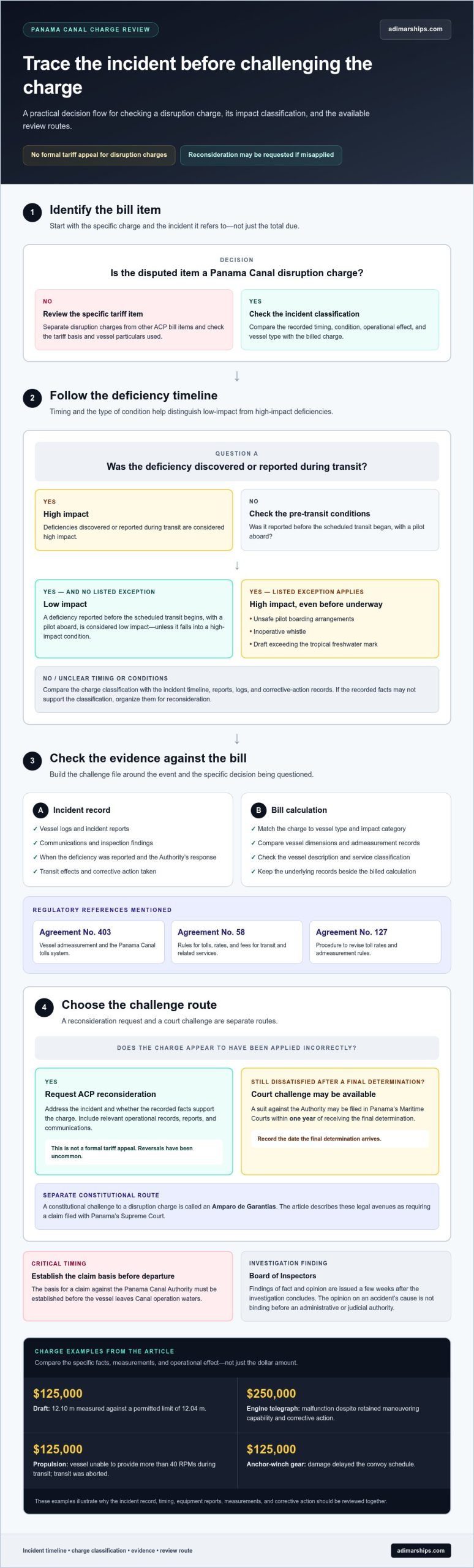
Panama Canal disruption charges are set out in maritime tariffs, so they cannot be challenged through a formal tariff appeal. If a charge appears to have been applied incorrectly, a vessel may request reconsideration from the Panama Canal Authority. The request should address the incident and whether the recorded facts support the charge. Include relevant operational records, reports, and communications so the Authority can compare the vessel’s account with its record of the event.
Reconsideration is different from a court challenge, and reversals have been uncommon. A constitutional challenge to a disruption charge is called an Amparo de Garantias. The legal avenues described for challenging these charges require filing a claim with Panama’s Supreme Court. These proceedings are separate from a reconsideration request, which asks the Authority to review how it applied the charge. Organize the evidence around the specific decision being challenged.
Timing matters while the vessel is still in Canal operation waters. The basis for a claim against the Panama Canal Authority must be established before the vessel departs those waters. Preserve the incident timeline, including when the deficiency was reported, how the Authority responded, and how the transit was affected. A clear chronology helps connect records made at the time to the grounds for disputing the charge.
If the Authority issues a final determination and the claimant remains dissatisfied, suit may be filed against the Authority in Panama’s Maritime Courts within one (1) year of receiving that determination. Keep a record of when the determination arrives, because that date anchors the stated filing period. The Board of Inspectors issues findings of fact and opinion a few weeks after its investigation concludes. Its opinion on an accident’s cause is not binding before an administrative or judicial authority.
For a practical challenge file, separate the grounds and supporting material:
- Identify whether the issue concerns the charge’s application or the Authority’s final determination.
- Preserve vessel logs, incident reports, and communications that establish the timeline.
- Record the date of the final determination and keep the evidence linked to the disputed event.
What types of Panama Canal charges can vessel owners dispute?
Start by identifying the bill item and the event behind it. Panama Canal disruption charges took effect on 1 January 2023, after their introduction in December 2022. The Panama Canal Authority is open to discussing these charges case by case, particularly where the incident record may not match the charge classification.
Timing and operational consequences help distinguish low-impact from high-impact deficiencies. A deficiency reported before a scheduled transit begins, with a pilot aboard, is considered low impact. However, unsafe pilot boarding arrangements, an inoperative whistle, or draft exceeding the tropical freshwater mark are high-impact deficiencies, even if reported before the vessel gets underway. Deficiencies discovered or reported during transit are also considered high impact.
Compare the charge with the specific condition recorded. One vessel received a $125,000 charge after its draft measured 12.10 m against a permitted limit of 12.04 m. In another case, a vessel incurred a $250,000 charge after an engine telegraph malfunction, despite retaining maneuvering capability and addressing the issue. These examples show why owners should examine measurements, equipment reports, timing, and documented corrective action together.
Other incidents have involved propulsion failures or equipment damage that affected canal operations. A vessel unable to provide more than 40 RPMs during transit faced a $125,000 high-impact charge, and its transit was aborted. A damaged anchor-winch gear delayed the convoy schedule and led to a $125,000 charge. The central dispute is whether the recorded facts support the charge’s impact classification and amount.
- Match the billed charge to the vessel type and recorded impact category.
- Compare incident timing with reports, logs, and corrective-action records.
- For owners coordinating transit communications, an Owner’s Nominated Agency can provide local agency coordination.
How are Panama Canal tolls calculated, and what measurement or classification errors can affect the amount?
Panama Canal tolls depend on vessel admeasurement and applicable toll regulations. Agreement No. 403 is titled as subrogating the regulation for vessel admeasurement and the Panama Canal tolls system. Agreement No. 58 modifies rules for tolls, rates, and fees for transit and related services. Together, these references show why a bill review should begin with its tariff item and vessel particulars, not just the total due.
Measurement discrepancies can affect the amount assessed. Compare the vessel’s recorded dimensions and measurement details with the particulars used for the charge. Agreement No. 127 covers the procedure to revise Panama Canal toll rates and admeasurement rules. That makes admeasurement records relevant when an owner believes the vessel’s measurement was entered incorrectly or applied under the wrong basis. Keep the underlying records beside the billed calculation.
Classification matters because tariff treatment depends on how the vessel or transit is categorized. Check that the vessel description and service classification on the bill match the transit records. For example, a mismatch between recorded vessel particulars and those used for admeasurement could affect the toll basis. Identify the specific entry in question and compare it with the supporting vessel documentation.
The fresh water surcharge provides another item to examine. Its variable component ranges from 0% to 10% of a vessel’s total tolls. Compare the percentage applied with the surcharge entry and the total toll figure shown on the bill. A calculation review should distinguish this variable component from other line items, rather than treating the entire invoice as one amount. Preserve the relevant bill and supporting records together.
- Match the bill’s vessel particulars against its admeasurement records.
- Identify the tariff or surcharge entry being questioned, including the fresh water surcharge.
- Check whether the listed classification and calculation basis correspond to the transit documentation.
A focused comparison can help establish whether the issue concerns measurement, classification, or arithmetic. Identifying the precise discrepancy gives a reconsideration request a clearer factual basis.
What fees, interest, penalties, or operational risks apply during a Panama Canal charge dispute?
Separate a disputed disruption charge from other Panama Canal bill items. Booking cancellation and reservation changes have their own tariff consequences, so an invoice may contain charges unrelated to the incident being challenged. For example, a Panama Canal booking cancelled with up to 96 hours’ notice carries a cancellation charge of 100% of the booking. A non-booked vessel that wins an auction and then cancels is charged 100% of its winning bid.
Reservation changes also have distinct charges. The Panama Canal applies a 60% reservation charge for a booking-date change request made more than 21 days to 60 days before booking. The charge is 70% for a request made 7 to 21 days before booking, and 80% for a request made 4 to 7 days before booking. Match each amount to the relevant request and timing before treating it as part of a disruption dispute.
Other tariff items can affect the total without being penalties for disputing a bill. The high-demand-day surcharge is 10% of the booking fee for eligible Neopanamax and Panamax-plus vessels. A Just-in-time slot costs $2,000 for a Regular vessel. Check the invoice line by line, then identify which charge relates to the alleged disruption and which reflects a separate booking or service item.
Operational exposure can arise from the incident itself. A deficiency that delays a transit or affects a convoy may create consequences beyond the amount on one invoice. Identified conditions should be reported through VUMPA, and known deficiencies must be reported at least 96 hours before arrival. If a condition arises underway, the vessel has 30 minutes from the time it is reported or detected to correct it and avoid disruption charges.
The available information does not establish a general interest rate or additional penalty for filing a dispute. Do not assume that a reconsideration request pauses payment obligations or operational consequences. Keep the disputed line item, booking records, VUMPA reports, and correspondence together so the basis for the charge remains clear while transit coordination continues.
Adimar Shipping: Ship Agency Services
Adimar Shipping, Inc. supports ship owners and charterers with local coordination for Panama Canal transits. When a charge dispute concerns an incident during passage, organized communication and accurate operational records can help vessel representatives stay aligned as they review the matter.
Through Ship Agency Services, including Owner’s Nominated Agency and Charterer’s Nominated Agency, Adimar Shipping, Inc. coordinates with relevant parties around a vessel’s canal passage. Husbandry Services support vessel and crew needs. These services suit owners or charterers seeking a local agency partner for transit-related coordination, while legal claims remain a separate process.
For agency coordination related to your vessel’s Panama Canal transit, contact Adimar Shipping, Inc. or visit adimarships.com.
Move the dispute forward with a clear plan
Keep the next stage coordinated rather than letting it become a series of disconnected messages. Assign one person to maintain the working file, track correspondence, and note outstanding questions. Keep operational follow-up separate from any formal legal claim, so each party understands its role and transit coordination stays organized.
A practical approach to how to dispute Panama Canal charges starts with a clear account of the issue and its operational context. Before sending further correspondence, make sure the vessel owner, charterer, and relevant representatives share the same timeline and facts. This helps reduce confusion as the matter progresses.
Adimar Shipping can support vessel coordination through its agency services, while formal legal proceedings remain a separate matter. Contact Adimar Shipping for support with Panama Canal vessel agency coordination. A clear plan puts your team in a stronger position to manage the next step with focus.
Frequently Asked Questions
Who handles disputes over Panama Canal tolls and other charges?
The Panama Canal Authority handles requests to reconsider charges it has applied. Court proceedings follow a separate route through Panama’s judicial system. To dispute Panama Canal charges, first identify who holds the billing records and incident documentation, then coordinate the response with the vessel’s operational representatives. A ship agent can support vessel-related coordination, but the Authority or courts decide the dispute.
What are the official deadlines for disputing or appealing Panama Canal charges?
The basis for a claim against the Panama Canal Authority must be laid before the vessel departs Canal operation waters. After receiving the Authority’s final determination, a dissatisfied claimant may file suit against the Authority in Panama’s Maritime Courts within one (1) year. Record the date of receipt and preserve earlier incident communications, so the relevant events and decision dates remain clear in the claim file.
How do you submit a toll billing dispute to the Panama Canal Authority (ACP)?
To understand how to dispute Panama Canal charges, start with a request for reconsideration if a disruption charge appears to have been applied incorrectly. Identify the charge, vessel, and transit, then explain the factual grounds for challenging the assessment and attach supporting records. The available information describes reconsideration but does not specify a filing channel or required form, so do not assume a particular submission method.
What documents and evidence are required to challenge a Panama Canal charge?
There is no fixed evidence checklist for every challenge. Build the file around the specific charge, including the bill, event timeline, relevant vessel logs, incident reports, and communications about reporting or correcting the condition. For a measurement issue, include records supporting the vessel particulars used. Preserve original timestamps and document versions so the sequence can be compared with the Authority’s account.
What are the ACP procedures for reviewing and deciding a charge dispute?
The Panama Canal Authority considers disruption charges case by case, and a reconsideration request asks it to review whether a charge was applied correctly. For an investigated accident, the Board of Inspectors issues findings of fact and opinion a few weeks after its investigation concludes. That opinion does not bind an administrative or judicial authority, so it is not a final legal ruling.
Are there administrative appeal options if the ACP rejects a Panama Canal billing dispute?
A formal tariff appeal is not available for Panama Canal disruption charges. A constitutional challenge may be another legal route, but the available information does not establish how to pursue it. If the Authority issues a final determination and the claimant remains dissatisfied, a suit may be filed against it in Panama’s Maritime Courts within one (1) year of receiving that determination.