
A single transit slot recently commanded a record $5.3 million at auction, a stark reminder of the financial pressure facing vessel operators today. With daily transits capped at 34 and scheduled to drop further to 32 by mid-September, Panama Canal transit delays have become an unavoidable reality for the global fleet. You’re likely dealing with unpredictable demurrage costs and the constant risk of missing your next port window. It’s a stressful environment where a lack of transparency from the anchorage can leave your team feeling blind to the true situation on the ground.
We understand that these disruptions feel like an uncontrollable variable, but they’re manageable with the right local oversight. This 2026 guide helps you master the complexities of current congestion through a proactive agency strategy. You’ll learn how to secure transit slots under the new ACP auction system and use expert husbandry coordination to turn waiting time into productive maintenance periods. We’ll break down the specific drivers behind the 131-vessel queue and provide actionable steps to reduce your waiting time, ensuring your vessel moves efficiently through the waterway.
Key Takeaways
- Understand how 2026 rainfall patterns and Gatun Lake water levels directly dictate the Panama Canal Authority’s daily transit quotas.
- Minimize Panama Canal transit delays by leveraging the 90-day booking window and calculating precise break-even points for slot auctions.
- Identify and mitigate the hidden financial risks of congestion, including mounting demurrage rates and auxiliary fuel consumption.
- Turn idle time at the anchorage into a productive window by coordinating essential husbandry services through a vigilant local representative.
- Establish transparent communication between the Master and the ACP to safeguard your vessel’s transit slot and downstream port schedule.
The 2026 Landscape: Navigating New Realities at the Panama Canal
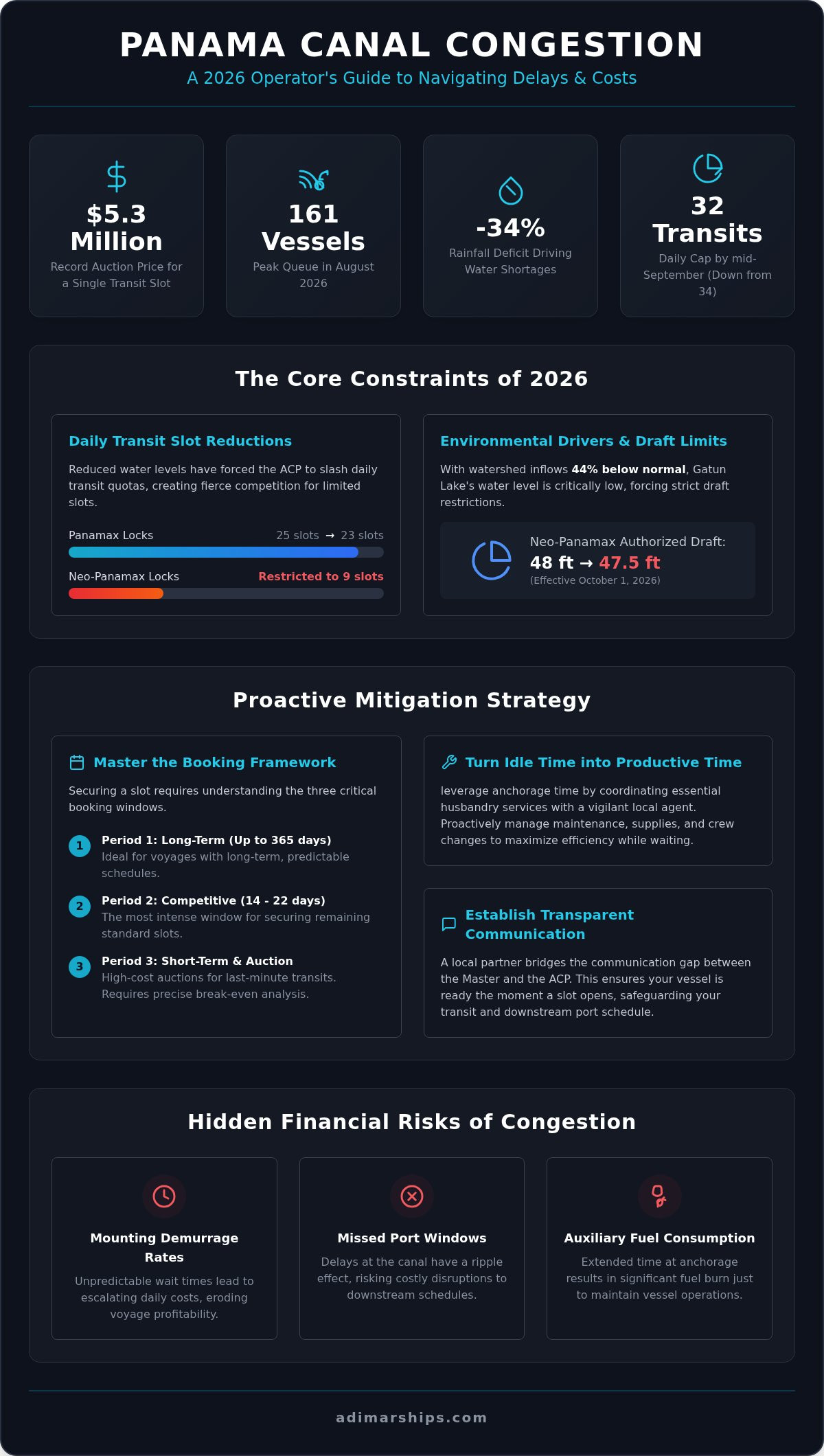
The history and function of the Panama Canal have always been tied to the availability of fresh water, but 2026 has pushed this relationship to its limit. Operators can no longer rely on historical averages to predict voyage timelines. In years past, a vessel might expect a predictable transit window; today, the queue is a volatile metric that peaked at 161 ships in August 2026. Panama Canal transit delays are now driven by a “perfect storm” of a 34% rainfall deficit and sustained global demand. This shift means that planning based on 2024 or 2025 data will lead to significant demurrage risks.
The delay profiles have diverged sharply between vessel classes. While Panamax locks are seeing a reduction from 25 to 23 daily slots by mid-September 2026, the Neo-Panamax locks are restricted to just nine slots. This scarcity has transformed the transit from a routine logistical step into a high-stakes strategic hurdle. Operators who fail to adapt their planning to these specific 2026 quotas often find their vessels languishing at the anchorage for over a week.
Environmental Drivers: Water Management in 2026
Water management is the heartbeat of the canal’s current operational status. With watershed inflows 44% below normal levels, the Panama Canal Authority (ACP) must balance the needs of global trade with reservoir conservation for local consumption. This has resulted in aggressive draft restrictions. As of early September 2026, the authorized draft for Neo-Panamax vessels is 48 feet, but this will drop to 47.5 feet on October 1, 2026. Lower water levels in Gatun Lake impose stricter draft limits, which effectively reduces the total cargo weight a vessel can carry per centimeter of immersion to maintain safe transit depth.
The 2026 Slot Allocation Framework
The Panama Canal Authority (ACP) has implemented a refined auction and booking system to manage the reduced capacity. Understanding the three distinct booking periods is vital for securing a slot:
- Period 1: Bookings made up to 365 days in advance, requiring long-term foresight.
- Period 2: The 14 to 22-day window where competition for remaining slots intensifies.
- Period 3: Short-term bookings that often lead into the high-cost auction system.
A new auction system introduced on September 3, 2026, now categorizes vessels into four specific groups, including LNG/LPG carriers and Tankers. This targeted approach aims to streamline traffic, but it also means that Neo-Panamax operators must be more precise than ever with their arrival times to avoid losing a hard-won slot. Managing these Panama Canal transit delays requires a vigilant local partner who understands the nuances of these shifting 2026 protocols.
Primary Causes of Transit Delays: Beyond the Weather
Weather isn’t the only bottleneck. Operational hurdles often create the most sudden spikes in Panama Canal transit delays. A single mechanical failure in a lock chamber or a vessel losing propulsion can halt traffic for hours. These incidents ripple through the queue, turning a minor hiccup into a multi-day backlog for those at the end of the line. Operators who don’t account for these variables often find their voyage profitability eroded by unexpected demurrage.
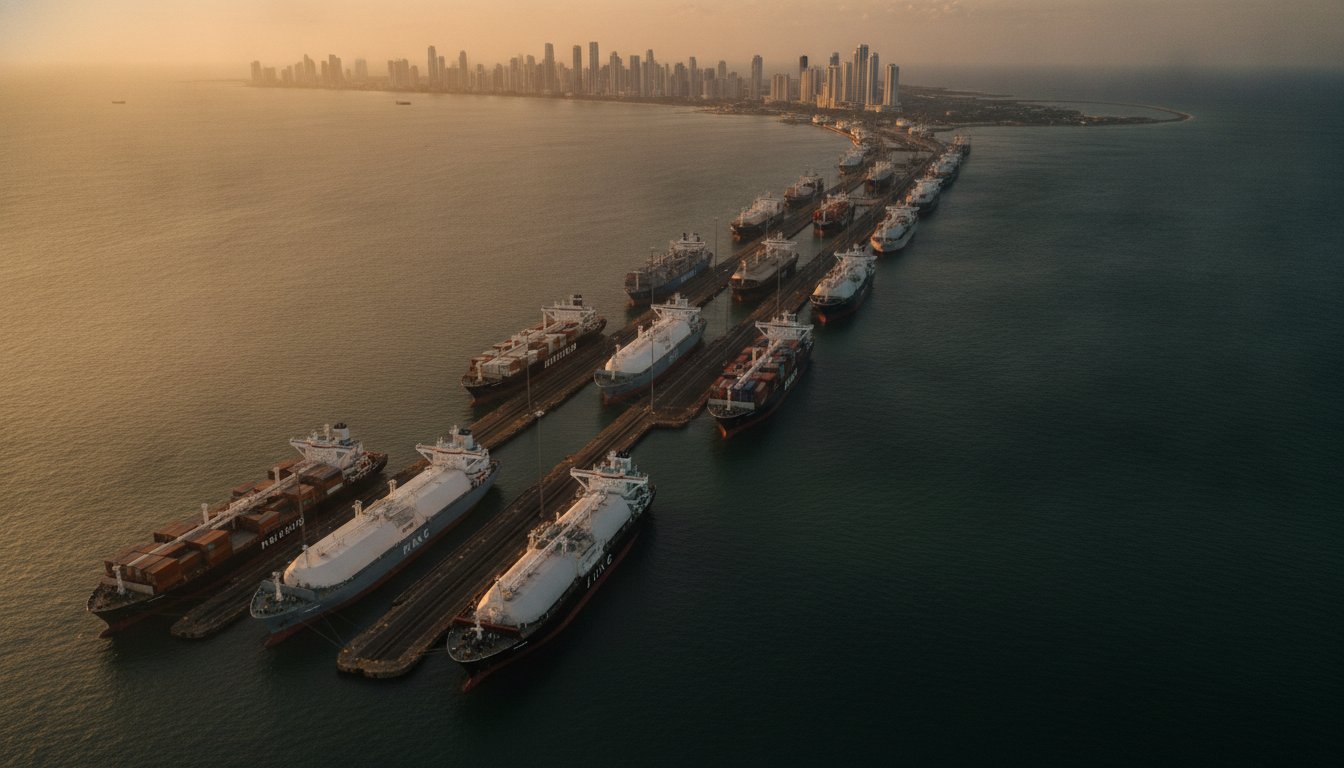
The “Booking Gap” creates the most significant disparity in wait times. Vessels with reserved slots generally move through with minimal friction. However, those arriving without a booking face exponential delays. In mid-August 2026, the queue peaked at 161 ships, and those without reservations faced waits exceeding a week. This is where expert ship agency services become essential. We help bridge the communication gap between the Master and the anchorage to ensure your vessel is ready the moment a slot opens.
Lock Maintenance and Capacity Reductions
The 2026 maintenance calendar is a critical tool for voyage planning. Both the Miraflores and Gatun locks require periodic overhauls to ensure long-term reliability. During these periods, the ACP often shifts between Condition 1 and Condition 2 traffic management. Condition 1 represents normal operations, while Condition 2 is triggered when maintenance limits the number of daily transits. Staying informed through Panama Canal Authority Advisories allows operators to adjust their strategy before these capacity shifts occur.
Traffic Volume and Global Trade Shifts
Global trade patterns are shifting in ways that directly impact Panama. A surge in LNG and LPG traffic has crowded out conventional bulk carriers, as these high-value vessels often dominate the auction system. Additionally, instability at other global chokepoints has diverted more cargo toward the Americas. This influx, combined with seasonal agricultural exports, creates predictable bottleneck months where demand far outstrips the 32 to 34 daily transit slots available in late 2026.
Finally, poor husbandry synchronization can add unnecessary hours to a delay. If bunker barges, crew changes, or spare parts deliveries aren’t perfectly timed with the vessel’s arrival, you risk losing your window when the ACP finally calls the ship for transit. Proactive coordination ensures that every hour spent waiting is used productively. We act as your eyes and ears on the ground, ensuring that husbandry requirements don’t interfere with your transit window.
Calculating the Financial Impact: The True Cost of Waiting
Financial fallout from Panama Canal transit delays extends far beyond the initial booking fee. While headline-grabbing auction prices capture the industry’s attention, the quiet erosion of voyage profitability happens at the anchorage. Every day a vessel sits idle, it’s burning through its margin. Direct demurrage costs can quickly escalate into the tens of thousands of dollars depending on the charter party terms. For operators already facing a 234% year-over-year increase in spot rates on some routes, these additional expenses can turn a profitable voyage into a loss-making endeavor.
Operational costs add another layer of complexity. Auxiliary engines and boilers must run continuously to maintain vessel systems, consuming fuel that wasn’t budgeted for an extended stay. This isn’t just about the fuel bill; it’s about the wear and tear on machinery that’s designed for transit, not prolonged idling. The “hidden” cost often lies in the opportunity loss. Missing a cancelation date for your next fixture can leave a vessel without its next cargo, creating a gap in the schedule that’s impossible to recover. Reputational damage with charterers is equally dangerous, as late deliveries can jeopardize long-term relationships in a competitive market.
Demurrage and Contractual Risks
Disputes often arise over the Notice of Readiness (NOR) when a vessel is stuck at the anchorage. If the NOR is contested, the charterer may argue that the clock hasn’t started, leaving the owner to shoulder the cost of the delay. It’s vital to have an owner’s nominated agency on the ground to provide impartial, documented evidence of the vessel’s status. We act as your vigilant representative. We ensure that all delay causes are recorded accurately to protect your contractual position and minimize financial exposure.
The Husbandry Factor: Maximizing Idle Time
You don’t have to view waiting time as a total loss. By utilizing comprehensive husbandry services, you can convert “dead time” into a productive maintenance window. We help you manage crew changes, medical visits, and Cash to Master (CTM) while the vessel is at anchor. Consolidating these deliveries into a single launch service reduces overall costs and ensures that when the canal opens up, your vessel is fully prepared. This proactive approach ensures your team stays focused on the transit while we handle the logistical heavy lifting in the background.
Proactive Mitigation: Strategies to Minimize Waiting Time
Success in 2026 requires moving beyond reactive management. Advanced voyage planning should begin at least 90 days out to align with the ACP’s reservation windows. By using real-time local intelligence, you can adjust your vessel’s speed, a practice known as slow steaming, to match a confirmed arrival window. This reduces fuel consumption and prevents unnecessary idling at the anchorage. Panama Canal transit delays often hit hardest when vessels arrive too early without a plan, so syncing your ETA with local conditions is a primary defense. It’s about ensuring that your vessel arrives “just in time” rather than joining a stagnant queue.
Leveraging an agent’s network can also open doors to a “Transit Slot Swap.” In some cases, operators with similar vessel types might find mutually beneficial opportunities to exchange slots when cargo or maintenance schedules shift. This level of coordination requires a partner with deep roots in Panama City who can monitor the movements of other vessels in real time. It’s a specialized maneuver that can save a voyage from a week of waiting time, but it depends entirely on having a vigilant representative who can negotiate on your behalf.
The Transit Reservation (Booking) System
Navigating the three booking periods is essential for cost control. Period 1 offers the most security for those planning a year in advance, while Periods 2 and 3 provide flexibility as the voyage date nears. Competition is fierce, especially for Neo-Panamax slots, where only nine daily transits are available. A Transit Booking Fee is a strategic investment in schedule reliability that protects your voyage from the volatility of the unbooked queue. Operators should view these fees not as an extra cost, but as a safeguard for their downstream port windows and charterer commitments.
Strategic Use of Auctions and Special Slots
When standard bookings are unavailable, the daily auction system becomes a critical tool. This involves a cold calculation: you must determine if the cost of an auction bid is lower than the accumulated daily demurrage and operational burn of waiting at the anchorage. We act as your proactive representative, executing bids on your behalf and providing the data you need to calculate a precise “break-even” bid price. This ensures you don’t overpay during high-competition periods while still avoiding the worst Panama Canal transit delays.
To secure your spot and optimize your transit strategy, consult with our specialized agency team today.
Adimar Shipping: Your Vigilant Partner in Delay Management
Adimar Shipping, Inc. acts as your vigilant, on-the-ground representative in a maritime environment that feels increasingly unpredictable. We provide the local oversight necessary to navigate the current 2026 congestion, serving as your “eyes and ears” from the moment your vessel enters Panamanian waters. Panama Canal transit delays create a high-pressure atmosphere where communication gaps can lead to missed opportunities. We bridge that gap by maintaining a direct line between the ACP, the Master, and the Owner, ensuring that information is transparent and actionable at every stage of the voyage.
Our role as a Protective Agency is particularly vital during periods of heavy congestion. When dozens of vessels are waiting at anchor, supplier errors and administrative oversights become more common. We safeguard your interests by auditing local invoices and monitoring vendor performance. This protective layer ensures that you aren’t overpaying for services or suffering from logistical mistakes made in the chaos of the queue. With over 20 years of local expertise and a direct presence in Panama City, we bring a level of stability and ethical conduct that is essential for protecting your bottom line.
Eliminating Confusion and Delays
Proactive documentation management is the first step toward a smooth voyage. We handle the complexities of Panama Canal transit paperwork to ensure your vessel maintains a “Transit Ready” status at all times. This preparation is critical because the ACP can call a vessel for transit with very little notice. By coordinating closely with pilots and tugs, we ensure that zero minutes are lost once your slot opens. This level of oversight significantly reduces the Master’s administrative burden, allowing the crew to focus on safe operations during high-stress transit windows.
The Value of a Specialized Ship Agent
Navigating the 2026 landscape requires more than just a general agent. A Panama Canal ships agent with specialized knowledge of the new auction systems and draft restrictions is your most valuable asset. We integrate essential services, such as PCSOPEP authorized person representation and husbandry, into a single, efficient transit plan. This holistic approach ensures that your vessel remains compliant and well-supplied without adding to the risk of Panama Canal transit delays. Adimar Shipping, Inc. is committed to protecting your interests through every mile of the waterway. Contact us today to secure expert local representation for your fleet.
Strategic Oversight for a Complex Waterway
The 2026 maritime landscape is undeniably challenging, but it doesn’t have to be a source of constant financial risk. Success on this route now requires a shift from reactive waiting to proactive logistical planning. By mastering the refined slot auction system and utilizing idle time for essential husbandry, you can protect your margins even during peak congestion. Effectively managing Panama Canal transit delays is ultimately about having a vigilant representative who can anticipate operational changes before they impact your schedule.
Delegating these specialized tasks to a partner with deep local roots provides the security and transparency your operations demand. Adimar Shipping serves as your protective shield against the complexities of the waterway. With over 20 years of local expertise and our status as an authorized PCSOPEP representative, we ensure your vessel remains compliant and ready for transit the moment a window opens. Our specialized Protective Agency services are designed to safeguard your interests and eliminate the confusion often found at the anchorage.
Secure your vessel’s 2026 transit schedule with Adimar Shipping.
We look forward to helping you navigate the year ahead with precision, reliability, and total peace of mind.
Frequently Asked Questions
What is the average Panama Canal transit delay for non-booked vessels in 2026?
Non-booked vessels are currently experiencing wait times exceeding seven days at the anchorage. This delay can fluctuate based on the total queue size, which reached 131 vessels in late August 2026. Without a reserved slot, your ship is placed in the general queue, where passage depends entirely on daily capacity leftovers. These unpredictable Panama Canal transit delays can severely impact voyage profitability if not managed by a local agent.
How does the ACP calculate the daily number of transit slots?
The Panama Canal Authority (ACP) determines daily transit quotas based on the water levels of Gatun Lake and the surrounding watershed inflows. In late 2026, rainfall was 34% below historical averages, forcing a reduction in daily transits. The current cap is set at 34 vessels per day, with a scheduled drop to 32 transits starting September 15, 2026. This water management strategy ensures the long-term sustainability of the waterway.
Can my vessel skip the queue through the auction system?
Yes, the auction system allows vessels to secure unassigned or canceled slots, effectively bypassing the standard waiting list. As of September 3, 2026, the ACP uses a categorized auction framework for LNG carriers, tankers, and container ships. While this provides a faster route for urgent cargo, bidding is highly competitive. We help our clients calculate a break-even bid price to ensure the auction cost doesn’t exceed the financial burden of demurrage.
What is the difference between a Panamax and Neo-Panamax delay?
Delay profiles differ significantly due to the number of available slots in each lock system. Neo-Panamax locks are restricted to just nine daily transits, creating intense competition for larger vessels. In contrast, the Panamax locks allow 25 daily transits, though this will decrease to 23 slots by mid-September 2026. Because Neo-Panamax slots are scarcer, these vessels often face higher auction prices and more rigid scheduling requirements compared to their smaller counterparts.
Does weather in the Atlantic affect delays on the Pacific side?
Yes, weather patterns affect the entire canal ecosystem regardless of which side the vessel is anchored. The primary driver of 2026 delays is a watershed-wide rainfall deficit, which lowers the depth of Gatun Lake. Since this lake feeds both the Atlantic and Pacific locks, water conservation measures apply to all transits. High winds or storm surges on one side can also disrupt pilot boarding operations, causing ripple effects that increase wait times.
How far in advance should I book my Panama Canal transit slot?
You should aim to book as early as possible, ideally within the Period 1 window which opens 365 days in advance. For operators with less lead time, Period 2 offers slots 14 to 22 days before the transit date. Given that Panama Canal transit delays are currently driven by a 44% deficit in watershed inflows, securing a slot early is the only way to avoid the volatile and expensive auction queue.
Are there specific days of the week when delays are typically shorter?
There isn’t a specific day of the week that guarantees a shorter wait, as the queue is managed by the ACP based on arrival time and booking status. However, delays often spike during seasonal peaks, such as agricultural export windows or when global chokepoints divert traffic to Panama. We monitor the daily Advisories to Shipping to help you identify temporary lulls in traffic, allowing for more precise voyage planning and fuel optimization.
How does Adimar Shipping help reduce my vessel’s waiting time?
We act as your proactive representative to ensure your vessel is Transit Ready the moment a slot becomes available. Our team manages all ACP documentation and coordinates with pilots and tugs to prevent administrative hold-ups. With over 20 years of local expertise, we also integrate husbandry services and PCSOPEP compliance into your waiting period. This turns idle time into a productive window, ensuring your vessel moves efficiently through the waterway without unnecessary friction.