

For any shipowner or charterer, calculating the cost of a Panama Canal transit seems straightforward at first. You consult the official tariffs, use an online calculator, and budget accordingly. Yet, the final invoice that arrives is often significantly higher, filled with charges you never anticipated. The reality is that the official toll is just the beginning. To truly manage your voyage costs, you must look beyond the published rates to uncover the unexpected fees for booking, operations, and compliance that can derail your budget.
Beyond the Official Toll: The Costs Everyone Knows
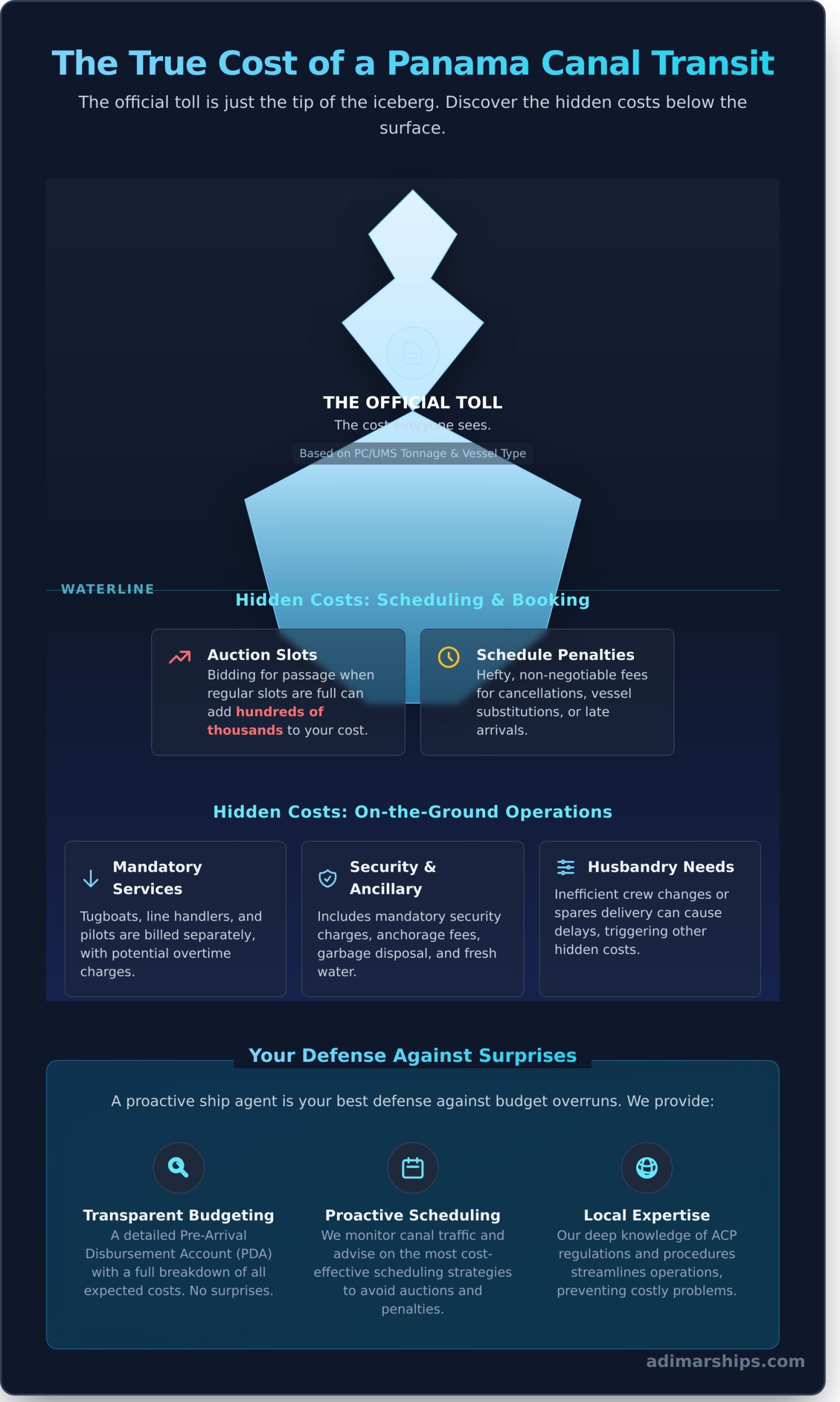
Every transit budget starts with the baseline toll, the primary fee charged by the Panama Canal Authority (ACP). This cost is calculated based on the Panama Canal Universal Measurement System (PC/UMS), which determines a vessel’s net tonnage. The toll structure varies for different types of vessels, whether you are operating a container ship, a tanker, a bulk carrier, or a passenger vessel. This figure forms the foundation of your expenses, but it’s a mistake to consider it the final number. It is merely your ticket to the starting line.
Why Toll Calculators Can Be Misleading
Online toll calculators are useful for a preliminary estimate, but they are not a final quote. These tools provide a snapshot based on ideal conditions and standard data. They simply cannot account for the dynamic, real-time operational variables that every transit faces. From booking competition to slight delays and mandatory on-the-ground services, a range of factors come into play that these calculators leave out. Let’s explore the critical costs they fail to mention.
This challenge of managing complex, dynamic costs isn’t unique to the maritime industry. In the competitive retail sector, for example, accurately tracking and adjusting prices is a critical daily operation, a process detailed by industry experts like ESLtags, Corp.. Just as in shipping, the initial estimate is only the beginning of the story.
The High Price of Time: Hidden Costs in Scheduling & Booking
The process of securing a transit slot is one of the most significant sources of variable and hidden costs. The demand for passage, your vessel’s specific requirements, and the timing of your arrival can dramatically affect the fees associated with just getting in line. In the world of canal transits, time truly is money, and scheduling missteps carry hefty price tags.
Auction Slots: When Bidding Drives Up the Price
What happens when the regular booking slots are full? To guarantee passage and avoid costly waiting times at anchor, shipowners can enter the transit reservation auction system. This is a bidding process for a limited number of slots, where the highest bidder secures the transit. While effective for maintaining a tight schedule, winning a slot at auction can add tens, or even hundreds of thousands of dollars, to your total transit cost, turning a routine expense into a major financial event.
Penalties for Changes: Cancellation and Late Arrival Fees
The Panama Canal Authority operates on a strict schedule, and deviations are penalized. If you need to substitute a vessel for a booked slot, cancel a reservation outside the allowed window, or arrive after your scheduled time, you will face significant fees. For example, arriving just a few hours late can result in a penalty that impacts your bottom line. These charges are applied rigorously and are non-negotiable with the ACP, making schedule adherence absolutely critical.
On-the-Ground Charges: The Operational Costs You Didn’t Budget For
A successful transit requires a complex coordination of services that go far beyond simply passing through the locks. Many of these essential operational services are mandatory, arranged by your agent, and invoiced separately from the canal tolls. Failing to budget for them is one of the most common reasons for a discrepancy between the estimated and final costs.
Tugboat, Line Handler, and Pilot Fees
A common misconception is that the cost of tugboats, line handlers, and pilots is included in the transit toll. This is incorrect. These services are mandatory and billed separately. The number of tugboats required depends on your vessel’s size and specifications, directly impacting the cost. Furthermore, if your transit extends beyond standard working hours, overtime charges for pilots and crews can accumulate, adding another layer of expense to your final disbursement account.
Security, Anchorage, and Ancillary Service Charges
Every vessel is subject to a mandatory security charge for each transit to comply with international maritime security standards. Additionally, if your vessel faces delays or must wait for orders, you may incur unexpected anchorage fees. Other ancillary services, such as garbage disposal, fresh water provisions, or sludge removal, also contribute to the final invoice and must be accounted for in a comprehensive budget.
Urgent Husbandry Needs: Crew Changes & Spares
The hidden cost of an inefficient or unresponsive husbandry agent can be immense. A poorly coordinated crew change or a delay in delivering critical spare parts can prevent your vessel from meeting its scheduled transit time. This single issue can have a costly ripple effect, potentially causing you to miss your slot and incur late arrival penalties or forcing you into the expensive auction system. It is vital to have a reliable partner on the ground. Let us handle your husbandry needs efficiently.
Your Best Defense: How a Proactive Ship Agent Eliminates Hidden Costs
Ultimately, most hidden costs are the result of poor planning, miscommunication, or a lack of local expertise. An experienced, proactive ship agent is your best defense against financial surprises. We act as your eyes and ears at the Canal, anticipating challenges and managing the entire process on your behalf. The true value of a great agent is not in just processing transactions, but in active cost avoidance.
Transparent Budgeting with a Pre-Arrival Disbursement Account (PDA)
Before your vessel even sets sail for Panama, we provide a detailed Pre-Arrival Disbursement Account (PDA) that offers a comprehensive estimate of ALL expected costs. We believe in full transparency, explaining every line item-from tolls and tugs to security and husbandry-so you can budget with confidence. We manage all funds with the utmost integrity and provide a final, clearly itemized DA after the transit is complete, with no surprises.
Proactive Scheduling and Problem Solving
We do more than just book a slot. We actively monitor canal traffic, analyze booking trends, and advise on the most cost-effective scheduling strategy for your specific needs. Our team maintains constant communication with the ACP, pilots, and your vessel’s master to ensure a smooth operation. If unexpected issues arise, we leverage our experience to find quick, effective solutions before they can evolve into costly problems.
Local Expertise That Saves You Money
Navigating the Panama Canal is about more than logistics; it’s about understanding the nuances of the ACP’s regulations and procedures. Our deep local knowledge and long-standing professional relationships help streamline all on-the-ground operations, from clearing paperwork to coordinating pilots. Adimar Shipping is your trusted partner at the Canal, dedicated to protecting your interests and your budget. Put your transit in our hands. Get a quote today.
Frequently Asked Questions About Canal Costs
What is the single biggest hidden cost when transiting the Panama Canal?
The most significant potential hidden cost is often the fee for securing a transit slot through the auction system. When standard slots are unavailable, bidding for a slot can add a substantial, unpredictable amount to the total cost, far exceeding any other ancillary fee.
Are tugboat and line handler fees negotiable?
No, the fees for mandatory services like tugboats and line handlers are set by the Panama Canal Authority and their service providers. They are based on the vessel’s size and transit requirements and are not negotiable.
How can I avoid paying for an expensive auction slot?
The best way to avoid the auction is through careful, long-range planning and working with a proactive ship agent. An agent can monitor slot availability and advise on the optimal time to book, helping you secure a standard reservation and avoid the high costs of last-minute bidding.
What happens if my vessel’s measurements are different upon arrival?
If the ACP’s official measurement of your vessel upon arrival differs from the information submitted, your tolls and fees will be recalculated. This can lead to an unexpected increase in costs. It is crucial to provide accurate data to your agent from the start.
Does a ship agent pay the canal fees on my behalf?
Yes. Shipowners and charterers provide funds to their agent through a Pre-Arrival Disbursement Account (PDA). The agent then uses these funds to pay all tolls, fees, and service costs directly to the Panama Canal Authority and other providers on your behalf, ensuring a smooth and timely process.
Don’t let unexpected charges compromise the profitability of your voyage. A successful Panama Canal transit is a predictable one, and predictability comes from partnering with an expert who knows how to navigate the complexities of the system. By understanding the full spectrum of potential costs and entrusting your passage to a dedicated team, you can ensure your vessel transits efficiently and, most importantly, on budget. Request a transparent transit quote from your trusted Panama Canal partner.