
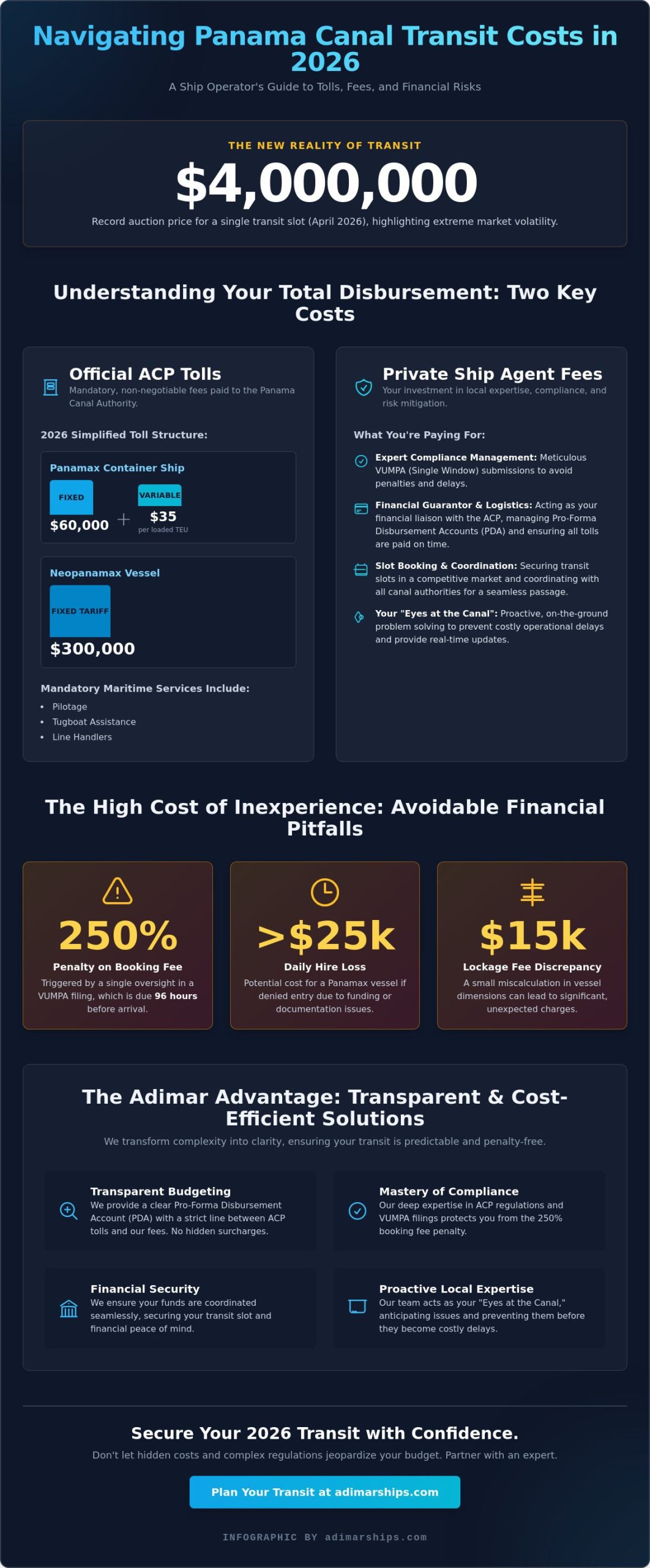
With auction prices for transit slots hitting a staggering $4 million in April 2026, the margin for error in your maritime logistics has never been thinner. You likely feel the mounting pressure of rising costs and the constant worry that hidden surcharges or a misunderstanding of the ACP’s new toll structure will blow your budget. It’s frustrating when you’re trying to plan a 2026 transit and the line between official tolls and private panama canal ship agent fees feels blurred. We understand that timing is everything; a single oversight in a VUMPA filing can trigger a 250% penalty on your booking fee, turning a routine passage into a financial crisis.
This guide will help you master these complexities and show you how to optimize your transit budget through transparency and expert coordination. We’ll break down the latest 2026 fee structures, explain how a Pro-Forma Disbursement Account (PDA) protects your bottom line, and show you why a trusted agent is your best defense against unexpected penalties. We are your eyes at the Panama Canal, ensuring you have a clear financial picture and predictable budgeting for every transit you make.
Key Takeaways
- Distinguish between mandatory ACP tolls and private panama canal ship agent fees to build a transparent and accurate transit budget for 2026.
- Avoid expensive regulatory penalties by understanding the critical timing for VUMPA submissions and mandatory documentation management.
- Master the financial lifecycle of a Pro-Forma Disbursement Account (PDA) to ensure seamless fund coordination and slot security.
- Identify how vessel size and transit complexity impact your total costs, allowing for more predictable budgeting across different ship types.
- Discover how local expertise serves as your “eyes at the Canal” to proactively solve problems and prevent costly operational delays.
Understanding the Structure of Panama Canal Transit Costs
Ship owners and charterers often find the financial side of a transit confusing. You’re dealing with two distinct cost categories that determine your total disbursement. First, there are the official tolls and maritime services paid to the Panama Canal Authority (ACP). Second, there are the private panama canal ship agent fees that cover your local representation, logistics, and compliance management. Understanding the line between these two is the first step toward predictable budgeting.
The Panama Canal operates under a strict regulatory framework where the agent serves as the legal and financial liaison. The ACP requires a local agent for every transit to act as a financial guarantor. This means the agent is responsible for ensuring all tolls are paid in full before the vessel arrives. In the high-stakes 2026 maritime environment, where auction prices for transit slots have reached $4 million due to global reroating, having a partner who manages these massive capital transfers with integrity is vital for your peace of mind.
Official ACP Tolls and Maritime Services
The ACP has implemented a simplified toll structure that will be fully phased in during 2026. This system combines fixed tariffs with capacity-based charges. For example, a Panamax container ship faces a fixed tariff of $60,000 plus $35 per loaded TEU. Larger Neopanamax vessels see a fixed tariff of $300,000. These costs are non-negotiable and go directly to the canal’s operation. Beyond the base toll, you must account for mandatory maritime services. These include pilotage, tugboat assistance, and line handlers. Because a small miscalculation in a vessel’s dimensions can lead to a $15,000 difference in lockage fees, your agent must verify all ship data against ACP requirements long before you reach the locks.
The Private Agency Fee: Your Local Operating Cost
While the ACP manages the physical waterway, they don’t handle the ship’s specific documentation or logistical needs. Your panama canal ship agent fees are the service charges for this local representation. This fee is entirely separate from the official tariffs and covers the immense workload of coordinating with canal authorities. We serve as your eyes at the Panama Canal, managing the VUMPA (Single Window) filings that must be submitted at least 96 hours before arrival. A simple oversight in this filing can trigger a 250% penalty on your booking fee. Your agent fee is a strategic investment that buys you the expertise needed to avoid these exponentially higher costs of non-compliance and delay.
Breaking Down Ship Agent Fees: What Are You Paying For?
When evaluating panama canal ship agent fees, many operators make the mistake of viewing them as a simple administrative overhead. In reality, these fees represent the man-hours and expert local knowledge required to protect a multi-million dollar asset from operational failure. You aren’t just paying for a signature; you’re paying for a dedicated team that navigates the friction between your vessel’s schedule and the rigid requirements of the Canal Authority. We are experts so you don’t have to be, taking the weight of coordination off your shoulders so you can focus on your broader business goals.
The core of the agency service involves the meticulous coordination of the Panama Canal transit schedule. This includes securing slots in an increasingly competitive market where auction prices can fluctuate wildly. Beyond scheduling, the agent manages the settlement of all port and canal dues. This requires precise financial logistics to ensure that funds are cleared and available according to the official Panama Canal tariffs before the vessel arrives at the locks. Without this proactive financial management, your ship could be denied entry, leading to daily hire losses that often exceed $25,000 for a Panamax vessel.
Administrative and Documentation Management
Compliance is the cornerstone of a successful passage. Our team ensures strict adherence to the latest Panama Canal regulations, which include complex VUMPA (Single Window) submissions. These filings must be completed at least 96 hours before arrival. A single error in this documentation doesn’t just cause a delay; it can trigger a 250% penalty on your booking fee. We handle all customs, immigration, and quarantine clearances, preparing arrival and departure declarations that keep your vessel moving without legal friction. If you want to eliminate the confusion of these filings, having a specialized agent is the only reliable solution.
Operational Liaison and Oversight
A ship agent serves as your “eyes at the Canal,” providing 24/7 communication between the vessel, the ACP, and your office. We monitor the vessel’s ETA in real-time, adjusting schedules to minimize expensive anchorage time. This operational oversight extends to the physical transit itself. We coordinate with pilots, tugboat operators, and line handlers to ensure a seamless entry into the locks. By acting as your local office on the ground, we provide the vigilance needed to spot potential issues before they become costly delays. This proactive problem-solving is the true value hidden within your agency fee.
Factors That Influence Agency Fee Variability
Vessel operators often find that no two transits are priced exactly the same. This variability isn’t arbitrary; it reflects the specific workload and risk profile associated with your ship and its schedule. While the Official Panama Canal Tariffs provide a transparent baseline for tolls, your panama canal ship agent fees scale based on the intensity of the coordination required. A Neopanamax container ship with a tight booking window demands more vigilance than a smaller bulk carrier waiting in the “first-come, first-served” queue.
Transit complexity is a major driver of cost. In 2026, with slot auction prices reaching record highs due to global rerouting, the agent’s role in securing and defending your transit window is more critical than ever. If you’re managing a last-minute booking to avoid delays elsewhere, the administrative pressure increases significantly. We act as your local office on the ground, stepping in to handle the surge in documentation and communication required for high-stakes transits. This proactive management ensures that your panama canal ship agent fees translate into tangible time savings and risk reduction.
Nominated Agency vs. Protective Agency Fees
It’s vital to distinguish between the different types of representation available. An Owner’s Nominated Agency is appointed to prioritize the ship owner’s specific interests throughout the stay. In contrast, a charterer’s agent may focus more heavily on cargo-related logistics. Many owners choose to appoint an Owners Protective Agency (OPA) to oversee the charterer’s agent, providing an essential layer of security and financial oversight. Specialized compliance roles, such as serving as the PCSOPEP Authorized Person, also add to the fee profile but are necessary to protect you from environmental liabilities and massive fines.
Husbandry and Crew-Related Expenses
Time is money at the Canal. Bundling husbandry services with your transit agency is almost always the most cost-efficient strategy. This allows for the seamless coordination of crew changes, medical assistance, and provisioning while your vessel is at anchorage. Logistics fees for spare parts delivery and bunkering in Panama can escalate quickly if managed by separate entities. By centralizing these husbandry tasks with your transit agent, you eliminate the confusion of multiple invoices and ensure that technical needs don’t interfere with your scheduled lockage time.
Pro-Forma Disbursement Accounts (PDA) and Financial Logistics
Navigating the financial logistics of a canal transit starts with the Pro-Forma Disbursement Account (PDA). This document serves as your financial roadmap, estimating every cost from official tolls to panama canal ship agent fees. In Panama, 100% advance payment of these estimated costs is the industry standard. The Panama Canal Authority (ACP) requires full payment before a vessel is even scheduled for lockage. Without cleared funds, your ship remains in “anchorage hold” status, accruing daily hire costs that can easily top $25,000 for a Panamax vessel. We manage these capital transfers with precision so your transit remains on schedule.
The financial process doesn’t end when the ship exits the locks. After the transit is complete, the account enters the reconciliation phase. The transition from a PDA to the Final Disbursement Account (FDA) typically takes 4 to 8 weeks. This timeline allows for the collection and verification of final invoices from the ACP and local vendors. You should audit your PDA carefully to identify “hidden” administrative surcharges that some agencies might tuck into miscellaneous categories. Transparency is the bedrock of our service, and we ensure every line item is justified and documented.
How to Read a Panama Canal PDA
Reading a PDA shouldn’t feel like deciphering a code. You can protect your budget by following these three verification steps:
- Step 1: Verify the vessel dimensions and cargo type against ACP tariff categories. As mentioned previously, a small error in admeasurement data can lead to a $15,000 difference in lockage fees.
- Step 2: Distinguish between fixed ACP fees and estimated out-of-pocket expenses, such as launch services or pilotage surcharges.
- Step 3: Confirm the agency fee matches your pre-agreed service contract exactly to avoid unexpected administrative costs.
Managing Fund Transfers and Currency Risks
Timing is everything when it comes to fund coordination. Ensure your bank transfers arrive at least 48 to 72 hours before the vessel’s ETA to account for international banking delays. We recommend requesting transaction receipts immediately to provide proof of payment to the Canal Authority if funds are caught in transit. Adimar prioritizes financial integrity through clear, itemized reporting. We act as your local office at the Canal, ensuring that your funds are handled with the highest level of security and accountability. If you want to secure your transit with a partner you can trust, nominate Adimar as your agent today.
The Adimar Advantage: Transparent and Cost-Efficient Agency Solutions
Choosing the right partner for your transit involves more than just comparing panama canal ship agent fees. It requires finding a team that understands the commercial pressure of a $25,000 daily hire rate and the volatility of a market where auction slots are hitting $4 million. With over 20 years of experience as a specialized ship agency in Panama, we have built our reputation on the belief that timing and coordination are the keys to your profitability. We don’t just process paperwork; we serve as your local office on the ground, protecting your interests at every stage of the passage.
Our “eyes at the Canal” philosophy is designed to provide proactive risk mitigation that global corporate networks often miss. While larger agencies might treat your vessel as just another number in a database, we provide vigilant, real-time oversight. This means we spot potential scheduling conflicts or documentation errors before they turn into expensive “anchorage holds” or VUMPA penalties. By acting as an extension of your own team, we eliminate the confusion of canal logistics and ensure that your transit is handled with the highest level of professional care.
Integrity is the cornerstone of our pricing model. We provide a clear, itemized breakdown of costs with no hidden markups on third-party services like launch hire, medical assistance, or provisioning. Whether you require an Owner’s Nominated Agency or specialized husbandry support, our service packages are customized to fit your specific operational needs. We are experts so you don’t have to be, allowing you to focus on your core business while we handle the complexities of the waterway.
Why Integrity Matters in Panama Canal Agency
In the high-stakes environment of 2026, the commercial value of a trusted partner cannot be overstated. We treat your vessel as if it were our own, providing a level of security and reliability that safeguards your bottom line. Our clients benefit from direct access to senior management, ensuring that critical decisions are made quickly and accurately. This streamlined communication prevents the frustration of slow response times, which is vital when you are navigating tight booking windows or last-minute slot auctions. We pride ourselves on being a service provider known for integrity, every time.
Next Steps: Securing Your 2026 Transit Quote
Planning your next passage starts with a clear financial picture. We invite you to nominate Adimar Shipping for your upcoming transit to experience a new standard of transparency and efficiency. By providing your specific vessel particulars, you can request a detailed Pro-Forma Disbursement Account that accurately reflects the latest 2026 tariffs and local service costs. Contact Adimar Shipping today for a transparent Panama Canal fee estimate and put your transit in the hands of the experts.
Secure Your 2026 Transit with Confidence
Navigating the 2026 transit landscape requires more than just an understanding of tolls. It demands a partner who can manage the financial and regulatory risks of the waterway with precision. You’ve seen how a transparent PDA prevents hidden costs and how expert slot coordination protects you from the volatility of record-high auction prices. By choosing a partner that prioritizes integrity, you ensure that your panama canal ship agent fees are a strategic investment in operational security rather than a mere administrative cost.
Adimar Shipping brings twenty years of experience and a dedicated local office in Panama City to every transit. As an Authorized Person for PCSOPEP compliance, we handle the heavy lifting of regulatory adherence so you don’t have to. We are your eyes at the Panama Canal, providing the vigilance needed to keep your vessel moving without delay. Our goal is to eliminate the confusion and frustration of transit planning with personalized service that treats your vessel as our own.
Request a Pro-Forma Quote from Adimar Shipping to get a clear, itemized estimate for your next passage. It’s time to put your transit in the hands of the experts and focus on your business with total peace of mind.
Frequently Asked Questions
How much are the average ship agent fees for a Panama Canal transit?
Specific agency fees vary based on the vessel type and the complexity of the services required for your passage. While official ACP tolls for a standard transit often range from $300,000 to $400,000, your panama canal ship agent fees represent a separate service charge for local representation and logistics. We provide detailed, itemized quotes to ensure you have a clear financial picture without any hidden surcharges.
Can I pay the Panama Canal tolls directly without a ship agent?
No, you cannot pay tolls directly to the Panama Canal Authority. The ACP requires every vessel to have a local agent who acts as a financial guarantor and primary liaison. This agent is responsible for ensuring all funds are cleared and documentation is filed correctly before the vessel arrives. We serve as your eyes at the Panama Canal, managing these critical payments with integrity and precision.
What is a Pro-forma Disbursement Account (PDA)?
A Pro-forma Disbursement Account (PDA) is a comprehensive financial estimate provided by your agent before the transit begins. It outlines all expected costs, including official tolls, maritime services, and your panama canal ship agent fees. This document is essential for predictable budgeting and ensures that the 100% advance payment required by the ACP is handled accurately to avoid scheduling delays.
Why do agency fees vary between different shipping companies in Panama?
Fee variability usually reflects the level of personalized service and the man-hours required to manage a specific transit. High-stakes passages, such as those involving record-high auction premiums or tight booking windows, demand more vigilant oversight and real-time coordination. Our fees are grounded in a commitment to integrity, ensuring you receive expert problem-solving and proactive communication without unexpected administrative markups.
What happens if I don’t send the funds before the vessel arrives at the Canal?
Failure to clear funds in advance will result in the vessel being placed in “anchorage hold” status by the Canal Authority. This delay is extremely costly, as daily hire rates for a Panamax vessel can exceed $25,000. We monitor fund transfers closely to prevent these bottlenecks, ensuring your money is in place and your transit slot is protected from cancellation or penalties.
Are husbandry services included in the standard ship agent fee?
Husbandry services are typically treated as separate line items and are not included in the basic transit coordination fee. These services include crew changes, medical assistance, and provisioning while the vessel is at anchorage. We recommend bundling these tasks with your primary transit agent, as it is more cost-efficient and eliminates the confusion of dealing with multiple local service providers.
How has the 2026 ACP tariff update affected agency service requirements?
The 2026 transition to a simplified toll structure has consolidated many charges but increased the administrative pressure for accurate VUMPA filings. Because a single error in these submissions can trigger a 250% penalty on booking fees, the agent’s role in documentation management is more critical than ever. We stay ahead of these regulatory changes so you don’t have to worry about compliance failures.
Is there a difference in fees for Panamax vs. Neopanamax vessels?
Yes, agency fees are generally higher for Neopanamax vessels due to the increased complexity and financial risk associated with larger lockages. Neopanamax transits involve significantly higher toll payments and more stringent documentation requirements. The fees reflect the extra vigilance needed to manage these high-value transits and coordinate the specialized maritime services required for the larger lock system.