

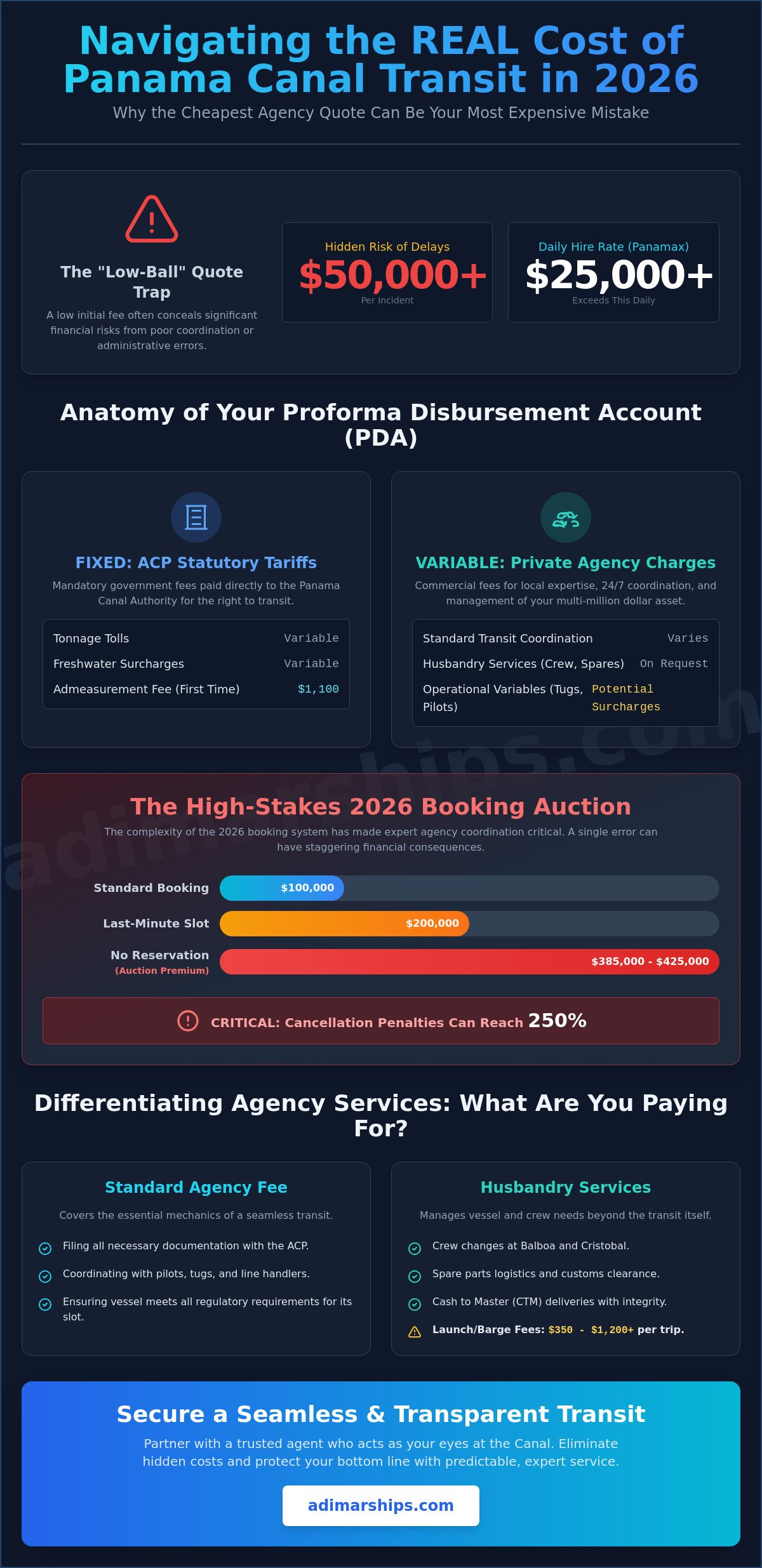
The cheapest quote for ship agency fees Panama Canal is often the most expensive mistake a maritime operator can make in 2026. While a low initial estimate might look attractive on a spreadsheet, it frequently hides the risk of $50,000 delays caused by poor coordination or administrative errors. You’ve likely felt the sting of a final disbursement account that looks nothing like the original proforma, especially when daily hire rates for Panamax vessels now exceed $25,000. It’s frustrating to navigate the widening gap between mandatory ACP charges, such as the $1,100 admeasurement fee, and the private service charges required to keep your vessel moving.
As your eyes at the Panama Canal, we believe you shouldn’t have to be a specialist to get a fair and transparent price. This guide helps you master the complexities of current fee structures to eliminate hidden costs and secure a seamless transit strategy. You’ll gain a clear understanding of the 2026 pricing landscape, learn to distinguish between Owner’s and Charterer’s agency costs, and discover how to build a predictable budget that protects your bottom line from unexpected “low-ball” quote traps.
Key Takeaways
- Identify how the 2026 slot auction and booking priority changes have shifted the landscape of local representation requirements.
- Differentiate between standard ship agency fees Panama Canal and husbandry services to avoid overpaying for unnecessary add-ons.
- Uncover the hidden operational variables, such as pilotage surcharges and tugboat standby rates, that frequently lead to budget overruns.
- Learn a proven method for evaluating agency quotes to ensure the management fee reflects the true level of service and local expertise provided.
- Build a more predictable budget by understanding the difference between fixed ACP statutory tariffs and variable private agency service charges.
Understanding Ship Agency Fees in the 2026 Panama Canal Landscape
Ship agency fees Panama Canal represent the professional service charges for local representation and coordination. While some see these as a simple line item on a spreadsheet, they’re actually the safeguard for your vessel’s schedule and budget. In the high-stakes environment of 2026, these fees cover the expertise required to navigate a waterway that has become increasingly complex due to water management challenges and evolving transit rules. You shouldn’t have to be an expert on local regulations when you have a trusted partner on the ground.
Timing and coordination dictate whether your final disbursement account matches your initial proforma. We serve as your eyes at the Panama Canal to prevent statutory fines and administrative delays. For instance, errors in customs documentation can lead to fines starting at $500 per line item. A proactive agent identifies these discrepancies before they reach the authorities, ensuring a seamless transit without the hidden extras that often frustrate ship owners and charterers. We are experts so you don’t have to be, allowing you to focus on your core business while we handle the local details.
The Difference Between ACP Tolls and Agency Fees
It’s vital to distinguish between the money you pay the government and the money you pay for service. ACP Tolls are mandatory statutory taxes paid directly to the Panama Canal Authority for the right to use the waterway. These include tonnage tolls, freshwater surcharges, and the mandatory first-time admeasurement fee of approximately $1,100. In contrast, agency fees are private commercial charges for logistics, documentation, and local expertise. An agency fee is the management premium for a $100M+ vessel asset.
Why 2026 Booking Rules Impact Your Agency Costs
The complexity of the booking rules introduced in the Code 1050 system, effective January 2025, has significantly increased the agency workload. Agents now manage a sophisticated auction system where standard Neopanamax bookings cost $100,000, while last-minute slots can reach $200,000. With cancellation penalties as high as 250%, the cost of a single communication error is staggering. Our team provides 24/7 coordination to manage these operational variables with integrity. This level of vigilance is required because auction premiums for ships without reservations have recently jumped to an average range of $385,000 to $425,000 as of May 1, 2026. Without a dedicated agent, you aren’t just paying a fee; you’re taking an uncalculated risk with your transit slot.
The Anatomy of Agency Fee Structures: Standard vs. Specialized Services
Understanding the breakdown of ship agency fees Panama Canal is the first step toward budget predictability. Most operators view agency fees as a single line item, but a transparent Proforma Disbursement Account (PDA) should distinguish between core transit coordination and specialized husbandry tasks. Standard fees cover the essential mechanics of your transit. This includes filing the necessary documentation with the ACP, coordinating with pilots and tugs, and ensuring your vessel meets all regulatory requirements for its scheduled slot. We act as your local office on the ground, managing the administrative burden so your crew can focus on safe navigation.
Specialized compliance adds another layer to the fee structure. For example, any vessel over 400 gross tons carrying oil as fuel or cargo must appoint a PCSOPEP Authorized Person. This is a mandatory requirement for oil pollution emergency plans that requires specific expertise. Additionally, external factors like fluctuating water levels can lead to variable agency costs as coordination becomes more labor-intensive during draught restrictions. When these variables arise, having a clear breakdown of what is included in your management fee prevents the hidden extras that plague many final accounts.
Husbandry Services: More Than Just Provisions
Husbandry services manage the vessel’s needs beyond the transit itself. This includes the complex logistics of crew changes at Balboa and Cristobal, where timing is everything. Beyond personnel, husbandry involves managing spare parts logistics and “Cash to Master” (CTM) deliveries with absolute integrity. Launch and barge fees for these deliveries typically start at $350 per trip but can exceed $1,200 depending on the anchorage location and cargo volume. If a delivery barge is kept waiting, standby rates can exceed $350 per hour, making efficient coordination vital. To see how these moving parts fit together, read our Comprehensive Guide to Ship Husbandry Services in Panama.
Protective Agency: Safeguarding the Ship Owner
When a charterer nominates the primary agent, the ship owner often needs a second set of eyes. This is where an Owner’s Protective Agency (OPA) provides value. An OPA acts as an independent auditor, reviewing the PDA for accuracy and ensuring the vessel’s long-term interests aren’t sacrificed for short-term speed. They oversee the charterer’s agent to prevent unnecessary surcharges and verify that husbandry requirements are met without conflict. If you’re unsure which service tier your next transit requires, our team can help you get a quote that reflects your specific operational needs. You can learn more about this role in our Owner’s Nominated Agency: A Ship Owner’s Guide.
Fixed ACP Tariffs vs. Variable Agency Costs: Managing Your PDA
Distinguishing between government taxes and operational service costs is essential for accurate budgeting. When calculating ship agency fees Panama Canal, you must look beyond the base tariff. Your final invoice is a combination of fixed statutory charges set by the Panama Canal Authority (ACP) and variable costs that depend on your vessel’s performance and the agent’s efficiency. While the ACP maintains its fee schedule through September 2026, operational variables like tugboat usage, line handler delays, and pilotage surcharges can quickly inflate your costs if they aren’t managed with integrity.
Our team acts as your vigilant partner, identifying potential “Vessel Deficiencies” before they trigger ACP fines. For example, mismatched quantities in customs documentation can result in fines starting at $500 per line item. We review your documentation with the precision of twenty years of experience to ensure you don’t face these avoidable surcharges. Beware of “low-ball” quotes from agencies that omit these variable costs to appear cheaper. These agents often leave out essential services, leading to financial surprises that can compromise your transit strategy.
The Proforma Disbursement Account (PDA) Explained
The Proforma Disbursement Account (PDA) is the financial blueprint for your canal transit. A transparent 2026 PDA should provide a detailed breakdown of all anticipated costs, including the $1,100 mandatory first-time admeasurement fee for the PC/UMS system. We ensure that commonly “forgotten” costs, such as garbage disposal, sludge removal, and ISPS security fees, are included from the start. The PDA is a financial roadmap, not just a price tag. By including these details early, we eliminate the confusion and stress that come with hidden extras on the final disbursement account. This transparency allows you to focus on your business with the security of a predictable budget.
Statutory Surcharges You Cannot Avoid
Some costs are non-negotiable and dictated by the environmental and operational realities of the waterway. The Freshwater Surcharge is a prime example; it fluctuates based on Gatun Lake levels and directly impacts your final invoice. Additionally, the Transit Reservation System fees have become more complex. As of May 2026, standard Neopanamax bookings are set at $100,000, while last-minute slots can reach $200,000. Auction premiums for ships without reservations have recently surged to ranges between $385,000 and $425,000. You can track these statistical cost trends and historical data by reviewing the ACP Panama Annual Report. Understanding these statutory layers helps you distinguish between what the Canal requires and where your agent can save you money through better coordination.
How to Evaluate Panama Canal Agency Quotes Without Getting Low-Balled
Evaluating ship agency fees Panama Canal requires a disciplined approach that looks beyond the bottom line. You can’t simply compare the final total of two proformas and assume you’re getting the same level of service. A low management fee is often a lure to hide a lack of local infrastructure or expertise. Start by verifying that the agent maintains a physical office in Panama and holds full ACP authorization. Without this local presence, you aren’t hiring a partner. You’re hiring a middleman who lacks the direct communication lines needed to solve problems in real time as they happen on the water.
When you compare ship agency fees Panama Canal across multiple providers, look specifically at the depth of the line items. You must compare the “Management Fee” against the “Total Estimated PDA.” A transparent agent provides a detailed breakdown of third-party costs such as tugs, launches, and logistics. For example, launch fees typically start at $350 but can exceed $1,200 depending on the vessel’s anchorage location. If these aren’t specified, you’re likely looking at a low-ball quote designed to secure the nomination before the real costs appear on the final account. Ensure the quote also includes specialized compliance requirements. A PCSOPEP Authorized Person is mandatory for vessels over 400 gross tons carrying oil as fuel or cargo, and omitting this fee is a common tactic used by less reputable agencies.
Red Flags in Cheap Agency Quotes
Watch out for vague “miscellaneous” fees. These are often placeholders that balloon once the vessel has already transited. In the current 2026 environment, any quote that ignores water-level restrictions or draft limitations is a major red flag. These operational constraints dictate transit timing and can trigger unexpected surcharges if not managed with integrity. If an agent doesn’t have a 24/7 operations desk to monitor these daily changes, your vessel is at risk of costly delays. Misjudge your timing and you lose. It’s that simple in a waterway where coordination is everything.
The Value of Integrity in Shipping Agency
Time is money. This isn’t a cliché; it’s a financial reality when daily hire rates for Panamax vessels exceed $25,000. A $500 saving on an agency fee can quickly lead to a $10,000 delay if a single communication is missed or a document is filed late. High-quality shipping services require proactive problem-solving. We believe Why a Panama Canal Ships Agent is Your Most Valuable Asset is found in their ability to eliminate confusion before it costs you money. If you want to avoid the stress of hidden extras and secure a predictable budget, request a transparent quote from our team today.
Adimar Shipping, Inc.: Your Eyes at the Panama Canal for Transparent Fees
Celebrating our 20th year in business, Adimar Shipping, Inc. prides itself on being a service provider with integrity. We understand that ship agency fees Panama Canal represent a significant portion of your operational budget. Our commitment to you is simple: the Proforma Disbursement Account (PDA) you receive from our office is the price you can bank on. We eliminate the frustration of hidden extras and vague surcharges by providing a financial blueprint built on local expertise and honest communication. You shouldn’t have to guess what your final costs will be when you have a trusted partner on the ground.
Personalized service is the core of our approach. We don’t just process paperwork; we see ourselves as your local office at the Panama Canal. This deep reliability allows ship owners and charterers to focus on their core business while we manage the high-stakes coordination of a transit. In a waterway where time is money, our vigilance ensures that your vessel doesn’t fall victim to the costly delays that often stem from poor planning or administrative errors. Put your transit in our hands and we will eliminate the confusion.
Expertise So You Don’t Have to Be
We are experts so you don’t have to be. As your eyes at the Panama Canal, Adimar Shipping, Inc. proactively manages every piece of vessel documentation to ensure zero-delay clearance. Our team stays ahead of the ACP’s evolving regulations, including the complex booking system rules that dictate 2026 transit schedules. While previous sections of this guide highlighted the risks of statutory fines, our role also extends to the seamless execution of complex logistics. For example, we recently coordinated a critical spare part delivery at the Atlantic terminal that required precise timing with a vessel’s pilot boarding. By managing the launch schedule with absolute precision, we avoided the hourly standby rates that often inflate final accounts for less prepared operators.
Get Your Personalized 2026 Transit Quote
Securing a firm, transparent quote requires precise data. To provide an accurate PDA for your 2026 transit, our team needs your vessel’s PC/UMS tonnage, current draft, and any specific husbandry requirements, such as crew changes or provisioning needs. We use this data to build a quote that accounts for all statutory charges and variable operational costs. Don’t settle for “low-ball” estimates that leave out essential services. Contact our expert team for Ship Agency Panama services to experience the difference that integrity makes. We are ready to secure your next transit with the transparency and quality your business deserves. Get a transparent quote today and ensure your budget stays on track.
Secure Your 2026 Transit Strategy with Confidence
Mastering the 2026 landscape requires a shift from chasing the lowest quote to securing the highest level of coordination. As this guide has detailed, the gap between a proforma and the final disbursement account is bridged by an agent’s local expertise and vigilance. By prioritizing transparency and identifying the “low-ball” traps discussed earlier, you protect your fleet from the operational friction that leads to cascading delays. Ship agency fees Panama Canal are the safeguard for your bottom line in a high-stakes waterway where timing is the only currency that matters.
Put your transit in expert hands so you can focus on your broader commercial objectives. Adimar Shipping, Inc. brings over 20 years of experience as an ACP Authorized Agency and specialized PCSOPEP provider to every vessel nomination. Our Red Dot-level commitment to integrity ensures that your budget remains predictable and your vessel interests are protected at every turn. We are ready to serve as your local office and your eyes at the waterway. Nominate Adimar Shipping, Inc. as your trusted Panama Canal Ship Agent today. Your seamless transit starts with a partner who values your time as much as you do.
Frequently Asked Questions
What is the average ship agency fee for a Panama Canal transit in 2026?
Ship agency fees Panama Canal are private commercial charges for local representation and are not fixed by the Canal Authority. While the total cost for a standard transit often reaches $300,000 to $400,000 as of May 2026, the agency portion covers the professional management of this high-value asset. We provide a detailed PDA that accounts for your specific vessel size and transit requirements to ensure total transparency from the start.
What is the difference between an agency fee and a husbandry fee?
Agency fees cover the essential coordination of the transit, whereas husbandry fees handle the vessel’s internal needs. An agency fee covers ACP clearance and pilot coordination. Husbandry services manage crew changes, medical assistance, and provision deliveries. Launch fees for these services often start at $350 per trip. Distinguishing between these two tiers is the best way to avoid confusion on your final disbursement account.
Why did my final disbursement account (FDA) differ from the proforma (PDA)?
Final accounts often differ from proformas due to operational variables like barge standby rates or tugboat delays. If a delivery barge is kept waiting, standby rates can exceed $350 per hour. These variables are often omitted by agencies providing “low-ball” quotes to look cheaper. We include these potential costs in our initial PDA to provide a financial roadmap that reflects the reality of the 2026 transit environment.
Can I use the same agent for both the owner and the charterer?
You can use one agent, but owners frequently hire a separate Owner’s Protective Agent (OPA) to safeguard their interests. When a charterer nominates the primary agency, the OPA audits the PDA and oversees husbandry requirements. This second set of eyes prevents unnecessary surcharges and ensures the vessel’s long-term safety isn’t sacrificed for speed. It’s a common strategy for maintaining deep reliability during complex transits.
Are Panama Canal agency fees regulated by the ACP?
No, the Panama Canal Authority does not regulate private ship agency fees Panama Canal. The ACP only controls statutory tariffs like the $1,100 admeasurement fee or the $100,000 Neopanamax booking fee. Agency fees are commercial rates based on the level of personalized service and local infrastructure provided. We maintain a Red Dot-level commitment to integrity to ensure our fees remain fair and fully transparent.
What happens if I don’t have a PCSOPEP authorized person in Panama?
Your vessel will face immediate transit denial if you don’t have a PCSOPEP authorized person on the ground. This is a mandatory requirement for all vessels over 400 gross tons carrying oil as fuel or cargo. As your eyes at the Canal, we serve as your authorized person to ensure full compliance with pollution emergency plans. Missing this requirement can lead to costly delays and significant administrative fines.
How far in advance should I request an agency quote for a Canal transit?
You should request an agency quote at least 30 to 45 days before your expected arrival. This lead time is necessary to manage the Code 1050 reservation system and participate in transit slot auctions. With Neopanamax auction premiums recently reaching $425,000 as of May 1, 2026, early coordination is vital. Our team needs this time to finalize your documentation and secure the most cost-effective transit strategy.
What are the most common “hidden fees” in Panama Canal shipping?
The most common hidden fees are customs fines and unquoted husbandry surcharges. Errors in documentation can trigger fines starting at $500 per line item. Additionally, launch fees for delivering provisions can exceed $1,200 depending on the anchorage location. We eliminate this confusion by identifying these potential costs early. Our goal is to provide a quote that reflects the true cost of a seamless transit every time.