
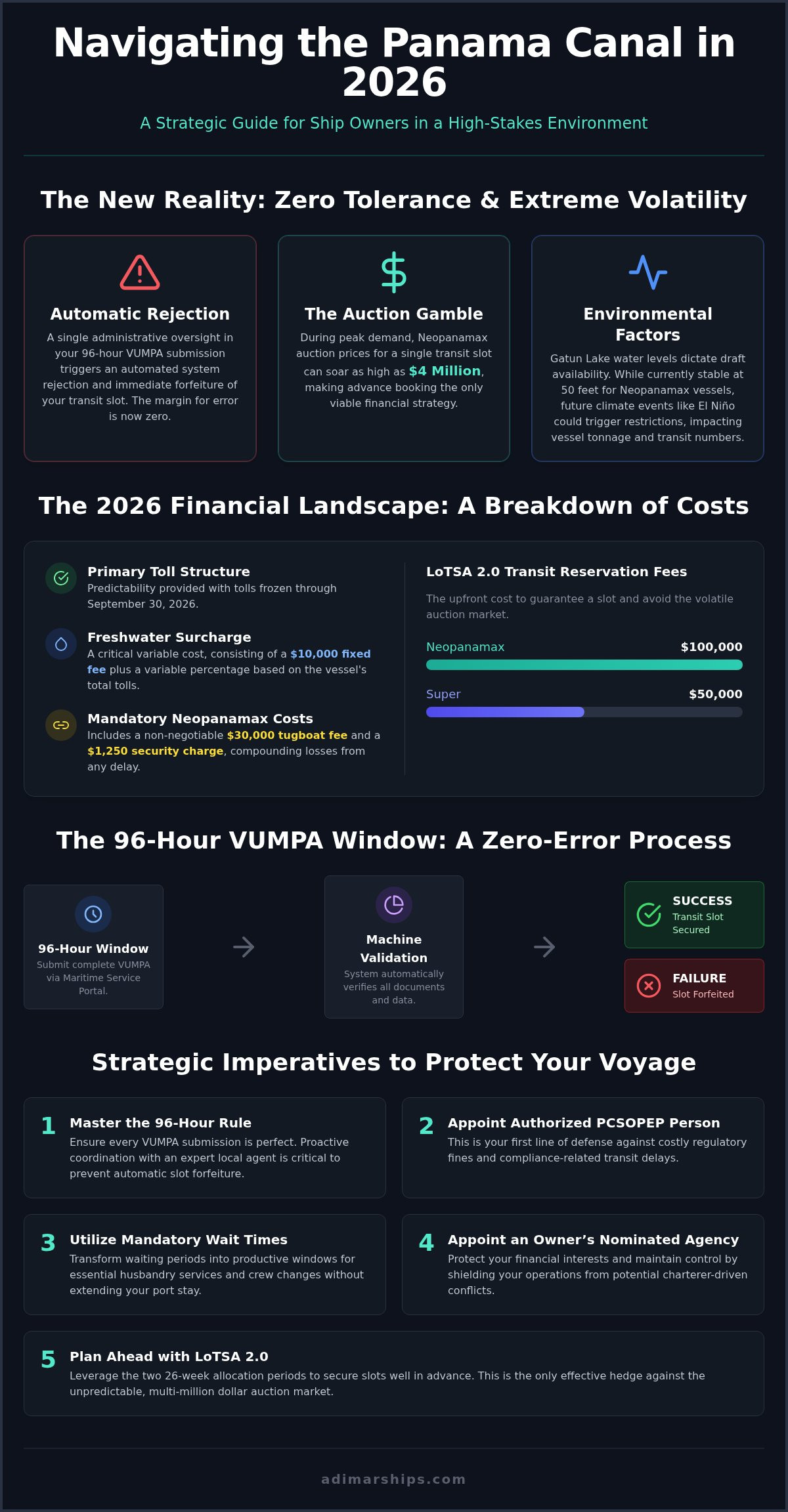
In 2026, a single administrative oversight in your 96-hour VUMPA submission doesn’t just cause a delay; it triggers an automatic rejection and the immediate forfeiture of your transit slot. With Neopanamax auction prices reaching as high as $4 million during peak demand, the margin for error has effectively vanished. Managing the Panama Canal transit process for ship owners now requires more than just paperwork. It demands a proactive hedge against a landscape defined by machine-validated compliance and the new LoTSA 2.0 reservation system.
We understand that the current environment, marked by a frozen toll structure but rising operational surcharges, feels like a constant balancing act between compliance and profitability. You need to ensure your vessel meets strict PCSOPEP requirements while shielding your interests from charterer-driven conflicts. This guide provides a strategic roadmap to master these complexities. You’ll learn how to optimize toll costs under the 2026 regulations, maintain zero-delay schedules through expert local representation, and protect your financial interests with dedicated husbandry services that act as your vigilant eyes and ears on the ground.
Key Takeaways
- Understand how the 2026 toll restructuring and Gatun Lake water levels directly impact your vessel’s transit costs and draft availability.
- Master the Panama Canal transit process for ship owners by navigating the 96-hour VUMPA submission window to avoid automatic slot forfeiture.
- Learn why appointing an authorized PCSOPEP person is your first line of defense against regulatory fines and transit delays.
- Discover how to transform mandatory wait times into productive windows for husbandry services and crew changes without extending your port stay.
- Identify the critical financial advantages of appointing an Owner’s Nominated Agency to protect your interests against charterer-driven conflicts.
The 2026 Panama Canal Landscape: Financial Stakes for Ship Owners
The 2026 maritime environment presents a unique duality for global shipping. On one hand, the Panama Canal Authority (ACP) has provided a degree of predictability by freezing the primary toll structure through September 30, 2026. On the other, the financial landscape is increasingly defined by variable surcharges and high-stakes auctions. For those managing the Panama Canal transit process for ship owners, understanding these nuances is no longer optional. It’s a fundamental requirement for protecting the bottom line. A “wait-and-see” approach in this climate is often a multi-thousand dollar mistake, as slot availability can vanish within hours of a geopolitical shift or a change in weather patterns.
Environmental factors remain the ultimate arbiter of capacity. While consistent rainfall has allowed for the restoration of the full 50-foot draft for Neopanamax vessels, the looming threat of an El Niño event in late 2026 keeps the industry on edge. For a deeper understanding of the waterway’s role, reviewing the history and overview of the Panama Canal reveals how Gatun Lake has always been the heartbeat of this passage. When lake levels fluctuate, the ACP must implement preventive water management measures that directly impact vessel tonnage and transit numbers.
The Economic Impact of New Toll Structures
The shift toward dynamic, capacity-based costs has changed how owners calculate their voyage expenses. While base tolls are stable, the Freshwater Surcharge remains a critical variable, consisting of a fixed $10,000 fee plus a variable percentage based on the vessel’s total tolls. Transit Reservation Fees in the 2026 context are the upfront costs required to guarantee a slot through the LoTSA 2.0 system, currently set at $100,000 for Neopanamax and $50,000 for Super vessels.
Neo-Panamax vessels face significantly higher entry barriers than standard Panamax ships. Beyond the reservation fee, Neopanamax owners must account for a mandatory $30,000 tugboat fee and a $1,250 security charge. These fixed costs mean that any delay in the Panama Canal transit process for ship owners results in a compounding financial loss that extends far beyond daily hire rates.
Operational Volatility and Risk Management
The ACP now manages daily transit slots through two 26-week allocation periods under the LoTSA 2.0 system. This structure offers transparency but punishes those who fail to plan. In a high-demand environment, the auction market becomes the only alternative for non-reserved vessels. We’ve seen auction prices soar to several million dollars during periods of high demand, making advance booking the only logical hedge against volatility.
A 24-hour delay at the locks creates a massive ripple effect. It’s not just the lost time; it’s the potential for missing follow-on port windows and the sudden accumulation of late-booking penalties. Proactive owners don’t just watch the clock. They secure their positions months in advance and rely on local expertise to navigate the machine-validated VUMPA requirements that can otherwise lead to immediate slot forfeiture.
A Step-by-Step Breakdown of the Panama Canal Transit Process
The Panama Canal transit process for ship owners is a sequence of high-precision events that begins long before the vessel reaches the breakwater. Success depends on a seamless transition between four distinct phases. According to the U.S. government overview of Panama’s market, the canal’s operational efficiency is central to the regional economy. This high-stakes environment leaves no room for administrative errors or equipment failures. Every minute of delay translates into significant financial loss, making a structured approach essential for every voyage.
Phase 1: Pre-Arrival and Slot Securing
Everything hinges on the 96-hour pre-arrival notification window. Owners must submit a complete Vessel Update and Movement Processing Application (VUMPA) through the Maritime Service Portal. In 2026, these submissions are machine-validated. If your package is incomplete, the system automatically rejects it, leading to the immediate forfeiture of your transit slot. Coordinating with an expert agent to verify vessel dimensions and visibility requirements is critical during this stage. Utilizing a specialized Panama Canal Transit booking strategy ensures that your vessel meets all ACP criteria before the clock starts ticking.
Phase 2: On-Site Inspection and Pilotage
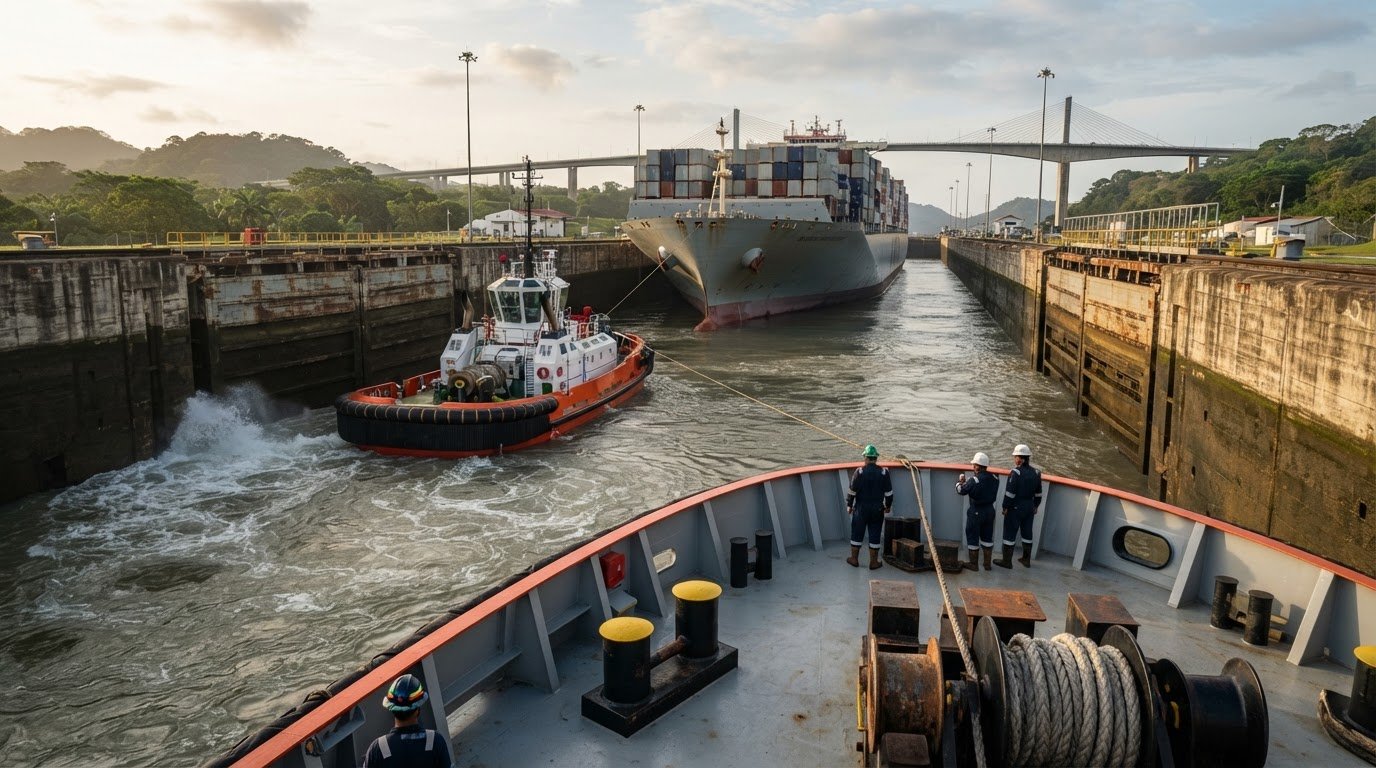
Upon arrival at the Cristobal or Balboa anchorage, the vessel undergoes a rigorous inspection by an ACP boarding officer. They verify that deck equipment, mooring lines, and chocks meet the 2026 ACP standards. Any deficiency discovered here can lead to a “not ready” status, resulting in heavy fines and delays. For Neopanamax vessels, this phase also involves coordinating mandatory tug assistance. The role of the Panama Canal pilot is absolute once they board. They take tactical command to guide the ship through the locks and the narrow confines of Culebra Cut. Ensuring your vessel is fully compliant before the officer steps on deck—often through independent audits by SeaFleet Backbone—is the best way to maintain your schedule.
Phase 3 involves the actual physical transit through the locks and Gatun Lake. This is a 10 to 12-hour operation where the ship rises 85 feet above sea level to cross the continental divide. Finally, Phase 4 covers the post-transit departure. Once the vessel clears the final set of locks, your agent handles the documentation clearance to ensure the ship can proceed to its next port without lingering administrative ties. To ensure every stage of the Panama Canal transit process for ship owners remains error-free, appointing a dedicated Owner’s Nominated Agency provides the local oversight needed to protect your interests.
Strategic Optimization: Tolls, Slots, and Husbandry Coordination
Managing the Panama Canal transit process for ship owners involves more than just securing a spot in the queue. It requires a tactical approach to every hour spent in Panamanian waters. Waiting at anchor is often viewed as a sunk cost, but strategic owners treat these periods as operational windows. By integrating essential services into the transit timeline, you can eliminate the need for separate port calls and reduce the overall financial impact of the voyage. Bundling these requirements under a single local representative ensures that no time is wasted once the vessel arrives at the breakwater.
Husbandry as a Cost-Saving Tool
The logistics of Bunkering in Panama during transit queues offer a significant advantage for operators looking to maximize efficiency. Instead of scheduling a dedicated stop that incurs additional pilotage and port fees, bunkering can often be performed at the Atlantic or Pacific anchorages while awaiting your transit slot. This overlap turns a mandatory wait into a productive maintenance window. Cash to Master (CTM) services are secured through a series of verified local protocols that ensure the safe and transparent delivery of funds directly to the vessel’s captain while at anchor.
Technical support and underwater inspections are also more cost-effective when performed during these windows. Utilizing Husbandry Services for hull cleanings or propeller polishing while in the queue can improve vessel performance for the remainder of the voyage. Coordinating crew changes and medical services without extending port stays requires precise timing. A proactive agent ensures that launches, transport, and immigration clearances are aligned perfectly with the vessel’s arrival, preventing any friction with the ACP’s strict transit schedule.
Slot Auction Strategy for Ship Owners
The Panama Canal transit process for ship owners frequently hits a crossroads at the auction stage. When slots are scarce, participating in ‘Condition 2’ or ‘Condition 3’ auctions becomes necessary for vessels without advance reservations. Condition 2 auctions typically occur when there are fewer than 31 slots available, while Condition 3 is triggered during periods of extreme high demand or reduced capacity. Analyzing the ROI of a last-minute slot purchase is essential; paying a premium for an auction slot is often more economical than the daily hire loss of a five-day wait.
A vigilant agent monitors the ‘Daily Transit Schedule’ around the clock to identify opening opportunities that others might miss. They act as your on-the-ground eyes, watching for slot cancellations or shifts in the LoTSA 2.0 allocation that could benefit your vessel. This proactive oversight allows owners to make data-driven decisions about whether to hold their position or bid for an earlier passage. Protecting your financial interest in these high-stakes moments requires a partner who understands the local auction dynamics and can execute a strategy that avoids the multi-million dollar pitfalls seen in recent peak seasons.
Compliance and Documentation: Mastering the 96-Hour Rule
Compliance in 2026 is no longer a matter of administrative preference; it’s a digital gatekeeper. The Panama Canal transit process for ship owners is now governed by machine-validated systems that leave zero room for manual correction once the clock starts. A single mismatched data point in your pre-arrival package can trigger an automatic rejection. This doesn’t just delay your voyage. It results in the immediate forfeiture of your transit reservation and can lead to significant financial penalties. Protecting your vessel requires a meticulous approach to every line of the Maritime Service Portal.
PCSOPEP and Environmental Compliance
The Panama Canal Shipboard Oil Pollution Emergency Plan (PCSOPEP) is a mandatory requirement for any vessel carrying 400 metric tons or more of persistent oil as cargo or fuel. This isn’t a mere formality. Violations often result in a minimum fine of $50,000 and an immediate loss of your transit slot. Your designated Authorized Person acts as your first line of defense. This individual must be a resident of Panama and serves as the primary liaison between the vessel and the Panama Canal Authority (ACP) in the event of an environmental incident.
Beyond oil pollution plans, managing waste disposal and sludge removal requires strict adherence to local port rules. The ACP has intensified its oversight of MARPOL compliance. Documentation for the discharge of ship-generated waste must be uploaded and verified before the vessel reaches the locks. Having an agent who understands these local nuances prevents the “not ready” status that plagues unprepared operators.
Digital Documentation Mastery
The 96-hour ‘Notice of Arrival’ (NOA) through the VUMPA system is the most critical document in the Panama Canal transit process for ship owners. This digital filing includes vessel dimensions, visibility calculations, and cargo manifests. In 2026, the ACP’s automated validation engine cross-references this data against historical records. Common errors, such as outdated safety certificates or incorrect draft declarations, are flagged instantly. These errors often stem from technical changes made to the vessel that weren’t updated in the ACP’s central database.
Adimar Shipping, Inc. acts as your digital intermediary to verify all portal entries before they’re submitted. We don’t just pass along forms. We audit every data point to ensure it aligns with current 2026 ACP protocols. This proactive verification eliminates the risk of automatic rejections and keeps your transit on schedule. To secure your voyage against documentation risks, contact Adimar Shipping, Inc. for expert agency representation and ensure your VUMPA submission is error-free.
Protecting the Owner’s Interest: The Adimar Advantage
When a vessel enters Panamanian waters, the ship owner and the charterer often have competing priorities. While both want a successful passage, their financial focus differs significantly. The Panama Canal transit process for ship owners involves managing long-term vessel integrity, crew welfare, and complex husbandry logistics that a charterer’s agent might not prioritize. Without dedicated representation, owners often find themselves navigating a maze of “standard” fees that lack transparency. Protecting your bottom line in 2026 requires more than just a coordinator; it requires a vigilant partner who acts as an extension of your own team.
Owner’s vs. Charterer’s Agency
A Charterer’s Nominated Agency is primarily focused on cargo efficiency and minimizing the specific port expenses that the charterer is responsible for. This often means that owner-centric needs, such as specialized technical support or urgent crew medical services, are treated as secondary concerns. Appointing an Owner’s Nominated Agency eliminates this conflict of interest. We ensure that every aspect of the vessel’s stay is managed with the owner’s financial health in mind.
Adimar Shipping, Inc. frequently serves as a Protective Agent (OPA) to audit the primary agent’s costs. We scrutinize proforma Disbursement Accounts (DAs) to ensure that every charge is legitimate and aligned with 2026 ACP tariffs. This level of financial transparency prevents the “hidden” surcharges that often accumulate during complex transits. By delegating this oversight to a local expert, you gain the peace of mind that your funds are being managed with the highest ethical standards.
The Adimar Commitment to Ship Owners
How Adimar Shipping, Inc. eliminates confusion is by providing a single point of accountability for every phase of the voyage. Our role as your local office means we are on the ground at the locks, observing the boarding officer inspections and pilot transfers in real time. We don’t just report delays; we work proactively to prevent them. Our 24/7 communication protocol ensures that the master and the owner’s office receive instant updates, especially during the critical VUMPA validation window. This constant vigilance is what separates a transactional agency from a strategic partnership.
The Panama Canal transit process for ship owners is a high-stakes maneuver where local knowledge is your best hedge against volatility. Adimar Shipping, Inc. leverages decades of experience to navigate the 2026 toll restructuring and slot auction dynamics on your behalf. We treat your vessel as our top priority, ensuring that your transit is seamless, compliant, and cost-optimized from arrival to departure. Secure your 2026 transit with Adimar Shipping, Inc. today and experience the advantage of truly dedicated representation.
Securing Your Vessel’s Competitive Edge in 2026
The 2026 maritime landscape requires a shift from reactive logistics to proactive strategy. Success now hinges on more than just securing a reserved slot; it requires mastering machine-validated VUMPA requirements and utilizing anchorage periods for high-efficiency husbandry coordination. By appointing a specialized Owner’s Nominated Agency, you ensure that your financial interests remain the primary focus, shielding your operations from the inherent conflicts often found in charterer-led representation.
Managing the Panama Canal transit process for ship owners is a high-stakes endeavor that leaves no room for administrative error. You need a partner who serves as your vigilant local office, providing the oversight necessary to navigate toll restructuring and PCSOPEP compliance with total confidence. Our local expertise in Panama City allows us to act as your eyes and ears on the ground, protecting your vessel from the moment it reaches the breakwater until it clears the final set of locks.
Take control of your voyage and eliminate the stress of regulatory volatility. Partner with Adimar Shipping, Inc. for a Seamless 2026 Transit and benefit from our authorized PCSOPEP person services and dedicated representation. We’re ready to ensure your next transit is your most efficient one yet.
Frequently Asked Questions
What are the primary changes in the 2026 Panama Canal toll structure?
The Panama Canal Authority has frozen the main toll structure until September 30, 2026, to provide industry stability. However, owners must still manage variable surcharges, such as the Freshwater Surcharge. This includes a fixed $10,000 fee plus a variable percentage based on the vessel’s total tolls. Neopanamax vessels also face a mandatory $30,000 tugboat fee and a $1,250 security charge per transit.
How far in advance should a ship owner book a Panama Canal transit slot?
Owners should secure slots as early as possible within the two 26-week allocation periods provided by the LoTSA 2.0 system. Booking months in advance is the only way to avoid the volatile auction market, where prices have recently reached several million dollars. While the 96-hour rule applies to documentation, the actual reservation should be part of your long-term voyage planning to ensure schedule reliability.
What is the role of a PCSOPEP Authorized Person during the transit process?
The Authorized Person serves as a resident liaison in Panama between the vessel and the ACP for oil pollution emergencies. This role is mandatory for any vessel carrying 400 metric tons or more of persistent oil. They’re responsible for coordinating with the ACP in the event of a spill. Having a designated expert ensures that your vessel remains compliant with strict environmental mandates and avoids heavy fines.
Can husbandry services be performed while the vessel is transiting the locks?
Husbandry services cannot be performed during the actual lockage process for safety and operational reasons. Instead, these tasks are optimized at the Atlantic or Pacific anchorages while the vessel awaits its transit window. This strategy allows for crew changes, bunkering, and spare parts delivery without extending the port stay. A proactive agent ensures these services are perfectly timed with your scheduled arrival at the breakwater.
What happens if a vessel fails the ACP boarding officer inspection?
The vessel is immediately declared “not ready,” which typically results in the forfeiture of the transit slot and significant fines. Owners must rectify all equipment or documentation deficiencies before requesting a re-inspection. This often leads to multi-day delays and the need to bid for a new slot at auction. Pre-arrival audits by your local agent are the best defense against these costly inspection failures.
How does an Owner’s Nominated Agency differ from a Charterer’s Agency?
An Owner’s Nominated Agency focuses exclusively on the ship owner’s interests, such as husbandry coordination and cost auditing. Charterer’s agents often prioritize cargo efficiency and may not give adequate attention to owner-specific requirements like crew welfare or technical support. Appointing your own agent provides a single point of accountability and ensures full financial transparency through the auditing of all proforma Disbursement Accounts.
What is the 96-hour rule for Panama Canal documentation?
The 96-hour rule requires the submission of a complete VUMPA pre-arrival package at least 96 hours before arriving at the Canal anchorage. This is a critical phase of the Panama Canal transit process for ship owners. In 2026, the ACP uses machine-validation for these entries. Incomplete or incorrect packages are automatically rejected, which leads to the immediate loss of your reserved transit slot and potential administrative penalties.
Are there specific environmental regulations for ships transiting the canal in 2026?
Vessels must adhere to strict PCSOPEP requirements and MARPOL waste disposal standards. The Panama Canal transit process for ship owners also involves monitoring Gatun Lake water levels, as environmental conditions can lead to preventive draft restrictions. In 2026, the ACP has intensified oversight of sludge removal and ship-generated waste. Every discharge must be documented and verified through the Maritime Service Portal before the vessel is cleared for transit.