

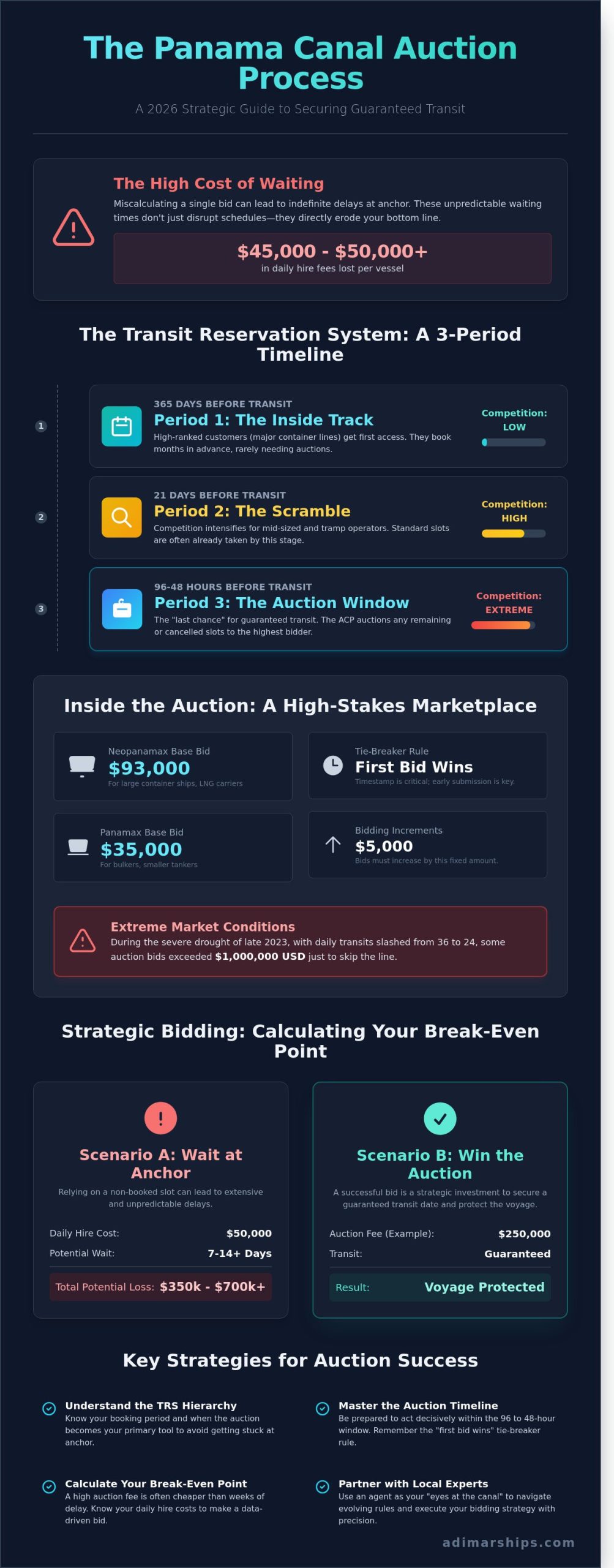
Miscalculating a single bid in the panama canal transit auction process can instantly inflate your voyage expenses by $45,000 in daily hire fees. You already know that timing is everything in maritime logistics; it’s frustrating to watch your schedule slip while your vessel idles at the entrance because of a misunderstood ACP bidding rule. We understand that these unpredictable waiting times don’t just disrupt your operations. They erode your bottom line and create unnecessary stress for your crew and stakeholders.
You don’t have to gamble with your fleet’s schedule. This 2026 strategic guide empowers you to master the complexities of the auction system so you can secure guaranteed transit dates and eliminate costly delays. We will walk you through the latest bidding tiers, professional documentation standards, and the specific strategies we use as your eyes at the Panama Canal to minimize your total voyage costs. This overview provides a clear roadmap to navigate the ACP system with the confidence of a seasoned expert.
Key Takeaways
- Understand how to navigate the hierarchy of the Transit Reservation System to secure the most advantageous booking window for your vessel.
- Master the panama canal transit auction process by understanding the critical timeline and bidding requirements set by the ACP.
- Learn to calculate “Daily Hire” savings to determine when a higher bid is a strategic investment that eliminates costly maritime delays.
- Identify the essential PCSOPEP and financial compliance steps required to integrate auction costs into your total Disbursement Account (D/A).
- Discover how a tactical partnership with local experts can eliminate confusion and provide the “eyes” needed to navigate evolving canal regulations.
Understanding the Panama Canal Transit Reservation System (TRS)
Managing a vessel’s schedule at the Panama Canal isn’t just about showing up and waiting your turn. It’s a high-stakes logistics game where timing is everything. The Transit Reservation System (TRS) creates a clear hierarchy; vessels with a confirmed booking move to the front of the line, while non-booked vessels wait at anchor. This wait can last anywhere from a few days to over two weeks during peak congestion. Since the completion of the Panama Canal expansion and booking system updates in 2016, the Autoridad del Canal de Panamá (ACP) has refined this process to handle larger Neopanamax vessels alongside the traditional Panamax fleet. We’ve seen how these changes transformed the panama canal transit auction process into a vital tool for operators who can’t afford to sit idle.
The ACP uses auctions to manage excess demand when the standard booking windows close. It’s a supply and demand solution. When slots are scarce, especially during seasonal peaks or maintenance periods, the price of a slot rises based on what the market is willing to pay. For many charterers, paying an auction fee is far cheaper than losing $50,000 USD per day in vessel operating costs while waiting at sea. We act as your eyes at the canal to ensure you don’t overpay while still securing your spot.
Booking Period 1 vs. Period 2: The Ranking Game
The ACP doesn’t treat every shipping line the same. They use a customer ranking system based on the total number of transits a company completes within a rolling 12-month window. High-ranked customers, typically the major container lines that transit weekly, get the first opportunity to book slots during Period 1, which opens 365 days before transit. These top-tier players rarely need to look at auctions because they’ve already secured their schedule months in advance.
Period 2 opens 21 days before the transit date. This is where the competition intensifies for mid-sized operators and tramp ship owners. If your ranking is low, you’ll likely find that all standard slots are already taken by the time your window opens. It’s a frustrating reality for new or low-frequency operators. Without a high ranking, the standard reservation system often feels like a closed door; this is exactly where the panama canal transit auction process becomes your most powerful alternative.
The 3rd Period: When the Auction Becomes Essential
Period 3 is the “last chance” window for guaranteed transit. It opens just 96 hours before the transit date. At this stage, the ACP gathers any remaining slots or cancellations and puts them up for grabs. These slots are divided between Panamax locks and the larger Neopanamax locks. During the severe drought of late 2023, daily transits were slashed from 36 to 24 vessels, making these Period 3 slots incredibly competitive. The Panama Canal Auction is a competitive bidding process for unreserved slots starting 48 to 96 hours before transit.
- Panamax Slots: Often used by dry bulkers and smaller tankers.
- Neopanamax Slots: Reserved for the massive container ships and LNG carriers that require the new locks.
- Special Auctions: Occasionally held when a slot becomes available due to a last-minute cancellation.
Bidding starts at a base price, often beginning around $15,000 USD to $55,000 USD depending on the vessel size, but final prices can skyrocket. In late 2023, we saw some auction bids exceed $1,000,000 USD just to skip the line. We help you calculate the “break-even” point so you don’t bid more than the delay is actually worth. It’s about protecting your bottom line while keeping your cargo moving with integrity.
How the Panama Canal Transit Auction Process Works
The panama canal transit auction process operates as a competitive marketplace for ship owners who missed the standard booking windows. It’s a high-stakes environment where timing and precision determine whether your vessel moves or remains anchored. The Panama Canal Authority (ACP) typically opens these auctions 96 hours before the intended transit date. For Neopanamax vessels, the base bid often starts at $93,000, while Panamax slots might begin at $35,000. These figures represent only the auction premium and don’t include standard transit tolls or maritime services.
Bidding occurs in fixed increments, usually $5,000 per jump. You’ve got to be prepared to move quickly because the competition is fierce. If two owners submit the exact same bid amount, the ACP awards the slot to the party that submitted their bid first. This timestamp-based tie-breaking rule makes early submission a strategic advantage, even in a blind format. Since the ACP implemented the revamped Panama Canal booking system, understanding these technical nuances is more critical than ever for fleet managers aiming for 2025 and 2026 schedules.
The Mechanics of Placing a Bid
All bids go through the ACP’s secure digital portal. It’s a “blind” auction, which means you can see how many other bidders are participating, but you can’t see their specific dollar amounts. This lack of transparency often leads to a frantic rush in the final minutes before the window closes at 09:00 local Panama time. We’ve seen auctions where the price jumps by $100,000 in the final sixty seconds. Success requires a clear ceiling price and a ship agent who can execute the entry without technical delays. If you’re feeling overwhelmed by the complexity, nominating an experienced agent can simplify the entire submission phase.
- Digital Portal: Access is restricted to registered maritime agencies using the Vessel Awareness System (VMS).
- Visibility: You only see the total number of active participants, not their financial limits.
- Deadline: Most auctions close exactly 48 hours before the transit date, leaving no room for late entries.
Post-Award Requirements and Deadlines
Winning the bid is only half the battle. Once the ACP awards the slot, the 48-hour rule goes into effect. Your vessel must arrive at the Canal waters (either Cristobal or Balboa) within 48 hours of the award, or you risk losing the slot and the money. The financial stakes are absolute; the full bid amount is due immediately. Your agent handles this through a direct guarantee or wire transfer to the ACP. There’s no “cooling-off” period in this process.
Fail to show up on time and you’ll face heavy penalties. The ACP can charge the full winning bid amount as a “no-show” fee, which can easily exceed $200,000 for Neopanamax slots. Beyond the financial loss, your vessel loses its priority status and goes back to the end of the queue. We act as your eyes at the Panama Canal to ensure your vessel meets every technical requirement before the auction even begins. This prevents a scenario where you win a slot but get rejected during the physical inspection for a minor equipment failure. Efficiency here isn’t just about speed; it’s about protecting your bottom line from avoidable fines.
Strategic Bidding: How to Win Without Overpaying
Winning a slot doesn’t require having the deepest pockets in the shipping industry. It requires cold, hard math. The panama canal transit auction process often feels like a high-stakes gamble for many owners, but data removes the guesswork. We start by analyzing the “Market Price” of a slot, which isn’t a fixed number. It’s a reflection of current congestion. If the backlog at the Gatun anchorage exceeds 20 vessels, prices will naturally climb. We look at the “Daily Hire” calculation to justify your bid. If your vessel costs $60,000 per day to operate and faces a six-day delay, you’re looking at a $360,000 loss. In this context, a $100,000 auction bid isn’t an expense; it’s a $260,000 saving for your bottom line.
Seasonal variations play a massive role in these calculations. During the severe drought of late 2023, we saw auction prices for Neopanamax slots hit record highs of $4 million. However, during periods of high water levels and 36 daily transits, those same slots often go for the base minimum. You should consult the Panama Canal Authority’s official 2026 transit reservation regulations to see how the ACP adjusts available slots based on projected rainfall and trade shifts. Understanding these tiers helps us predict when the “Quiet Days” will occur, typically midweek when competition from bulk carriers is historically 12 percent lower.
The biggest objection we hear is the fear of “unlimited” bidding wars. Owners worry they’ll get caught in the heat of the moment and overpay. We eliminate this risk by establishing a hard “Walk-Away” price before the auction opens. This price is based on your vessel’s specific bunker consumption, crew costs, and port deadlines. By treating the panama canal transit auction process as a financial hedge rather than a competition, you maintain control over your voyage expenses.
Panamax vs. Neopanamax Auction Dynamics
Neopanamax slots often command 5x the bid price of Panamax slots because they’re far more limited. Vessels with a beam over 107 feet are restricted to the newer Cocoli and Agua Clara locks, where the ACP typically offers fewer daily auction slots. We track vessel dimensions closely. A ship that’s just a few inches too wide for the older locks faces a much tighter bidding environment. We identify “Quiet Days,” such as the period immediately following major Chinese holidays, when Neopanamax demand often drops by 20 percent.
The Role of the Ship Agent in Strategic Bidding
At Adimar, we see ourselves as your local office and your eyes at the Canal. We monitor the “Waiting List” every hour to predict auction intensity. If the list grows by five ships in a single afternoon, we know the next day’s auction will be aggressive. Our role is to provide real-time communication during the bidding window. We give you the ground-level perspective that a computer screen in London or Tokyo can’t provide. We help you set a price that reflects the reality of the water, ensuring you don’t spend a dollar more than necessary to keep your schedule on track.
Financial and Regulatory Compliance for Auction Winners
Winning the bid is a major milestone, but the financial and regulatory clock starts ticking the moment the auction closes. We ensure the auction bid, which can range from $50,000 to over $1,000,000 during periods of high demand, integrates seamlessly into your total Disbursement Account (D/A). This integration is vital for accurate tax reporting and internal audits. We manage these high-value transfers with the speed required by the Panama Canal Authority (ACP), ensuring your funds are positioned correctly before the transit window opens.
You cannot participate in the panama canal transit auction process without a valid Panama Canal Shipboard Oil Pollution Emergency Plan (PCSOPEP). This is a mandatory requirement for vessels with a carrying capacity of 400 metric tons or more of oil, whether as fuel or cargo. We verify your vessel’s compliance status at least 96 hours before your arrival. If your PCSOPEP is expired or improperly filed, the ACP will disqualify your bid, leading to costly delays and potential fines. We serve as your local office, double-checking these details so you don’t have to worry about administrative oversights.
The role of the ‘Authorized Person’ (AP) is another non-negotiable factor. Per ACP regulations, every vessel must designate an AP who is a resident of Panama and available 24/7. This individual acts as the legal liaison between the ship and the ACP during emergencies. Compliance and bidding go hand-in-hand because the ACP requires proof of an active AP before a slot is finalized. We provide this link, acting as your eyes at the Panama Canal to ensure all legal communications are handled with total integrity.
It is a mistake to view the winning bid as the final price. Hidden costs often catch unprepared operators off guard. The auction fee only secures the time slot; it does not cover standard transit expenses. You must still account for:
- Tugage fees: Often exceeding $5,000 per tug depending on vessel size.
- Pilotage: Standard rates based on the vessel’s dimensions and draft.
- Admeasurement fees: Charges for calculating the Panama Canal Universal Measurement System (PC/UMS) tonnage.
- Security charges: Mandatory fees for canal protection and monitoring.
Payment Transparency and Integrity
Integrity is the foundation of our service. Managing high-value auction payments alongside Cash to Master (CTM) requests requires meticulous documentation. We provide clear, transparent financial reporting for every auction fee. Adimar ensures all ACP payments are documented with official receipts and verified against the latest tariff schedules. This prevents the confusion that often arises when large sums of money move quickly across international borders.
Avoiding Compliance Delays Post-Auction
If a vessel wins an auction but fails a physical inspection, the consequences are severe. The ACP may cancel the transit, and the winning bid amount is typically non-refundable. Our team works with your husbandry agent to prepare the crew for transit. We verify that the vessel meets all ACP safety standards, including pilot ladder configurations and mooring equipment. We don’t just hope for a smooth transit; we plan for it by identifying potential bottlenecks before the inspectors board.
Don’t let financial surprises or compliance errors ruin your schedule. Nominate Adimar as your agent to manage your Panama Canal auction with expert precision and integrity.
Why Adimar Shipping is Your Tactical Partner for Auction Success
Adimar Shipping has spent two decades mastering the panama canal transit auction process. Since the Neopanamax locks opened in June 2016, we’ve adapted to every shift in the Panama Canal Authority (ACP) reservation system. We don’t just watch the market; we interpret it for you. This expertise ensures you don’t overbid in a cooling market or miss out during peak congestion when slot prices can skyrocket.
We are experts so you don’t have to be. Our communication style is direct and transparent. We remove the guesswork from the auction cycle by providing real-time data on how many vessels are competing for your specific slot. Our team treats every transit as a unique project. We understand that a bulk carrier’s needs differ from a container ship’s schedule. By treating your vessel as our own, we ensure that every decision aligns with your commercial goals. We pride ourselves on being a service provider with integrity. This means we provide honest assessments of your chances in the auction, even if it means advising against a bid that doesn’t make financial sense for your bottom line.
Operating from our headquarters in Panama City, we manage the heavy lifting of logistics and compliance. We handle the 100% advance payment requirements in USD and the submission of all necessary EDCS (Electronic Data Collection System) documentation. This on-the-ground presence means we resolve issues with the ACP in minutes, not days. We are your local office at the Panama Canal, providing the quick solutions you need to stay on schedule. Whether it’s coordinating husbandry services or managing crew changes during the transit window, our local team ensures that your ship’s time in Panamanian waters is cost-conscious and efficient.
- 20+ Years of Expertise: We’ve navigated the evolving ACP rules through droughts, expansions, and record-breaking traffic years.
- Proactive Communication: We eliminate the “confusion” of the auction with clear, timely updates that respect your time.
- Ownership Mindset: We treat your transit with the same urgency and care as if it were our own vessel.
- Local Logistics: Our Panama City presence handles all documentation and payments to ensure zero administrative delays.
We Are Your Eyes at the Panama Canal
Our local office monitors traffic and auction trends 24/7. During the 2023 water level crisis, we helped clients navigate the drastic reduction in daily slots from 36 to 24. As a nominated agency, we protect the owner’s interests by ensuring every dollar of the auction bid is justified by current market data. We take the stress out of coordination so you can focus on your core business.
Get a Strategic Transit Quote Today
The first step is evaluating your vessel’s current position and ranking. We analyze historical auction data where Neopanamax slots have occasionally exceeded $1,000,000 in high-demand periods. This data helps us build a bid strategy that balances cost and urgency within the panama canal transit auction process. You can nominate Adimar as your trusted Panama Canal ship agent to gain this competitive edge. Request a customized transit strategy and quote from Adimar Shipping to secure your next passage with confidence.
Master Your 2026 Transit Strategy Today
Navigating the panama canal transit auction process requires more than just a high bid; it demands a deep understanding of the Transit Reservation System’s shifting tiers. Success in 2026 depends on your ability to balance aggressive bidding with strict regulatory compliance. Missing a single PCSOPEP filing or misinterpreting a slot opening can result in delays that cost your operation $10,000 or more in daily standing costs. You need a partner who understands the local Panama market and the nuances of the ACP regulations.
Adimar Shipping brings 20 years of experience to your bridge. We act as your eyes at the Canal, serving as a PCSOPEP Authorized Person and a trusted partner for international charterers worldwide. We manage the complex auction logistics and financial requirements so you don’t have to worry about the details. Our team ensures every document is perfect and every bid is strategic, protecting your bottom line from unnecessary overpayment. Let us handle the pressure of the auction while you maintain your focus on global trade.
Secure your transit slot with Adimar’s expert agency services and experience the peace of mind that comes with professional local representation. We’re here to ensure your vessel moves through the locks without a hitch.
Frequently Asked Questions
What is the starting bid for a Panama Canal transit auction?
The starting bid for a Panama Canal transit auction slot begins at $15,000 for Panamax vessels and $55,000 for Neopanamax vessels. These base prices are set by the Panama Canal Authority (ACP) and represent the minimum amount required to enter the bidding process. During peak congestion periods, such as the drought restrictions seen in late 2023, winning bids have frequently exceeded $1,000,000 for a single transit slot.
Can any vessel participate in the auction process?
Only vessels that are properly registered with the ACP and possess a valid ship identification number can participate. Your ship must meet all technical requirements, including an updated visibility certificate and a clean safety record. Ships with outstanding debts to the canal or those that don’t meet specific maneuverability standards are excluded from the panama canal transit auction process until they resolve those issues.
What happens if I win the auction but my ship is delayed arriving?
You’ll forfeit the entire bid amount and lose your assigned slot if your vessel doesn’t arrive at the canal’s designated waters by the specified deadline. The ACP maintains a strict arrival policy to ensure the schedule remains efficient for all users. Since these payments are non-refundable, it’s vital to coordinate closely with your agent to ensure your vessel’s ETA is realistic and accounts for potential weather delays.
How often does the Panama Canal Authority hold these auctions?
The ACP typically holds auctions every day for slots that become available within a 48 to 96-hour window. They also offer special “long-term” auctions for slots up to a year in advance for certain market segments. In 2024, the frequency of these sessions has been adjusted frequently to manage the daily transit capacity which currently sits at approximately 24 to 32 vessels per day.
Are auction fees refundable if the vessel cancels its transit?
Auction fees are strictly non-refundable once the ACP confirms you’re the winning bidder. This policy ensures that only serious operators participate and that slots don’t go to waste. If you cancel your transit, you lose the bid money plus any additional administrative fees. The only exceptions involve rare canal-wide closures or extreme operational changes initiated by the canal authorities themselves.
How does the ACP ranking system affect my ability to bid?
Your ACP customer ranking determines your eligibility for specific auction tiers and can provide a competitive edge in tie-break scenarios. This ranking is calculated based on your total number of transits and the tolls paid over the preceding 12-month period. High-ranking operators often receive priority access to certain slots, making it easier for established fleets to secure predictable transit times during busy seasons.
Do I need a local agent to place a bid on my behalf?
You’re required to use a licensed local ship agent to navigate the panama canal transit auction process and submit formal bids. The ACP doesn’t allow direct bidding from offshore offices because a local representative must guarantee the funds and manage the technical documentation. We act as your eyes at the Panama Canal, handling the heavy lifting and financial transfers so you don’t have to manage the 24-hour bidding cycle yourself.
What is the difference between a Panamax and Neopanamax auction slot?
The difference lies in the specific locks the vessel will use and the corresponding base bid price. Panamax slots are for the original locks and have a $15,000 starting price, while Neopanamax slots are for the larger expanded locks and start at $55,000. Because Neopanamax locks accommodate ships up to 1,200 feet long, these auctions are significantly more competitive and often draw much higher final bids from LNG and container ship operators.