
Did you know that in August 2026, a single vessel paid approximately $4 million at auction just to secure a transit slot through the Panama Canal? The financial stakes of a crossing have never been higher, especially as the ACP implements tighter Neopanamax draft restrictions and manages a predicted 81% probability of a severe El Niño event. We understand that coordinating crew, spares, and documentation amidst these shifting variables is incredibly stressful. Using a comprehensive Panama Canal transit checklist is no longer just a best practice; it’s a necessity for avoiding the $15,000 minimum fine for PCSOPEP non-compliance or the sudden loss of a primary transit slot.
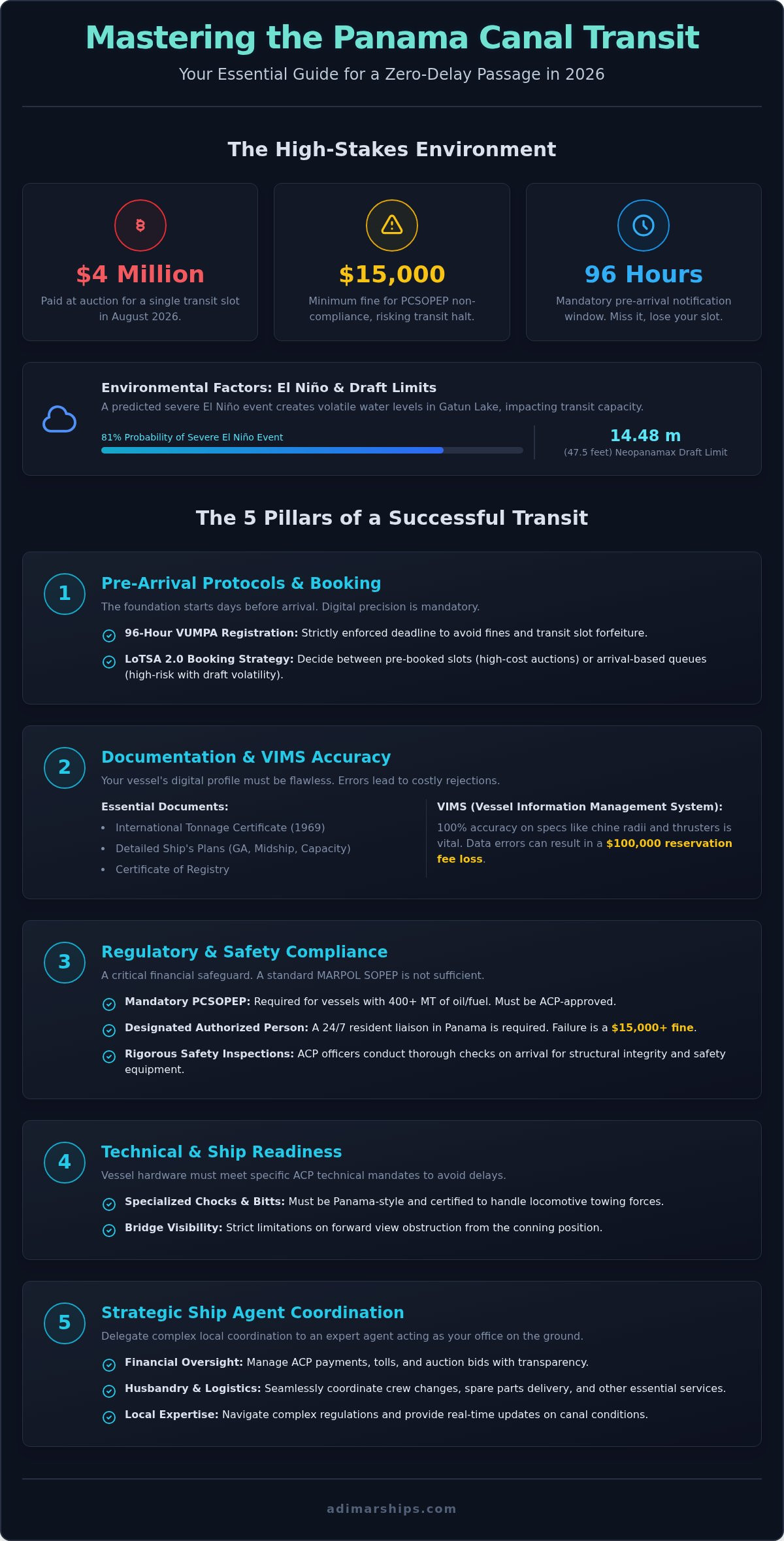
You deserve a passage that’s defined by precision rather than panic. We’ve developed this guide to help you master every logistical and regulatory requirement for a seamless 2026 transit. By following our expert-verified steps, you can ensure zero-delay transit and full compliance with the latest 96-hour VUMPA submission deadlines. We will preview the critical updates to the LoTSA 2.0 booking system, detail the mandatory husbandry coordination, and provide the technical oversight you need to act as your local office on the ground in Panama.
Key Takeaways
- Navigate the mandatory 96-hour pre-arrival notification window and VUMPA registration to prevent transit slot loss or administrative fines.
- Secure mandatory compliance by designating a resident Authorized Person and verifying that your PCSOPEP meets specific ACP standards.
- Audit vessel hardware against technical mandates, including bridge visibility limitations and the requirement for specialized Panama-style chocks and bitts.
- Use our comprehensive Panama Canal transit checklist to master the logistical coordination of husbandry services like crew changes and spare parts delivery.
- Delegate complex coordination to a specialized ship agent who acts as your local office, managing financial oversight and ACP payments with transparency.
Pre-Arrival Protocols: Documentation and Booking Systems
The foundation of a successful crossing starts days before your vessel reaches the breakwater. Your Panama Canal transit checklist must prioritize the 96-hour pre-arrival notification window. The ACP strictly enforces this timeline through the VUMPA (Ventanilla Única Marítima de Panamá) system. Missing this deadline doesn’t just result in administrative fines; it can lead to the immediate forfeiture of your hard-won transit slot. For a comprehensive Panama Canal overview of operational standards, it’s clear that the ACP relies on digital precision to manage its 14,000 annual transits.
You must ensure all essential documents are uploaded and verified well in advance. Any discrepancy between your physical vessel and the digital records will cause immediate delays during the mandatory admeasurement process. We recommend verifying the following documents:
- International Tonnage Certificate (1969): This is the primary document used for toll calculations.
- Detailed Ship’s Plans: Specifically the general arrangement, midship section, and capacity plan.
- Certificate of Registry: Verifying current vessel ownership and flag state status.
The ACP Booking Window: Timing Your Entry
In 2026, the ACP transitioned to the LoTSA 2.0 reservation system. This update requires ship operators to be more strategic than ever. You have two primary options: securing a pre-booked slot or joining the arrival-based queue. While arrival-based queuing is often more flexible, the 81% probability of a severe El Niño event in late 2026 means water levels in Gatun Lake are volatile. This volatility often leads to sudden draft reductions, currently capped at 14.48 meters (47.5 feet) for Neopanamax vessels. We act as your local eyes on the ground, constantly monitoring the canal schedule to help you decide when to bid in the high-stakes slot auctions, where prices have recently reached $4 million for a single crossing.
Vessel Information Management System (VIMS)
Precision in your vessel’s electronic profile is non-negotiable. VIMS is the central repository the ACP uses to calculate tolls and assign pilots. Common data entry errors, such as incorrect chine radii or bow thruster specifications, can lead to transit rejections. It’s vital to update these dimensions specifically for the transit type. Neopanamax vessels face much stricter draft management than standard Panamax ships. By delegating this technical data entry to us, you eliminate the confusion that often plagues international owners. We ensure your VIMS profile is 100% accurate, protecting you from the $100,000 reservation fee losses associated with data-driven cancellations.
Regulatory Compliance: PCSOPEP and Safety Mandates
Compliance in the Panama Canal is more than a paperwork exercise; it’s a critical financial safeguard. For any vessel carrying 400 metric tons or more of fuel or oil, the Panama Canal Shipboard Oil Pollution Emergency Plan (PCSOPEP) is mandatory. It’s a common mistake to assume a standard MARPOL SOPEP is sufficient. It isn’t. Your Panama Canal transit checklist must verify that a specific PCSOPEP is approved by the ACP and that a resident “Authorized Person” is designated to act as a 24/7 liaison. Failing this requirement triggers an immediate minimum fine of $15,000 and can halt your transit entirely.
PCSOPEP: Protecting Your Interests in Panama
The ACP requires that every vessel needing a PCSOPEP appoints a local representative who can coordinate with authorities during an emergency. This PCSOPEP authorized person must be available around the clock. Beyond the plan itself, the ACP has increased its environmental ESG focus in 2026, leading to more frequent, unannounced drills to verify spill response capabilities. You’ll need to submit your plan for approval well before arrival. We handle the technical delegation of these tasks, ensuring your plan aligns with the latest Official Vessel Requirements to avoid costly administrative delays.
Safety and Security Inspections
Upon arrival, ACP boarding officers conduct a rigorous initial inspection. They focus on structural integrity and safety equipment. Common deficiencies that stall transits include poorly maintained pilot ladders, malfunctioning navigation lights, or inaccurate bridge visibility calculations. Security is equally paramount. Under the ISPS Code, vessels must comply with the port facility security code and pay a standard $1,250 vessel security charge. Our team acts as a vigilant protector on-site, pre-screening your vessel’s readiness to ensure a smooth inspection process. If you have concerns about your vessel’s specific configuration, our ship agency services provide the local expertise needed to resolve issues before the pilot boards.
Environmental compliance extends to local waste disposal and MARPOL standards. The ACP enforces strict “zero discharge” rules within canal waters. This includes sewage and gray water management. Finally, maintaining high ethical standards is a core brand promise for us. We ensure all interactions with local authorities are transparent and fully compliant with anti-corruption regulations. This ethical framework protects your reputation and ensures that your transit costs remain predictable and fair, without the risk of hidden “facilitation” expenses often found in less regulated zones.
Technical Ship Readiness: Equipment and Visibility Standards
Technical failure during transit is more than an inconvenience; it’s a high-cost operational risk. Your Panama Canal transit checklist must include a rigorous audit of the vessel’s physical hardware. If a winch fails or a chock shears during lockage, the ACP will immediately suspend the transit. This leads to massive surcharges and the potential loss of your slot. We act as your vigilant eyes on the ground, ensuring every technical detail meets the ACP’s stringent 2026 standards before the pilot boards.
Mooring and Lockage Equipment
The ACP distinguishes between the Panamax locks and the Neopanamax locks. Panamax transits rely on locomotives, known as mules, which require specific mooring configurations. Neopanamax vessels utilize tug-assisted transits. These transits include a mandatory $30,000 tugboat charge. You must verify that your vessel is equipped with “Panama-style” chocks and bitts. These fittings are designed to handle the extreme lateral and vertical tensions encountered within the lock chambers. Beyond the hardware, ensure your deck crew maintains clear, unobstructed space. ACP line handlers require safe passage to secure lines quickly; any clutter can lead to a safety-related delay.
Winches and lines must meet specific capacity ratings updated for 2026. We recommend a full load test of all mooring equipment as part of your pre-arrival protocol. If equipment is found to be substandard during the initial inspection, the vessel may be required to undergo repairs at the anchorage, causing you to miss your scheduled window.
Navigation and Communication Tools
Pilots require an unobstructed view of the water from the bridge. Blind sector limitations are strictly enforced. If cargo or ship structures block more than the authorized visibility range, the ACP may mandate an additional pilot or tug assistance at the owner’s expense. Pilot ladder safety is another high-priority area. Boarding stations must meet specific height and lighting requirements to ensure the pilot’s safety during the transition from the launch.
Your AIS must be fully operational for real-time tracking throughout the channel. We also suggest testing all VHF radio channels and internal communication systems between the bridge and the engine room. Propulsion and steering gear must be tested and logged within 48 hours of arrival. These tests aren’t just a formality; they’re your insurance against a catastrophic steering failure in the narrowest sections of the Culebra Cut. By delegating these technical checks to a seasoned agent, you gain the peace of mind that your vessel is truly ready for the demands of the canal.
Logistics and Husbandry: The ‘Human’ Side of Transit
Technical readiness is vital, but the human element often dictates the efficiency of a canal stop. Your Panama Canal transit checklist must account for the complex logistics of crew and cargo that occur while the vessel is at anchor. Coordinating these services in Panama is a high-stakes balancing act between the Pacific and Atlantic terminals. You’re dealing with different port authorities, immigration offices, and launch providers across the Panama City and Colon divide. We act as your local office to bridge this gap, ensuring that your “human” logistics are as streamlined as your technical compliance.
Navigating Crew Changes in Panama
Panama is a premier hub for crew rotations, yet it remains one of the most administratively demanding parts of a transit. On-signers and off-signers require precise visa coordination and immigration clearance before they land at Tocumen International Airport. We manage these husbandry services by synchronizing secure transport and launch services with your vessel’s specific arrival window. If a seafarer requires medical attention, we provide immediate access to specialized clinics in Panama City, ensuring that health issues don’t lead to costly transit delays.
Spares and Provisions Logistics
Moving spare parts into Panama requires a sophisticated understanding of local customs. To avoid local taxes, items must be correctly declared as “ship spares in transit.” Timing is the most critical variable here. If spares arrive too late, you risk losing your transit slot; if they arrive too early, you face mounting storage fees. We coordinate these deliveries to hit the vessel during its anchorage window at either Balboa or Cristobal. This precision prevents the logistical stress of coordinating multiple vendors in a foreign port.
Fresh water and high-quality provisions are essential, especially if your vessel faces extended wait times due to the predicted 2026 El Niño water level management. We also handle Cash to Master (CTM) deliveries with the highest security and ethical standards, protecting you from the confusion of local banking nuances. You deserve the operational freedom that comes from delegating these tasks to a trusted partner. If you’re planning a 2026 crossing, contact us to see how our Ship Agency Services can simplify your husbandry needs and protect your bottom line.
The Strategic Role of a Panama Canal Ship Agent
A comprehensive Panama Canal transit checklist is only as effective as the team executing it. The canal isn’t a static waterway; it’s a dynamic environment where regulations change with the tide and water levels. A specialized ship agent serves as the central nervous system for your entire operation. We eliminate confusion by acting as the single point of contact for the ACP, port authorities, and third-party vendors. This coordination ensures that every technical and logistical requirement we’ve discussed is met with surgical precision. You’re not just hiring a service provider; you’re securing a partner who understands the high stakes of your schedule.
Financial oversight is one of the most critical services we provide. We manage your Proforma Disbursement Accounts (PDA) with absolute transparency. This includes handling large-scale ACP payments for tolls and reservation fees. Without a vigilant partner, owners often face unexpected “no-show” fines for tugs or pilots when timing goes awry. We protect your interests as your owner’s nominated agency, ensuring you aren’t overcharged for services you didn’t receive. Our goal is to provide the financial predictability you need to manage your fleet’s bottom line.
Why Personalized Service Outperforms Global Aggregators
Large global aggregators often prioritize volume over vigilance. They lack the on-the-ground presence to spot a pilot ladder issue or a VUMPA data error before it’s too late. Our ship agency Panama services focus on deep local expertise and personalized attention. We provide 24/7 monitoring of canal conditions, allowing us to respond rapidly to any shift in ACP requirements. This personalized approach saves you from the cascading costs of a missed slot. When a problem arises at 02:00 in the Culebra Cut, you need an agent who is already on-site to resolve it.
Managing the Financial Risks of Transit
Precision in pilot and tug orders is the difference between a profitable transit and a financial loss. We coordinate these orders to align perfectly with your vessel’s actual arrival time. This vigilance prevents the steep penalties associated with operational delays. You gain peace of mind knowing your finances and vessel are in expert hands. We act as an extension of your own team, providing the operational freedom you need to focus on your next port of call. Nominate Adimar Shipping as your trusted Panama Canal agent today.
Master Your 2026 Transit with Precision and Confidence
Success in the Panama Canal depends on technical accuracy and proactive local coordination. We have detailed the digital requirements of VUMPA, the strict technical standards for Neopanamax lockage, and the complex human logistics of husbandry. Utilizing a detailed Panama Canal transit checklist ensures your vessel avoids $15,000 non-compliance fines and the logistical stress of the Pacific and Atlantic divide. You deserve the operational freedom that comes from delegating these high-stakes tasks to a partner you can trust.
As an Authorized PCSOPEP Person with 20+ years of maritime expertise, we provide the personalized, cost-conscious coordination you need to navigate these waters. We act as your vigilant eyes on the ground, eliminating confusion and protecting your financial interests during every step of the journey. Secure your 2026 transit with Adimar Shipping; your expert Panama Canal ships agent. We look forward to ensuring your next passage is seamless, efficient, and secure.
Frequently Asked Questions
What is the most common reason for Panama Canal transit delays?
Documentation errors and technical deficiencies are the primary causes of transit delays. Missing the 96-hour pre-arrival notification window or providing inaccurate vessel dimensions in the VIMS profile often leads to immediate slot forfeiture. Additionally, mechanical failures in steering or propulsion systems during the initial ACP inspection can halt a passage before it begins. Using a professional Panama Canal transit checklist helps identify these risks early, allowing owners to resolve issues before the pilot boards.
How far in advance should I book a Panama Canal transit slot?
You should ideally secure a booking slot as soon as your vessel’s schedule is confirmed, as the ACP allows reservations up to 365 days in advance. In 2026, the LoTSA 2.0 system manages tiered booking periods. High demand and water level volatility mean that many operators now rely on slot auctions closer to their arrival date. We monitor these auctions in real-time to help you navigate the competitive bidding process and avoid long queues at the anchorage.
Is a local ship agent legally required for Panama Canal transit?
Yes, a local ship agent is legally required for all commercial vessels transiting the canal. The ACP mandates that every ship has a resident representative to handle official communications, documentation, and payment of tolls and fees. Beyond the legal requirement, an agent acts as your local office, coordinating essential husbandry services and ensuring technical requirements are met. This partnership protects your interests and prevents the confusion that arises from managing complex local regulations from abroad.
What are the PCSOPEP requirements for vessels transiting the canal?
Any vessel with a fuel or oil carrying capacity of 400 metric tons or more must have an ACP-approved Panama Canal Shipboard Oil Pollution Emergency Plan (PCSOPEP). A standard MARPOL SOPEP is not a substitute. You must also designate a Panama-resident Authorized Person who is available 24/7 to coordinate with the ACP during an emergency. Non-compliance with these specific pollution prevention mandates results in a minimum fine of $15,000 and can lead to significant transit delays.
Can I perform a crew change during the Panama Canal transit?
Crew changes are permitted and are most efficiently performed while the vessel is at the Pacific or Atlantic anchorages. Coordinating these rotations requires precise timing with immigration authorities and launch service providers. Our husbandry services manage the entire process, from securing necessary visas to arranging safe transport from Tocumen International Airport. We ensure that on-signers and off-signers are processed smoothly so that the vessel’s transit schedule remains unaffected by personnel logistics.
What happens if my vessel fails the ACP safety inspection?
If a vessel fails the initial safety inspection, the ACP boarding officer will require that the deficiencies be corrected before transit begins. This often means the vessel must remain at the anchorage for repairs, which can lead to the loss of a pre-booked slot and the payment of additional reservation fees. Common failures include pilot ladder issues or bridge visibility obstructions. We pre-screen vessels to identify these vulnerabilities, helping you avoid the financial impact of a failed inspection.
How are Panama Canal transit fees calculated in 2026?
Transit fees in 2026 are calculated based on a vessel’s total tonnage, transit type, and specific surcharges. The total cost includes:
- A fixed Fresh Water Surcharge of $10,000 for vessels over 300 feet plus a variable fee based on lake levels.
- A mandatory vessel security charge of $1,250.
- Tugboat charges, which are $30,000 for Neopanamax vessels.
- LoTSA 2.0 reservation fees, which vary by booking tier.
We provide detailed Proforma Disbursement Accounts to ensure full financial transparency.
What is the difference between a Panamax and Neopanamax transit checklist?
The primary difference lies in the lock technology and technical specifications. A Panamax checklist focuses on locomotive (mule) mooring configurations and standard lock dimensions. In contrast, a Neopanamax transit checklist prioritizes tug-assisted maneuvers and stricter draft management. As of late 2026, Neopanamax vessels face a maximum authorized draft of 14.48 meters (47.5 feet). These larger ships also require different bridge visibility standards and specialized mooring hardware to handle the scale of the newer locks.