
In the world of maritime logistics, time is money-and nowhere is this truer than at the Panama Canal. Planning a voyage for 2026 can feel like navigating a maze of complex tolls, potential surcharges, and the ever-present risk of costly delays. A simple online calculator might give you a number, but does it provide real confidence in your budget? The fear of unexpected fees and the financial risk of a miscalculation are significant concerns for any ship owner or charterer.
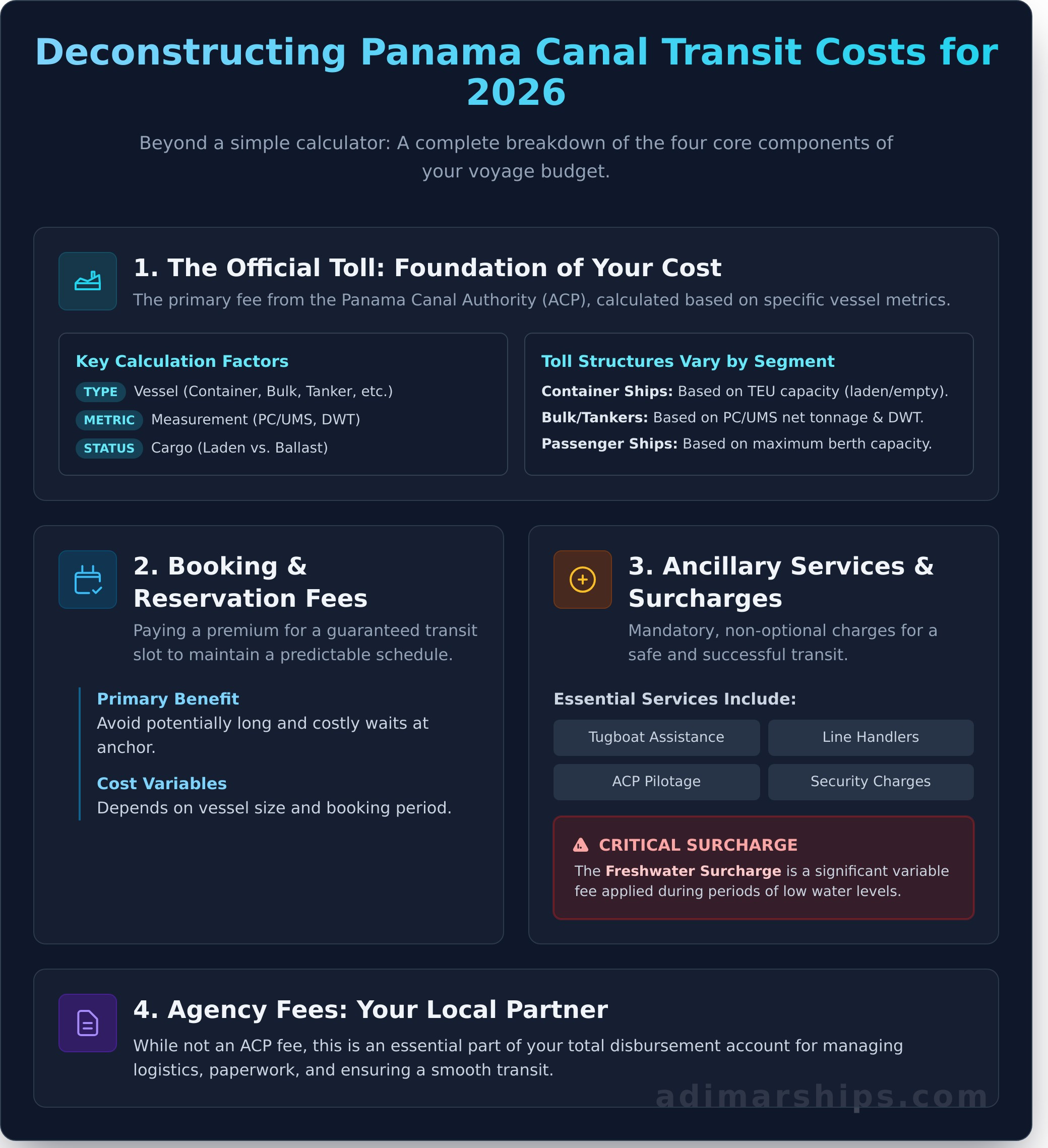
That’s why we’ve created more than just a panama canal transit cost calculator 2026; we’ve developed a complete guide to budgeting your voyage with integrity and precision. This guide moves beyond basic toll estimates. We will break down every potential cost, from booking charges and security fees to the variable surcharges that can impact your final invoice. You will gain a clear understanding of the entire financial picture, empowering you to create a reliable budget, avoid expensive surprises, and plan your 2026 transit with the assurance that comes from true expert insight.
Why a Simple ‘Calculator’ Isn’t Enough: The Core Components of Transit Costs
When planning for a crossing, many ship owners and charterers search for a panama canal transit cost calculator 2026 expecting a single, straightforward number. While these tools provide a valuable baseline, the final invoice from the Panama Canal Authority (ACP) is far more detailed. Misjudging the total cost can lead to significant financial and operational challenges. Understanding the history and significance of the Panama Canal helps explain why its fee structure is designed with such precision to manage this vital global waterway.
Think of the official toll as your ‘ticket price.’ It’s the largest and most predictable component. However, just like an airline ticket, the final cost includes mandatory fees, taxes, and optional services. To budget accurately, you must account for four distinct categories: Tolls, Booking Fees, Ancillary Charges, and your local Agency Fees.
The Official Toll: The Foundation of Your Cost
This is the primary fee charged by the ACP and the foundation of your transit expenses. The toll is not a flat rate; it’s a complex calculation based on specific vessel metrics. Key factors include the vessel type (e.g., container ship, LNG carrier, bulk carrier), its measurement system (PC/UMS), and its cargo status-whether it is laden (carrying cargo) or in ballast (empty). Most online calculators focus exclusively on estimating this foundational toll.
Booking & Reservation Fees: Paying for a Guaranteed Slot
In the world of shipping, time is money. The Panama Canal’s Transit Reservation System allows vessels to book a specific transit date, securing a place in the queue and avoiding potentially long and costly waits at anchor. This booking fee is essential for maintaining a predictable schedule. The cost varies depending on the vessel’s size and the specific booking period, making it a critical variable in any accurate panama canal transit cost calculator 2026 projection.
Ancillary Services & Surcharges: The Necessary Extras
A safe transit requires a suite of mandatory services, and these are billed as ancillary charges. These are not optional add-ons; they are integral to the operation. This category includes essential support such as:
- Tugboat assistance for maneuvering in the locks
- Line handlers on board
- ACP pilotage fees
- Vessel security charges
Furthermore, this category includes variable surcharges that can impact your final cost, such as the critical Freshwater Surcharge, which is applied during periods of low water levels in the canal’s watershed.
Deconstructing the Panama Canal Toll Structure for 2026
Understanding the Panama Canal’s toll system is the first step toward accurate budget forecasting. It is not a one-size-fits-all fee; rather, it is a highly segmented and complex structure that requires expert navigation. While major structural changes are not anticipated for 2026, proactive planning remains essential for cost-conscious and efficient transits. Any reliable panama canal transit cost calculator 2026 must be built on this foundation.
The core of most calculations is the Panama Canal Universal Measurement System (PC/UMS), which measures a vessel’s total volume. However, how this metric is applied differs significantly depending on the vessel type and which locks it uses-the original Panamax locks or the larger Neopanamax locks. The Panama Canal Authority maintains a detailed official Panama Canal toll structure that outlines these segment-specific rates, which we simplify below.
Tolls for Container Ships: The TEU-Based Model
For container vessels, tolls are primarily driven by their total Twenty-foot Equivalent Unit (TEU) capacity. The pricing model is tiered, applying different rates based on the vessel’s size. A crucial distinction is made between laden (full) and empty containers, with laden TEUs charged at a significantly higher rate. To encourage consistent traffic, the Canal also offers a loyalty program that provides premium pricing for frequent container lines that meet specific volume commitments.
Tolls for Bulk Carriers, Tankers, and Gas Carriers
Vessels carrying dry bulk, liquid bulk (tankers), and gas are assessed differently. Their tolls are calculated based on the vessel’s PC/UMS net tonnage, with distinct rates applied for the Panamax and Neopanamax locks. In some cases, the vessel’s Deadweight Tonnage (DWT) is also factored into the final cost. Specialized vessels like Liquefied Natural Gas (LNG) and Liquefied Petroleum Gas (LPG) carriers have their own unique toll structures, reflecting their specific market dynamics and vessel designs.
Special Tolls: Passenger Ships and Other Vessels
The toll system adapts for non-cargo vessels as well. Passenger ships, for instance, are charged based on their maximum berth capacity, essentially a per-person rate. Other vessel categories, such as car carriers (Ro-Ro), dredgers, and yachts, each have unique assessment methods tailored to their specific measurements and purpose. This reinforces a critical point: every transit calculation is unique, requiring a precise understanding of the vessel’s specific segment and certified measurements.
Beyond the Tolls: Ancillary and Variable Costs You Must Budget For in 2026
A vessel’s Panama Canal toll is only the starting point of your total transit expenses. To create a truly accurate budget and avoid costly surprises, you must account for a range of ancillary and variable fees. These non-negotiable charges, set by the Panama Canal Authority (ACP), can significantly increase your final bill. Misjudging these costs is a common and expensive mistake. Any reliable panama canal transit cost calculator 2026 must factor in these additional charges for a realistic financial forecast.
Understanding these costs is crucial for effective voyage planning. The ACP’s fee structure is dynamic and reflects operational needs and environmental conditions, a complexity explored in depth by the International Monetary Fund’s economic analysis of the Panama Canal’s expansion. As your trusted partner at the Canal, we ensure these variables are transparently included in your proforma disbursement account.
The Freshwater Surcharge: A Critical New Cost Factor
In recent years, the Freshwater Surcharge has become one of the most significant variable costs. Implemented to manage the water levels of Gatun Lake, the Canal’s primary water source, this fee fluctuates based on the lake’s operational level. The surcharge is applied per transit and can change with little notice, making it essential to monitor ACP advisories. This charge underscores the direct link between climate conditions and transit costs.
Mandatory Services: Tugboats, Line Handlers, and Pilots
Every transit requires a standard set of services, each with its own associated fee. These are not optional extras but integral components of a safe passage:
- Tugboat Assistance: The cost varies based on your vessel’s size (PC/UMS) and specific transit requirements. Larger vessels or those with unique handling characteristics may require additional tugs at a higher cost.
- Line Handlers & Mooring: A fixed fee is charged for the specialized personnel who manage the vessel’s mooring lines within the lock chambers.
- Pilotage: An experienced Panama Canal pilot is required to be on board for the entire transit, and this service is included in the standard fee schedule.
Other Potential Charges: Inspections, Delays, and Security
Finally, several other charges may apply depending on your vessel’s status and transit circumstances. These include the ISPS (security) charge applied to all vessels for compliance with international security protocols, potential fees for admeasurement if your vessel is transiting for the first time, and costs associated with unforeseen delays or extra anchorage time. Meticulous planning with an experienced agent helps minimize these unexpected expenses.
Strategic Planning: How Your Choices Impact the Final Bill
While a panama canal transit cost calculator 2026 provides an excellent baseline for tolls and fixed fees, the final invoice is heavily influenced by operational decisions. The most significant cost savings are found not in the tolls themselves, but in meticulous, forward-thinking planning. In the high-stakes environment of the Canal, misjudging your timing doesn’t just cause delays-it creates substantial and avoidable expenses. This is where an agent’s expertise transforms from a service into a critical financial tool.
The Transit Reservation System: Booking vs. Arriving Unannounced
Arriving without a reservation means waiting for an opening, which can take days or even weeks depending on traffic. While this avoids a booking fee, the daily costs of fuel, crew, and potential demurrage charges quickly eclipse any initial savings. Securing a booked slot through the Transit Reservation System provides certainty and minimizes idle time. The Panama Canal Authority (ACP) offers different booking periods, each with its own fee structure, allowing for flexibility based on your vessel’s schedule. Remember the cardinal rule of shipping: time is money.
The High Cost of Auction Slots
For operators who need a last-minute slot or must transit during a period of peak demand, the ACP offers a limited number of slots via auction. While this system provides an opportunity for passage, the price is dictated by demand and can be astronomical, often reaching hundreds of thousands of dollars on top of standard transit costs. Viewing the auction as anything other than a last resort for emergencies is a costly strategic error that proactive planning can almost always prevent.
Avoiding Penalties: The Price of Inefficiency
The ACP enforces strict rules to maintain the Canal’s efficiency, and non-compliance comes with a hefty price tag. Poor coordination can lead to significant financial penalties that a simple cost calculator won’t predict. Common fines include:
- Cancellation Fees: Charged for cancelling a booked slot outside the permitted timeframe.
- Late Arrival Penalties: Imposed if your vessel is not ready at the scheduled time, disrupting the convoy.
- Compliance Fines: Levied for issues like inadequate vessel condition, incorrect paperwork, or safety violations.
Navigating these complex requirements is our specialty. Let us handle the details to ensure a smooth, penalty-free transit.
How a Trusted Ship Agent Creates Your True Cost Calculation
While online tools can provide a baseline, they cannot account for the dynamic, on-the-ground variables of a Panama Canal transit. When you need a true panama canal transit cost calculator 2026, a trusted ship agent becomes indispensable. We transform a complex list of potential fees, booking nuances, and operational requirements into a clear, actionable budget, ensuring there are no costly surprises.
The Proforma Disbursement Account (PDA): Your Real-World Budget
The most accurate financial tool isn’t an algorithm; it’s the Proforma Disbursement Account (PDA) prepared by an experienced agent. This detailed estimate itemizes every anticipated expense for your specific vessel-from official Canal tolls and security charges to ancillary services like tugs, line handlers, and our agency fee. A PDA from a seasoned agent is the most reliable budget forecast you can receive, providing a transparent and comprehensive financial roadmap for your transit.
Optimizing Costs Through Expert Coordination
An expert agent’s value extends far beyond accurate accounting. We actively work to lower your total expenditure through meticulous planning and coordination. This includes:
- Strategic Booking: Securing the most advantageous and cost-effective transit slots based on real-time availability and your vessel’s schedule.
- Efficient Coordination: Arranging tugboats and line handlers with precision to prevent costly delays at anchorage or during the transit itself.
- Regulatory Compliance: Ensuring all documentation is flawlessly prepared and submitted, sidestepping potential fines and administrative hurdles that impact your bottom line.
Your Eyes at the Canal: Proactive Problem-Solving
Ultimately, controlling costs means managing the unexpected. At Adimar, we are your eyes at the Panama Canal. This is our operational promise. We provide constant communication and manage any unforeseen issues-from weather delays to operational changes-in real time. This proactive oversight is the ultimate tool for safeguarding your budget and ensuring a smooth, efficient passage, transforming a potential liability into a well-managed operation.
For a reliable financial forecast, partner with an expert who can navigate the complexities for you. Contact Adimar Shipping to receive your detailed Proforma Disbursement Account.
Your True Panama Canal Cost: From Estimate to Execution
As we have seen, budgeting for a 2026 voyage through the Panama Canal is far more complex than entering figures into a simple form. Your final cost is a dynamic total of official tolls, variable ancillary fees, and the strategic operational choices made along the way. While a generic panama canal transit cost calculator 2026 can offer a baseline, it cannot account for the real-time variables and cost-saving opportunities that define an efficient passage.
This is where a trusted partner becomes your most valuable asset. The only truly accurate calculation comes from a detailed Proforma Disbursement Account (PDA) crafted by on-the-ground experts. With over 20 years of experience, Adimar Shipping provides the clarity and foresight you need. We are experts in cost-conscious and efficient transit coordination, delivering personalized service built on a foundation of integrity and transparency.
Stop guessing and start planning with certainty. Request a Proforma Disbursement Account for your 2026 transit today and let our team be your eyes at the Canal. Navigate your next voyage with confidence and a clear, predictable budget.
Frequently Asked Questions About Panama Canal Transit Costs
What is PC/UMS and how is it calculated for my vessel?
PC/UMS stands for Panama Canal/Universal Measurement System. It is the official metric used to determine a vessel’s volumetric tonnage for toll calculation. The calculation is based on the total volume of enclosed spaces, derived from an International Tonnage Certificate (ITC-69). This figure is fundamental for any panama canal transit cost calculator 2026 to provide an accurate estimate. An authorized ACP admeasurer confirms this volume, which directly impacts the final transit tolls.
How much does the Panama Canal Freshwater Surcharge typically add to the cost?
The Freshwater Surcharge is a variable fee implemented by the ACP based on the water levels of Gatun Lake. This cost is not fixed and can fluctuate significantly, especially during dry seasons. It can range from a nominal fee to a substantial percentage of the total toll, sometimes adding tens of thousands of dollars for larger vessels. As your trusted partner, we monitor these charges daily to provide the most accurate and up-to-date cost projections for your transit.
What happens if my vessel arrives late for its booked transit slot?
Timeliness is critical at the Panama Canal, as time is money. Arriving late for a booked transit slot typically results in the forfeiture of that slot and any associated booking fees. Your vessel will lose its priority and be placed in the queue for un-booked vessels, leading to significant delays and increased operational costs. To avoid these expensive setbacks, our team provides vigilant monitoring and coordination to ensure your vessel meets its scheduled arrival time.
How far in advance do I need to book a Panama Canal transit?
Booking windows vary by vessel size and the type of locks used (Panamax or Neopanamax). Generally, booking periods open months in advance, with slots often filling up quickly, especially during peak seasons. For standard transits, booking can be made up to 365 days ahead. We recommend booking as early as possible to secure a favorable slot and avoid last-minute auction fees. Proper planning is key to a cost-conscious and efficient transit.
Can I transit the Panama Canal without a reservation?
Yes, it is possible to transit without a reservation, but it is not recommended. Vessels arriving without a booked slot are considered “first-come, first-served” and are subject to potentially long waiting times, which can last for days or even weeks depending on canal traffic. This uncertainty disrupts schedules and significantly increases costs. A booked transit provides certainty and is the most efficient way to cross the isthmus, a service we specialize in managing with integrity.
What is the difference in cost between a laden and a ballast transit?
The cost difference is substantial. A “laden” transit, meaning the vessel is carrying cargo, is charged at a higher toll rate per PC/UMS ton than a “ballast” transit, where the vessel is empty. The ACP’s toll structure is designed to reflect the commercial value of the passage. The laden rate can be significantly higher, making accurate cargo declaration essential for correct billing and for getting a precise estimate from any panama canal transit cost calculator 2026.