
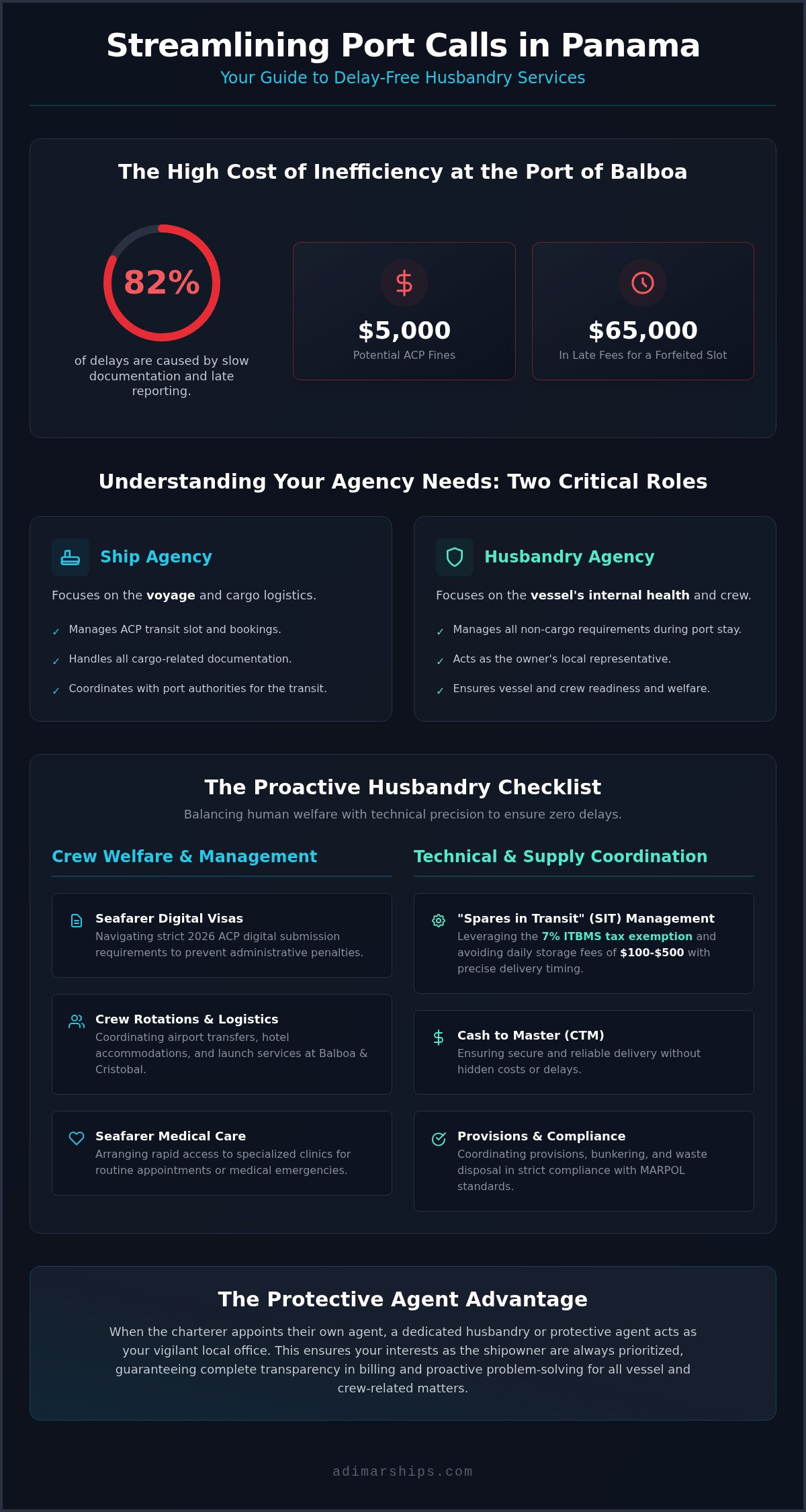
82% of delays in husbandry services at the Port of Balboa result from slow documentation and late reporting. For a ship operator, these aren’t just administrative errors. They’re expensive bottlenecks that can trigger ACP fines of up to $5,000 or cause you to forfeit a reserved transit slot worth $65,000 in late fees. You’ve likely felt the frustration of uncoordinated spare parts deliveries or the anxiety of meeting new 2026 environmental standards while your vessel sits at anchorage.
We understand that your vessel’s internal health and crew readiness are just as critical as the transit itself. This guide provides a comprehensive husbandry services checklist Panama to help you streamline every port call. You’ll learn how to navigate the latest digital visa requirements, optimize launch services at Balboa or Cristobal, and ensure the reliable delivery of Cash to Master (CTM) without hidden costs. We’ll show you how a vigilant local representative can turn a complex logistical puzzle into a seamless, delay-free experience.
Key Takeaways
- Differentiate between voyage-focused ship agency and vessel-centric husbandry to optimize your operational budget and avoid service gaps.
- Implement a robust husbandry services checklist Panama to streamline crew rotations, medical visits, and technical maintenance under strict 2026 ACP regulations.
- Master the logistical nuances of Balboa and Cristobal to ensure the “zero-delay” delivery of provisions, spare parts, and Cash to Master.
- Stay ahead of 2026 compliance requirements, including seafarer digital visas and environmental surcharges, to prevent costly administrative penalties.
- Discover the benefits of appointing a protective agent to act as your vigilant local office and ensure total transparency in all husbandry-related billing.
Defining the Husbandry Agent: The ‘Caretaker’ of the Sea
Maritime operations at the Panama Canal involve two distinct spheres of responsibility. While a standard ship agent focuses on the voyage logistics, a husbandry agent manages the vessel’s internal health. The definition of ship husbandry centers on the management of all non-cargo related requirements during a port stay. It’s essentially the professional “housekeeping” of a maritime asset. This includes everything from ensuring the crew has fresh provisions to coordinating technical repairs that keep the vessel sea-worthy.
The distinction is vital for shipowners to understand. A panama canal ships agent often prioritizes the ACP transit slot and cargo documentation. In contrast, husbandry is vessel and crew-focused. By delegating these tasks, the shipowner ensures that their local representative acts as a legal and logistical extension of their own office. This separation of duties prevents conflicts of interest and ensures your husbandry services checklist Panama is managed with total transparency and dedicated oversight.
The Core Philosophy of Vessel Support
Success in the 2026 maritime environment requires more than just meeting deadlines; it demands proactive readiness. We prioritize vessel uptime and operational readiness by anticipating bottlenecks before they delay a transit. As the vital bridge between international operators and local ACP officials, we ensure that every internal requirement aligns with local regulations. A husbandry agent serves as the local guardian of a vessel’s internal interests, protecting the owner’s investment while the ship is in Panamanian waters.
When Should You Nominate a Husbandry Agent?
Operators often find that a single agent can’t effectively manage both cargo and owner interests simultaneously. You should consider a dedicated partner when:
- High-Traffic Transits: During peak 2026 windows, technical needs become urgent and require immediate local coordination to avoid slot forfeiture or expensive auction premiums.
- Charterer-Appointed Agency: If the charterer has appointed their own agent to manage cargo, the owner still needs a representative to handle crew rotations, medical needs, and Cash to Master.
- Emergency Scenarios: Technical failures or medical emergencies at the Balboa or Cristobal anchorages require a partner who can intervene instantly with local authorities to secure priority launch services.
Key Responsibilities: What Your Husbandry Checklist Must Include
A comprehensive husbandry services checklist Panama must balance human welfare with technical precision. Since 82% of delays at the Port of Balboa stem from slow documentation, your checklist is your first line of defense against operational friction. It ensures that while the ship agent handles the canal transit, your local representative manages the people and machinery that keep the vessel moving. This proactive oversight prevents the “hidden costs” of uncoordinated deliveries that often surprise unprepared operators.
Crew Welfare and Management in Panama
Managing crew rotations involves a complex logistical dance of airport transfers and hotel stays. For 2026, the ACP has tightened requirements for seafarer digital visas, making early documentation vital. Your checklist must account for these digital submissions well in advance of arrival at either the Pacific or Atlantic terminals. Beyond paperwork, seafarer health is a primary concern. Accessing specialized seafarer medical panama ensures that routine appointments or emergency care don’t derail your schedule. We act as your on-the-ground team, coordinating with local clinics to provide rapid intervention when a crew member’s health is at stake.
Technical and Supply Coordination
Technical support requires a deep understanding of local customs and infrastructure. Panama’s “Spares in Transit” (SIT) regime is a significant advantage for operators, as it exempts critical ship parts from the 7% ITBMS tax. However, daily storage fees in local warehouses can range from $100 to $500 if timing is off. A proactive agent minimizes these costs by syncing deliveries perfectly with your vessel’s arrival window. This coordination extends to bunkering in panama and ensuring all waste disposal meets strict MARPOL standards. You can find the latest compliance details in the Panama Canal Authority vessel requirements, which dictate how technical deficiencies are handled at the locks.
Financial integrity is the final pillar of a reliable husbandry services checklist Panama. Secure Cash to Master (CTM) transactions require extreme precision. You must provide at least 72 hours’ notice for standard deliveries. For amounts exceeding $50,000, local banks and authorities require a minimum of five business days’ notice. By delegating these sensitive tasks to a trusted partner, you gain the operational freedom to focus on the voyage ahead. If you want to ensure your next port call is handled with this level of detail, consider how a specialized local office can protect your interests.
Husbandry vs. Ship Agency vs. Protective Agency
Understanding the hierarchy of agency roles is the first step toward a cost-effective transit. A ship agent manages the relationship with the ACP, handling tolls, transit bookings, and cargo documentation. However, their primary focus is the voyage, not the vessel’s internal needs. This is where a husbandry agent steps in to execute your husbandry services checklist Panama. By separating these roles, you ensure that crew welfare and technical maintenance receive undivided attention. It’s a pragmatic choice that protects your operational freedom and keeps your vessel ready for its next leg.
The Critical Role of a Protective Agent (OPA)
Owners often find themselves in a position where a charterer nominates the primary agent. In these cases, appointing an Owner’s Protective Agent (OPA) is a strategic move for financial integrity. The OPA acts as a watchdog, verifying Proforma Disbursement Accounts (PDA) to ensure third-party vendors don’t overcharge for services like launch hire or spare parts storage. They ensure local regulations are followed without the addition of unnecessary “convenience” fees that can inflate your port stay costs. “An OPA serves as your local eyes and ears when another party nominates the main agent.” This layer of protection provides the peace of mind that your interests are being prioritized by a dedicated representative who understands the local 2026 fee structures.
Choosing Between Full Agency and Husbandry-Only
Choosing the right representation depends on who controls the cargo and the specific needs of the vessel. If you are the shipowner, an owner’s nominated agency is essential to maintain control over vessel expenses and crew logistics. Dual-representation prevents the conflicts of interest that arise when a single agent tries to serve both the charterer and the owner simultaneously. Consolidating your husbandry tasks with a trusted local partner reduces administrative burden and streamlines communication.
This approach allows your team to delegate complex, specialized tasks to experts who understand the nuances of the 2026 Panama market. It ensures that your husbandry services checklist Panama is completed with the vigilance of an in-house team. By delegating these tasks, you minimize the risk of hidden costs or logistical bottlenecks during high-stakes transits. You gain the security of knowing a seasoned expert is managing your maritime assets on the ground, protecting your budget from the volatility of the local auction market and technical delays.
Husbandry at the Panama Canal: Unique 2026 Challenges
Timing in 2026 is no longer just an operational preference; it is a strict regulatory requirement. With maritime traffic stabilized at 36 daily transits, the ACP enforces arrival windows with zero tolerance for delays. Implementing a precise husbandry services checklist Panama is the only way to meet the “Zero Delay” mandate that shipowners now demand. Achieving this requires a deep understanding of the geographical split between the Pacific and Atlantic entrances. While both sides offer support, the logistical hurdles differ significantly between Balboa and Cristobal.
Coordinating Crew Changes in the Canal Zone
Pacific-side crew changes at Balboa are generally more cost-effective due to the proximity of Tocumen International Airport (PTY). Launch services at the Balboa anchorage range from $550 to $1,400, depending on the distance to the vessel. In contrast, Cristobal requires longer road transport times, which can complicate the 2026 digital seafarer pass system. This digital system requires real-time synchronization between the ship’s arrival and the immigration authorities. You can find deeper local context in our husbandry services guide, which details how to manage these windows without incurring hotel overages or missed flight fees.
Spares and Provisioning During Transit
Delivering heavy spares or provisions while a vessel is “on the move” through Gatun Lake or the locks is a high-stakes operation. The ACP monitors vessel performance closely. Any technical deficiency discovered during the panama canal transit can lead to a “Notice of Deficiency,” resulting in fines of $5,000 or more. Coordination is vital to ensure that launch boats meet the vessel at specific lock intervals. This prevents the vessel from having to slow down or anchor unnecessarily, which could jeopardize its reserved slot and trigger late fees exceeding $10,000.
Safety compliance remains the foundation of a successful port call. Every vessel transiting the canal must have a designated PCSOPEP authorized person in Panama to manage potential oil pollution emergencies. This isn’t just a paperwork exercise; it’s a critical safety link that must be established at least 96 hours before arrival. By delegating these specialized tasks to a vigilant local representative, you ensure that your vessel remains in full compliance with both environmental and operational standards. If you need a partner to act as your local office and protect your interests on the ground, contact our specialized team today.
Why Adimar Shipping is Your Trusted Husbandry Partner
Experience matters in the 2026 Panama Canal environment. With over 20 years of specialized experience as a panama canal ships agent, we provide the stability operators need during periods of high demand. We don’t just act as a third-party vendor; Adimar Shipping, Inc. functions as your “Local Office” in Panama. Our team treats every vessel with the vigilance of an in-house department, ensuring that your husbandry services checklist Panama is executed without a single detail falling through the cracks. This dedicated oversight is what prevents the 82% of delays typically caused by poor documentation and slow reporting at local ports.
The Adimar Shipping, Inc. Advantage: Integrity and Local Expertise
Our role involves more than just basic logistics. It’s about leveraging deep, long-standing relationships with the panama canal authority (ACP) to expedite your vessel’s needs. Whether you’re navigating the stabilized 36 daily transit limit or managing urgent technical repairs at the Balboa anchorage, our local expertise provides a significant advantage. We commit to the highest ethical standards in every transaction, ensuring that your interests are protected by a partner who values transparency. Our comprehensive ship agency panama services offer a seamless experience that allows your crew to focus on safe navigation.
Getting Started with Your Husbandry Nomination
Financial transparency is non-negotiable in high-stakes maritime logistics. We protect your bottom line through clear Proforma Disbursement Accounts (PDA) and cost-conscious coordination that eliminates unnecessary “convenience” fees. Professional husbandry services can reduce total port stay costs by an average of 15% by consolidating deliveries and minimizing launch trips. We monitor every line item, from warehouse storage for ship spares to the secure delivery of Cash to Master, to ensure you aren’t surprised by hidden charges. Our team provides 24/7 rapid response to navigate the ever-changing conditions of canal traffic and the latest ACP risk-based inspection models.
Nominating a partner you can trust is the first step toward a seamless, delay-free transit. You can nominate Adimar Shipping, Inc. as your husbandry or protective agent for any upcoming 2026 voyage at either the Pacific or Atlantic terminals. We provide detailed PDAs that reflect verified current rates for launch services, tugboats, and environmental surcharges. This allows your team to delegate complex, specialized tasks to a partner with deep local knowledge and a proven track record of reliability. Contact Adimar Shipping, Inc. for a personalized husbandry quote today.
Master Your 2026 Panama Canal Port Calls
A successful transit through Balboa or Cristobal requires more than just a booking; it demands a vigilant partner on the ground. By following a robust husbandry services checklist Panama, you ensure that crew rotations, technical repairs, and financial transactions occur without the friction that leads to costly delays. You don’t have to navigate these complexities alone; separating husbandry from voyage agency maintains transparency and protects your bottom line. This proactive approach ensures your seafarers are cared for and your technical assets remain ready for the open sea.
Celebrating 20 years of maritime excellence, Adimar Shipping provides the stability your fleet requires. As an authorized PCSOPEP representative for the ACP, we offer the specialized oversight needed to navigate 2026 compliance with absolute confidence. We provide 100% guaranteed professional local representation, acting as your dedicated office in Panamanian waters to secure your operational freedom. Delegating these tasks to a seasoned expert provides the peace of mind you need during high-stakes transits. We look forward to supporting your fleet with reliability and local expertise.
Secure Your Panama Canal Transit with Expert Husbandry Services
Frequently Asked Questions
What is the difference between a ship agent and a husbandry agent?
A ship agent focuses on the voyage and ACP transit logistics, such as booking slots and handling tolls. Conversely, a husbandry agent manages the vessel’s internal requirements and crew welfare. This distinction ensures that while the passage is secured, the ship’s physical needs aren’t neglected. By using a husbandry services checklist Panama, operators can delegate crew rotations and technical repairs to a specialist, ensuring the vessel remains operational without distracting the transit agent from their primary voyage duties.
Can a husbandry agent handle crew changes at the Panama Canal?
Yes, a husbandry agent is the primary coordinator for all crew changes at the Panama Canal. This process involves managing airport transfers from Tocumen International Airport, hotel logistics, and the 2026 digital seafarer pass system. We ensure that incoming and outgoing crew members meet all local immigration rules. Because 82% of delays result from slow reporting, we synchronize launch service windows at Balboa or Cristobal to ensure seafarers reach the vessel without expensive scheduling bottlenecks.
What is Cash to Master (CTM) in maritime husbandry?
Cash to Master (CTM) refers to the secure physical delivery of currency to the ship’s captain for crew wages and onboard expenses. It’s a critical component of maritime husbandry that requires high levels of security and transparency. In Panama, you must provide at least 72 hours’ notice for standard deliveries. For amounts exceeding $50,000, local regulations require five business days’ notice. We coordinate with local banks and authorities to ensure these funds arrive safely at either canal entrance.
Do I need a husbandry agent if I already have a transit agent?
You often need a husbandry agent even with a transit agent, especially if the charterer nominated the primary agency. The transit agent’s priority is the cargo and the voyage schedule, which might not align with the shipowner’s internal needs. A dedicated husbandry agent acts as your local office, focusing exclusively on your crew, technical maintenance, and provisions. This separation of duties prevents conflicts of interest and ensures your husbandry services checklist Panama is executed with total financial transparency.
How does a husbandry agent assist with ship spares delivery in Panama?
A husbandry agent manages the entire “Spares in Transit” (SIT) process, which exempts critical parts from the 7% ITBMS tax. We handle customs clearance at PTY airport and coordinate last-mile delivery to the vessel at the anchorage or during a lock transit. Timing is essential, as daily storage fees in local warehouses can range from $100 to $500. We minimize these costs by ensuring spares arrive exactly when the vessel is ready to receive them.
What are the 2026 requirements for seafarer medical assistance in Panama?
The 2026 requirements emphasize digital compliance and rapid reporting. Seafarers must have a valid digital pass synchronized with the ACP’s risk-based inspection model. If a crew member requires medical attention, we coordinate with specialized maritime clinics and arrange priority launch services. This ensures that routine checkups or emergency interventions don’t result in a “Notice of Deficiency.” Our team manages the logistical bridge between the vessel and local healthcare providers to maintain crew health and vessel readiness.
Why is local knowledge important for husbandry services at the ACP?
Local knowledge is vital because the ACP enforces strict arrival windows and documentation deadlines. An agent who understands the geographical differences between Balboa and Cristobal can prevent expensive logistical errors. For instance, knowing the specific launch service windows at the Pacific entrance can save thousands in wait-time fees. We use our 20 years of local expertise to navigate these nuances, ensuring that your vessel meets all 2026 regulatory standards while maintaining a seamless, delay-free transit through the canal.
How does a protective agent (OPA) differ from a husbandry agent?
A protective agent (OPA) acts as a watchdog to oversee the operations of a primary agent, whereas a husbandry agent actively executes vessel and crew services. If a charterer appoints the main agent, you nominate an OPA to verify Proforma Disbursement Accounts and ensure your interests aren’t compromised. While a husbandry agent handles the physical delivery of supplies or crew, the OPA provides an extra layer of financial security and ethical oversight for the shipowner.