
A single clerical error in your documentation can trigger a $15,000 fine before your vessel even reaches the locks. We understand that managing the complexities of Panama Canal Authority (ACP) regulations is a high-stakes challenge for any ship owner. The pressure of strict 96-hour notification deadlines and the technical nuances of Tier 1 versus Tier 2 classifications can be overwhelming. It’s a logistical burden where even a minor digital submission delay through the VUMPA system results in immediate financial sanctions. This guide will help you master the pcsopep approval process panama to ensure your fleet experiences zero delays during a 2026 transit.
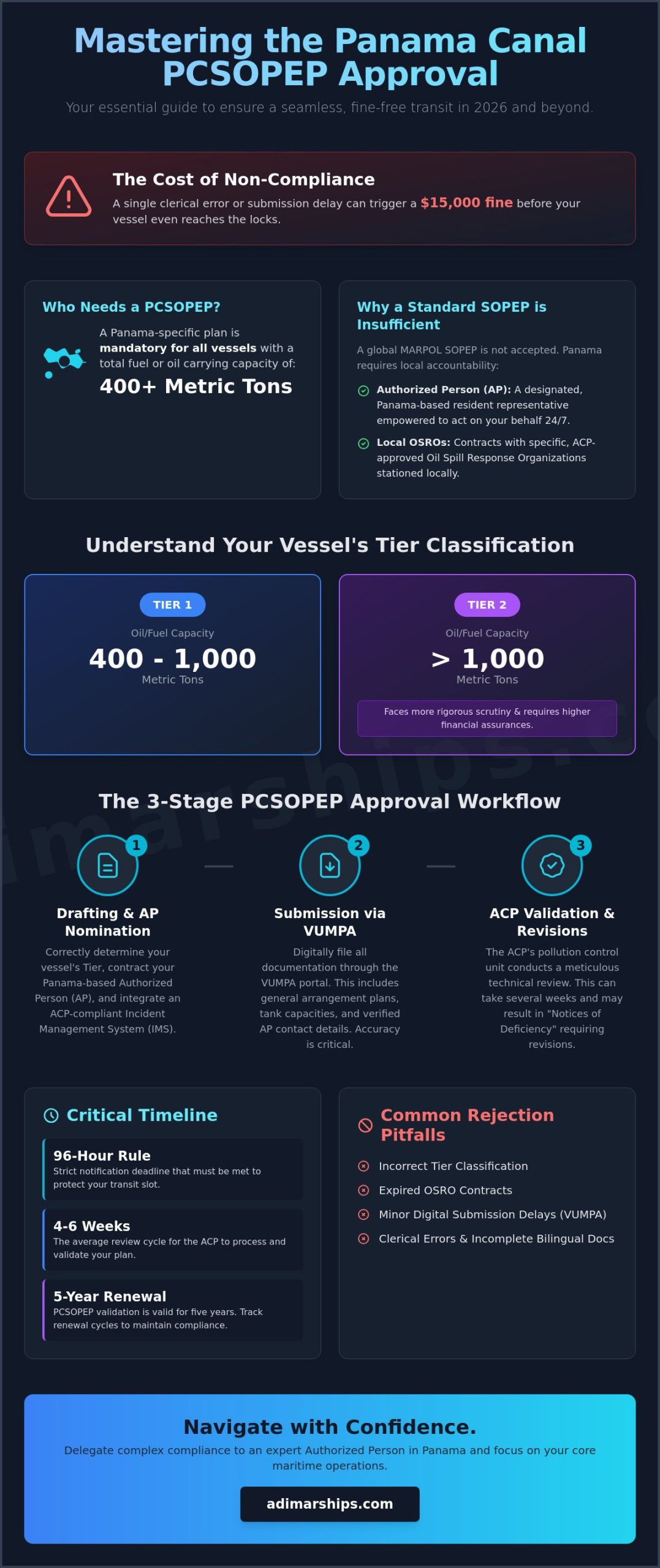
By understanding the 4-6 week review cycle and the mandatory bilingual requirements, you can protect your operational schedule and your bottom line. We’ll preview the essential steps for successful ACP plan validation, the importance of five-year renewal cycles, and the critical role your Panamanian Authorized Person plays in maintaining 24/7 compliance. You’ll gain the clarity needed to delegate these complex tasks and focus on your core maritime operations with total peace of mind. Our roadmap provides the local vigilance required to navigate these regulatory waters safely and efficiently.
Key Takeaways
- Confirm if your vessel meets the 400 metric ton oil capacity threshold requiring a localized PCSOPEP for all 2026 transits.
- Navigate the three-stage pcsopep approval process panama through the VUMPA portal to secure mandatory ACP validation.
- Protect your transit slot by meeting the strict 96-hour notification rule and avoiding costly non-compliance fines.
- Identify and resolve common pitfalls like incorrect Tier classifications and expired OSRO contracts before they lead to plan rejection.
- Leverage a resident Authorized Person to provide the 24/7 local representation required for emergency coordination and spill response.
Understanding the PCSOPEP Approval Mandate for 2026
The Panama Canal Authority (ACP) operates with zero tolerance for environmental risks. For any operator, the Panama Canal Ship Oil Pollution Emergency plan (PCSOPEP) is a localized extension of MARPOL specifically for the Canal. It’s mandatory for all vessels with a fuel or oil carrying capacity of 400 metric tons or more. You can’t enter Canal waters without a validated plan. This makes the pcsopep approval process panama a critical milestone in your pre-arrival workflow. Securing approval must happen through the ACP well before your transit entry to avoid costly delays or immediate rejection at the locks.
Why MARPOL SOPEP is Insufficient for Panama
While MARPOL provides a global framework, Panama demands higher levels of local accountability. A standard international SOPEP doesn’t list the specific, ACP-approved response organizations required for local operations. Panama requires vessels to contract with specific Oil Spill Response Organizations (OSROs) that have equipment and personnel stationed at both the Atlantic and Pacific terminals. Most importantly, you must designate a Panama-based Authorized Person (AP). This resident representative is the only individual legally empowered to act on your behalf during a spill, providing 24/7 coordination with the ACP. Without this local liaison, your international documentation holds no weight in Panamanian waters.
Tier Classifications and Approval Impact
The complexity of your plan depends heavily on your vessel’s oil capacity. The ACP divides vessels into specific Tiers (S, 1, 2, and 3) to scale response requirements. Tier 1 covers vessels with a capacity between 400 and 1,000 metric tons. Tier 2 applies to those exceeding 1,000 metric tons. These classifications aren’t just labels; they dictate the level of financial guarantees and response capabilities you must prove. Tier 2 vessels face more rigorous scrutiny during the pcsopep approval process panama because their potential environmental impact is greater. You’ll need to provide more detailed plan components and higher financial assurances to satisfy the ACP’s safety standards. Understanding your specific Tier early prevents technical errors that lead to plan rejection and transit forfeiture.
The 3 Stages of the PCSOPEP Approval Workflow
The pcsopep approval process panama isn’t a quick administrative check. It’s a structured, technical workflow that demands precision at every turn. For your 2026 transit, we recommend initiating this cycle at least 30 days before your vessel reaches Canal waters. This buffer protects your schedule against technical revisions or “Notices of Deficiency” that could otherwise stall your vessel at the entrance. Timing is everything in maritime logistics. A proactive start ensures that your documentation moves through the Panama Canal Authority (ACP) systems without friction.
Stage 1: Drafting and AP Nomination
Success starts with accurate drafting. You can’t guess your way through ACP standards. First, you must determine your vessel’s correct Tier based on the official PCSOPEP requirements. This step is critical because the documentation for a Tier 2 vessel is significantly more complex than for a Tier 1 ship. During this phase, you’ll also contract your Panama-based Authorized Person (AP). This individual isn’t just a name on a form; they’re your primary legal liaison with the ACP. Your plan must also integrate a clear Incident Management System (IMS) structure that aligns perfectly with Panamanian emergency response protocols.
Stage 2: Submission through VUMPA
VUMPA is the digital gatekeeper for the Canal. Once your plan is drafted and your AP is nominated, the digital filing begins through the Vessel Traffic Business Process (VUMPA) portal. You’ll need to upload high-resolution general arrangement plans, detailed tank capacities, and verified AP contact details. Your Ship Agent plays a vital role here. They act as a final filter, verifying every data point before the ACP begins its technical review. Accuracy at this stage prevents the common clerical errors that trigger automatic rejections. If you’re looking for a partner to manage these complex digital filings, Adimar Shipping, Inc. provides expert oversight as an extension of your own team.
Stage 3: ACP Validation and Revisions
The ACP’s pollution control unit conducts a meticulous technical review that can last several weeks. They aren’t just looking for signatures; they’re checking for operational viability. If the unit finds inconsistencies, they’ll issue a “Notice of Deficiency” letter. You must handle these corrections immediately to save your transit slot. Once the ACP is satisfied, they issue a formal Approval Letter. This document is typically valid for four years. However, you must re-validate the plan if your vessel’s configuration or oil capacity changes before that expiration date. This final validation is your green light for a secure, delay-free transit.
The 96-Hour Rule: Critical Timing for Approval
Confirming your approval status no later than 96 hours before arrival is a non-negotiable step in the pcsopep approval process panama. It’s vital to distinguish between “Plan Approval,” which is your long-term certification, and “Transit Notification,” which is the voyage-specific verification. Even if you hold a valid four-year Notice of Acknowledgement, failing to link that approval to your specific arrival through the VUMPA portal triggers immediate penalties. A slight delay in this digital filing can lead to a minimum sanction of $2,500. In more severe cases, the ACP may designate your vessel as a “Dead Ship,” which forces an immediate transit cancellation and results in massive rescheduling costs. This 96-hour window serves as the final safety net for your compliance strategy.
Pre-Arrival Notification Requirements
During this final countdown, your Authorized Person (AP) must be confirmed on standby for your exact transit window. This ensures the ACP has a 24/7 point of contact for any environmental contingencies while your vessel is in the jurisdiction. You must also verify that the physical plan on the bridge is identical to the digital version stored in the ACP database. Any discrepancy found during a boarding inspection can lead to a failed audit and a forced delay. This is the time to update crew lists and ensure all Incident Management System (IMS) contact points are operational. Vigilance here prevents the technical mismatches that often occur when vessels change crews or updated contact data isn’t synchronized with the shore-side responders.
Emergency Approval Scenarios
High-pressure situations often arise when a vessel is sold or renamed just days before arrival. Because the name on the vessel’s hull must match the Approval Letter exactly, your existing plan becomes invalid the moment the name changes in the registry. While an “Express Review” might be requested in exceptional circumstances, the ACP review period is notoriously rigid; it typically spans 4 to 6 weeks and lacks an official fast-track option. Adimar Shipping, Inc. acts as your vigilant, on-the-ground representative in these emergencies. We coordinate directly with the ACP pollution control unit to push through urgent corrections or name updates, protecting your transit schedule from a sudden collapse. Delegating these last-minute crises to a local specialist provides the operational security you need when your bottom line is at stake.
Common Pitfalls and How to Avoid Plan Rejection
A “Notice of Deficiency” isn’t just a minor administrative request; it’s a stop sign for your transit. While we’ve discussed the 4-6 week review cycle, many operators fall into avoidable traps that lead to outright rejection during the pcsopep approval process panama. One of the most frequent errors involves Tier calculation. The ACP looks at your vessel’s total oil carrying capacity, which includes both cargo and fuel oil. If you miscalculate this threshold by only counting bunker fuel, your entire plan structure will be technically flawed from the start. Inconsistencies between your PCSOPEP and the Ship’s Registry data also trigger immediate red flags. Every metric ton and tank name must match your official registration documents exactly.
Expired contracts with Oil Spill Response Organizations (OSROs) are another common failure point. Your agreement with these local responders must be active and valid for the entire duration of your transit. If a contract lapses even a day before you reach Canal waters, your plan is non-compliant. Additionally, you must appoint a Panama-resident Authorized Person who possesses deep Incident Management System (IMS) knowledge. Appointing a non-resident or someone without technical emergency training is a non-negotiable local rule violation. A failure to provide a resident AP with verified IMS training is one of the quickest ways to trigger a plan rejection.
Technical Errors in Plan Documentation
Your technical documentation must reflect the latest regulatory updates. We often see plans rejected because they include outdated spill notification flowcharts that don’t align with current ACP communication protocols. Your plan must comply with the latest ACP Notice to Shipping requirements, including N-12-2024. Poorly defined roles within the shipboard Incident Management Team also lead to scrutiny. The ACP expects to see a clear chain of command that integrates seamlessly with Panamanian shore-side response teams. For instance, the ACP requires specific personnel names and 24/7 contact numbers to be instantly accessible, not buried in appendices. If these roles are vague, the ACP will question your vessel’s operational readiness.
Administrative and Portal Failures
Digital barriers can be just as damaging as technical errors. VUMPA login credentials or ship agent authorization issues often cause delays during the critical review window. If your team fails to respond to ACP technical queries within their specified timeframe, your application may be archived. To avoid these administrative bottlenecks, many owners rely on a specialized owner’s nominated agency for oversight. This ensures a professional buffer between your technical team and the ACP portal. Accuracy in these digital filings is just as important as the plan’s technical content. If you want to eliminate the risk of rejection, contact Adimar Shipping, Inc. for a professional PCSOPEP audit before your next transit.
Adimar Shipping: Your Expert Authorized Person in Panama
Adimar Shipping acts as your vigilant, on-the-ground representative for all PCSOPEP matters. We provide 24/7 coordination between your vessel, the ACP, and local response teams to ensure your documentation moves through the pcsopep approval process panama without friction. We don’t just file papers; we provide a seamless integration of PCSOPEP authorized person services with our comprehensive ship agency. This holistic approach eliminates communication gaps that often lead to transit delays. We maintain the highest ethical standards, ensuring total transparency when managing your financial guarantees and compliance requirements. Our role is to simplify the complex, allowing you to focus on your core maritime operations while we handle the technical nuances of Canal law.
Why Local Expertise is Your Best Shield
Local expertise is more than just a convenience; it’s your best shield against regulatory friction. Our team possesses deep knowledge of Panama Canal transit regulations and maintains professional relationships with key ACP personnel. We don’t wait for problems to arise. We provide proactive monitoring of your plan’s validity to prevent expiration surprises that could otherwise result in the forfeiture of your transit slot. Should an incident occur within Canal waters, our team provides immediate incident management support. We act as an extension of your own crew, providing the local oversight and protection required to navigate high-stakes environmental protocols with confidence. Our presence on the ground ensures that your vessel is never left without professional representation during a crisis.
Next Steps for Your 2026 Transit
Preparing for your 2026 transit begins with a professional audit of your current documentation. You can initiate a comprehensive plan review with Adimar Shipping today to ensure every technical detail aligns with the latest ACP mandates. There’s a distinct operational advantage to bundling these specialized services with our ship agency Panama offerings. This centralization creates a single point of accountability, simplifying your logistics and ensuring your vessel’s interests are protected by a partner who understands the local landscape. Don’t let clerical errors or missed deadlines compromise your schedule. The pcsopep approval process panama requires a proactive partner who can navigate the VUMPA system and ACP technical units with ease. Contact Adimar Shipping to secure your PCSOPEP approval and experience the peace of mind that comes from expert representation.
Secure Your Fleet’s Future in the Panama Canal
Navigating the 2026 regulatory landscape requires more than just submitting paperwork. It demands a deep understanding of the strict 96-hour rule and the technical nuances of Tier classifications. By mastering the pcsopep approval process panama, you protect your vessel from $15,000 fines and the risk of forfeiting a critical transit slot. Successful validation isn’t a one-time task; it’s a continuous commitment to environmental safety and operational precision that requires local vigilance.
Adimar Shipping provides the vigilant, local oversight your operations deserve. With our official status as an Authorized PCSOPEP Person and decades of Panama Canal agency experience, we offer 24/7 localized compliance monitoring. We act as your proactive, on-the-ground partner to ensure every digital filing and incident management protocol meets ACP standards perfectly. Don’t leave your transit schedule to chance when expert representation is within reach. Secure Your 2026 PCSOPEP Approval with Adimar Shipping today. Your next successful transit starts with proactive preparation and the peace of mind that comes from a dependable local partner.
Frequently Asked Questions
How long does the PCSOPEP approval process take?
The Panama Canal Authority (ACP) technical review period for a PCSOPEP typically lasts between 4 and 6 weeks. You should account for this timeline when planning your 2026 transits, as the ACP doesn’t offer an expedited review service. Starting the pcsopep approval process panama at least two months in advance provides a necessary buffer for technical revisions or Notice of Deficiency responses.
Can I use my international SOPEP for the Panama Canal?
An international MARPOL SOPEP is not sufficient for Canal compliance. The Panama Canal Authority requires a specific, localized document that includes bilingual instructions in both English and Spanish. Your vessel must have a validated PCSOPEP that scales according to its specific Tier classification and includes contracts with Panama-approved Oil Spill Response Organizations (OSROs) to enter Canal waters legally.
What is the role of an Authorized Person (AP) in the approval process?
The Authorized Person (AP) acts as the resident Panamanian representative who is legally empowered to act on the ship owner’s behalf. They provide the 24/7 liaison required to coordinate spill response and must be available to provide financial guarantees for cleanup operations. Without a designated AP who is a resident of Panama, the ACP won’t validate your shipboard emergency plan during the review stage.
How often does a Panama Canal SOPEP need to be renewed?
Plans must be renewed or re-validated every five years under standard ACP regulations. However, you must also update the plan whenever significant changes occur to the vessel’s configuration, ownership, or oil-carrying capacity. It’s important to note that the Notice of Acknowledgement (NOA) delivered by an ACP boarding officer has a four-year expiration date, so tracking these overlapping dates is essential for continuous compliance.
What are the fines for not having an approved PCSOPEP?
Missing or outdated documentation can result in fines of $50,000 or more and mandatory forfeiture of your transit slot. Even minor clerical errors or slight delays in VUMPA submissions trigger immediate sanctions, often starting at $2,500. A single oversight in the pcsopep approval process panama can lead to a $15,000 non-compliance fine, making professional oversight a financial necessity for modern operators.
Is a physical copy of the approved plan required on board?
A physical, bilingual copy of the plan must be maintained on board at all times for inspection. This document must carry the official ACP approval marking and be signed by the current Master of the vessel in both the English and Spanish sections. Boarding officers will inspect this physical version during their arrival check to ensure it matches the digital version stored in the VUMPA database.
What is the 96-hour rule for Panama Canal compliance?
All vessels must confirm their PCSOPEP approval status at least 96 hours before arrival in Canal waters. This is a strict deadline enforced through the VUMPA system. Missing this window often results in significant delays or the classification of the vessel as a “Dead Ship.” This status carries massive financial penalties and usually leads to the immediate loss of the scheduled transit time.
Does the ACP require a specific format for the digital submission?
The ACP requires all submissions to be handled digitally through the Ventanilla Única Marítima de Panamá (VUMPA) system. The plan itself must be a bilingual document presented in both English and Spanish, including specific sections on the Incident Management System (IMS). Failure to follow the technical formatting guidelines for tank capacities and general arrangement plans will result in an immediate Notice of Deficiency.