
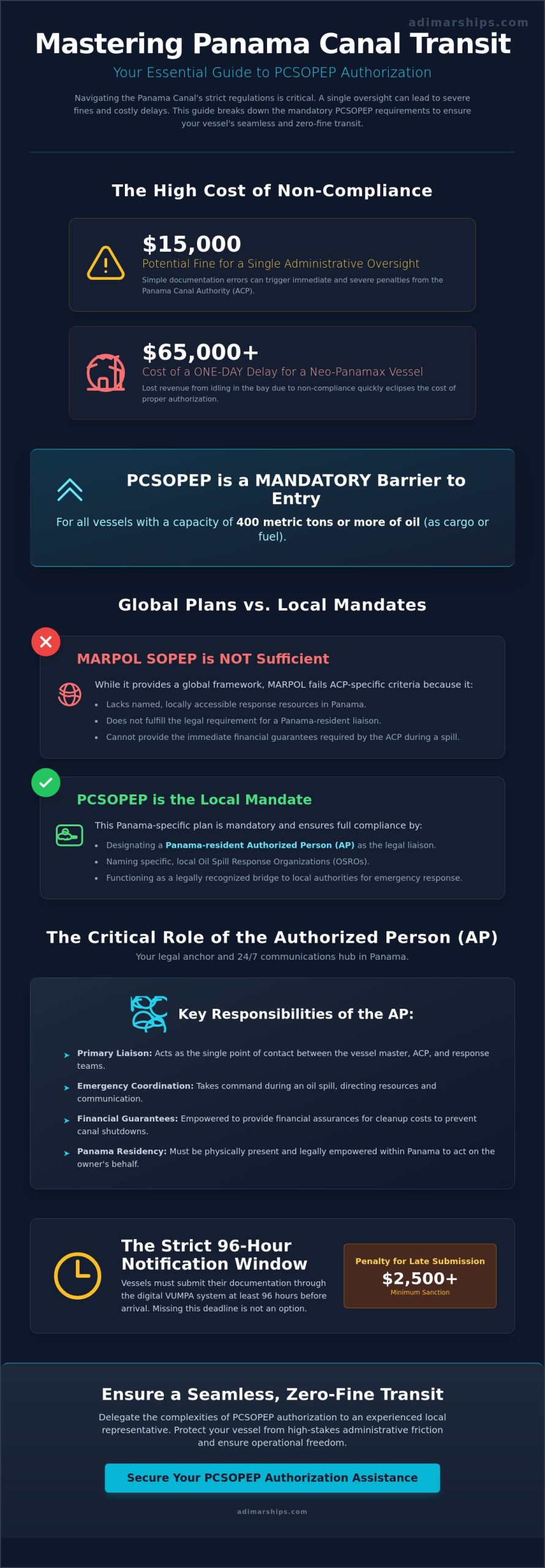
A single administrative oversight in your vessel’s documentation can trigger a $15,000 fine from the Panama Canal Authority, while a one-day delay for a Neo-Panamax vessel now costs upwards of $65,000 in lost revenue. It’s a high-stakes environment where the difference between a seamless transit and a costly bottleneck often comes down to precise pcsopep authorization assistance panama. Many operators mistakenly believe their international MARPOL SOPEP is sufficient, only to face strict enforcement at the Miraflores or Gatun Locks because they lack the specific, local PCSOPEP mandate required for vessels carrying over 400 metric tons of oil.
We understand the stress of hitting the mandatory 96-hour pre-arrival notification window while managing complex global schedules. You deserve the peace of mind that comes with knowing your documentation is flawless and your local representation is vigilant. This guide will help you master the complexities of Panama Canal oil pollution regulations and secure your mandatory PCSOPEP authorization with expert local assistance. We’ll break down the 2026 requirements for the Panama-resident Authorized Person, the digital VUMPA submission process, and the strategies needed to ensure a zero-fine transit through the waterway.
Key Takeaways
- Identify why international MARPOL plans fail to meet 2026 ACP criteria. Ensure your vessel meets specific Panama Canal emergency standards.
- Recognize the critical mandate for a Panama-resident Authorized Person. This representative serves as your dedicated liaison with Canal authorities.
- Navigate the complexities of oil-carrying capacity tiers. Meeting the strict 96-hour notification deadline is essential to prevent costly transit delays.
- Secure your vessel’s approval with specialized pcsopep authorization assistance panama. We bridge the gap between global documentation and local regulations.
- Delegate specialized tasks to an experienced local representative. This ensures operational freedom and protects against high-stakes administrative friction.
Understanding Mandatory PCSOPEP Authorization for 2026 Panama Canal Transits
The Panama Canal remains one of the most strictly regulated maritime corridors in the world. For any vessel carrying a capacity of 400 metric tons or more of oil, whether as cargo or fuel, compliance isn’t a suggestion; it’s a mandatory barrier to entry. This is where the Panama Canal Shipboard Oil Pollution Emergency Plan (PCSOPEP) becomes your most critical document. It functions as a localized emergency preparedness requirement unique to this waterway. Securing professional pcsopep authorization assistance panama ensures that your vessel doesn’t just carry a manual, but maintains a legally recognized bridge to local authorities. This legal threshold is absolute. Even if you’re only carrying fuel for your own engines, crossing that 400 MT mark triggers the full weight of environmental regulations.
The Gap Between Global MARPOL and Panama Canal Local Rules
Many operators assume their existing MARPOL SOPEP is sufficient for transit. It isn’t. While MARPOL provides a global framework, the Panama Canal Authority (ACP) demands specific local response resources be named within the plan. These resources must be immediately accessible within the local jurisdiction. The ACP requires a resident Panamanian entity to serve as the Authorized Person (AP). This individual acts as the legal liaison between the vessel and the canal, a role a global SOPEP cannot fulfill. This person must be prepared to act on behalf of the owner in the event of an oil spill, including providing financial guarantees for cleanup costs. Without this local verification and the formal appointment of an AP, your plan fails to meet ACP-specific criteria for 2026.
Consequences of Transit Without Valid Authorization
The financial penalties for non-compliance are immediate and severe. A single documentation error or a failure to update your plan can lead to a fine of $15,000. If you miss the strict 96-hour pre-arrival notification window, the minimum sanction starts at $2,500. These aren’t just theoretical risks. They are active enforcement measures used by the ACP to maintain environmental safety. Beyond the fines, you face the risk of Transit Denial. If your authorization isn’t in order, your vessel stays in the bay while the clock ticks. Consider these stakes:
- Daily Delay Costs: For a Neo-Panamax vessel, idling costs can exceed $65,000 per day.
- Non-Compliance Charges: These are often applied through the VUMPA system before the vessel even arrives at the locks.
- Safety Ratings: Persistent documentation issues or late submissions can lower your vessel’s safety rating, complicating future bookings.
Relying on outdated or generic plans is a gamble that puts your entire voyage at risk. Professional pcsopep authorization assistance panama ensures your documentation is approved and your resident representative is ready before you ever reach the locks.
The Critical Role of the Resident Authorized Person (AP) in Panama
The Authorized Person (AP) is your legal anchor in Panama. According to the Official PCSOPEP Requirements, every vessel must designate a resident representative who acts as the primary liaison with the Panama Canal Authority. This isn’t a passive role. During an actual oil spill, the AP takes command of coordination between the vessel master, the ACP, and Oil Spill Response Organizations (OSROs). They are the ones who provide the necessary financial guarantees to keep the cleanup moving without halting canal operations. Without an AP who is physically present and legally empowered, your vessel simply won’t be allowed to enter the locks.
When you seek pcsopep authorization assistance panama, you’re essentially hiring a 24/7 communication hub. The AP must be ready to bridge the gap between a vessel master in the middle of the Gatun Lake and the administrative offices in Balboa. This constant vigilance ensures that if a crisis occurs, the response is immediate, professional, and compliant with local law. It’s about delegating the high-pressure task of emergency coordination to a specialist who knows the terrain and the regulators.
Qualifications of a Valid Authorized Person
A valid AP needs more than a local address. They must possess deep technical knowledge of the Panama Canal Shipboard Oil Pollution Emergency Plan. This includes understanding the specific spill tiers and local response protocols. Because the ACP monitors availability, your AP must be reachable 24/7/365. Choosing an experienced ship agency in Panama is vital. An agency with established roots understands how to navigate the pressure of a real-time emergency while maintaining the vessel’s interests and protecting the owner from unnecessary liability.
AP Representation Beyond Emergency Response
The AP’s value shines even when there isn’t a crisis. They manage the administrative heavy lifting, ensuring your plan stays updated with the latest regulatory shifts. They are responsible for facilitating the “Acknowledgment of Receipt” from the ACP, which is the definitive green light your vessel needs to proceed. Having an AP who understands the specific Panama Canal transit nuances can prevent minor clerical errors from becoming $15,000 fines. They act as your eyes and ears on the ground, providing a layer of security that remote management simply can’t offer. If you’re preparing for a 2026 transit, consider how a dedicated PCSOPEP Authorized Person can simplify your compliance journey and protect your bottom line.
Navigating PCSOPEP Tiers and the 96-Hour Notification Rule
Compliance in 2026 hinges on understanding exactly how the Panama Canal Authority categorizes your vessel. This classification isn’t based on ship size or cargo type alone. Instead, it’s defined by the total amount of oil the vessel can carry, whether as fuel or cargo. This tier system dictates the level of emergency response resources you must have on standby. Obtaining pcsopep authorization assistance panama helps you correctly identify your tier and ensures your plan meets the corresponding resource requirements for a seamless transit.
Tier 1 vs. Tier 2: Which One Applies to Your Vessel?
The Panama Canal Authority PCSOPEP Regulations clearly delineate these categories. Tier 1 applies to vessels with an oil carrying capacity between 400 metric tons and 1,000 metric tons. If your capacity exceeds 1,000 metric tons, you fall into Tier 2. This distinction is vital because Tier 2 vessels require a more robust set of pre-arranged response equipment and personnel. There’s also “Tier S,” a specialized classification for vessels with less than 400 metric tons capacity. While Tier S vessels have reduced requirements, they still need to meet specific safety standards and maintain a valid plan to transit the waterway.
The 96-Hour Notification Window: A Zero-Tolerance Policy
Timing is everything when approaching the locks. You must submit your valid PCSOPEP documentation at least 96 hours before your vessel arrives in Canal waters. The ACP maintains a zero-tolerance policy regarding this window. Even a slight delay in submission through the VUMPA system can trigger a minimum sanction of $2,500. VUMPA, the Canal’s single window for maritime electronic arrival, is now the primary interface for all 2026 compliance checks. Securing reliable pcsopep authorization assistance panama is the most effective way to navigate this digital requirement without error.
Mistakes often happen during the digital upload process. A common error involves submitting outdated contact information for the Authorized Person or failing to verify the plan’s compatibility with current ACP notices. Adimar Shipping, Inc. manages this timeline with vigilant oversight. We don’t just wait for the deadline. We act as your on-the-ground representative to verify every digital entry is accurate well before the 96-hour clock starts. This proactive approach eliminates the stress of late-filing fees and ensures your transit remains on schedule. By delegating this technical task, you protect your vessel from the administrative friction that often leads to costly delays in the bay.
Step-by-Step Roadmap to Securing Your PCSOPEP Vessel Approval
Securing approval from the Panama Canal Authority isn’t a simple tick-box exercise. It’s a structured legal process that demands precision at every stage. Many operators find the bureaucratic layers frustrating. Adimar Shipping, Inc. simplifies this by acting as your proactive partner on the ground. Our pcsopep authorization assistance panama follows a proven methodology designed to eliminate administrative friction and protect your transit schedule. Precision is our standard because we know the high stakes of any logistical bottleneck.
- Formalize the Appointment: Your first step is the formal designation of your resident representative through a signed agreement. This establishes the legal foundation required by the ACP.
- Perform a Gap Analysis: We conduct a comprehensive review of your existing global SOPEP. We identify where it falls short of the unique 2026 Panama Canal mandates.
- Draft and Submit: Our team prepares the Panama-specific PCSOPEP document. This version includes the mandatory local response resources and OSRO contacts.
- Secure Compliance: We manage the direct coordination with the ACP until they issue the “Acknowledgment of Compliance.”
- Maintain Readiness: We oversee annual renewals and plan updates to ensure you’re always ready for your next transit.
Documentation Review and Plan Submission
Success depends on the accuracy of your vessel’s technical data. We verify your ship’s oil carrying capacity against official ACP records to prevent classification errors. A critical part of this phase is ensuring the plan names the correct Oil Spill Response Organizations (OSROs) currently certified in Panama. A dedicated PCSOPEP authorized person streamlines this approval by identifying potential red flags before they reach a regulator’s desk. We don’t just submit documents; we verify their compatibility with the latest maritime notices.
Managing the VUMPA Digital Approval Process
The Vessel Traffic Management and Maritime Statistics System (VUMPA) is the digital gateway to the Canal. In 2026, the ACP uses this interface for all compliance checks. Our agents take the lead in uploading and verifying electronic documents within this system. Digital rejection notices are common, often triggered by minor formatting issues or outdated contact details. We catch these errors instantly. By troubleshooting rejection notices before they escalate, we prevent them from becoming transit delays in the bay. If you want to ensure your documentation is flawless, contact Adimar Shipping, Inc. for personalized support through the VUMPA interface.
Why Adimar Shipping, Inc. is the Preferred Choice for PCSOPEP Assistance
Choosing a partner for your transit involves more than just selecting a service provider. It requires an extension of your own operations. Adimar Shipping, Inc. acts as your vigilant eyes and ears at the Panama Canal, providing the local oversight that remote management cannot achieve. Since our inception, we have served as a leading Panama Canal ships agent, offering the technical depth required for complex 2026 transits. Our pcsopep authorization assistance panama is built on a foundation of transparency and ethical conduct, ensuring that every interaction with the ACP is handled with the highest level of integrity.
We offer more than just a signature on a document. We provide an integrated suite of services that combines the role of the PCSOPEP Authorized Person with full husbandry and agency support. This reduces the number of vendors you manage and ensures that your compliance strategy is perfectly aligned with your operational needs. By delegating these specialized tasks to Adimar Shipping, Inc., you gain the freedom to focus on your vessel’s primary mission while we handle the administrative friction and regulatory hurdles.
Personalized Service vs. Large Corporate Agents
Unlike large corporate agents, we prioritize a personal connection with every fleet we represent. You won’t be passed between departments or left waiting for a response from a distant regional hub. Instead, you get direct access to our decision-makers and expert APs 24/7/365. This streamlined communication is critical during the high-pressure environment of a canal transit. We simplify the expertise delegation narrative by taking full ownership of your local requirements, providing a level of stability and dependability that large firms often struggle to match.
Securing Your 2026 Transit Schedule
Our goal is to ensure your vessel is “Transit Ready” long before it reaches the locks. We take the administrative burden off your crew, managing the digital VUMPA complexities we discussed earlier. Our comprehensive pcsopep authorization assistance panama eliminates the risk of late-filing fees and documentation errors that lead to costly bottlenecks. To protect your bottom line and secure your 2026 transit schedule, Contact Adimar Shipping, Inc. for PCSOPEP Assistance today. We are ready to safeguard your interests and ensure a seamless passage through the waterway.
Protect Your Vessel Interests with Expert Compliance Oversight
Operational success at the Panama Canal depends on precision and local vigilance. You’ve seen how the 400 MT oil capacity threshold and the strict 96-hour notification window create high-stakes hurdles for every transit. Missing these marks leads to immediate fines and costly delays in the bay. By delegating these specialized tasks to a dedicated partner, you protect your fleet from administrative friction and ensure your documentation meets every 2026 ACP mandate. Reliable pcsopep authorization assistance panama is the key to maintaining your transit schedule and safety rating.
Adimar Shipping stands as your vigilant, on-the-ground representative. We provide the security of an Authorized PCSOPEP Representative combined with deep expertise in ACP VUMPA compliance. Our 24/7 local emergency presence ensures that you have a dependable liaison ready to act at a moment’s notice. Don’t let documentation errors halt your voyage. Secure Your 2026 PCSOPEP Authorization with Adimar Shipping and experience the peace of mind that comes with professional expertise. We’re ready to guide your vessel safely through the locks.
Frequently Asked Questions
Is a global MARPOL SOPEP sufficient for a Panama Canal transit?
No, a standard MARPOL SOPEP doesn’t meet the Panama Canal Authority’s specific environmental criteria. The ACP mandates a localized PCSOPEP that names a resident Authorized Person and identifies specific local response resources. You must have this additional, canal-specific authorization to avoid transit denial and significant administrative fines.
How much is the fine for not having a PCSOPEP Authorized Person?
The Panama Canal Authority levies a $15,000 fine for a single oversight in documentation or the lack of a valid Authorized Person. Additionally, failing to meet the notification window triggers a minimum sanction of $2,500. These penalties apply immediately through the VUMPA system before your vessel ever reaches the locks.
What is the 96-hour notification rule for PCSOPEP?
You must submit your valid PCSOPEP documentation to the ACP at least 96 hours prior to your vessel’s arrival in Canal waters. This is a strict deadline enforced through the VUMPA digital window. Expert pcsopep authorization assistance panama ensures your electronic filing is accurate and submitted well before this zero-tolerance clock expires.
Can a non-resident individual serve as the Authorized Person (AP)?
No, the Authorized Person must be a resident of Panama. This mandate ensures the individual or company is physically present to act as a 24/7 liaison with the ACP. They must be prepared to provide financial guarantees and coordinate local spill response resources immediately if an incident occurs during transit.
How long does it take to get PCSOPEP authorization for a new vessel?
The process should begin well in advance of your transit to ensure all documentation is ACP-compatible. While the final digital submission must happen at least 96 hours before arrival, drafting the plan and formalizing the AP agreement requires prior coordination. Starting early prevents last-minute administrative friction that could delay your scheduled transit slot.
What is the difference between Tier 1 and Tier 2 PCSOPEP requirements?
Classification depends entirely on your vessel’s oil carrying capacity. Tier 1 applies to vessels carrying between 400 and 1,000 metric tons of oil. Tier 2 applies to any vessel exceeding 1,000 metric tons. Higher tiers require more extensive pre-arranged response equipment and personnel to be named in your emergency plan to satisfy ACP safety standards.
Do I need to renew my PCSOPEP authorization every year?
Yes, maintaining your authorization requires annual plan maintenance and the ongoing designation of your Authorized Person. These annual updates ensure your vessel remains “Transit Ready” and compliant with the latest ACP notices. Professional pcsopep authorization assistance panama includes managing these renewals so your shore-side staff can focus on other operational priorities.
What happens if my vessel has an oil spill during transit?
Your designated Authorized Person immediately becomes the central communication hub between the vessel master and the Panama Canal Authority. They coordinate with certified Oil Spill Response Organizations (OSROs) to deploy cleanup resources. The AP also provides the necessary financial guarantees to the ACP to ensure response efforts continue without disrupting Canal operations.