
Did you know that missing a single Panama Canal transit window in 2026 can cost your vessel up to $10,000 in daily losses, or even worse, force you back into a slot auction where prices have recently peaked at $4 million? It’s a high-stakes environment where a single customs delay or a misclassified box of engine components can derail your entire schedule. You shouldn’t have to choose between paying an unnecessary 7% ITBMS tax and keeping your position in the LoTSA 2.0 queue. Securing a reliable ship spare parts delivery panama canal is no longer just about transport; it’s about navigating complex digital pre-clearance protocols with absolute precision.
This guide will show you how to master the “Spares in Transit” regime to ensure your critical machinery arrives with zero tax and zero delays. We’ll break down the 2026 customs requirements and the exact synchronization needed to move cargo from Tocumen Airport to your vessel’s deck. By the end of this article, you’ll have a clear roadmap for achieving perfect alignment with the ACP schedule while maintaining full transparency over your last-mile delivery. We understand the pressure of the transit window, and we’re here to ensure your technical supplies are the last thing you have to worry about.
Key Takeaways
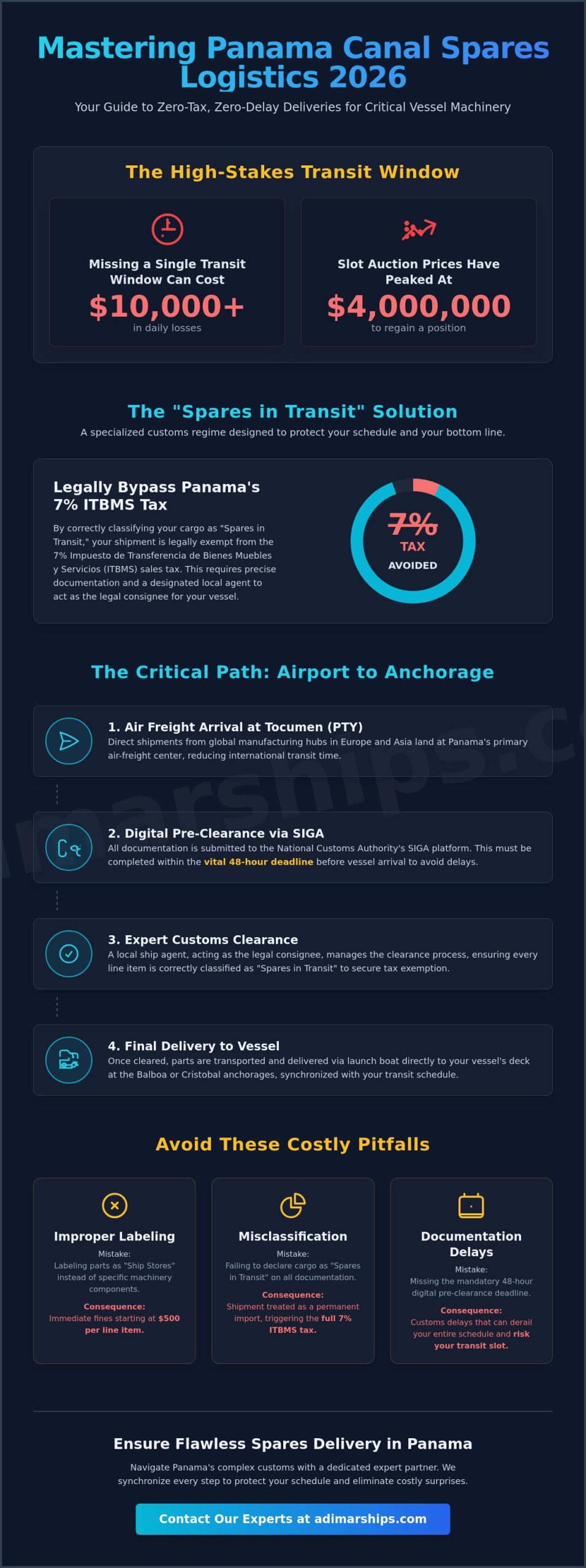
- Learn how to correctly utilize the “Spares in Transit” regime to bypass Panama’s 7% ITBMS tax and avoid unnecessary storage fees at Tocumen International Airport.
- Master the precise synchronization required for a successful ship spare parts delivery panama canal, ensuring critical machinery reaches your vessel without risking your scheduled transit slot.
- Understand the vital 48-hour documentation deadline and the updated 2026 digital pre-clearance protocols mandated by the National Customs Authority.
- Identify common labeling pitfalls, such as misidentifying parts as “Ship Stores,” which can trigger immediate fines starting at $500 per line item.
- Gain a strategic overview of the logistics chain, from coordinating international manufacturers to final delivery via launch boat at the Balboa or Cristobal anchorages.
The Strategic Role of Panama in Vessel Spare Parts Logistics
Vessel spare parts logistics in Panama is the specialized process of clearing and delivering ship machinery without incurring local import duties. It’s a high-stakes operation where precision timing meets strict customs compliance. In 2026, Panama remains the “Grand Central” for maritime spares. Its dual-ocean connectivity, centered around the strategic operations of The Panama Canal, provides an unmatched advantage for global fleets.
The local infrastructure is built for the “just-in-time” model. Shipping companies don’t have the luxury of waiting days for customs clearance. Panama’s logistics ecosystem is designed to move critical components from the tarmac to the anchorage in record time. This speed is supported by a robust network of warehouses and specialized transport services that understand the urgency of a vessel’s schedule. By treating the country as a transit corridor rather than a final destination, operators can maintain their global supply chains with minimal friction.
Panama as a Global Logistics Hub
Tocumen International Airport (PTY) is the engine behind every successful ship spare parts delivery panama canal. As a regional air-freight powerhouse, PTY receives direct shipments from major manufacturers across Europe and Asia. This connectivity offers several key advantages for technical managers:
- Direct Connectivity: Daily flights from global manufacturing centers significantly reduce international transit times.
- Bonded Storage: The proximity of the Colon Free Trade Zone provides secure facilities for the short-term storage of heavy machinery.
- Strategic Staging: Having parts staged near the ports allows for flexible delivery options at either the Balboa or Cristobal anchorages.
Whether your vessel is utilizing the Neopanamax or the original Panamax locks, the ability to coordinate air-freight with maritime arrivals is a massive operational win. It allows technical teams to plan maintenance or repairs with the confidence that their parts are already on the ground and ready for the final leg of the journey.
The Spares in Transit Concept
The “Spares in Transit” regime is a vital financial tool for ship owners. Under this specific customs classification, parts are legally exempt from Panama’s 7% ITBMS (sales tax). To qualify for this exemption, the cargo must be strictly documented as being in transit to a specific vessel currently in or arriving at Panamanian waters.
The ship agent plays a critical role in this process. They act as the vigilant representative for the owner, ensuring the “in-transit” status is maintained throughout the entire customs clearance workflow. Avoiding misclassification is essential. If parts are incorrectly labeled as permanent imports, the owner faces immediate taxes and administrative fines that can quickly escalate. By delegating this oversight to an experienced partner, you protect your bottom line and ensure the ship spare parts delivery panama canal proceeds without the risk of costly tax-related delays.
Navigating the ‘Spares in Transit’ Customs Regime in 2026
Panama’s customs landscape has evolved into a strictly digital environment. In 2026, the Autoridad Nacional de Aduanas requires all maritime cargo to be processed through the SIGA (Sistema Integrado de Gestión Aduanera) platform. This system demands absolute precision and a secure technical foundation. Just as maritime operators rely on specialized agencies for logistics, many enterprises turn to United Data Technologies (UDT) for Managed IT Services and Cybersecurity Assessments to secure and optimize their digital environments. The “Spares in Transit” label isn’t just a helpful suggestion; it’s a legal requirement for tax exemption. Without this specific classification on every piece of international documentation, your shipment is treated as a permanent import. This mistake triggers an immediate 7% ITBMS tax and can lead to administrative fines starting at $500 per line item for data entry errors.
A specialized local agent is mandatory to navigate this regime. Because a vessel is a mobile entity, it cannot act as its own legal consignee under Panamanian law. Your agent steps into this role, providing the legal framework and local tax ID required to receive and clear technical components. Delegating these technical filings to a specialized Ship Agency allows your crew to focus on the transit while we handle the bureaucracy. We act as your vigilant representative, ensuring that every bolt and circuit board is accounted for before it leaves the airport warehouse.
Mandatory Documentation for 2026
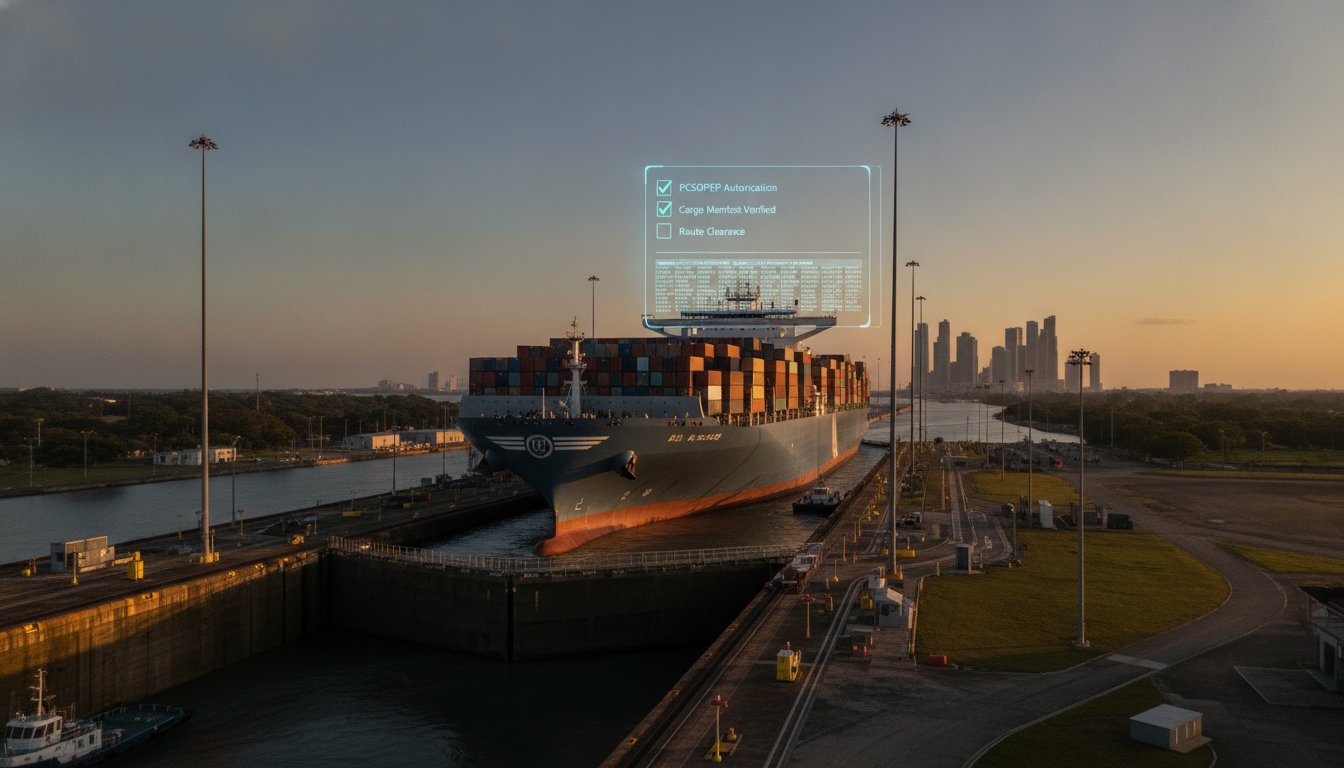
Formatting is everything when dealing with digital pre-clearance. Your commercial invoice and packing list must match exactly. Any discrepancy in weight, quantity, or description can trigger a physical inspection, which inevitably leads to delays. For air freight, the distinction between the Master Air Waybill (MAWB) and the House Air Waybill (HAWB) is critical. The MAWB must explicitly state the vessel’s name, its IMO number, and the port of delivery, whether it’s Balboa or Cristobal. Linking your shipment to the vessel’s specific record within the Panama Canal Authority (ACP) database is the final step in validating your tax-exempt status. If these details aren’t synchronized, the system will reject the filing, causing your ship spare parts delivery panama canal to stall before it even begins.
The 48-Hour Pre-Arrival Protocol
Timing is the most significant factor in avoiding unnecessary costs. Submitting digital document copies at least 48 hours before the cargo arrives at Tocumen International Airport is now the industry standard. This window allows the customs authority to pre-verify the data and issue a release authorization. Early filing is your best defense against “storage fees” at the airport customs warehouse, which can accumulate quickly after the first 24 hours. Your agent’s role is to pre-verify these documents for accuracy. We look for the subtle errors that automated systems flag, such as missing MSDS sheets for engine chemicals or lithium batteries. By catching these issues early, we ensure a seamless transition from the tarmac to the launch boat.
Synchronizing Spares with the Panama Canal Transit Schedule
Timing is the heartbeat of maritime logistics. In the high-stakes environment of the Panama Canal, a two-hour delay at customs isn’t just an inconvenience; it’s a financial risk. Missing a scheduled transit window can lead to daily losses of $5,000 to $10,000. With auction prices for urgent slots reaching $385,000 in early 2026, the cost of a logistics failure is staggering. You don’t just need a delivery; you need a precision-timed maneuver that aligns perfectly with your vessel’s position in the LoTSA 2.0 queue. Every minute spent waiting for a ship spare parts delivery panama canal is a minute that eats into your operational margin.
Coordinating the chain from the manufacturer to the ship’s deck requires a vigilant local partner. We act as your on-the-ground eyes, monitoring the cargo as it moves from Tocumen International Airport (PTY) to the designated port terminal. This process involves a complex dance between the Panama Customs Regulations and the real-time schedule of the canal. We maintain a constant dialogue with your Chief Engineer and the logistics providers to ensure that the moment the launch boat departs, your vessel is ready to receive it at the sea buoy.
The Step-by-Step Delivery Workflow
A successful delivery follows a strict, logical path to ensure zero-delay clearance. Once the cargo touches down at PTY, immediate customs clearance is the priority. Our team handles the digital filing to secure an instant release, followed by secure transport to the Balboa or Cristobal terminals. The workflow includes:
- Immediate Clearance: Pre-verified documentation ensures the cargo leaves the airport within hours of arrival.
- Secure Transit: Dedicated transport moves components directly to the port, avoiding unnecessary warehouse stops.
- Launch Coordination: We time the supply boat’s departure based on the vessel’s AIS position and ACP transit updates.
- Deck Delivery: Parts are delivered directly on board, and we secure a signed Proof of Delivery (POD) for your records.
Managing Anchorage Deliveries: Balboa vs. Cristobal
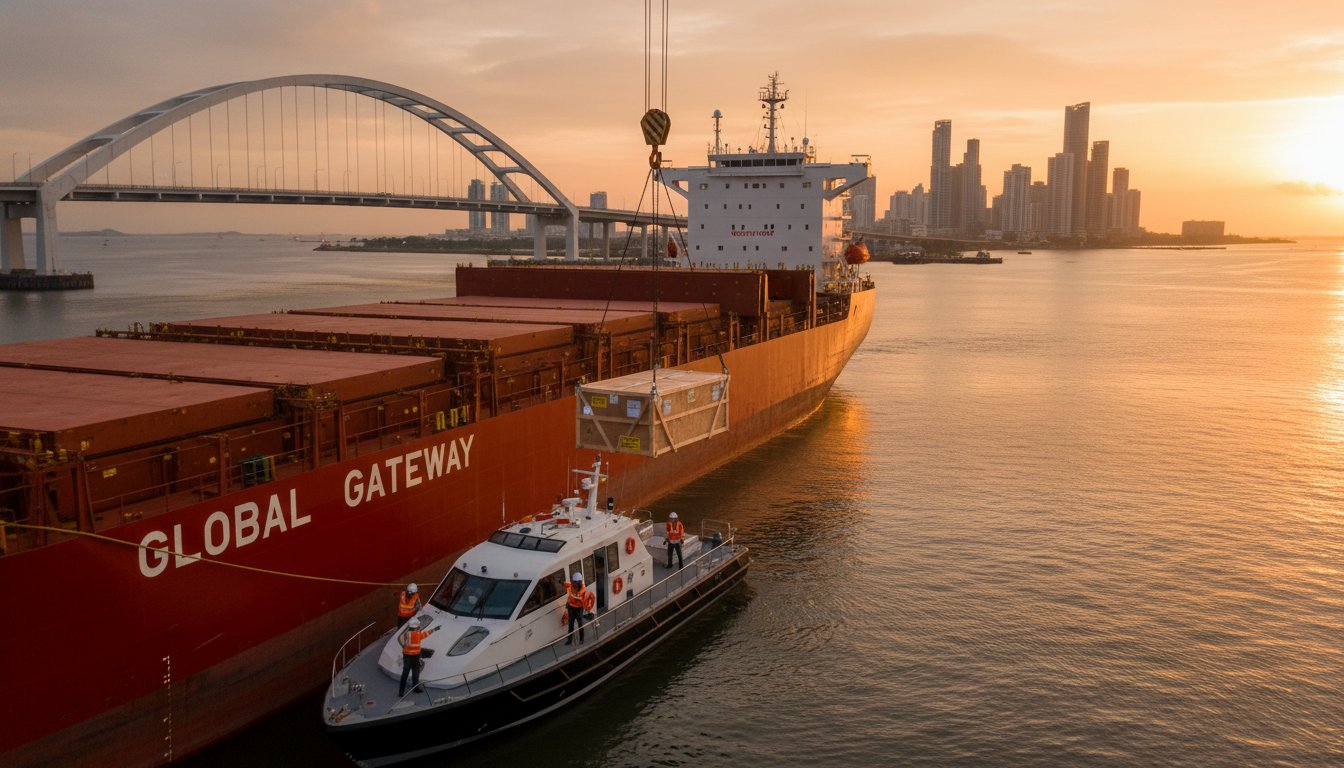
The geographical choice between the Pacific (Balboa) and Atlantic (Cristobal) anchorages dictates your logistics strategy. Balboa is often the busier hub, requiring more lead time for launch coordination due to the high density of vessel traffic. Cristobal, while often less congested, can be more exposed to weather conditions. During the rainy season, contingency planning is essential. We monitor sea states to ensure that launch boats, which typically cost between $350 and $1,200 depending on distance and cargo volume, can safely reach your vessel. For heavy engine blocks or oversized machinery, we select specialized barges equipped with the necessary crane capacity to ensure a safe transfer on deck.
Risk Mitigation: Avoiding Pitfalls in Panama Spares Logistics
Precision protects your budget. The most expensive mistake in Panamanian maritime logistics is a simple labeling error. Incorrectly identifying your cargo as “Ship Stores” rather than “Spares in Transit” is the primary cause of customs delays and unexpected costs. While “stores” are intended for consumption on board, “spares” are technical components necessary for the vessel’s operation. This distinction is the difference between a smooth delivery and a week-long customs audit that triggers a 7% ITBMS tax and administrative fines. We act as your vigilant representative on the ground, pre-verifying every commercial invoice to ensure your cargo maintains its tax-exempt status from the moment it touches the tarmac.
Emergency “Aircraft on Ground” (AOG) style marine spares require a different level of agility. When a vessel is already mid-transit and a critical component fails, there’s no room for error. We specialize in these high-pressure scenarios, staging parts at the next available anchorage to meet the vessel the moment it exits the locks. This proactive approach prevents Port State Control issues that could lead to a vessel being detained. Our role is to provide the local oversight that standard logistics providers lack, ensuring that even “Lost in Transit” items at the airport are tracked down and cleared before your vessel reaches the sea buoy. For complex technical needs, delegating these tasks to a specialized Ship Agency provides the security your fleet requires.
Common Compliance Failures and How to Avoid Them
Compliance isn’t just about paperwork; it’s about accuracy in the digital SIGA platform. Many technical managers fall into predictable traps that result in cargo being held indefinitely. To keep your logistics on track, avoid these common failures:
- Misdeclared Values: Invoices that don’t match the digital filing can lead to customs audits and fines starting at 500 US dollars per line item.
- Missing “Notify Party”: Failure to provide a local contact on the Air Waybill often results in cargo sitting unclaimed at Tocumen Airport because the carrier can’t reach the agent.
- Generic Courier Risks: Using standard international couriers for the “last mile” is dangerous. These providers often lack the permits to deliver directly to the ship’s deck at anchorage, leading to parts being abandoned at port gates.
Handling High-Value and Critical Machinery
Sensitive electronics and precision engine components require more than just transport; they need “white glove” handling. We coordinate specialized transport that minimizes vibration and environmental exposure during the journey from the airport to the port terminal. This level of care extends to the final transfer. Ensuring proper insurance coverage for the move from the launch boat to the vessel is a critical step that many managers overlook. By treating your machinery as if it were our own, we provide the peace of mind that your high-value assets are protected until they’re safely in the hands of your Chief Engineer.
Adimar Shipping: Your Expert Logistics Partner in Panama
Adimar Shipping, Inc. acts as a proactive extension of your technical team. We don’t just wait for cargo to arrive; we anticipate the needs of your vessel long before it reaches Panamanian waters. With over 20 years of local expertise navigating the complexities of the Panama Canal Authority (ACP) and the National Customs Authority, we provide the stability and local knowledge required for a seamless transit. Our approach is built on the “Adimar Advantage,” a combination of absolute transparency, high ethical standards, and 24/7 responsiveness. We understand that in the maritime industry, silence is often the precursor to a delay. That’s why we maintain constant communication with all stakeholders to ensure your ship spare parts delivery panama canal is executed with precision.
Efficiency is maximized when you consolidate your operational needs. By integrating spare parts delivery with our full husbandry services, we reduce the administrative burden on your crew and technical managers. This integrated model allows for the synchronization of multiple tasks, such as crew changes, provision delivery, and technical spares, under a single point of contact. This not only lowers launch hire costs but also ensures that every service aligns perfectly with your vessel’s transit schedule. We serve as your vigilant eyes on the ground, protecting your interests at every turn.
A Proactive Approach to Logistics
Our logistics oversight begins long before the cargo reaches the airport. We track critical components from the factory gate to ensure we’re ready for clearance the moment they land in Panama. This vigilance extends to the port terminal, where we maintain strong relationships with local launch boat operators to secure priority at the anchorages. As your authorized Panama Canal ships agent, we provide full transit coordination that bridges the gap between technical logistics and canal operations. We’re your on-the-ground representatives, ensuring that every delivery is documented, verified, and safely on deck.
Beyond Spares: Full Owner’s Support
We provide more than just technical logistics; we offer comprehensive owner’s support. Combining your spares delivery with crew changes or bunkering operations creates a streamlined workflow that saves both time and money. Our commitment to ethical conduct is non-negotiable. You’ll always receive transparent, itemized billing with no hidden fees or unexpected costs. We believe that trust is earned through consistent performance and honest communication. Contact us today for a customized logistics plan that secures your vessel’s operational freedom and ensures a stress-free passage through the Panama Canal.
Securing Your Fleet’s Operational Future in Panama
Navigating the 2026 logistics landscape requires a blend of technical precision and local regulatory mastery. By correctly utilizing the “Spares in Transit” regime and meeting digital filing deadlines, you eliminate the risk of tax-related delays and administrative fines. Successful coordination ensures your critical machinery is ready at the sea buoy, allowing your vessel to maintain its position in the transit queue without interruption. Delegating these complexities to an expert partner turns a potential bottleneck into a streamlined operational advantage, protecting both your schedule and your bottom line.
Adimar Shipping, Inc. provides the protection and oversight required to manage these high-stakes deliveries. With 20+ years of local Panama Canal expertise and a specialized customs clearance team, we serve as your vigilant representative on the ground. As an authorized PCSOPEP representative, we ensure your ship spare parts delivery panama canal is executed with the highest standards of transparency and efficiency. Secure your vessel’s spares delivery with Adimar Shipping, Inc. and gain the operational freedom your fleet deserves. We are ready to safeguard your next transit.
Frequently Asked Questions
What are ‘Spares in Transit’ in Panama and why does the classification matter?
‘Spares in Transit’ is a specific customs classification for technical components destined for a vessel in Panamanian waters. This designation is vital because it allows the cargo to enter the country without being subject to local import duties or the 7% ITBMS tax. To maintain this status, the documentation must explicitly link the parts to the vessel’s IMO number and arrival schedule. It’s the only way to ensure tax-free entry for critical machinery.
Can I deliver spare parts to my vessel while it is transiting the Panama Canal locks?
No, you cannot deliver spare parts while a vessel is actively transiting the canal locks. Safety regulations strictly prohibit any external contact or delivery operations during the lockage process. All ship spare parts delivery panama canal must take place at the designated anchorages in Balboa or Cristobal either before the transit begins or after it is completed. Timing your arrival at the sea buoy is essential for a successful transfer.
What is the ITBMS tax in Panama and how can I avoid it for ship spares?
The ITBMS is Panama’s 7% sales and services tax applied to most imported goods. You can avoid this tax on ship spares by ensuring they’re correctly labeled as “Spares in Transit” on all shipping documents. Your agent must also file the digital pre-clearance through the SIGA platform at least 48 hours before the cargo arrives at the airport. Failure to follow this protocol results in the tax being applied immediately without recourse.
Which airport is best for shipping vessel spares into Panama for a canal transit?
Tocumen International Airport (PTY) is the primary gateway for all maritime logistics in the region. It serves as a major air-freight hub with direct connections to manufacturing centers in Europe, Asia, and North America. Its proximity to both the Pacific and Atlantic ports makes it the most efficient choice for a ship spare parts delivery panama canal. Most international couriers and cargo airlines prioritize PTY for its robust infrastructure and customs processing capabilities.
How long does it typically take to clear customs for marine spares in Panama?
Customs clearance typically takes between 24 and 48 hours when documents are submitted in advance. The 2026 digital filing protocols through the SIGA system have streamlined the process, allowing for almost immediate release upon arrival if the data matches the physical cargo. Delays only occur when there are discrepancies in the commercial invoice or packing list. Having a vigilant agent on the ground is the best way to prevent these administrative bottlenecks.
What happens if my parts arrive in Panama after the vessel has already transited?
If your parts arrive late, your agent can store them in a secure, bonded warehouse until they can be forwarded. We can arrange for the spares to be sent to the vessel’s next port of call or held for a future transit. This avoids paying permanent import taxes, as the cargo maintains its “in-transit” status while under our supervision. It’s a common contingency that requires close coordination with your technical team.
Do I need a separate customs broker for my ship spares in Panama?
You don’t need to hire a separate customs broker if you’re working with a full-service ship agency. We act as the legal consignee and handle all customs interactions, digital filings, and physical clearances. Delegating this to your agent ensures that the technical logistics are perfectly synchronized with the vessel’s husbandry needs and transit schedule. This integrated approach reduces communication errors and speeds up the final delivery to the deck.
Is it better to deliver spares at the Balboa (Pacific) or Cristobal (Atlantic) anchorage?
The choice depends on your vessel’s direction and the current traffic density. Balboa is the preferred location for vessels arriving from the Pacific, while Cristobal serves those coming from the Atlantic. Balboa offers more frequent launch boat availability but can be more congested. Cristobal is often faster for Atlantic-bound ships, though it’s more susceptible to weather delays during the rainy season. We help you choose the best option based on real-time canal conditions.