

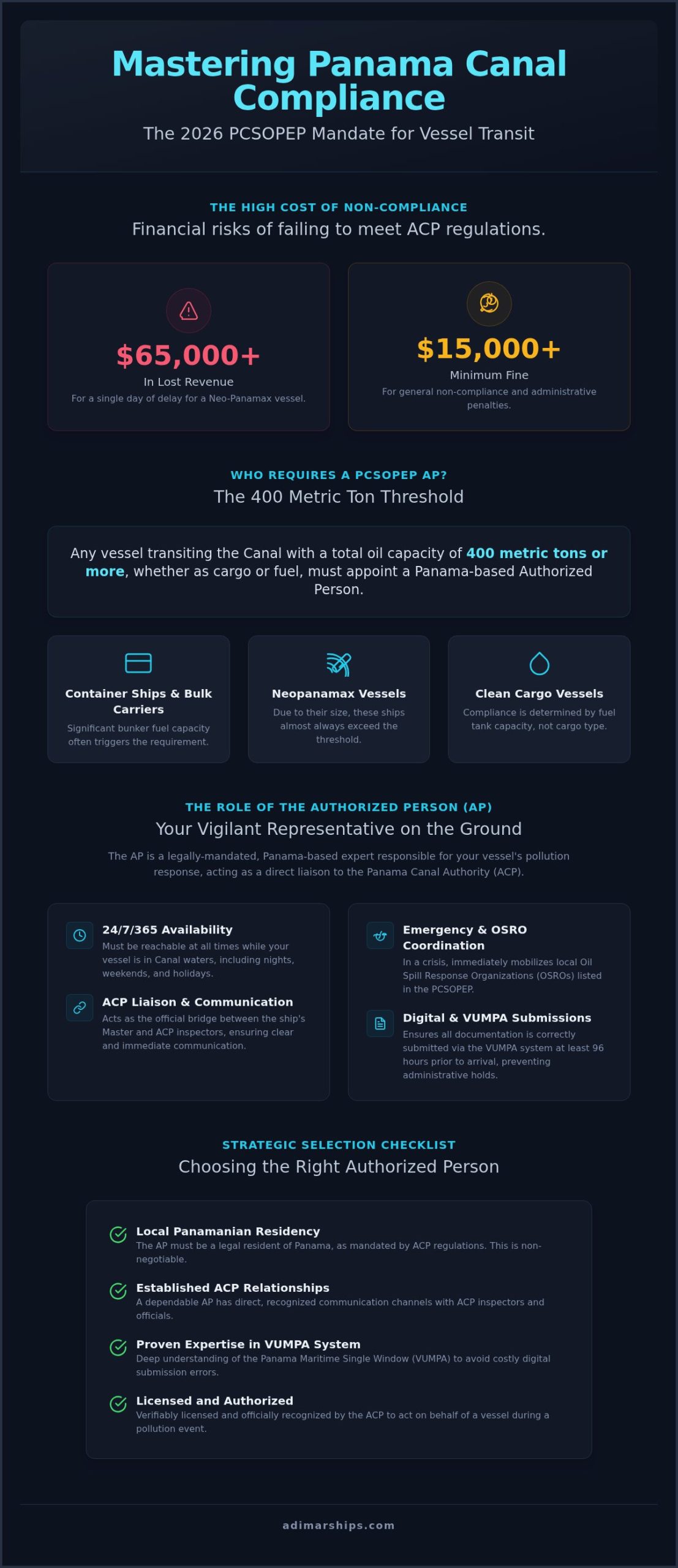
A single day of delay for a Neo-Panamax vessel can cost your operations upwards of $65,000 in lost revenue. For ship owners, the pressure to meet the Panama Canal Authority’s strict 96-hour notification window is immense. You already know that local regulations are far more demanding than standard international MARPOL plans. Securing reliable vessel agency services Panama isn’t just about paperwork; it’s about protecting your bottom line from a minimum $15,000 fine for general non-compliance.
It’s understandable to feel anxious about the 24/7 reliability of your local representatives. You need a partner who acts as your vigilant eyes and ears on the ground. This guide provides a clear roadmap for mastering Panama Canal pollution regulations in 2026. You’ll learn exactly how to select a PCSOPEP Authorized Person who ensures seamless transit and maintains a direct line to ACP inspectors. We’ll break down the critical responsibilities of the AP and the specific criteria that separate a standard agent from a dependable local expert who understands the high stakes of your transit.
Key Takeaways
- Understand why vessels with an oil capacity of 400 metric tons or more require a PCSOPEP distinct from international MARPOL standards.
- Learn about the legal mandate for a Panama-based Authorized Person to provide 24/7 emergency liaison with the Canal Authority.
- Avoid administrative penalties and general non-compliance fines that can exceed $15,000 by mastering the VUMPA digital submission process.
- Identify the essential criteria for selecting vessel agency services Panama, focusing on local residency and established ACP relationships.
- Discover how Adimar Shipping, Inc. acts as your vigilant local representative to ensure a seamless transit without pollution-related delays.
What is a PCSOPEP Authorized Person and Why is it Mandatory?
The Panama Canal is more than a transit route; it is the primary source of drinking water for over two million people. To protect this vital watershed, the Panama Canal Authority (ACP) mandates a localized Panama Canal Ship Oil Pollution Emergency plan (PCSOPEP). This requirement applies to any vessel carrying 400 metric tons or more of oil, whether as cargo or fuel. It is a distinct, high-stakes regulation that requires a dedicated local representative. You can’t simply apply international standards and expect a smooth transit.
While traditional vessel agency services Panama manage your logistics and husbandry, the Authorized Person (AP) fills a specific legal niche. The AP is not just another agent; they are a licensed, Panama-based individual who carries the legal and financial responsibility for your vessel’s pollution response. They must be available 24/7 to liaise with ACP inspectors and activate emergency protocols. The Canal’s unique freshwater ecosystem demands a level of response and local accountability that international MARPOL standards simply don’t cover.
The Legal Framework: ACP Regulations for 2026
The ACP operates under a strict environmental protection mandate. This isn’t just about maritime safety; it’s about national security for Panama’s water supply. Global SOPEP plans are often rejected because they lack the specific resource lists and local contact requirements defined in ACP Notice N-12-2026. According to ACP Article 20, the Authorized Person is the legal entity residing in Panama who is officially recognized and authorized to act on behalf of the vessel during a pollution event.
Who Needs an Authorized Person?
Compliance isn’t limited to tankers. Any vessel transiting the Canal, from Panamax to Neopanamax classes, must comply if its total oil capacity exceeds the 400 MT threshold. This includes:
- Container ships and bulk carriers: These vessels often carry significant bunker fuel that triggers the requirement even if they aren’t carrying oil as cargo.
- Neopanamax vessels: Given their size, these ships almost always exceed the threshold and require a verified AP.
- Clean cargo vessels: Even if your cargo is “clean,” your fuel tanks determine your compliance status.
Choosing the right partner means ensuring your AP has the local presence and direct recognition from the ACP to prevent costly delays at the locks. Delegating this task to an experienced local expert ensures your vessel remains in full compliance with the latest 2026 standards.
Core Responsibilities: What Your AP Does During Transit
The Authorized Person (AP) serves as your vessel’s primary defender during every minute of its transit through the Panama Canal. While standard vessel agency services Panama focus on the logistics of arrival and departure, the AP remains in a constant state of alert. They aren’t just a point of contact; they are an active participant in the Canal’s Incident Management System (IMS). Their role is to ensure that if a pollution risk arises, the response is immediate, professional, and compliant with local laws.
- 24/7/365 Availability: The AP must be reachable every second your ship is in Canal waters, including holidays and weekends.
- IMS Liaison: They act as the bridge between the ACP’s emergency center and the ship’s Master, ensuring instructions are followed without delay.
- OSRO Coordination: In a crisis, the AP immediately mobilizes local Oil Spill Response Organizations (OSROs) to contain the situation.
Liaison and Communication Protocols
Clear communication is the difference between a minor delay and a major incident. Your AP manages the digital flow of information through the Panama Maritime Single Window (VUMPA). They verify that all vessel data matches the submitted PCSOPEP documents at least 96 hours before your arrival. When ACP boarding officers step onto your deck, they expect every piece of environmental documentation to be current and accessible. The AP ensures your crew is prepared for these inspections, preventing administrative setbacks that can lead to the forfeiture of your transit slot.
Emergency Response and Spill Management
If an incident occurs, the Master’s first call is to the ACP, but the AP’s role is what follows. They activate the local response resources listed in your plan. This involves coordinating with specialized cleanup contractors and managing the logistical burden of the response on the ground. Because the AP is legally responsible, they handle the immediate local coordination and ensure the cleanup meets the ACP’s rigorous environmental standards.
Rapid local response is the only way to protect your interests from escalating operational costs. A delay in activating the OSRO can lead to mounting fines and prolonged operational paralysis. By delegating these high-stakes tasks to experienced local representatives, you ensure that someone who knows the local inspectors is always watching over your transit. This vigilance allows your team to focus on navigation while we handle the regulatory complexities in Panama City.
The High Cost of Non-Compliance: Fines and Delays
The Panama Canal Authority doesn’t tolerate administrative oversights. In 2026, the VUMPA digital system serves as a real-time monitor for every vessel’s compliance status. If your PCSOPEP plan is rejected or submitted past the 96-hour pre-arrival window, your vessel faces an immediate minimum administrative fine of $2,500. For more severe cases of non-compliance, such as an invalid plan or an unreachable Authorized Person during transit, the minimum fine jumps to $15,000. These aren’t just numbers; they are avoidable drains on your voyage’s profitability.
Beyond the fines, the operational paralysis is often the greater threat. A rejected plan means your vessel loses its transit slot. For a Neo-Panamax vessel, a single day of delay can translate to $65,000 in lost revenue. This is why specialized vessel agency services Panama are vital. They ensure your documentation is flawless before the ACP ever sees it. Choosing the right vessel agency services Panama ensures your AP is always reachable and your data is perfectly synchronized with VUMPA requirements.
Common Regulatory Pitfalls in Panama
Many ship owners fall into the trap of using outdated contact information. If the ACP attempts to reach your Authorized Person and receives no response, your vessel is deemed non-compliant. Mismatched data between the ship’s actual oil capacity and the database entry is another frequent cause for rejection. These errors often occur when using non-specialized agents who don’t understand the nuances of Notice N-12-2026. A vigilant partner prevents these clerical errors from becoming financial disasters through proactive verification.
Operational Delays: A Ship Owner’s Greatest Risk
Compliance issues trigger a cascading effect. When a ship is pushed to the back of the transit queue, it misses its next port call. This leads to demurrage claims and potential breaches of charter agreements. The ACP’s zero-tolerance policy regarding notification windows means there’s no room for negotiation once a deadline passes. You can find more detail on avoiding these bottlenecks in our Panama Canal Transit: The Complete Guide for Ship Operators.
Trusting your compliance to a reliable local expert isn’t just a legal necessity; it’s a strategic move to protect your operational freedom. By delegating these complex tasks, you ensure that your vessel moves through the locks without the shadow of a pollution-related delay. We act as your local eyes and ears, ensuring every digital submission is accurate and every deadline is met.
Strategic Checklist: Choosing the Right Authorized Person
Choosing a PCSOPEP Authorized Person shouldn’t be a last-minute administrative decision. It’s a strategic choice that determines how quickly your vessel resolves potential conflicts with the Panama Canal Authority. Many operators treat the AP as a simple checkbox requirement. However, a truly effective partner serves as a proactive safeguard against operational paralysis. You need an expert who understands the local regulatory climate and possesses the infrastructure to respond instantly to any ACP inquiry. This vigilance is the foundation of reliable vessel agency services Panama.
Local Expertise vs. Remote Consultants
Physical presence in Panama City is non-negotiable. While global compliance firms offer remote consulting, they lack the boots on the ground necessary for an immediate spill response. A Panama-based AP lives and works in the same time zone as the Canal. They have established professional relationships with ACP inspectors, which often leads to faster problem resolution. When an inspector has a question about your vessel’s data, having a local representative who can provide immediate clarification is invaluable. This local knowledge factor is what keeps your transit on schedule.
Integration with Ship Agency Services
Efficiency is born from delegation. When you combine your AP role with comprehensive vessel agency services Panama, you reduce your administrative burden significantly. A single point of contact manages your transit scheduling, compliance documentation, and logistical needs simultaneously. This integrated approach ensures that your husbandry requirements don’t clash with your compliance deadlines. For instance, while your AP verifies your PCSOPEP status, your agent can coordinate crew changes or spare parts delivery. You can explore how these roles overlap in our A Comprehensive Guide to Ship Husbandry Services in Panama.
Selecting a partner with a Ship Agency First mentality ensures that compliance never happens in a vacuum. It’s about protecting your interests through every phase of the transit. If you’re looking for a partner who acts as your vigilant local eyes and ears, you should contact Adimar Shipping today. Our team provides the security and reliability needed to navigate the Canal’s strict environmental standards without fear of fines or delays.
Adimar Shipping, Inc.: Your Vigilant Partner for PCSOPEP Compliance
Adimar Shipping, Inc. doesn’t just manage paperwork; we act as your local eyes and ears on the ground. Our team understands that for ship owners, the Panama Canal represents a high-stakes environment where compliance is the only path to profitability. We treat every vessel as if it were our own local office. This personalized approach is why we are a trusted provider of vessel agency services Panama. Whether you’re managing a Panamax bulk carrier or a massive Neopanamax container ship, our philosophy remains the same: total vigilance.
Our 2026 commitment is clear. We provide 24/7/365 availability to ensure that your vessel is never left without a direct liaison to the Panama Canal Authority. With increasing digitalization and stricter environmental enforcement, having a partner who knows the ACP inspectors personally is a critical safeguard. We bridge the gap between your global operations and the specific, local demands of the Canal’s watershed protection rules. Adimar Shipping, Inc. has handled the most complex environmental compliance scenarios, ensuring that our clients avoid the operational paralysis caused by regulatory delays.
The Adimar Advantage: Local Knowledge, Global Standards
Our headquarters in the San Francisco district of Panama City is strategically located for rapid response. We don’t rely on remote consultants or third-party contractors to fulfill our role as your Authorized Person. When an incident occurs or an inspector requires immediate vessel data, our team is ready to act. This physical presence allows Adimar Shipping, Inc. to maintain the highest ethical standards and provide transparent communication to owners across the globe. You’re never just a number in a database; you’re a partner whose interests we protect through every lock and lake.
We bring decades of experience to the table. Ensuring smooth transits requires more than just technical knowledge; it requires a deep understanding of the local maritime culture. We’ve built our reputation on reliability and speed, ensuring that your interests are protected from the moment your ship enters Canal waters until it clears the final lock. Our seasoned experts provide the stability you need in a fast-paced transit environment.
Seamless Transit Integration
Compliance shouldn’t be a separate headache. We coordinate your PCSOPEP requirements directly with our Owner’s Nominated Agency services. This integration creates a single, streamlined point of contact for your entire transit. It eliminates the need for redundant communication and reduces the administrative burden on your ship managers. By combining our vessel agency services Panama with specialized AP duties, Adimar Shipping, Inc. ensures that husbandry, logistics, and pollution compliance move in perfect synchronization.
Our digital portal provides a secure, efficient way to manage your documentation. We’ve simplified the submission process to ensure that your vessel meets the 96-hour notification window every time. By delegating these complex tasks to a specialist, you gain the operational freedom to focus on your core business. Contact Adimar Shipping, Inc. to appoint your PCSOPEP Authorized Person today and experience the peace of mind that comes with expert local representation.
Mastering Your 2026 Panama Canal Transit Compliance
Navigating the Canal’s environmental mandates is a strategic necessity for modern ship owners. You now recognize that a compliant PCSOPEP and a dependable Authorized Person are the primary defenses against administrative fines and transit delays. By prioritizing a partner with physical residency in Panama City, you ensure that your vessel meets every 2026 digital requirement and boarding inspection with ease. This proactive approach eliminates the stress of last minute rejections in the VUMPA system.
The distinction between global MARPOL plans and local ACP regulations is critical for maintaining your transit slot. Entrusting these responsibilities to Adimar Shipping, Inc. allows your crew to focus on safe navigation while we handle the regulatory liaison on the ground. Delegating these specialized tasks is the most efficient way to protect your voyage’s profitability and schedule. We act as your local eyes and ears, ensuring every digital submission is accurate and every deadline is met.
Adimar Shipping, Inc. provides the vigilance your operations demand. We offer comprehensive vessel agency services Panama backed by our status as an ACP-recognized Authorized Person. Our 24/7 emergency liaison and integrated husbandry services provide a seamless, all-in-one solution for your fleet. We’re committed to protecting your interests through every lock and lake.
Secure Your Panama Canal Transit with Adimar Shipping, Inc.’s PCSOPEP Services and enjoy the peace of mind that comes with expert local representation. We’re ready to guide your vessel safely through the locks.
Frequently Asked Questions
What is the difference between SOPEP and PCSOPEP?
PCSOPEP is a localized requirement specific to the Panama Canal’s freshwater watershed. While a standard SOPEP plan meets international MARPOL standards, it lacks the local resource lists and the mandatory Panama-based contact required by the ACP. Any vessel with an oil capacity of 400 metric tons or more must have this unique plan to protect the drinking water of millions of Panamanian citizens.
Can my regular ship agent act as my PCSOPEP Authorized Person?
Yes, if they hold the specific ACP recognition. Not every provider of vessel agency services Panama is qualified to serve as an Authorized Person. The AP role carries unique legal and financial liabilities that differ from traditional husbandry or logistics. You should confirm that your agent has a dedicated, licensed team available 24/7 to handle pollution-related emergencies and ACP liaison duties.
How often does a vessel’s PCSOPEP plan need to be updated?
A vessel’s plan remains valid for four years from the date of approval. However, you must submit updates immediately if there are changes to the ship’s oil capacity, name, or Authorized Person contact information. Keeping these details current in the VUMPA digital portal is essential to avoid administrative fines and ensure your vessel remains eligible for its scheduled transit slot.
What happens if my Authorized Person is unreachable during an incident?
If your AP is unreachable, the ACP considers the vessel to be in a state of non-compliance. This can lead to heavy fines and the immediate suspension of your transit. The ACP expects a response at any time, day or night. This is why we maintain a 24/7 emergency liaison office in Panama City to ensure your interests are always protected.
Is a PCSOPEP Authorized Person required for vessels in ballast?
Yes, the requirement is based on the ship’s total capacity for oil as fuel or cargo. Ballast vessels often carry bunker fuel well in excess of the 400 metric ton threshold. Since most commercial vessels exceed this capacity, they require an AP regardless of their current load. The regulation focuses on the potential risk to the freshwater ecosystem rather than the cargo status.
How long does it take for the ACP to approve a new PCSOPEP plan?
The ACP requires electronic submission at least 96 hours before your arrival in Canal waters. Approval times can vary, but a well-prepared plan submitted through experienced vessel agency services Panama usually moves through the system without issue. It’s best to allow extra time for data verification to ensure your transit slot isn’t forfeited due to a last-minute documentation error.
What are the specific residency requirements for an AP in Panama?
The Authorized Person must be a resident of Panama and have a physical office in the country. This residency requirement ensures the AP is legally accountable under Panamanian law and can communicate directly with ACP inspectors without time zone delays. Remote consultants can’t fulfill this mandate because the ACP requires a local representative who can provide immediate on-the-ground coordination.
Does the AP handle the actual oil spill cleanup?
The AP doesn’t perform the physical cleanup but coordinates the entire response. They are responsible for activating the local Oil Spill Response Organizations (OSROs) and managing the communication between the ACP and the ship’s Master. Their role is to handle the legal and logistical aspects of the incident, ensuring that all local environmental protocols are followed to the letter.