
A single clerical error in your VUMPA filing can trigger a $15,000 fine before your vessel even reaches the Gatun Locks. In the high-stakes environment of the Panama Canal, compliance isn’t just about paperwork; it’s about protecting your bottom line from avoidable delays. You’ve likely felt the pressure of managing the strict 96-hour notification window across different time zones while trying to decode the updated Tier classifications for 2026. It’s a heavy burden for any operations team to carry alone.
We understand that you need more than just a vendor; you need a vigilant local partner who acts as a professional extension of your own team. By utilizing specialized PCSOPEP compliance services Panama, you can master the complexities of the latest ACP regulations and ensure your vessel moves through the canal without a second of downtime. This article explores the mandatory digital submission requirements under OP Notice N-01-2026, the critical role of a resident Authorized Person, and the specific strategies you need to maintain full regulatory compliance and secure a seamless transit.
Key Takeaways
- Understand why a standard MARPOL SOPEP is insufficient and how to meet the unique, Panama-specific requirements of ACP Chapter IX.
- Identify your vessel’s specific 2026 Tier classification to ensure your spill response plan aligns with new oil carrying capacity thresholds.
- Learn how professional PCSOPEP compliance services Panama provide the mandatory resident Authorized Person required for 24/7 liaison with canal authorities.
- Master the 96-hour notification window and the essential document checklist required for successful machine-validated submissions through the VUMPA system.
- Discover how local expertise simplifies complex logistics by bridging the gap between regulatory compliance and essential husbandry services.
Navigating PCSOPEP Compliance: Why Panama Canal Regulations Demand Local Expertise
Transiting the Panama Canal requires more than just standard maritime protocols. For any vessel carrying 400 metric tons or more of oil, fuel, or cargo, the Panama Canal Ship Oil Pollution Emergency Plan (PCSOPEP) is a mandatory requirement. The Panama Canal Authority (ACP) enforces these rules under Chapter IX of the Vessel Regulations with a policy of zero tolerance. Relying on generic PCSOPEP compliance services Panama isn’t enough; you need a partner who understands that the ACP treats a minor clerical error with the same severity as a technical failure. Compliance is a 24/7 commitment that starts long before the vessel reaches the locks.
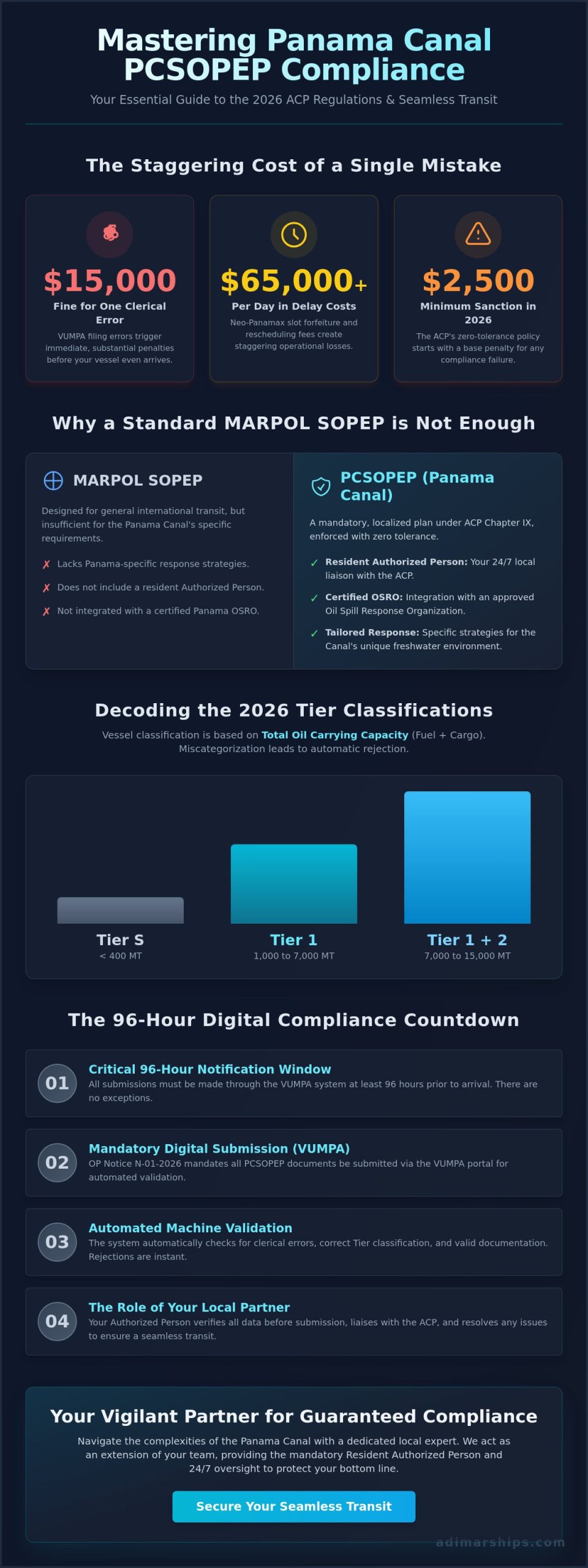
The financial risks of non-compliance are steep and immediate. As of 2026, the minimum sanction for failing to meet these standards starts at $2,500. However, clerical mistakes or missed notification windows can quickly escalate into fines reaching $15,000. Beyond the direct penalties, a vessel denied transit faces staggering operational costs. For Neo-Panamax operators, slot forfeiture and rescheduling fees can exceed $65,000 per day. These aren’t just theoretical risks; they’re the daily reality of modern canal operations.
Think of a local Authorized Person as your “eyes on the ground.” In the complex environment of the Canal, we act as a vigilant extension of your team. We don’t just file forms; we monitor the regulatory landscape to protect your vessel’s interests. This local oversight is your best defense against the automated rejection systems used by the ACP. Having a representative who understands the local geography and administrative nuances ensures that your vessel remains a priority rather than a statistic in a queue of delayed ships.
PCSOPEP vs. MARPOL SOPEP: Understanding the Difference
A standard international MARPOL SOPEP is designed for global transit, but it’s insufficient for a Panama Canal crossing. The ACP demands a plan that includes a resident Authorized Person and a certified Oil Spill Response Organization (OSRO). These “Panama-only” requirements often catch global operators off guard. A localized response strategy tailored to the Canal’s unique freshwater environment and narrow channels is non-negotiable for approval.
The Evolution of Panama Pollution Regulations in 2026
The implementation of OP Notice to Shipping No. N-01-2026 has fundamentally changed the compliance landscape. All plans must now be submitted through the VUMPA (Single Window for Maritime Electronic Arrival) system for machine validation. This shift toward total digitalization means that version tracking and submission dates are automated. The ACP’s focus on environmental ESG standards has increased the frequency of unannounced drills, making the readiness of your local partner more critical than ever.
Decoding the 2026 Tier Classifications and Requirements
Determining your vessel’s specific category is the first step toward a successful transit. The Panama Canal Authority (ACP) uses a tiered system to scale response capabilities based on a vessel’s potential pollution risk. This classification isn’t just about the size of the ship; it’s calculated using the total oil carrying capacity, which includes both fuel and cargo. Relying on the official PCSOPEP requirements is essential to ensure your vessel isn’t miscategorized during the VUMPA submission process. Miscalculations often lead to automated rejections and subsequent transit delays.
The 2026 regulations define four distinct categories. Tier S (Small) covers vessels with less than 400 MT of oil capacity. While these vessels face fewer requirements, they still fall under ACP oversight. For the vast majority of commercial fleets, the requirements start at the 400 MT threshold. To navigate these technicalities without friction, many operators choose to delegate these calculations to professional PCSOPEP compliance services Panama. This ensures that every piece of spill response equipment and every personnel certification meets the ACP’s strict formulas.
Tier 1 and Tier 2: The Core of Commercial Transit
Tier 1 applies to vessels with an oil carrying capacity of more than 1,000 MT up to 7,000 MT. Once a vessel’s capacity exceeds 7,000 MT but remains under 15,000 MT, it must meet both Tier 1 and Tier 2 standards. These classifications demand detailed documentation of on-board response gear and verified contracts with local responders. Maintaining this level of readiness requires constant oversight. You can simplify this process by partnering with a reliable owner’s nominated agency that treats your fleet’s compliance as their own priority.
Tier 3: Large Scale Compliance for Tankers and Bulkers
Vessels with a carrying capacity exceeding 15,000 MT represent the highest pollution risk. These ships must comply with Tier 1, Tier 2, and Tier 3 requirements simultaneously. Compliance at this level is complex; it requires deep coordination with local Oil Spill Response Organizations (OSROs) to ensure heavy-duty resources are available 24/7. Your Authorized Person acts as the critical link here. They manage the specialized protocols and emergency communication channels that the ACP expects for high-capacity vessels. When the stakes are this high, having a local partner who understands the nuances of Tier 3 logistics provides the security you need for a seamless transit.
The Authorized Person (AP) is the cornerstone of your vessel’s legal and operational standing in Panama. Far from being a mere administrative requirement, the AP serves as the primary legal liaison between your vessel and the Panama Canal Authority. Choosing the right partner for PCSOPEP compliance services Panama means securing a representative who understands the weight of this responsibility. The ACP mandates that an AP must be a resident of Panama and available every second of every day. In the maritime world, office hours are a foreign concept. If a situation arises at 03:00 on a Sunday, your AP must be ready to act immediately.
This role also carries significant financial implications. The AP ensures that the vessel is covered by a contract with a certified Oil Spill Response Organization, providing the financial and operational guarantees the ACP requires. By delegating these complex bureaucratic tasks to a local PCSOPEP Authorized Person, you free your operations team to focus on the voyage itself. We act as a vigilant extension of your staff, managing the intricate details of Panamanian law so you don’t have to. Trusting a local expert isn’t just about compliance; it’s about operational freedom.
Emergency Response Coordination
In the event of an incident, the first 60 minutes are decisive. Your AP takes charge as the on-the-ground representative, coordinating between the vessel master, local tug services, and the ACP. We establish clear communication protocols to ensure everyone is aligned. This immediate response minimizes environmental impact and protects the shipowner from escalating liabilities. We speak the language of the authorities and understand the local terrain, allowing us to navigate the crisis with precision and calm.
Administrative Vigilance and Plan Maintenance
Compliance is a dynamic process, not a one-time filing. The Panama Canal Authority PCSOPEP Regulations require annual plan reviews and periodic updates to stay valid. We ensure that every piece of data, from crew contact lists to vessel technical specifications, remains current in the VUMPA system. Proactive compliance audits are a standard part of our service. By identifying potential issues before your vessel reaches the Atlantic or Pacific entries, we eliminate the risk of last-minute transit denials. This level of oversight ensures your plan is always ready for an unannounced ACP inspection.
The 96-Hour Compliance Countdown: A Step-by-Step Submission Process
Timing is the most critical variable in a successful transit. The 96-hour pre-arrival notification isn’t just a guideline; it’s a hard requirement that dictates your vessel’s position in the Canal’s schedule. For ships arriving from nearby ports where the voyage is less than 96 hours, the plan must be submitted before the vessel clears its last port of call. Missing this window doesn’t just cause a headache; it disrupts the entire operational flow and exposes the shipowner to significant financial risks. We treat this countdown as a mission-critical operation, ensuring all administrative pieces are in place well before the vessel enters the Atlantic or Pacific sea buoys.
A flawless document package is your only defense against automated system rejections. The checklist for a successful filing is extensive, requiring the formal Plan Summary, a verified Letter of Authorization (LOA) for your resident Authorized Person, and proof of contract with a certified Oil Spill Response Organization. Because the ACP now utilizes machine-validated VUMPA filings, even a minor discrepancy in an IMO number or a misspelled contact name can trigger an immediate rejection. Adimar Shipping, Inc. eliminates these risks by conducting a multi-point audit of every document before the final submission. We act as a vigilant filter, catching the clerical errors that lead to transit delays.
Our approach to providing PCSOPEP compliance services Panama centers on proactive timeline management. We don’t just wait for the 96-hour mark; we begin the verification process weeks in advance. This administrative precision allows your crew to focus on safe navigation while we handle the technical friction of the digital portal. By acting as a professional extension of your operations team, Adimar Shipping, Inc. ensures that your vessel moves from the open sea to the locks without a second of administrative downtime.
Phase 1: Pre-Arrival Documentation (96 Hours Out)
The submission process starts with the digital filing of the PCSOPEP Plan into the ACP’s VUMPA system. We verify that the Authorized Person’s credentials are correctly linked to your specific voyage and that all Tier classifications match the vessel’s current configuration. Once the system accepts the filing, we secure the official acknowledgment of receipt. This document is your primary insurance against transit denials and serves as proof of regulatory standing for the Canal authorities.
Phase 2: Arrival and Verification
Compliance remains an active requirement even after the vessel arrives at the anchorage. ACP inspectors may board the vessel to perform a physical audit of the onboard plan to ensure it matches the digital data submitted earlier. Our ship agency Panama team coordinates the logistics of this boarding, acting as a liaison between the Master and the ACP officer. This coordination ensures that the inspection is a routine formality rather than a source of stress. Secure your vessel’s schedule by partnering with Adimar Shipping, Inc. for comprehensive compliance management.
Adimar Shipping, Inc.: Your Vigilant Partner for PCSOPEP Compliance in Panama
Adimar Shipping, Inc. operates from a position of deep local expertise in Panama City. This proximity to the Canal Authority isn’t just a geographical detail; it’s the foundation of our “Vigilance Signature.” When you engage our PCSOPEP compliance services Panama, you aren’t simply checking a box on a regulatory list. You’re integrating a dedicated team of experts who serve as a watchful extension of your own operations department. We monitor the shifting tides of ACP policy so you don’t have to, providing the security that comes from having a representative who understands the local terrain.
The maritime industry in 2026 demands more than just technical skill; it requires an unwavering commitment to ethical standards and transparent pricing. Adimar Shipping, Inc. prioritizes clarity in every transaction. We eliminate the frustration of hidden fees or ambiguous service descriptions that can plague complex logistics. By delegating your specialized compliance needs to us, you gain the operational freedom to focus on your vessel’s global schedule while we manage the intricate details of Panamanian law. Trust is our primary currency, built through years of reliable service and a client-centric approach.
Integrated Transit Solutions
Efficiency in the Panama Canal is often found in consolidation. By linking your PCSOPEP requirements with our comprehensive husbandry services, you remove the friction of managing multiple third-party vendors. This integrated approach ensures that every aspect of your vessel’s stop, from crew changes to regulatory filings, is handled by a single, accountable partner.
When Adimar Shipping, Inc. acts as your owner’s nominated agency, the benefits of this synergy become even more apparent. We consolidate your compliance and vessel agency needs under one roof, significantly reducing administrative overhead and the risk of communication gaps. We’ve seen firsthand how this unified strategy prevents the minor coordination errors that often lead to expensive transit delays.
Secure Your 2026 Transit Today
Appointing Adimar Shipping, Inc. as your Authorized Person is a precise and efficient process. Our onboarding for new fleets or individual vessels begins with a thorough audit of your current plans against the latest 2026 ACP updates. This ensures that your documentation is robust before the 96-hour countdown even begins. We analyze your specific Tier requirements to ensure your OSRO contracts and equipment lists are fully compliant.
Once the initial review is complete, we handle the formal registration within the VUMPA system, securing your vessel’s legal standing for its upcoming voyage. Don’t wait until your ship is approaching the breakwater to address regulatory gaps. Contact our Panama City office to schedule a compliance audit and ensure your fleet is backed by the expert PCSOPEP compliance services Panama provided by Adimar Shipping, Inc.
Mastering the Panama Canal Compliance Landscape
Success at the Panama Canal in 2026 depends on more than just following standard maritime protocols. It requires a precise understanding of the ACP’s digital shift and the strict Tier classifications that now govern every transit. By utilizing specialized PCSOPEP compliance services Panama, you protect your vessel from the $15,000 fines and operational delays that stem from minor clerical errors. We’ve explored how the 96-hour notification window and the role of the Authorized Person are the primary line of defense for your fleet’s schedule and financial integrity.
Adimar Shipping, Inc. stands ready as your Authorized PCSOPEP Person, offering the 24/7/365 local vigilance necessary for modern shipping. Our deep expertise in Chapter IX and MARPOL regulations ensures that your vessel’s plan is always ready for inspection. By acting as a vigilant representative on the ground, we serve as a seasoned extension of your own team. Let us handle the technical details while you focus on a safe and efficient voyage. We bridge the gap between complex bureaucracy and operational freedom.
Secure your 2026 Panama Canal transit with Adimar Shipping, Inc.’s PCSOPEP compliance services.
We’re here to ensure your next transit is seamless, compliant, and completely stress-free.
Frequently Asked Questions
What is the primary purpose of the PCSOPEP at the Panama Canal?
The primary purpose of the PCSOPEP is to ensure that every vessel transiting the Canal has a localized emergency response strategy specifically tailored to the waterway’s freshwater environment. Unlike international plans, it mandates a resident representative and a certified local response organization. This ensures the Panama Canal Authority can coordinate immediate action to mitigate environmental damage during an oil pollution incident.
How do I determine if my vessel needs a Tier 1 or Tier 2 PCSOPEP plan?
Your vessel’s classification depends on its total oil carrying capacity, which includes both fuel and cargo. Tier 1 applies to vessels with a capacity of more than 1,000 MT up to 7,000 MT. If your capacity is between 7,000 MT and 15,000 MT, you must meet both Tier 1 and Tier 2 requirements. Professional PCSOPEP compliance services Panama can help you calculate these figures accurately to avoid VUMPA rejections.
Can my regular ship agent also act as my PCSOPEP Authorized Person?
Yes, your ship agency can serve as your Authorized Person if they are a resident of Panama and maintain the required ACP authorization. This dual role often simplifies communication and ensures that your compliance strategy is perfectly aligned with your husbandry needs. It’s essential to verify that your agent is equipped to provide the 24/7 emergency liaison services mandated by the authorities.
What are the specific fines for missing the 96-hour PCSOPEP notification deadline?
Missing the 96-hour notification window or making clerical errors in the digital submission can result in significant financial penalties. The ACP enforces a minimum sanction of $2,500 for non-compliance. In cases involving repeated errors or serious notification delays, these fines can reach up to $15,000. Beyond the direct fines, you also risk slot forfeiture and high costs associated with transit delays.
Does a PCSOPEP plan expire, or is it valid for the life of the vessel?
A PCSOPEP plan requires annual reviews and updates to remain valid under Panama Canal Authority regulations. While the core plan doesn’t expire like a certificate, it must be kept current with any changes to the vessel’s technical specifications, crew contact lists, or Authorized Person details. Failure to maintain an updated plan can lead to transit denials during an unannounced ACP inspection.
What documents must be kept on board to satisfy an ACP pollution inspector?
To satisfy an ACP pollution inspector, you must maintain a physical copy of the approved PCSOPEP plan on the bridge. This package should include the official Plan Summary, a valid Letter of Authorization (LOA) for your resident AP, and a copy of the contract with a certified Oil Spill Response Organization. Consistency between these physical documents and your digital VUMPA filing is critical for a smooth inspection.
How does the ACP verify the financial guarantee provided by the Authorized Person?
The ACP verifies the financial guarantee by confirming that the vessel has a valid contract with a certified local Oil Spill Response Organization (OSRO). The Authorized Person acts as the legal liaison who ensures these contracts are in place and that the vessel has the necessary local representation. This system provides the ACP with the security that resources are immediately available for any necessary spill cleanup.
Is there a discount for enrolling an entire fleet in PCSOPEP compliance services?
Shipping companies should consult directly with their service provider regarding fleet enrollment options. While many agencies offer comprehensive management for multiple vessels, specific commercial terms depend on the scope of the required PCSOPEP compliance services Panama. Consolidating your fleet under a single Authorized Person often improves administrative efficiency and ensures a consistent compliance standard across all your transiting vessels.