

In the high-stakes world of maritime commerce, time is money. Every minute your vessel sits idle at a port in Panama, the meter is running. The threat of unexpected delays, confusing local regulations, and steep demurrage costs can quickly erode your profits. For many owners and charterers, an agency fee can feel like just another expense. But what is the true cost of navigating Panamanian ports without an expert on the ground? This is where a proper ship agent cost benefit analysis reveals the real story.
This guide provides a clear framework to look beyond the initial fee and understand the immense value a trusted local partner delivers. We will walk you through how to quantify the savings from a smooth, predictable port turnaround and avoid costly penalties. By the end, you will be able to make a data-driven decision, transforming your view of a ship agent from a simple expense into a critical investment for protecting your assets and maximizing your voyage’s profitability.
Key Takeaways
- View the agency fee as a strategic investment in local expertise and coordination, not just a simple cost, to ensure smooth port calls and transits.
- A professional agent actively reduces your operational expenses by preventing costly delays and avoiding fines, generating savings that far exceed their fee.
- A proper ship agent cost benefit analysis reveals that intangible benefits like risk mitigation and peace of mind are just as valuable as direct financial savings.
- Learn to identify a true partner versus a mere service provider to ensure your agent is focused on protecting your interests and maximizing value in Panama.
Deconstructing the ‘Cost’: What’s Included in a Ship Agent’s Fee?
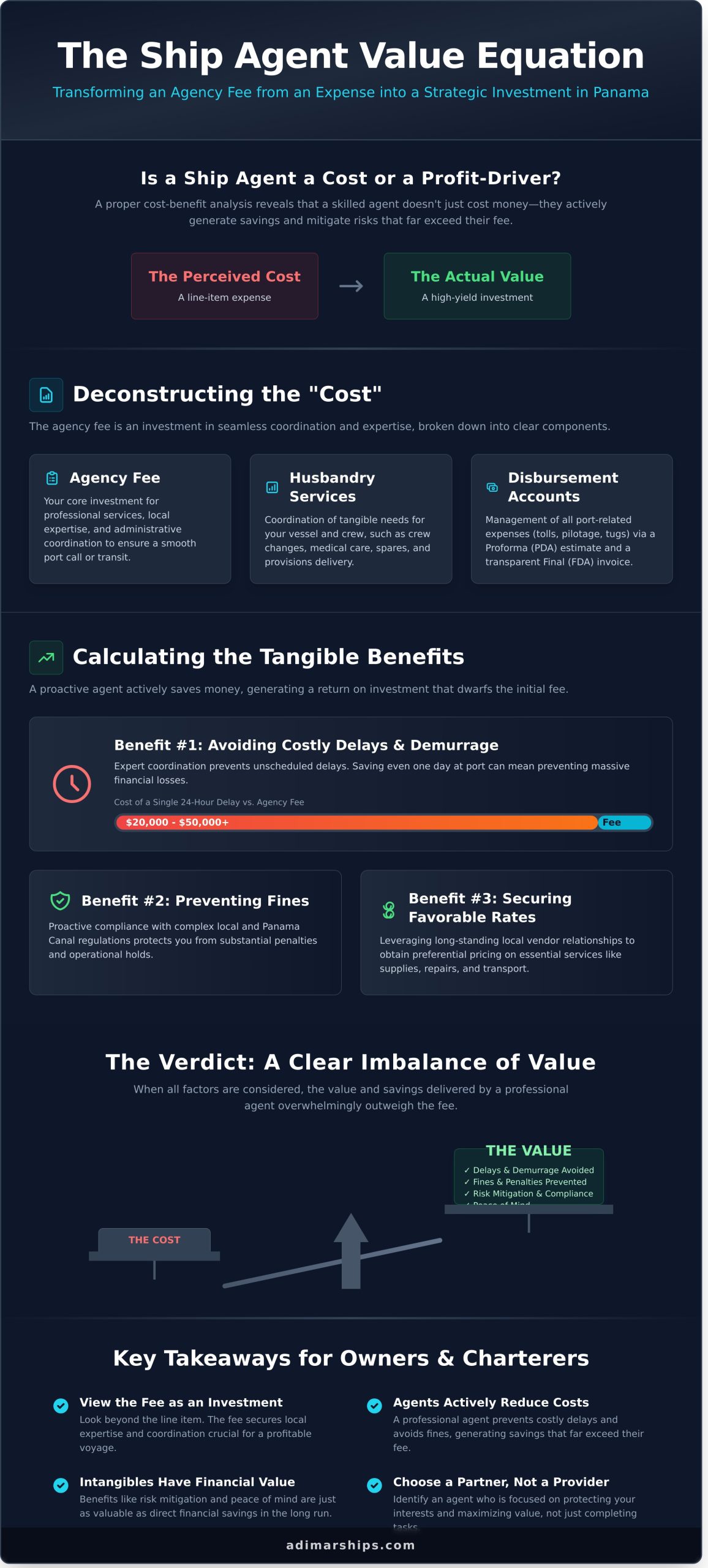
When conducting a ship agent cost benefit analysis, the first step is to understand what you’re actually paying for. It’s easy to view an agent’s fee as just another line item, but it’s more accurately an investment in seamless local coordination and expertise. This fee isn’t a single, mysterious charge. It’s a combination of professional service fees and the coordination of necessary port expenses. To make sense of it all, we need to demystify the Proforma Disbursement Account (PDA) and differentiate between the agent’s direct fees and the pass-through costs they manage on your behalf.
The Agency Fee: Your Core Service Investment
This is the core charge for the agent’s professional services. Think of it as payment for having a dedicated, local expert on your team in Panama. This fee, which can be fixed or variable, covers the immense administrative and coordination work required for a smooth port call. It includes arranging vessel clearance with authorities like the Panama Canal Authority (ACP), preparing all required documentation, and maintaining constant communication. To fully grasp this, it helps to understand the agent’s fundamental role; if you’re unfamiliar, this overview explains in detail What is a Ship Agent?. Essentially, this fee secures the expertise that prevents costly delays.
Husbandry Services: Caring for Vessel and Crew
Beyond administrative duties, your agent handles the tangible needs of your vessel and crew. These are known as husbandry services. These charges are not for the agent’s time but for the actual goods and services provided, such as:
- Crew changes, including transport and immigration formalities.
- Arranging medical or dental appointments for the crew.
- Coordinating the delivery of spares, mail, and provisions.
- Cash to Master (CTM) delivery.
These costs are itemized based on your specific requests and are crucial for maintaining crew welfare and ensuring the vessel is operationally ready for its next voyage.
Understanding the Proforma vs. Final Disbursement Account (PDA/FDA)
The Proforma Disbursement Account (PDA) is a critical financial document you’ll receive upfront. It is a detailed estimate of all anticipated port costs-including canal tolls, pilotage, tugs, agency fees, and any requested husbandry services-which you pay in advance. After the port call is complete, you receive the Final Disbursement Account (FDA). The FDA is the final, itemized invoice detailing all actual expenses, supported by receipts. A transparent FDA is the hallmark of an agent with integrity; it provides a clear accounting of every dollar spent, which is essential for an accurate evaluation.
The ‘Benefit’ Side: Calculating Tangible Financial Gains
When conducting a ship agent cost benefit analysis, it’s easy to focus on the agency fee as a line-item expense. However, a trusted agent doesn’t just cost money; they actively save it. This section moves beyond abstract value to calculate the direct, quantifiable financial gains of partnering with an expert on the ground in Panama. We’ll explore how local knowledge and proactive service translate directly to a healthier bottom line, proving that the cost of a single misstep often dwarfs the entire agency fee.
Avoiding Costly Delays and Demurrage
In shipping, time is money-a lot of it. The daily running cost of a commercial vessel can range from $20,000 to over $50,000. An unscheduled 24-hour delay at port or waiting for a Panama Canal transit slot isn’t just an inconvenience; it’s a massive financial loss. A proactive ship agent prevents these delays by expertly coordinating with port authorities, pilots, and tugboat operators. By ensuring all documentation is ready and schedules are perfectly aligned, they save you your most valuable asset: time. Saving even one day of delay can deliver a return on investment that is multiples of the agency fee.
Preventing Fines Through Regulatory Compliance
Navigating the complex local regulations of Panamanian ports and the Panama Canal is a specialized skill. A single error in customs paperwork or a missed reporting deadline can trigger substantial fines and operational holds. Ship agents are your experts in compliance, staying current on every rule change. Navigating the web of maritime law, which is influenced by international standards set by bodies like the U.S. Maritime Administration, requires dedicated local expertise. This benefit is pure risk mitigation, protecting your voyage from penalties that could easily reach tens of thousands of dollars.
Securing Favorable Rates on Local Services
Your ship agent is your local procurement office. They leverage long-standing relationships with a network of trusted local vendors to secure preferential rates on essential services. This includes:
- Bunker fuel and lubricants
- Freshwater and provisions
- Sludge and waste disposal
- Minor repairs and maintenance
These negotiated savings, driven by volume and trust, are passed on to you. In many cases, the total cost reduction on these services can partially or even completely offset the agency fee, making the agent’s expert coordination an incredible value proposition in any comprehensive ship agent cost benefit analysis.
Beyond the Balance Sheet: The Critical Intangible Benefits
A comprehensive ship agent cost benefit analysis goes far beyond simple fee comparisons. While direct cost savings are tangible, the most significant value often lies in mitigating operational risks and administrative burdens. These intangible benefits-efficiency, security, and peace of mind-don’t appear on an invoice but have a profound impact on your bottom line. A trusted agent in Panama acts as a dedicated extension of your own team, on the ground and protecting your interests around the clock.
Benefit 4: A Single Point of Contact & Streamlined Communication
Coordinating a port call or a Panama Canal transit involves juggling communication with numerous entities: port authorities, pilots, tug operators, suppliers, and customs officials. This creates a significant administrative load on your shoreside team. A ship agent consolidates all these lines of communication into one. Instead of chasing multiple parties for updates, you receive clear, concise, and timely information from a single, reliable source, eliminating confusion and freeing your team to focus on their core responsibilities.
Benefit 5: On-the-Ground Problem Solving & Local Expertise
In shipping, time is money, and unforeseen problems are costly. An experienced local agent anticipates issues before they escalate. Their value is demonstrated in their deep understanding of local regulations and operational nuances, including the intricate details within the official Panama Canal Vessel Requirements, which helps prevent expensive compliance delays. Whether it’s a last-minute crew change, an urgent spare part delivery, or a documentation issue, they know exactly who to call to resolve the situation quickly and efficiently. This proactive, on-the-ground problem-solving is an invaluable asset in a crisis.
Benefit 6: Enhanced Security and Peace of Mind
When your vessel is thousands of miles away, trust is paramount. Your ship agent serves as your ‘eyes and ears’ at the port, ensuring your vessel, crew, and cargo are secure. They oversee all local operations with your best interests at heart, from verifying vendor services to ensuring all safety protocols are met. This vigilance provides unparalleled peace of mind, allowing you to operate with confidence, knowing a dependable partner is safeguarding your assets. This is the ultimate, and perhaps most important, factor in any ship agent cost benefit analysis. Experience the peace of mind our clients trust.
Case Study: A Panama Canal Transit Cost-Benefit Analysis
Let’s apply our framework to one of the world’s most critical and complex maritime passages. The Panama Canal presents unique operational challenges and strict regulations where a detailed ship agent cost benefit analysis becomes essential, not just theoretical. To illustrate the immense value of an expert partner, we’ll compare two scenarios for a typical transit.
Scenario A: Transit Without a Dedicated Agent
Attempting a Panama Canal transit without an experienced, on-the-ground agent is a high-risk gamble. The complex booking system and stringent documentation requirements can easily lead to costly errors. A single mistake could mean a lost slot, pushing your vessel to the back of the queue and creating a cascade of logistical problems.
- Booking Errors: Missteps in securing a transit slot can result in significant delays and rescheduling fees.
- Non-Compliance Fines: Failure to meet specific mandates, like the Panama Canal Shipboard Oil Pollution Emergency Plan (PCSOPEP), can lead to heavy fines from the Panama Canal Authority (ACP).
- Communication Gaps: Direct communication with the ACP can be difficult and slow for those unfamiliar with the process, causing further setbacks.
The potential cost of these issues quickly escalates. A delay of just one to two days can cost a vessel owner between $40,000 and $100,000 in operational expenses, not including penalties or missed charter opportunities.
Scenario B: Transit With an Adimar Agent
Now, consider the same transit with Adimar as your trusted partner. We are your eyes and ears at the Canal, managing every detail proactively. All documentation is prepared and submitted correctly and on time, ensuring your booking is secure. We guarantee full compliance with all ACP and PCSOPEP regulations, eliminating the risk of fines. Our team provides seamless coordination of pilots, tugs, and line handlers for a smooth, efficient passage, turning a potentially frustrating process into a predictable one.
The Verdict: A Clear Positive ROI
The conclusion of this ship agent cost benefit analysis is undeniable. When you compare our transparent agency fee to the potential six-figure cost of even a minor delay, the return on investment is immediate and substantial. Hiring a professional ship agent is not an expense; it is a critical risk management strategy. In an environment where time truly is money, Adimar Shipping ensures your transit is handled with the integrity and efficiency your business deserves.
How to Choose an Agent That Delivers Maximum Value
The success of your ship agent cost benefit analysis hinges on one critical factor: the quality of your agent. Not all agents are created equal. The difference between a transactional service provider and a genuine partner can mean thousands of dollars saved, smoother port calls, and significantly less stress. Your goal is to find an agent who acts as an extension of your own team-your trusted eyes and ears on the ground in Panama.
Choosing the right partner requires looking beyond the initial quote. Look for tangible signs of integrity, deep local experience, and transparent practices. Asking the right questions upfront is the most effective way to protect your investment and ensure the agent you nominate will truly maximize your vessel’s efficiency and minimize costs.
Essential Qualities of a High-Value Ship Agent
A high-value agent consistently demonstrates a few core traits that set them apart. These qualities are the foundation of a partnership that delivers real returns.
- Proven Experience: They must have a deep, verifiable track record with your specific vessel type and, crucially, with Panama Canal transits and local port operations. This expertise allows them to anticipate challenges before they become costly problems.
- A Reputation for Integrity: In an industry where time is money, transparent billing and honest communication are non-negotiable. A trustworthy agent provides clear, detailed disbursement accounts and never hides fees.
- Excellent, Proactive Communication: The best agents don’t wait for you to ask for updates. They provide timely, clear, and concise information, ensuring you are always aware of your vessel’s status and any potential issues.
Key Questions to Ask a Potential Agent
Before committing, take the time to conduct a thorough vetting process. The answers to these questions will reveal the true value an agent can offer, completing your ship agent cost benefit analysis with confidence.
- What is your fee structure and what does it include? A transparent agent will gladly break down their agency fee and explain exactly what services are covered, helping you avoid unexpected charges.
- How do you handle unexpected issues or emergencies? Their response will demonstrate their problem-solving skills, local contacts, and ability to act decisively under pressure.
- Can you provide references from similar clients? Speaking with current or past clients who operate similar vessels is the best way to verify an agent’s claims of quality and reliability.
At Adimar Shipping, we believe in complete transparency and partnership. Ask us anything. Get a transparent quote today.
Beyond the Ledger: The True Value of a Trusted Ship Agent
As we’ve explored, viewing a ship agent’s fee as a simple expense is a critical misstep. The real value emerges when you consider the tangible financial gains from avoided delays and the immense intangible benefits of seamless operations and peace of mind. Ultimately, a comprehensive ship agent cost benefit analysis consistently proves that the right local partner is not a cost center, but a powerful driver of profitability and efficiency for your voyage.
Choosing that partner is the most important decision. With over 20+ years of specialized experience, Adimar Shipping has been the trusted, on-the-ground partner for countless owners and charterers at the Panama Canal. We are built on a foundation of integrity and transparent communication, acting as your eyes and ears to ensure every transit is cost-conscious and efficient. Don’t leave your success to chance. Request a quote for your next Panama Canal transit and see the value for yourself.
Frequently Asked Questions
What is the difference between an owner’s agent and a charterer’s agent?
An owner’s agent is appointed by and represents the shipowner, focusing on the vessel’s needs like crew, supplies, and protecting the owner’s financial interests. A charterer’s agent is nominated by the party chartering the vessel, and their primary responsibility is the cargo-ensuring efficient loading or discharge to minimize costs for the charterer. While one agent can sometimes serve both parties, it is crucial to understand whose interests they are contractually obligated to prioritize first and foremost.
How can I ensure an agent is providing transparent billing?
Transparency begins with requesting a detailed Proforma Disbursement Account (PDA) before the port call. A trusted agent will provide a clear breakdown of all anticipated costs. For final billing, insist on receiving original, third-party invoices for all services, not just a summary on their letterhead. This commitment to financial integrity is a critical component of any positive ship agent cost benefit analysis, ensuring you only pay for services actually rendered at fair market rates.
Can’t my vessel’s master or crew handle port arrangements?
While your master and crew are experts in maritime operations, they lack the local knowledge and established relationships essential for an efficient port call in Panama. An agent acts as your local team, navigating complex regulations and coordinating with authorities to prevent costly delays. This allows your crew to focus on their primary duty: the safe operation and maintenance of the vessel. Relying on an expert on the ground is almost always more time- and cost-effective.
How much is a typical ship agency fee for a Panama Canal transit?
A standard ship agency fee for a routine Panama Canal transit typically ranges from $2,000 to $4,000. This fee can vary based on the vessel’s size, the complexity of the transit, and any additional husbandry services required, such as crew changes, inspections, or delivery of spares. This agency fee is a separate charge from the official Panama Canal Authority (ACP) tolls. A reliable agent will always provide a clear and detailed quote upfront.
What is a protective agency and when would I need one?
A protective agent (PA) is appointed to safeguard your interests when you did not nominate the primary agent. For example, if a charterer appoints the full agent, the shipowner may hire a protective agent to act as their “eyes and ears.” The PA oversees the port call, scrutinizes the disbursement account from the primary agent, and ensures the owner’s interests are fully protected. It is a prudent measure to maintain financial control and operational oversight.
Does a ship agent handle customs clearance for cargo?
A ship agent’s primary role is to handle customs clearance for the vessel, its crew, and any ship’s spares or provisions. The customs clearance for the actual cargo is managed by a separate entity-a customs broker or freight forwarder-who is appointed by the cargo owner (the shipper or consignee). While we do not handle cargo brokerage, we coordinate closely with all nominated brokers to ensure a smooth, seamless port operation for all parties.