
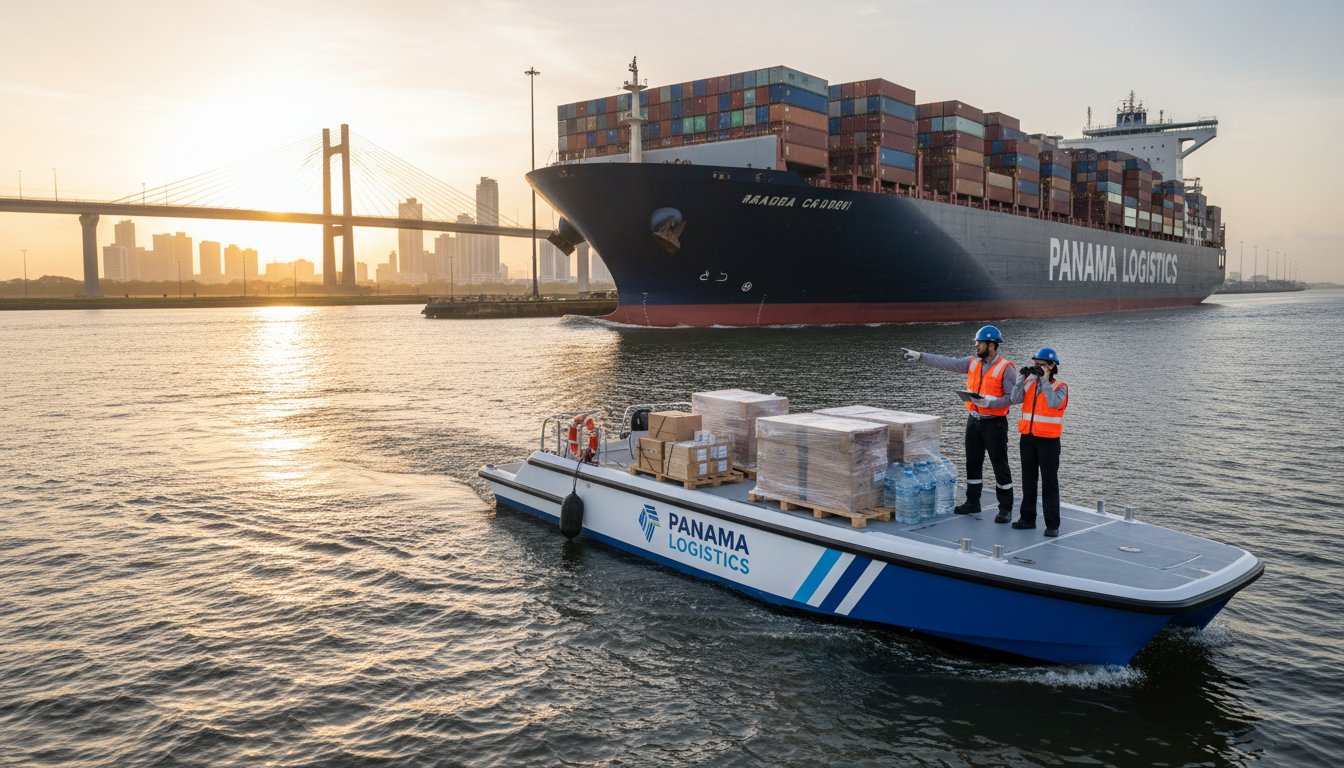
Last month, a Master approaching the Cristobal anchorage found his fresh stores sitting on a pier in 32°C heat because the chandler missed the pilot’s updated 04:00 boarding time. It’s a frustrating, costly mistake that happens to roughly 15% of vessels during peak transit seasons. You already know that securing reliable ship provisions panama is about more than just a shopping list; it’s a high-stakes race against tropical humidity and strict ACP schedules where one misstep ruins the galley’s inventory.
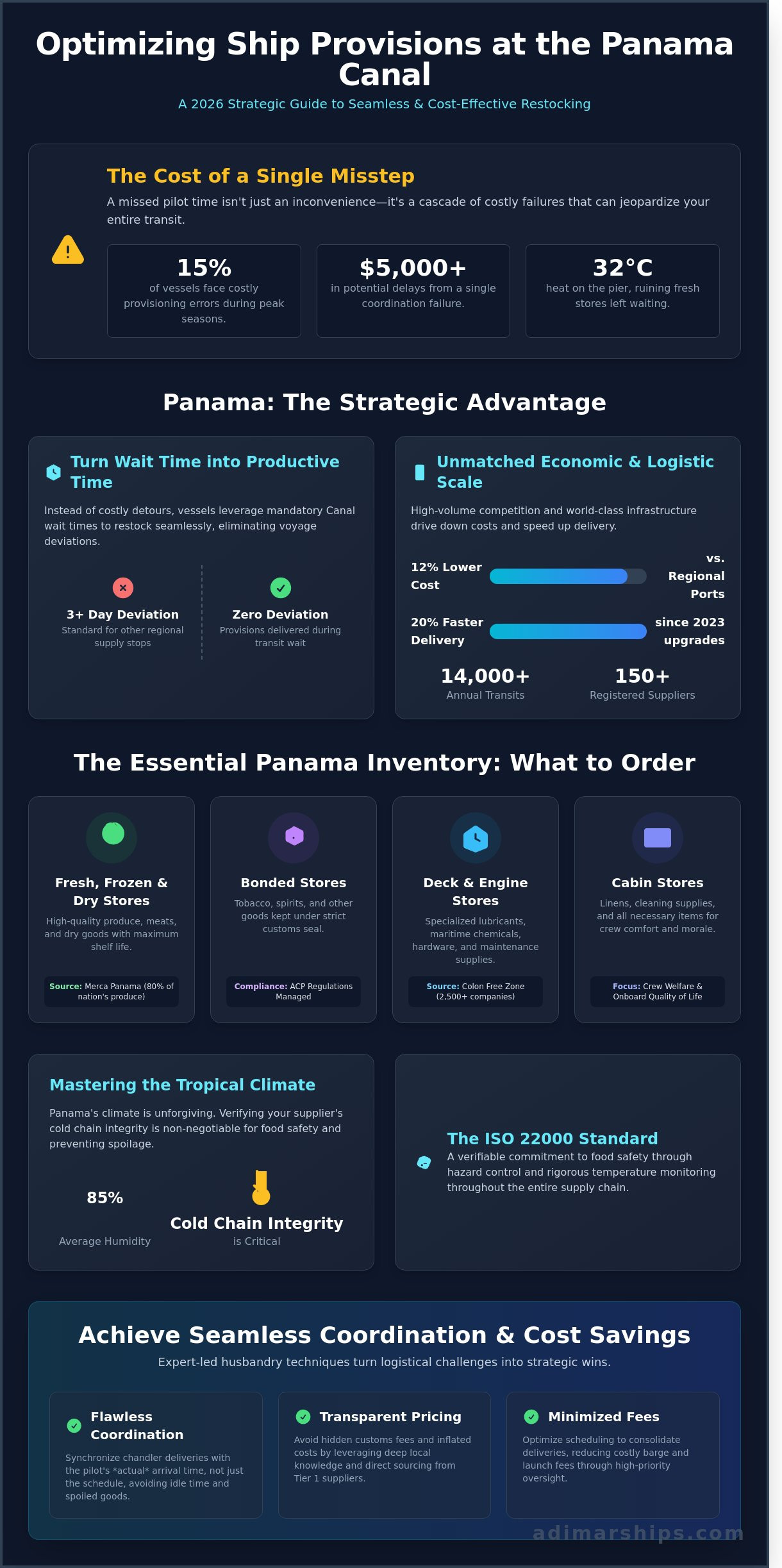
We’ve spent over 20 years acting as your local eyes at the Panama Canal, and we know that “time is money” when you’re facing a potential $5,000 delay. This guide will teach you how to optimize your vessel’s provisioning to ensure high-quality stores and zero transit interruptions. We will break down our 2026 strategies for transparent pricing, avoiding hidden customs fees, and achieving seamless coordination between your chandler and the pilot’s actual arrival time.
Key Takeaways
- Learn how to turn mandatory Canal wait times into a strategic advantage by securing high-quality ship provisions panama without deviating from your voyage route.
- Identify the unique logistical advantages of Balboa and Cristobal to optimize your supply chain near the Colon Free Zone and local warehouse hubs.
- Understand the critical coordination required between ship chandlers and agents to ensure your stores arrive exactly when the ACP schedule permits.
- Discover how to source Tier 1 fresh, frozen, and bonded stores while maintaining strict compliance with Panama’s customs and maritime regulations.
- Master cost-saving husbandry techniques that minimize barge and launch fees through expert-led scheduling and personalized, high-priority oversight.
Why Panama is the Global Hub for Ship Provisions in 2026
Panama’s position as the premier maritime gateway remains undisputed in 2026. Ship provisioning in Panama involves the strategic procurement of fresh food, dry goods, bonded stores, and technical supplies specifically during a vessel’s Canal transit. It’s a logistical masterstroke. Instead of adding three days to a voyage for a supply stop in the Caribbean or South America, owners use the mandatory wait time at the Pacific or Atlantic anchorages to restock. This eliminates costly deviations. Since the history and significance of the Panama Canal established it as a global crossroads, the local infrastructure has evolved to support over 14,000 transits annually.
You get access to a massive variety of international brands and high-quality local produce. Panama’s agricultural sector in the Chiriquí province provides fresh vegetables delivered to the deck within 24 hours of harvest. High-volume competition among the 150+ registered suppliers in the Colon and Balboa areas drives prices down. In 2026, the average cost for a standard provision order in Panama is 12% lower than in alternative regional ports due to this density of suppliers and the tax-free status of the Colon Free Zone for maritime sales.
The ‘Time is Money’ Factor at the Canal
Misjudge your timing at the anchorage and you lose more than just a few hours; you lose your place in the queue. Every hour of delay can jeopardize a pre-booked transit slot. Losing a slot can cost a ship owner upwards of $65,000 in late fees and missed scheduling. Panama acts as a true one-stop-shop for global maritime logistics. By 2026, new barge lanes and dedicated logistics corridors have improved last-mile delivery to vessels at anchor by 20% compared to 2023 levels. We are your eyes at the Panama Canal, ensuring your ship provisions panama order arrives exactly when the vessel is ready to receive it.
- One-Stop Efficiency: Coordinate fuel, provisions, and crew changes simultaneously.
- Reduced Deviation: Zero miles added to the voyage plan for restocking.
- 2026 Infrastructure: Upgraded crane systems at Balboa and Cristobal speed up technical supply loading.
Quality Standards in a Tropical Climate
Panama’s 85% average humidity and high tropical temperatures pose serious risks to dry stores and fresh produce. You must verify a supplier’s cold chain capabilities before placing an order. Look for climate-controlled warehouses and a transport fleet equipped with real-time temperature tracking. High-Quality Provisions under ISO 22000 standards represent a verifiable commitment to food safety through hazard control and rigorous temperature monitoring throughout the supply chain. We don’t settle for “good enough” because we know your crew’s health and morale depend on the quality of the ship provisions panama services you select. We serve as your local office, checking every crate to ensure it meets our standards of integrity and excellence.
The Essential Inventory: What to Order in Panama
Managing ship provisions panama requires a deep understanding of local logistics and timing. Panama serves as a premier global hub where vessels can restock everything from basic sustenance to specialized machinery. We categorize these needs into four primary groups to ensure your vessel remains compliant and fully operational during its transit. Successful procurement starts with Tier 1 markets. These local hubs provide high-turnover goods that haven’t sat in secondary storage, ensuring you receive the maximum possible shelf life for your investment.
Fresh, frozen, and dry stores form the backbone of any order. In Panama, we source directly from Merca Panama, the country’s largest wholesale distribution center. This facility handles over 80% of the nation’s fresh produce. By bypassing retail middle-men, we secure 2024 market pricing that remains competitive with major US ports. Bonded stores represent another critical category. These items, including tobacco and premium spirits, stay under a strict customs seal until the vessel reaches international waters. Our team manages the documentation required by Panama Canal Authority regulations to prevent delays during inspection.
Deck and engine stores are equally vital. The Colon Free Zone (CFZ) houses more than 2,500 companies, making it a goldmine for maritime chemicals and hardware. Whether you need specialized lubricants or grit for deck maintenance, the proximity of the CFZ allows for 24-hour turnaround times. Finally, cabin stores keep the crew comfortable. This includes everything from high-thread-count linens for officer quarters to industrial-grade galley equipment. We ensure every cleaning chemical delivered meets Marpol Annex V standards for environmental safety.
Fresh Produce and Gourmet Sourcing
Quality nutrition directly impacts crew morale and performance. We utilize direct-from-grower advantages to source fruits like pineapples and papayas that are harvested just 12 to 18 hours before delivery. This “Last Day” harvesting technique is a game-changer for long-haul voyages. It extends the usable life of leafy greens by up to 5 days compared to standard supermarket sourcing. Our meat selections include USDA-certified cuts and poultry that meet ISO 22000 food safety management systems. You can request a customized quote to see our current seasonal availability.
Technical and Safety Equipment
Technical managers often face emergencies when transiting the Isthmus. We specialize in sourcing engine spares like fuel injectors or gaskets that are stocked within the Colon Free Zone for immediate dispatch. Safety equipment is another priority. We facilitate the inspection and restocking of fire extinguishers and life vests to ensure they meet 2024 SOLAS requirements. If your vessel has “spares-in-transit” arriving via Tocumen International Airport, Adimar coordinates the “last mile” delivery. We act as your local office to clear these parts through customs and transport them to the pier before your scheduled pilot time. This precision prevents the $5,000 to $10,000 daily losses associated with missed transit windows.
Our 20 years of experience in the region has taught us that timing is everything. We don’t just deliver boxes; we manage the entire supply chain. By maintaining transparent communication with captains and shore-side managers, we eliminate the guesswork from the procurement process. It’s about providing high-quality service with integrity every time the vessel calls at a Panamanian port.
Ship Agent vs. Ship Chandler: Understanding the Critical Difference
The distinction between a ship chandler and a ship agent is often blurred by those outside the maritime industry, but for a ship owner, confusing the two is a recipe for financial loss. A ship chandler is essentially a specialized retail vendor. They maintain the warehouses, manage the inventory of fresh produce, and source the technical spares required for ship provisions panama. They are the “what” of the transaction. The ship agent, however, is the “how” and the “when.” As your designated agent, Adimar acts as the conductor of the entire logistical symphony at the Canal.
Ordering direct-to-chandler often seems like a shortcut to save a few dollars, but it frequently leads to massive logistical bottlenecks. A chandler’s primary goal is to sell goods. They don’t always have the full picture of the vessel’s transit window or the shifting priorities of the Panama Canal Authority. If a vendor sends a delivery barge to the anchorage and the vessel is delayed by three hours, that barge sits idle. In Panama, barge standby rates can exceed $350 per hour. Without an agent to coordinate the timing, these “hidden” costs can quickly double the price of your supplies.
Adimar eliminates this risk by acting as your expert intermediary. We don’t just wait for the goods to arrive; we manage the vendor’s timeline to match the actual position of the ship. We are experts so you don’t have to be. We’ve spent 20 years refining these processes to ensure that your ship provisions panama orders are handled with precision and professional care.
The Protective Agency Advantage
Adimar serves as a shield for the ship owner. We oversee the chandler’s performance to ensure the quantity and quality of the delivered goods match the original Request for Quotation (RFQ) exactly. If you paid for Grade A produce but receive subpar items, we catch the discrepancy before the ship departs. We also prevent unauthorized delivery fees at the wharf. It’s common for local terminals to attempt to add $200 or $300 in “access fees” that aren’t the owner’s responsibility. Adimar’s commitment to integrity means we audit every line item. We ensure transparent billing for every provision order, protecting you from the 10% to 15% price “creep” that often occurs in unmonitored transactions.
Communication as a Safeguard
Reliable logistics depend on a “triangle of communication” between the Master, the Chandler, and the Agent. We facilitate this flow to keep everyone aligned. Our team provides real-time updates to the Master regarding the delivery barge ETA. You won’t have to guess when your stores are arriving while navigating the complex waters of the Canal. We see ourselves as your local office at the Panama Canal. This perspective allows us to treat your vessel with the same urgency and attention to detail as if it were our own. By maintaining this constant link, we eliminate the confusion that typically leads to missed deliveries and wasted fuel. We provide high quality, timely shipping services with integrity, ensuring your transit remains on schedule and within budget.
Logistics and Coordination: Balboa vs. Cristobal
Timing determines your profit margin at the Panama Canal. Every hour your vessel spends idling at the breakwater costs upwards of $2,500 in fuel and operational overhead. Choosing between Balboa on the Pacific side and Cristobal on the Atlantic side is the first major decision for successful coordination. Balboa features expansive anchorage areas like Flamenco and Taboguilla, but barge availability often fluctuates based on terminal congestion. If your vessel is southbound, Balboa is your last chance to secure supplies before hitting the open Pacific, where replenishment options disappear for thousands of miles.
Cristobal offers a distinct logistical advantage due to its proximity to the Colon Free Zone. This massive warehouse hub sits less than 5 kilometers from the main piers. Because 95% of bonded technical stores and specialized ship provisions panama originate here, turnaround times are significantly faster on the Atlantic side. You’ll often see a 4 to 6 hour reduction in delivery times for engine parts and dry stores when compared to the Pacific entrance. We see ourselves as your local office, ensuring that the distance between the warehouse and the deck is bridged with zero friction.
The 24-hour rule is a hard requirement you can’t afford to ignore. All orders must be finalized at least 24 hours before your ship reaches the breakwater. This window gives us the necessary time to coordinate with the Panama Maritime Authority (AMP) and secure the required health certificates. Missing this window doesn’t just cause a delay; it often results in a $250 “rush fee” from local suppliers or a complete delivery failure if the barge misses the pilot’s boarding window. We are experts so you don’t have to be, and we manage these tight timelines so your crew stays focused on the transit.
Navigating the Ports of Panama
Delivery speeds vary by season and location. From January to March, the ‘Papagayo’ winds reach speeds of 25 to 30 knots on the Atlantic side. These gusts often suspend barge operations for 12 hours or more for safety reasons. During these months, we recommend the Pacific side for heavy provisioning to avoid weather-related standbys. For the most efficient transfer of ship provisions panama, vessels should request anchorage at Area F in Balboa or the Breakwater in Cristobal to minimize barge transit costs.
Customs Clearance and Documentation
For 2026, the Panamanian Customs Authority requires a finalized manifest 48 hours before arrival for all duty-free stores. Common errors, such as mismatched quantities on the commercial invoice or missing IMO numbers, result in fines starting at $500 per line item. We act as your eyes at the Panama Canal, verifying every document against the physical load. Our team manages the interface with the Customs Broker to ensure your bonded goods move through the corridor without a single hour of administrative delay.
Don’t let logistical confusion delay your transit. Nominate Adimar as your agent to ensure your provisions arrive on time and within budget.
Optimizing Your Husbandry: The Adimar Shipping Approach
One of the biggest hidden costs in Panama is the launch and barge fees. These charges often start at $350 per trip and can exceed $1,200 depending on the anchorage location and cargo volume. Our approach minimizes these expenses by grouping services. When you order ship provisions panama through Adimar, we look at the bigger picture. We check if you have spare parts arriving at Tocumen International Airport or if you need a crew change. By putting everything on a single launch, we save you hundreds of dollars in logistics fees. Getting the right ship provisions panama requires a local partner who knows the vendors and the water.
Integrated Husbandry Services
We believe efficiency comes from integration. Our team coordinates provision deliveries alongside spare parts handling and crew transfers. We maintain a network of over 50 vetted, reliable suppliers across Panama to ensure quality. This isn’t just about food; it’s about technical supplies and CTM (Cash to Master) delivered securely. You can nominate Adimar as your agent to streamline your next transit and reduce administrative headaches. We’ve seen that integrated handling reduces total port stay costs by 15% on average compared to fragmented service providers.
- Consolidation of spare parts and provisions to reduce barge runs.
- Secure Cash to Master (CTM) delivery coordinated with vessel arrival.
- Vetted supplier network ensuring food safety and quality standards.
- Expert handling of Panama Canal Authority requirements.
Your Eyes at the Panama Canal
The Master of a vessel has enough to worry about during a transit. We act as your eyes on the ground. We provide real time updates so the Master is never left in the dark about when the barge will arrive. If an emergency arises, like a last minute technical failure or a medical need, our 24/7 team finds a solution immediately. We’ve handled emergency supply requests in under 4 hours for vessels already at the Pacific anchorage.
Adimar is the trusted partner for transit efficiency because we understand that time is money. We’ve spent two decades eliminating Canal confusion for owners and charterers. Our guarantee is simple: we provide high quality, timely service with integrity. Every ship, every time. By choosing a partner who sees themselves as your local office, you ensure your vessel moves through the Canal without the usual frustrations of local logistics. We are experts so you don’t have to be. Put your transit in our hands and focus on your core business while we handle the rest.
Master Your Next Canal Transit with Expert Husbandry
Success at the Panama Canal in 2026 hinges on precise timing and local intelligence. Managing your ship provisions panama requirements involves more than just filling a pantry; it requires seamless coordination between Balboa and Cristobal to avoid expensive scheduling conflicts. By partnering with a specialized agent instead of a simple vendor, you ensure that every logistical detail aligns perfectly with your transit window.
Adimar Shipping offers 20 years of proven expertise in Panama Canal agency services to protect your bottom line. As an authorized PCSOPEP representative with a dedicated husbandry team available 24/7, we eliminate the confusion of local regulations so you don’t have to worry about the details. We’re your eyes on the ground, ensuring your vessel receives high quality service with total integrity at every turn.
Put your transit in expert hands today. Get a personalized quote for your Panama Canal transit and provisioning needs to secure your schedule. We look forward to guiding your fleet safely through the waterway.
Frequently Asked Questions
How far in advance should I order ship provisions for a Panama Canal transit?
You should place your order for ship provisions panama at least 72 to 96 hours before your scheduled arrival. This lead time allows our team to source fresh local produce and coordinate logistics with the Panama Canal Authority’s schedule. If you wait until 24 hours before arrival, you risk limited availability or higher rush fees. We manage every detail to ensure your supplies are ready the moment your vessel anchors.
Can I order bonded stores while anchored at Balboa or Cristobal?
Yes, you can order bonded stores including tobacco and spirits while anchored at either Balboa or Cristobal. Adimar Shipping coordinates with licensed customs brokers to ensure all items are delivered under seal. We handle the paperwork and delivery via launch boat to your specific anchorage coordinates. This service ensures your crew stays supplied without needing to dock at a terminal. It’s a seamless process that saves you time and effort.
What happens if the provisions delivery is delayed and my transit slot is called?
Your transit slot is the priority because missing it can cost over $50,000 in late fees and lost time. If a delay occurs, we immediately pivot to deliver the supplies at the opposite end of the Canal. Our team monitors the transit schedule 24/7 to ensure no conflict arises. We’re your eyes at the Panama Canal, so we anticipate these shifts before they become problems. You don’t have to worry about logistics.
Are there specific Panamanian customs regulations for spare parts in transit?
Spare parts arriving in Panama must be clearly labeled as Ship Spares in Transit to qualify for tax-exempt status under Panamanian law. You must provide the Air Waybill or Bill of Lading at least 48 hours before the cargo arrives. Failure to follow this protocol results in a 7% ITBMS tax and additional storage fees at Tocumen International Airport. We manage the customs clearance process to keep your costs low and your operations efficient.
How does Adimar Shipping verify the quality of the food provided by chandlers?
We verify the quality of your ship provisions panama by conducting physical inspections at our vetted suppliers’ warehouses. Our team checks expiration dates and the cold chain integrity for all perishable goods. We only work with 5 certified local chandlers who meet international food safety standards. This proactive approach ensures your crew receives fresh, high-quality supplies every single time. We are experts so you don’t have to be.
Is it possible to coordinate a crew change at the same time as provisioning?
You can absolutely coordinate crew changes alongside your provisioning schedule. Combining these services reduces your launch boat fees by approximately 30% compared to booking them separately. We manage the immigration paperwork for arriving and departing crew while the provisions are being loaded. Our goal is to make your stop as efficient and cost-conscious as possible. It’s about maximizing your time while the vessel is stationary at the anchorage.
What are the payment terms typically expected for provisioning in Panama?
Payment terms in Panama typically require a 100% advance wire transfer based on the proforma invoice. Most transactions are settled in US Dollars ($) to avoid currency fluctuations. For long-term partners with a 2-year history, we sometimes offer 30-day credit terms. We provide transparent invoicing with no hidden fees, so you know exactly where your budget is going. Integrity is the core of our financial dealings with every client we serve.