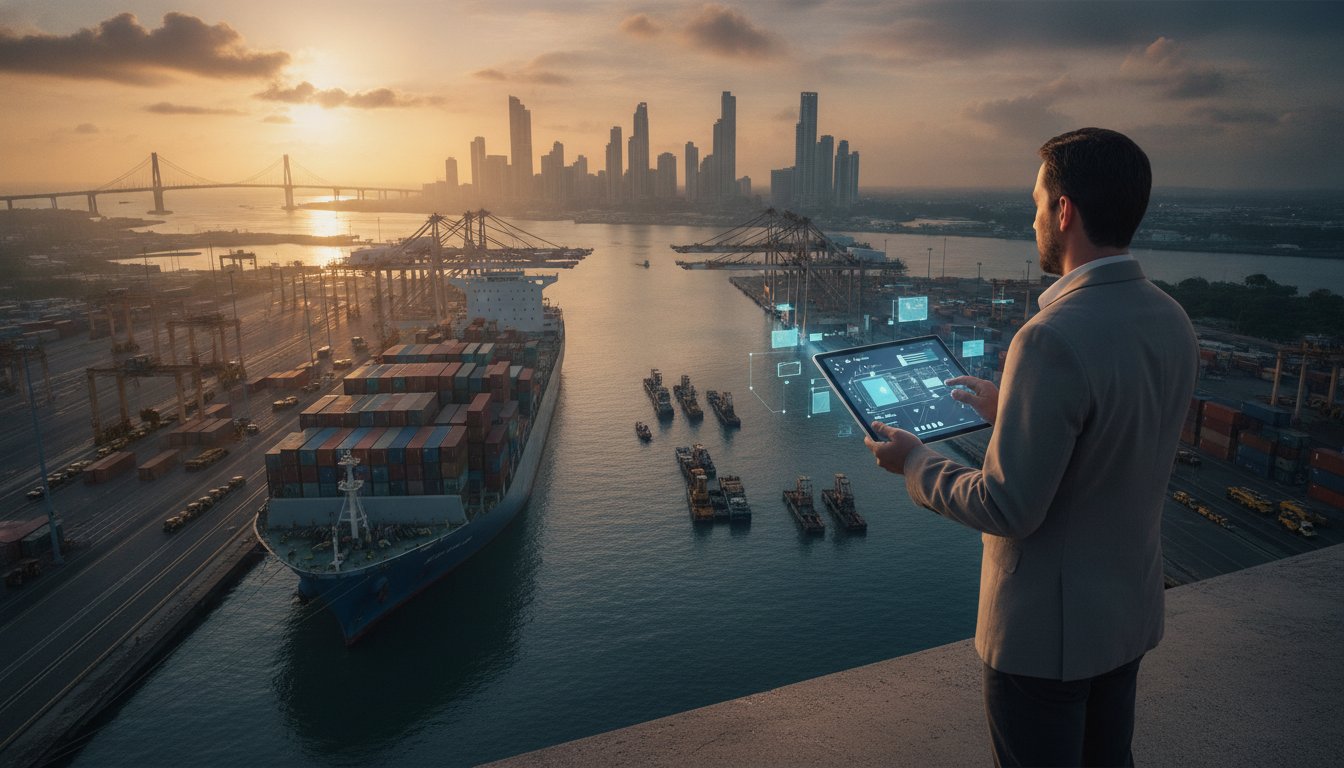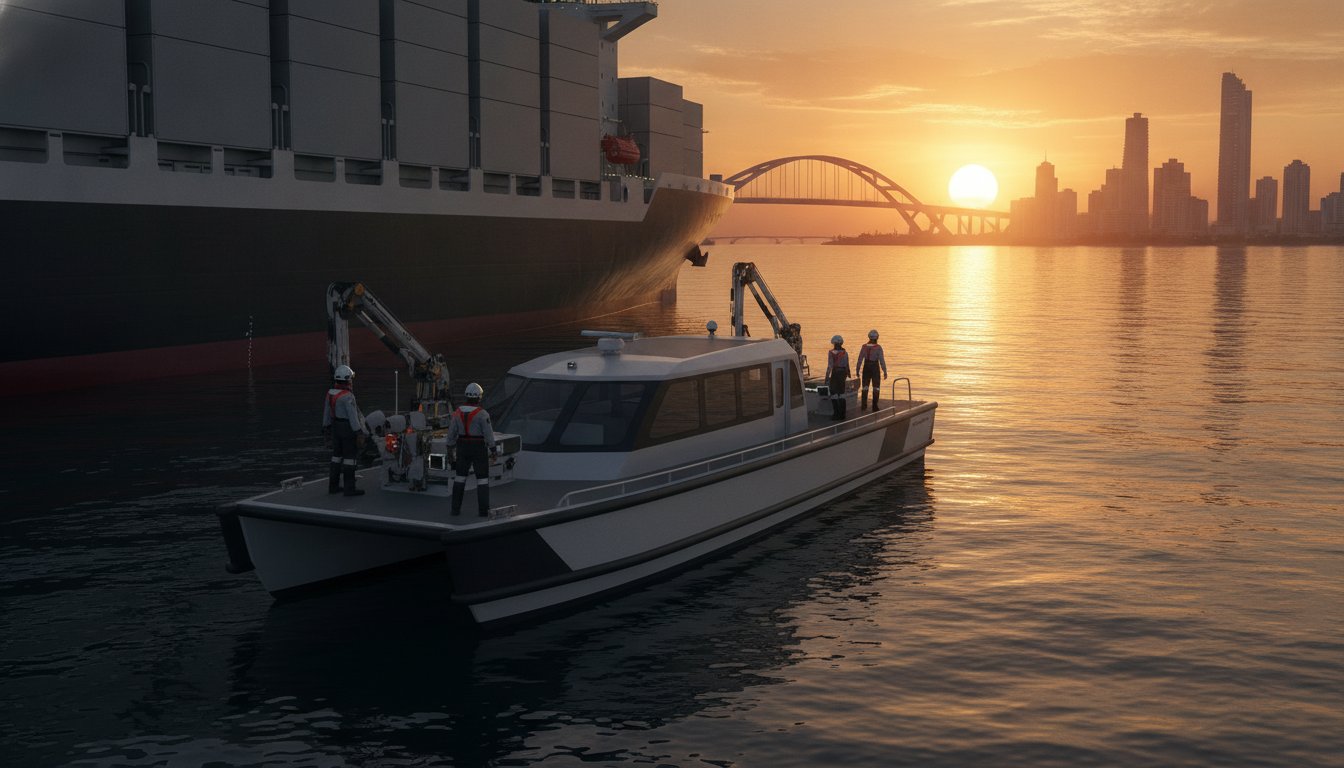

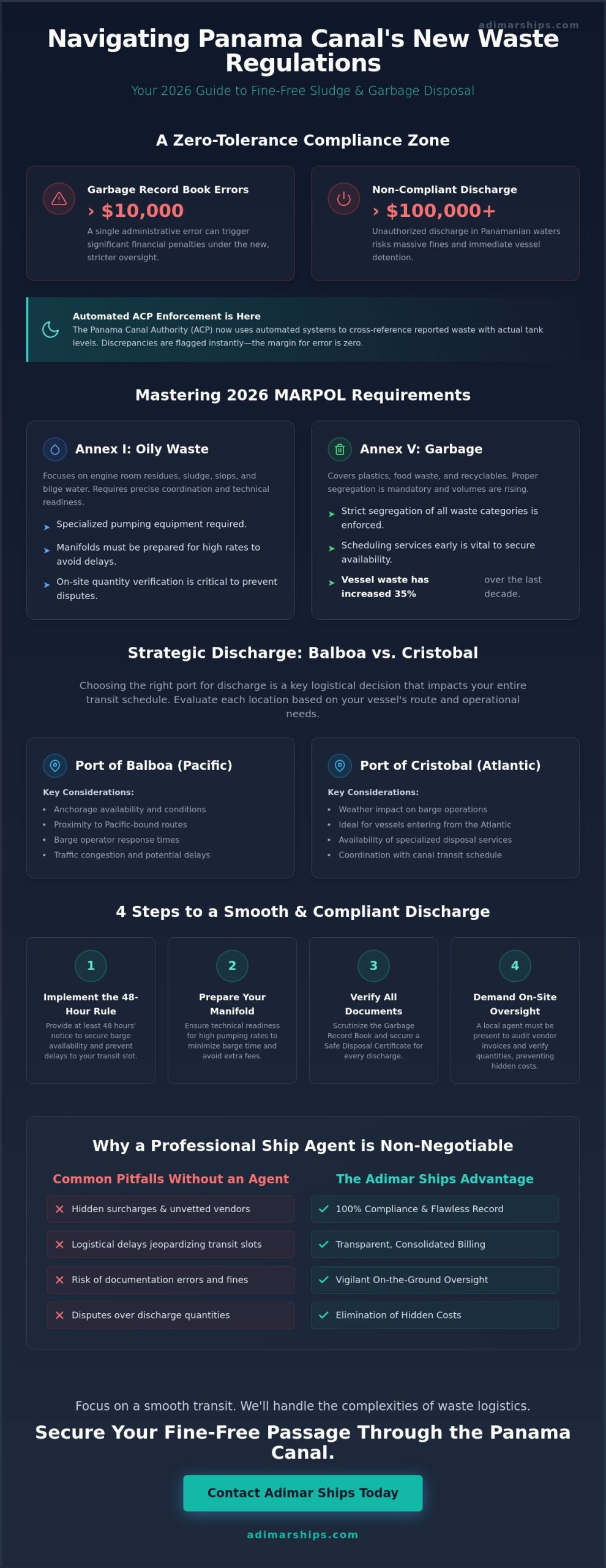
A single error in your vessel’s Garbage Record Book can now lead to fines exceeding $10,000, while non-compliant discharge in Panamanian waters risks penalties over $100,000 and immediate detention. With the Panama Canal Authority (ACP) now using automated systems to cross-reference reported waste with actual tank levels, the margin for error has disappeared. We understand that coordinating sludge and garbage disposal services panama is a high-stakes maneuver where any logistical delay can jeopardize your entire transit schedule. It’s a complex environment where unvetted barge operators and hidden surcharges often create unnecessary friction for busy vessel managers.
You need a partner who acts as a vigilant extension of your team on the ground. This guide provides the expertise you need to master the 2026 MARPOL Annex V amendments and navigate the shifting management at the ports of Balboa and Cristobal. You’ll learn how to ensure 100% compliance, avoid hidden costs, and utilize a single agent for transparent, consolidated billing. We’ll simplify the complexities of waste logistics so you can focus on a smooth, fine-free transit through the canal.
Key Takeaways
- Understand the Panama Canal Authority’s rigorous environmental oversight to maintain a flawless compliance record during your transit.
- Master the technical requirements for manifold preparation and the 2026 MARPOL Annex V updates to ensure efficient sludge and garbage disposal services panama.
- Evaluate the logistical differences between Balboa and Cristobal to select the most efficient discharge location for your vessel’s specific route.
- Implement the 48-hour notification rule to secure barge availability and prevent waste management issues from impacting your transit slot.
- Learn how a professional ship agent eliminates hidden costs by auditing vendor invoices and providing local oversight during the discharge process.
Navigating Waste Management Regulations in the Panama Canal Zone
Panama serves as the ultimate checkpoint for vessels preparing for long-haul Pacific or Atlantic crossings. For a vessel manager, the Isthmus is more than a transit point; it’s a strategic hub where waste management becomes a high-stakes compliance maneuver. As of January 2026, the Panama Canal Authority (ACP) has heightened its environmental oversight by implementing automated systems that cross-reference reported waste volumes with a vessel’s actual tank levels. This technological shift means that discrepancies are flagged instantly, leaving no room for administrative oversight.
Effective sludge and garbage disposal services panama involve the seamless collection and certified treatment of vessel-generated waste. These services aren’t merely about logistics; they are about maintaining the legal integrity of the vessel. Every discharge must be documented with a Safe Disposal Certificate, a document the ACP boarding officers scrutinize with increasing intensity during the 2026 transit season. Failing to provide this documentation or attempting an unauthorized discharge can result in immediate vessel detention and fines that can exceed $100,000.
The Legal Framework: ACP and MARPOL
Local Panamanian regulations are deeply integrated with international standards, specifically the MARPOL 73/78 convention. While MARPOL provides the global baseline, the ACP adds layers of local requirements that vessels must meet to secure a transit slot. A critical component of this framework is the role of the PCSOPEP authorized person. This individual is mandatory for vessels carrying 400 metric tons or more of persistent oil and acts as the bridge between the ship and the ACP during environmental emergencies. Beyond emergency planning, they ensure that all waste operations align with the Panama Canal Shipboard Oil Pollution Emergency Plan. In 2026, even a minor error in the Garbage Record Book can trigger a $10,000 fine, making expert oversight a financial necessity rather than an optional service.
Sludge vs. Garbage: Operational Priorities
Vessel managers must prioritize their discharge operations based on tank capacity and the duration of the upcoming voyage. Sludge management, governed by MARPOL Annex I, focuses on oily waste and engine room residues. These require specialized pumping equipment and specific manifold preparations to ensure high pumping rates and zero spills. Conversely, garbage management under Annex V involves the segregation of plastics, food waste, and recyclables. Because the volume of waste generated by transiting vessels has increased by nearly 35% over the last decade, scheduling sludge and garbage disposal services panama early is vital. Vessels often find that their tank capacity is the limiting factor for their next leg, making the efficiency of the Panamanian discharge operation the deciding factor in their transit scheduling.
MARPOL Annex I and Annex V: Ensuring Compliance in 2026
Compliance in 2026 isn’t just about following old rules; it’s about adapting to a digital, highly monitored environment. The Panama Canal Authority has moved toward a zero-tolerance policy regarding documentation errors. While sludge and garbage disposal services panama are readily available, the quality of the reporting determines whether you’ll face a fine. Beyond Annex I and V, vessel managers must also stay current with MARPOL Annex VI regulations to ensure total environmental conformity across all operational categories.
Annex I: Sludge, Slops, and Bilge Water
Discharging oily waste in Gatun Lake or at the anchorages requires specific technical readiness. Your manifold must be prepared for high pumping rates to minimize barge time and avoid extra fees. We’ve seen many operators struggle with quantity verification during these transfers. Discrepancies between the ship’s figures and the barge’s meter lead to disputes that delay departures. Our husbandry services bridge this gap by providing on-site oversight. We ensure that every cubic meter is accounted for and that all pumping operations meet ACP safety standards. This vigilance prevents the hidden surcharges that often arise from unvetted barge operators.
Annex V: Garbage Segregation and Disposal
The 2026 regulatory landscape has significantly increased the pressure on Annex V compliance. As of January 1, 2026, the requirement for a Garbage Record Book has been extended to all ships between 100 and 400 gross tonnage. This means smaller vessels that were previously exempt now face the same scrutiny as Neopanamax carriers. You can’t afford to treat garbage as an afterthought when a single error in the record book can trigger a $10,000 penalty.
- Segregation: You must strictly separate plastics, hazardous waste, and recyclables. Mixed bags are often rejected by local contractors, leading to transit delays and additional sorting fees.
- Food Waste: Discharging food waste within the Canal Zone is strictly prohibited. All such waste must be bagged, sealed, and handed over to authorized shore reception facilities that provide certified disposal receipts.
- Documentation: The Safe Disposal Certificate is your primary shield against ACP fines. We verify that every receipt includes the exact volume, category, and time of disposal to satisfy inspectors.
We don’t just book a barge and hope for the best. Our team verifies all electronic record-keeping entries and MARPOL certificates before your vessel leaves Panamanian waters. This level of oversight is why many operators choose to partner with an experienced local agent to manage their environmental logistics. By delegating these complex tasks, you protect your transit schedule and your bottom line while maintaining a flawless compliance record.
Logistical Comparison: Sludge Removal at Balboa vs. Cristobal
Selecting the optimal port for waste discharge is a strategic choice that directly affects your vessel’s transit timeline. Both ends of the Canal offer specialized facilities, yet the direction of your voyage and current terminal congestion dictate the most efficient path. In 2026, with the Canal Authority handling approximately 33 transits daily, every hour spent at anchorage impacts your bottom line. Choosing where to book sludge and garbage disposal services panama requires an intimate understanding of local infrastructure and current management shifts at the ports of Balboa and Cristobal.
Barge-based waste reception at the anchorage is generally the most efficient option for vessels. It allows you to avoid occupying a terminal berth and incurring additional port fees. We recommend evaluating your tank levels at least 72 hours before arrival to determine if a Pacific or Atlantic discharge best serves your schedule. Our team provides the local oversight needed to navigate these choices, ensuring your vessel remains productive while meeting all MARPOL requirements.
Discharging at Balboa Anchorages
Balboa, on the Pacific side, serves as the preferred hub for northbound transits. The infrastructure here is robust, but the significant Pacific tides present a unique challenge for barge maneuvering. Ship operators must account for these tidal swings; they can impact both the approach of the barge and the efficiency of pumping rates. Under the 2026 management of APM Terminals, coordination between terminal operations and anchorage services has become more structured, yet barge availability remains tight. We recommend aligning your discharge with your Panama Canal transit schedule to ensure the barge is ready as soon as you reach the Pacific anchorage. This proactive approach avoids the $450 to $900 launch fees often incurred when services are delayed and require multiple trips for crew or technicians.
Discharging at Cristobal and Colon
For southbound traffic, Cristobal on the Atlantic side offers immediate access to Atlantic shipping lanes. While Cristobal provides excellent coordination with terminal operations, weather is a significant variable. During the Panamanian rainy season, sudden squalls can interrupt discharge operations, potentially leading to missed transit slots if not managed by an experienced agent. Since Terminal Investment Limited (TIL) took over management of the Port of Cristobal in early 2026, operational adjustments have occurred. Integrating waste removal with other ship agency Panama services at Cristobal allows for consolidated logistics. This means sludge removal, crew changes, and provisioning can happen simultaneously, maximizing your time at the Atlantic entrance.
Best Practices for Coordinating Efficient Waste Discharge
Efficiency in the Panama Canal Zone isn’t accidental. It’s the result of a disciplined coordination framework. With the volume of waste generated by transiting vessels increasing by 35% since the 2016 expansion, the demand for barge services is at an all-time high. Securing sludge and garbage disposal services panama requires a proactive approach that starts long before your vessel reaches the breakwater. When the Panama Canal Authority expects to handle 33 transits daily, even a minor delay in waste discharge can cause you to miss your scheduled slot, leading to cascading logistical failures and mounting costs.
Effective coordination relies on a transparent communication triangle between the Master, the Agent, and the Vendor. The Master must provide accurate technical data, while the agent ensures that the vendor is vetted and ready. This collaboration concludes with a rigorous audit trail. You must verify all quantities and ensure that the Safe Disposal Certificates are signed and stamped before the barge departs. This prevents the billing disputes and documentation gaps that often plague unmanaged operations.
The Pre-Arrival Coordination Timeline
Success is built on a strict 72-hour countdown. At the 72-hour mark, your agent should initiate inquiries and vet available vendors for compliance and capacity. The 48-hour rule is the most critical milestone. This is when you must finalize waste quantities and secure the mandatory ACP permit. Failing to meet this window often results in being pushed to the back of the queue. Finally, at the 24-hour mark, we confirm the specific barge arrival time and the vessel’s anchorage position. This precision eliminates the need for multiple launch trips, which can cost between $450 and $900 per trip in the Balboa or Cristobal anchorages.
Safety and Environmental Protection
Sludge transfer at sea is a high-risk operation that demands strict adherence to spill prevention protocols. Technical readiness is non-negotiable; your crew must have the manifold prepared and the pumping systems tested well in advance. We verify that every vendor holds the necessary licenses and environmental certifications from the Panama Maritime Authority (AMP). Because fines for non-compliant discharge can exceed $100,000, having a professional Panama Canal ships agent on the ground is your best defense. We provide the vigilant oversight needed to ensure every liter of sludge and every bag of garbage is handled ethically and legally.
Don’t leave your compliance to chance. Contact Adimar Shipping, Inc. today to ensure your next waste discharge is handled with professional precision and zero impact on your transit schedule.
Why a Professional Ship Agent is Critical for Waste Logistics
Delegating waste removal to third-party contractors without local oversight is a significant financial risk. While many vendors provide reliable sludge and garbage disposal services panama, the lack of a neutral auditor often leads to invoice creep. Hidden surcharges for pumping delays, unverified volumes, or emergency handling fees can quietly inflate your port disbursement account. We act as your proactive partner on the ground to ensure that every charge is justified and every operation follows the strict ethical standards you expect from a premier agency.
Our role goes beyond simple coordination. We provide the peace of mind that comes from knowing your interests are protected by a seasoned expert with deep local knowledge. By integrating waste disposal with other essential husbandry tasks, we eliminate the friction of managing multiple vendors. This consolidated approach reduces the administrative burden on your technical managers and ensures that your vessel remains focused on its primary objective: a safe and efficient transit.
The Protective Agency Advantage
We serve as the owner’s eyes and ears during every third-party contractor operation. When a barge pulls alongside at the Balboa or Cristobal anchorage, our team is already verifying the technical readiness and pumping rates. If a dispute over quantity arises, we resolve it in real-time before the barge departs and the documentation is finalized. Ensuring that the owner’s nominated agency maintains full control over the process prevents vendors from dictating terms that favor their own bottom line over yours. We audit every invoice against the physical receipts and the initial quotes to guarantee 100% billing accuracy.
Comprehensive Transit Support
Managing the financial disbursement for all waste-related port services requires a high level of transparency. We provide a single point of contact for the Master and technical managers, simplifying the communication flow. Instead of juggling separate emails for sludge removal, crew changes, and bunkering, you receive a consolidated update. This seamless integration ensures that sludge and garbage disposal services panama don’t happen in a vacuum; they’re synchronized with your vessel’s entire port stay. We handle the complexities of local permits and ACP documentation so you don’t have to. Reach out to our team today to request a tailored quote for your 2026 waste logistics needs and experience the security of true professional representation.
Securing Your Vessel’s Compliance and Schedule in 2026
Compliance in the Panama Canal Zone has evolved into a precision operation. The 2026 regulatory landscape demands strict adherence to MARPOL standards to avoid staggering fines and vessel detention. Successfully managing sludge and garbage disposal services panama depends on proactive coordination and a deep understanding of the logistical nuances between the Pacific and Atlantic anchorages. By selecting the right port and following the 48-hour notification rule, you protect both your transit slot and your vessel’s operational efficiency.
Delegating these complex tasks to a specialized partner is the most effective way to eliminate hidden costs and administrative stress. As an authorized PCSOPEP representative with deep expertise in MARPOL Annex I and V compliance, we act as your vigilant eyes and ears on the ground. We provide 24/7 operational coordination to ensure every discharge is documented, verified, and ethically handled. Contact Adimar Shipping for Expert Waste Logistics in Panama to secure your next transit. We’re ready to safeguard your interests and keep your fleet moving forward with confidence.
Frequently Asked Questions
How far in advance must I book sludge disposal in Panama?
You should initiate your booking at least 48 hours before your arrival at the Balboa or Cristobal anchorage. While 48 hours is the critical notification window for securing mandatory ACP permits, starting the process 72 hours in advance allows your agent to vet available barge operators for capacity. Early booking is essential to secure a slot, as the high volume of transiting vessels often leads to peak demand for specialized sludge and garbage disposal services panama.
Can I discharge both sludge and garbage during the same anchorage stop?
Yes, you can discharge both waste types during a single anchorage stop, provided the logistics are coordinated well in advance. This approach maximizes your operational efficiency and reduces launch costs, which can range from $450 to $900 per trip in the local anchorages. Your agent must ensure that the barge operator is licensed for both Annex I and Annex V waste or coordinate two separate arrivals to avoid delaying your scheduled transit.
What documentation is required by the ACP for garbage disposal?
The Panama Canal Authority requires a Safe Disposal Certificate issued by an authorized shore reception facility for every discharge. This document must specify the exact volume, category, and time of disposal to satisfy environmental inspectors. You must also maintain accurate entries in your Garbage Record Book, as ACP boarding officers cross-reference these with physical receipts. Since January 2026, even minor discrepancies in this documentation can lead to fines exceeding $10,000.
Are there specific manifold requirements for sludge discharge in Panama?
Vessels must utilize standard MARPOL flange connections for sludge discharge to ensure compatibility with local barge equipment. It’s critical to have the manifold prepared and the pumping systems tested before the barge pulls alongside. Proper manifold readiness ensures high pumping rates, which minimizes the time spent at anchorage and helps you avoid additional hourly fees from the barge operator. Your agent will confirm any specific technical requirements based on the assigned vendor.
How does Adimar Shipping verify the quantity of sludge removed?
We provide on-site oversight to verify quantities through physical tank soundings and barge meter readings. Our team acts as your vigilant representative, cross-referencing the ship’s figures with the barge’s reported volumes before any documentation is signed. This protective measure eliminates billing disputes and prevents hidden surcharges. By auditing the discharge in real-time, we ensure that you only pay for the exact volume of waste removed from your vessel during the operation.
Can waste disposal be performed while the vessel is in Gatun Lake?
Waste disposal is possible in Gatun Lake, but it’s typically reserved for specific operational needs or emergency situations. Most sludge and garbage disposal services panama are performed at the Balboa or Cristobal anchorages to avoid interfering with the main transit flow. Discharging at the anchorages is generally more cost-effective and provides better access to a wider range of barge operators and specialized reception facilities, ensuring a smoother compliance process for the crew.
What happens if the barge is delayed and misses my transit window?
If a barge delay threatens your transit window, your agent must immediately communicate with the ACP to evaluate your options. Missing a scheduled transit slot due to delayed waste discharge can result in significant financial penalties and multi-day delays for a new slot. This risk highlights why we only work with vetted, reliable vendors and maintain a strict 48-hour coordination timeline to ensure all services are completed well before your pilot arrives on board.
Does Panama offer recycling services for ship-generated garbage?
Panama provides recycling facilities for glass, paper, and certain plastics, but these services require strict segregation by the crew before discharge. Mixed garbage is treated as general waste and may incur higher disposal fees or be rejected by local contractors. By maintaining a disciplined Garbage Management Plan, you support ethical environmental standards and ensure that your vessel remains compliant with the 2026 MARPOL Annex V updates during your stay in Panamanian waters.