
A single administrative oversight in your PCSOPEP documentation can trigger a minimum $50,000 fine and the immediate forfeiture of your Panama Canal transit slot. For vessel operators, the distinction between a standard MARPOL SOPEP and the Panama-specific PCSOPEP requirements remains a source of significant operational stress. You already know that global compliance isn’t enough when you’re entering ACP waters; you need a local partner who understands the nuances of the 2026 regulations. Learning how to choose a PCSOPEP authorized person is the most critical step in protecting your schedule and your bottom line from avoidable penalties.
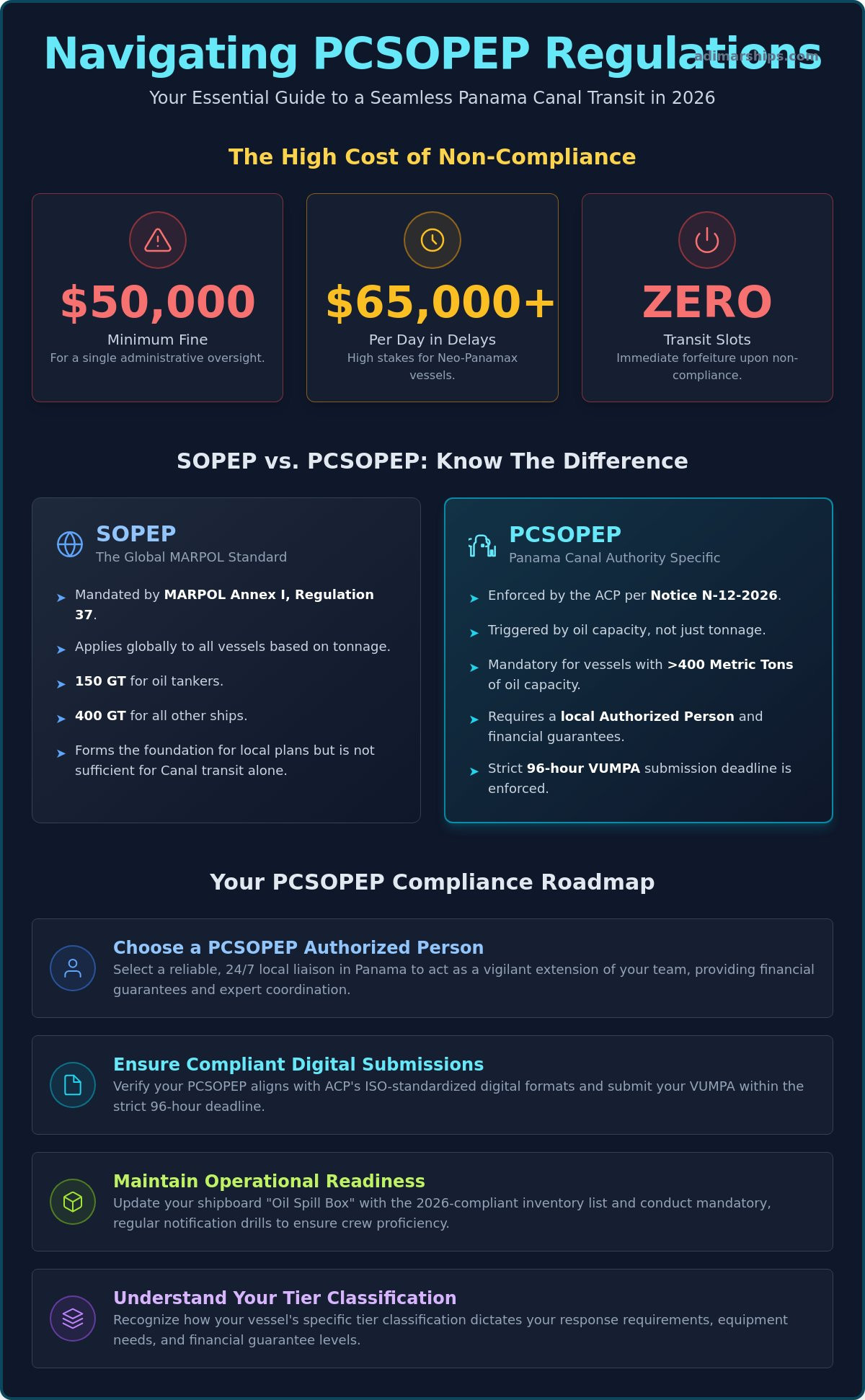
It’s frustrating to coordinate emergency response entities from the other side of the world, especially with the strict 96-hour VUMPA submission deadline looming. We understand the high stakes of a Neo-Panamax transit where daily delay costs can exceed $65,000. This guide will help you master the complexities of the latest OP Notice to Shipping N-12-2026 to ensure total compliance and zero delays. We’ll examine the criteria for selecting a reliable local representative, the mandatory ISO-standardized digital formats, and the specific tier classifications that dictate your requirements. By the end of this article, you’ll have a clear roadmap for securing a dependable Authorized Person in Panama to act as a vigilant extension of your own team.
Key Takeaways
- Understand the critical differences between global MARPOL Annex I standards and the specific PCSOPEP requirements enforced by the Panama Canal Authority for 2026.
- Identify the mandatory 400 metric ton oil capacity threshold and the strict 96-hour VUMPA submission deadline to avoid $50,000 minimum fines.
- Learn how to choose a PCSOPEP authorized person who acts as a reliable, 24/7 local liaison and provides the necessary financial guarantees for your vessel.
- Maintain operational readiness by following the updated 2026 inventory list for your shipboard “Oil Spill Box” and conducting mandatory notification drills.
- Ensure a seamless canal transit by delegating complex local coordination to an experienced agency that understands the latest ACP digital submission formats.
Understanding SOPEP: The MARPOL Standard for Oil Pollution Prevention
The Shipboard Oil Pollution Emergency Plan (SOPEP) stands as a vessel’s primary defense against marine environmental incidents. It’s a mandatory manual that outlines exactly how a crew must respond to an oil spill, from initial reporting to mitigation actions. While it serves a global purpose under international law, it also forms the essential foundation for more specific local requirements. Understanding these global standards is the first step in learning how to choose a PCSOPEP authorized person for your upcoming transit. Without a solid SOPEP in place, your vessel won’t clear the initial hurdles of international maritime safety inspections.
The Legal Mandate of MARPOL Annex I
Regulation 37 of MARPOL Annex I provides the regulatory framework for 2026 compliance. Every oil tanker of 150 gross tonnage (GT) and above, and every ship other than an oil tanker of 400 GT and above, must carry an approved SOPEP manual. This isn’t just a suggestion; it’s a strict legal mandate that requires formal approval from the vessel’s flag state or a recognized organization. If your documentation is outdated or missing, the consequences are severe. Port State Control (PSC) can detain your vessel, leading to massive financial losses and reputational damage. In the high-stakes environment of 2026, even a minor clerical error in your plan can lead to a “no-go” decision at the locks. Beyond the immediate fines, non-compliance risks your P&I insurance coverage, leaving you exposed to astronomical cleanup costs that could bankrupt an unprepared operator.
SOPEP vs. SMPEP: Which Does Your Vessel Need?
Some vessels carry more than just oil. If your ship transports noxious liquid substances (NLS) in bulk, a standard SOPEP isn’t enough. You’ll likely need a Shipboard Marine Pollution Emergency Plan (SMPEP). A Shipboard Marine Pollution Emergency Plan (SMPEP) is a comprehensive manual required under MARPOL Annex II, Regulation 17, for vessels certified to carry noxious liquid substances in bulk. Many operators prefer a combined plan that addresses both oil and NLS to simplify training and reporting requirements for the crew.
When you’re preparing for a Panama Canal transit, these global plans must align perfectly with local ACP expectations. This is where specialized ship agency services in Panama become invaluable. They ensure your global manuals meet the specific criteria of the Canal Authority, preventing delays before they happen. Knowing how to choose a PCSOPEP authorized person ensures that your global SOPEP integrates seamlessly with the mandatory local response framework. A proactive agency acts as your eyes and ears on the ground, verifying that your manual’s contact lists and reporting procedures are current for the 2026 cycle.
Essential Components of a Compliant SOPEP Manual
A compliant SOPEP manual is much more than a regulatory requirement; it’s a tactical guide for high-pressure situations. To meet the 2026 standards, your manual must follow a standardized structure that transitions seamlessly from reporting procedures to immediate mitigation actions. It isn’t enough to have the document on board. The information must be actionable and synchronized with the specific coastal state requirements of the waters you’re entering. Understanding these internal requirements is the first step in learning how to choose a PCSOPEP authorized person who can effectively bridge the gap between your crew and the Panama Canal Authority (ACP).
Command and Control: Crew Responsibilities
Success during a spill depends on a clear chain of command. The Master serves as the ultimate decision-maker, coordinating with coastal authorities and your local representative. Engineering teams must be ready to execute stop-gap measures, such as closing valves or managing internal transfers to stop a leak at its source. Simultaneously, the deck department handles the physical deployment of containment equipment. If these roles aren’t clearly defined in your manual, the resulting confusion can lead to environmental damage and massive liability. A reliable partner providing ship agency services in Panama can help you review these protocols to ensure they meet local expectations before you reach the locks.
Reporting Procedures and Contact Lists
Communication protocols differ significantly between offshore and coastal incidents. While offshore reporting focuses on flag state notification, coastal incidents require immediate contact with the nearest port authorities. You must maintain an accurate “List of National Operational Contact Points” at all times. The ACP is particularly strict about this. Even a minor administrative error in your contact details can lead to a $15,000 fine. Contact lists must be updated at least quarterly to ensure every phone number and email address is current for the 2026 cycle.
The 24-hour notification requirement for coastal authorities is a non-negotiable standard. However, for the Panama Canal, the 96-hour VUMPA submission deadline is the real hurdle. This level of detail is why knowing how to choose a PCSOPEP authorized person who offers proactive document review is vital for a smooth arrival. They act as your vigilant eyes on the ground, ensuring your reporting procedures don’t just meet MARPOL standards, but also satisfy the rigorous demands of the Panama Canal’s unique regulatory environment.
SOPEP vs. PCSOPEP: Navigating Panama Canal Specifics
While a standard MARPOL SOPEP covers global environmental safety, it’s insufficient for the unique ecological and operational environment of the Panama Canal. The Panama Canal Authority (ACP) enforces the Panama Canal Shipboard Oil Pollution Emergency Plan (PCSOPEP) as a mandatory local evolution of the international standard. This plan is required for all vessels with a carrying capacity of 400 metric tons or more of persistent oil, whether as fuel or cargo. If you’re managing a transit in 2026, you must understand that the ACP’s verification process is rigorous. They don’t just look for a manual; they look for a verified local infrastructure that can respond within minutes to an incident. This is why knowing how to choose a PCSOPEP authorized person is a critical operational decision rather than a simple administrative task.
The Role of the Authorized Person (AP) in Panama
The Authorized Person (AP) serves as the legally mandated bridge between your vessel and the ACP. Unlike a standard agent, the AP must be a Panama-resident entity available 24/7 to activate response resources and provide financial guarantees for cleanup costs. This role is so central to compliance that we’ve developed a PCSOPEP authorized person guide to help operators understand their legal exposure. Your AP must possess deep local knowledge to coordinate with the Panama Canal’s own pollution response teams effectively. They act as your vigilant representative, ensuring that if an incident occurs, the financial and logistical response is immediate and compliant with Panamanian law.
ACP Verification and the VUMPA System
The ACP verifies your compliance through the Maritime Service Portal, specifically the VUMPA (Ventanilla Única Marítima de Panamá) system. You must submit your bilingual plan at least 96 hours before arrival. Common reasons for rejection include using incorrect ISO-standardized PDF/A formats or listing expired contact information. Successful Panama Canal transit coordination depends on this plan being approved well in advance. If your plan is rejected during the booking stage, you risk losing your transit slot and facing a $2,500 late submission sanction.
When you’re evaluating how to choose a PCSOPEP authorized person, look for an agency that treats the role as a core competency. You need a partner who doesn’t just check a box but actively monitors ACP regulatory updates, such as the OP Notice to Shipping N-12-2026. A dependable AP provides the security that your vessel remains in full compliance, allowing your crew to focus on the safe navigation of the locks without the fear of administrative delays or heavy fines.
Operational Readiness: Equipment, Drills, and the Oil Spill Box
Documentary compliance is only half the battle. When an ACP inspector steps on board, they look for physical evidence of operational readiness. Your vessel’s primary defense against a minor deck spill is the “Oil Spill Box,” a dedicated station that must be easily accessible and fully stocked. If your equipment is degraded or missing, you risk a $15,000 administrative fine or even the forfeiture of your transit slot. This physical readiness is often overlooked, but it’s a vital factor in how to choose a PCSOPEP authorized person. You need a partner who provides clear checklists and guidance to ensure your crew isn’t scrambling to find a non-sparking shovel while the inspector is watching.
The Oil Spill Box Checklist
The ACP requires a specific inventory to manage potential incidents during transit. Your spill box should be located on deck, clearly marked, and protected from the elements. Minimum quantities for 2026 include absorbent pads, pillows, and booms designed for persistent oil. Safety is the priority; ensure the box contains non-sparking tools and portable, intrinsically safe pumps to prevent ignition during cleanup. Your team also needs dedicated Personal Protective Equipment (PPE), including oil-resistant gloves, boots, and eye protection. Maintaining this gear isn’t just about passing an inspection; it’s about protecting your crew and the Canal’s sensitive environment.
Conducting Effective Shipboard Drills
Equipment is useless without a trained crew. Under the current OP Notice to Shipping N-12-2026, vessels must conduct notification exercises with their Authorized Person at least twice a year. These drills should cover various scenarios, such as bunkering overflows or hull breaches, to evaluate response times and communication effectiveness. To satisfy an ACP inspector, every drill must be recorded in the Deck Log and the Oil Record Book, detailing the date, time, participants, and the specific scenario tested. Records of these exercises must be kept for a minimum of three years for verification.
A proactive agency will help you schedule these mandatory drills and verify that your documentation meets ACP standards before you reach the locks. When you’re evaluating how to choose a PCSOPEP authorized person, prioritize an entity that acts as an extension of your safety team. They should offer more than just a signature; they should provide the local oversight and vigilance needed to keep your vessel moving. For expert support in maintaining these strict standards, you can rely on our specialized PCSOPEP Authorized Person services to ensure your vessel is fully prepared for every inspection.
Adimar Shipping, Inc.: Your Expert Authorized Person in Panama
Adimar Shipping, Inc. fulfills the mandatory requirement for a Panama-resident Authorized Person with the precision and reliability your operations demand. We act as your vigilant, on-the-ground representative, providing the 24/7 availability necessary to activate response resources at a moment’s notice. This specialized role is a core competency of our ship agency services in Panama. When you’re deciding how to choose a PCSOPEP authorized person, you need more than a name on a document; you need a proactive partner who understands the high stakes of a canal transit. We ensure your vessel meets all Panama Canal Authority regulations before you reach the breakwater, eliminating the stress of last-minute compliance hurdles.
Why Delegate Compliance to a Local Specialist?
Delegating complex regulatory tasks to a local specialist is the most efficient way to manage operational risk. We eliminate language barriers and time zone delays that can turn a minor administrative question into a logistical disaster. Our team leverages deep local knowledge to prevent the costly administrative errors that lead to heavy ACP fines. As your Owner’s Nominated Agency, Adimar Shipping, Inc. prioritizes your interests with total transparency and strict ethical standards. We don’t just coordinate services; we act as an extension of your own team. This partnership allows you to delegate specialized tasks to a knowledgeable partner, framing compliance as a strategic advantage rather than a burden.
Streamlining Your Next Canal Transit
Efficiency is the lifeblood of the maritime industry. We integrate our PCSOPEP Authorized Person services with comprehensive husbandry and crew changes to provide a single, reliable point of contact for your entire stay in Panamanian waters. Our team maintains constant vigilance, monitoring your vessel’s status and ensuring all digital submissions via the VUMPA system are flawless. Knowing how to choose a PCSOPEP authorized person means finding an agency that offers a complete suite of husbandry and logistics support under one roof.
Our long-standing history in Panama City provides the stability you need in a regional partner. We use unique local oversight to protect your vessel’s schedule, ensuring that every drill is documented and every piece of equipment in your spill box is ready for inspection. This level of dedication helps you avoid pollution-related delays and maintain your transit slot. To secure a dependable Authorized Person and experience the peace of mind that comes with expert local representation, contact Adimar Shipping, Inc. today to formalize your vessel’s appointment for the 2026 cycle.
Securing Your Vessel’s Future in the Panama Canal
Compliance in the 2026 maritime landscape requires more than just a standard MARPOL manual. It demands a proactive approach to the Panama Canal’s unique environmental protections. You’ve seen that while SOPEP provides a global foundation, the PCSOPEP is a non-negotiable local mandate for vessels with significant oil capacity. Mastering how to choose a PCSOPEP authorized person ensures your operations remain resilient against shifting ACP requirements and high administrative fines. By prioritizing physical readiness on deck and maintaining rigorous drill records, you protect both your schedule and your reputation.
Adimar Shipping, Inc. stands ready as your specialized Panama Canal ship agency. As an authorized PCSOPEP representative, we provide the 24/7 local emergency response coordination you need to navigate these waters with confidence. We act as an extension of your team, providing the vigilance and local oversight that standard agencies can’t match. Don’t leave your transit slot to chance or risk avoidable delays at the locks. Secure your Authorized Person for Panama Canal transit with Adimar Shipping, Inc. and gain the operational freedom to focus on a successful voyage. We look forward to being your dependable partner on the ground.
Frequently Asked Questions
What is the difference between SOPEP and PCSOPEP?
The Shipboard Oil Pollution Emergency Plan (SOPEP) is a global requirement under MARPOL Annex I for all vessels over 400 GT. The Panama Canal Shipboard Oil Pollution Emergency Plan (PCSOPEP) is a specific, additional mandate from the Panama Canal Authority (ACP). While SOPEP covers international waters, the PCSOPEP is tailored to the Canal’s unique environment and requires a Panama-resident Authorized Person to be legally valid.
Which vessels are required to have a PCSOPEP plan for the Panama Canal?
A PCSOPEP plan is mandatory for all vessels with a capacity to carry 400 metric tons or more of persistent oil as fuel or cargo. This includes tankers and non-tankers alike. The ACP uses the total oil carrying capacity to determine your vessel’s tier classification, which dictates the specific response resources your Authorized Person must be able to coordinate during your transit.
Who can serve as an Authorized Person (AP) for a ship in Panama?
Only a Panama-resident entity that is available 24/7 and recognized by the ACP can serve as an Authorized Person. This representative acts as the primary liaison between the vessel and the Canal Authority during a pollution incident. When considering how to choose a PCSOPEP authorized person, verify that your agent has a proven track record of immediate response coordination within Panama City and the Canal zones.
How often must a SOPEP plan be updated and approved?
An approved plan is generally valid for two years unless the vessel undergoes significant modifications or changes ownership. However, you must update the contact lists and coastal state information much more frequently. We recommend a quarterly review of all contact details to ensure your crew can reach the correct authorities without delay during an emergency.
What are the penalties for non-compliance with Panama Canal pollution regulations?
The minimum fine for a PCSOPEP violation is $50,000, and the ACP may also require the forfeiture of your transit slot. Administrative errors, such as a late document submission, carry a minimum sanction of $2,500. Because the daily cost of delay for a Neo-Panamax vessel can exceed $65,000, ensuring your Authorized Person is fully compliant is a vital financial safeguard.
What equipment must be kept in the ship’s oil spill box?
Your oil spill box must contain absorbent pads, pillows, booms, and dedicated Personal Protective Equipment for the cleanup team. It’s also mandatory to include non-sparking tools and portable, intrinsically safe pumps to manage the spill without risk of ignition. All equipment must be maintained in good condition and be easily accessible on deck for immediate deployment during an inspection or incident.
Does a SOPEP cover chemical spills as well as oil?
No, a standard SOPEP only covers oil pollution incidents as defined under MARPOL Annex I. If your vessel carries noxious liquid substances in bulk, you need a Shipboard Marine Pollution Emergency Plan (SMPEP) under MARPOL Annex II. Many operators choose to maintain a combined plan that addresses both oil and chemical pollution to simplify crew training and reporting procedures.
How do I submit my PCSOPEP plan to the Panama Canal Authority?
You must submit your plan digitally through the VUMPA system at least 96 hours prior to your vessel’s arrival in Canal waters. For 2026, the ACP requires all submissions to be in a specific ISO-standardized PDF/A format. Learning how to choose a PCSOPEP authorized person like Adimar Shipping, Inc. who can manage these digital submissions is the best way to ensure your documentation is approved without technical rejections.