

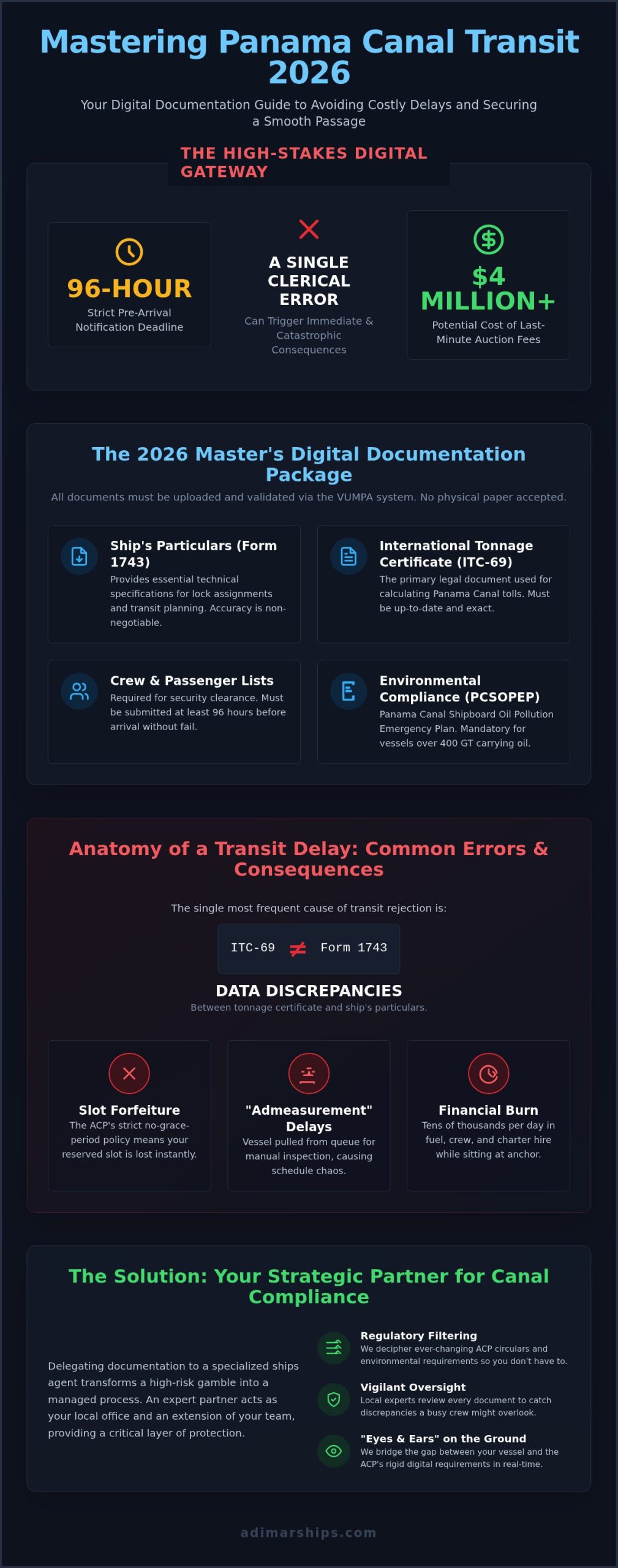
A single clerical error in the VUMPA system can now cost a shipowner more than just time; it can result in the immediate forfeiture of a transit slot and millions in last-minute auction fees. In 2026, the digital requirements for Panama Canal vessel documentation are no longer just paperwork; they’re the high-stakes digital key to one of the world’s most complex waterways. We understand that coordinating between owners, charterers, and the Panama Canal Authority (ACP) feels like a constant battle against shifting regulations and strict 96-hour pre-arrival deadlines.
You shouldn’t have to manage this administrative burden alone. This guide is designed to help you master the latest requirements and ensure a delay-free transit for your fleet. We’ll provide a clear checklist for the 2026 season, explain how to navigate the digital SIDMAR system, and detail the new environmental performance documentation needed for preferential toll rates. By the end of this article, you’ll have the assurance that your vessel is fully prepared to pass its inspection on the very first attempt.
Key Takeaways
- Understand why Panama Canal vessel documentation is the critical foundation for transit clearance and how to avoid the “Timing vs. Loss” dynamic that leads to costly surcharges.
- Learn to compile a complete 2026 Master’s Documentation Package, transitioning fully from traditional paperwork to the mandatory digital formats required by the ACP.
- Navigate the SIDMAR and VUMPA digital systems with confidence to ensure your vessel’s data is machine-validated and cross-checked against global maritime databases.
- Identify and eliminate the most frequent documentation errors, specifically discrepancies between the ITC-69 and Form 1743, before they trigger a transit rejection.
- Discover the benefits of delegating local logistics to a specialized ships agent who acts as your vigilant “eyes and ears” on the ground in Panama.
Why Vessel Documentation is the Foundation of a Smooth Transit
Panama Canal vessel documentation represents the critical administrative prerequisite for any successful transit. It’s much more than a list of ship particulars; it’s a legal and operational commitment to the Panama Canal Authority (ACP). Understanding the history and operations of the Panama Canal reveals that efficiency has always relied on precise coordination. Without accurate and timely documentation, a vessel is effectively invisible to the scheduling system. In the high-pressure environment of 2026, these digital records serve as the foundation upon which every other logistical step is built.
The “Timing vs. Loss” dynamic is unforgiving in the current maritime landscape. A single missing form or a late VUMPA submission doesn’t just cause a minor delay; it can lead to the immediate forfeiture of a reserved transit slot. With auction prices for last-minute slots reaching as high as $4 million due to increased demand, the financial stakes of a paperwork error are astronomical. Professional ship agents act as the “local office” for the owner, bridging the gap between the vessel’s crew and the ACP’s rigid requirements. We introduce the concept of “Vigilant Oversight,” where every document is reviewed by local experts to catch discrepancies that a busy crew might overlook.
The Cost of Documentation Errors in 2026
Incorrect vessel particulars often trigger “Admeasurement” delays that disrupt the entire transit schedule. If the physical dimensions or cargo configurations don’t match the submitted ITC-69 or Form 1743, the vessel is often pulled from the queue for manual inspection. This administrative friction has direct financial consequences:
- Operational Burn: Daily costs for a vessel sitting at anchor can reach tens of thousands of dollars in fuel, crew wages, and charter hire.
- Missed Windows: A delay in document verification can push a vessel past its assigned arrival window, triggering heavy surcharges.
- Slot Forfeiture: The ACP maintains a strict no-grace-period policy for pre-arrival notifications in 2026.
A Documentation Hold is the primary cause of non-weather-related delays.
Adimar’s Role as Your Local Documentation Partner
Delegating these tasks to a specialized Panama Canal ships agent transforms your transit from a risk-heavy gamble into a managed process. Adimar acts as your local office in Panama, filtering through ever-changing ACP circulars and carbon emission requirements. We provide a layer of protection that simple crew submissions cannot match. Our team acts as an extension of the owner’s own team on the ground, serving as your vigilant eyes and ears. By handling the Panama Canal vessel documentation with 20 years of specialized expertise, we ensure that your fleet moves through the locks without the stress of administrative uncertainty.
Essential Documents for Panama Canal Clearance in 2026
Every successful transit begins with the compilation of the Master’s Documentation Package. In the 2026 maritime environment, this package is entirely digital. The Panama Canal Authority (ACP) no longer accepts physical paper for pre-arrival clearance. Instead, all Panama Canal vessel documentation must be uploaded through the VUMPA system. Precision is non-negotiable. Even a minor discrepancy in ship particulars can lead to a re-measurement, causing delays that ripple through your entire schedule.
The Core Transit Package: Particulars and Manifests
The foundation of your submission rests on the ACP Ship’s Particulars (Form 1743). This document provides the technical specifications the canal uses for lock assignments. For vessels utilizing the Neo-Panamax locks, these dimensions must be updated with extreme accuracy to account for the tight tolerances of the larger chambers. You must also provide the International Tonnage Certificate (ITC-69), which serves as the primary basis for toll calculations. For security clearance, the Crew List and Passenger List must be submitted at least 96 hours before arrival. Following the official Panama Canal Authority (ACP) regulations ensures that these manifests meet the latest security protocols.
PCSOPEP and Environmental Compliance
Environmental safety is a top priority for the ACP. Any vessel over 400 gross tons carrying oil as cargo or fuel must maintain a Panama Canal Shipboard Oil Pollution Emergency Plan (PCSOPEP). This plan is specific to the canal’s unique geography. A critical requirement is the designation of a PCSOPEP authorized person who resides in Panama. This individual acts as the legal liaison during an emergency. Adimar Shipping holds specialized status as an authorized person, allowing us to manage these complex filings and ensure your vessel remains in full compliance with local pollution prevention laws.
New 2026 Sustainability and Carbon Reporting
Effective February 2026, a new toll structure offers preferential rates for vessels with superior environmental performance. To qualify, you must submit detailed emissions data and green vessel classifications. Accurate reporting can impact your vessel’s priority and final costs. Our role as your agent involves verifying these technical documents before they reach the ACP. We act as your local “eyes and ears,” ensuring your data reflects your ship’s energy-efficiency technologies correctly. If you’re unsure about your vessel’s current status, it’s wise to consult with a local expert to review your environmental documentation before the 96-hour deadline.
Navigating the ACP Digital Systems: SIDMAR and Beyond
The Maritime Service Information System, known as SIDMAR, serves as the central nervous system for all 2026 canal logistics. This platform is where the digital transition truly takes hold. Paperless clearance is now the absolute standard for Panama Canal vessel documentation, meaning the Master on board must be proficient in digital data entry. However, the system is more than just a repository. It utilizes automated machine-validation to cross-check ship data against global maritime databases in real-time. If there’s a mismatch between your digital entry and the physical certificates on the bridge, the system triggers an immediate administrative hold.
We often hear owners ask if they can simply manage these uploads themselves. While the portal is accessible, the risk of system rejection is high for those unfamiliar with its technical nuances. Adimar performs a rigorous “Digital Verification” process. We check your entries against your actual certificates before they hit the ACP server. This vigilant oversight prevents the “lock-out” scenarios that occur when the system identifies a data conflict. In a period where environmental volatility and the impact of drought on Canal transits have already strained schedules, digital precision is your best defense against unexpected delays.
Electronic Data Interchange (EDI) Requirements
The ACP requires specific Electronic Data Interchange (EDI) formats for all cargo and vessel transmissions. The most critical element is the Arrival Notification, which must be submitted through the VUMPA portal at least 96 hours before arrival. This isn’t a suggestion; it’s a hard deadline with no grace period in 2026. Adimar monitors your vessel’s SIDMAR status in real-time, providing you with constant updates. We ensure that every data packet meets the ACP’s technical standards so your transit slot remains secure.
Security and ISPS Code Documentation
Security pre-clearance is a mandatory step before any vessel reaches the breakwater. You must provide comprehensive documentation regarding the International Ship and Port Facility Security (ISPS) Code. This includes the last ten ports of call and current security levels on board. Our team coordinates directly with the Panama Canal Authority to resolve any security queries before they become obstacles. By delegating these complex interactions to a local expert, you ensure that your security documentation is handled with the professional care required for high-stakes maritime operations.
Avoiding Common Documentation Errors and Transit Delays
The primary cause of rejection for Panama Canal vessel documentation isn’t usually a missing file; it’s a data discrepancy. Specifically, mismatches between the International Tonnage Certificate (ITC-69) and the ACP Ship’s Particulars (Form 1743) trigger immediate red flags. These documents must align perfectly. Even a one-centimeter difference in reported beam or a slight rounding error in displacement can lead to a re-measurement order. Adimar applies a “Vigilance Factor” to every transit, reviewing every line of data before it ever reaches an ACP inspector’s screen.
Beyond technical ship data, we also manage the documentation for husbandry services. Crew changes, spare parts delivery, and provisions must all be documented correctly to avoid delays from Port State Control. If these side operations aren’t aligned with the main transit filing, they can hold up your vessel at the breakwater. We ensure that every administrative thread is tied together so that secondary logistics don’t interfere with your primary transit schedule.
The 96-Hour Submission Countdown
Timing is everything in 2026. The ACP operates on a strict chronological schedule, and missing a window can be financially devastating. Following this checklist is essential for maintaining your slot:
- 96 Hours: Finalize and submit the Pre-Arrival Notification via VUMPA. This includes the security manifest and ISPS data.
- 48 Hours: Provide updated Estimated Time of Arrival (ETA). If your ETA changes by more than three hours, you must update it immediately or risk losing your transit window.
- 24 Hours: Final confirmation of cargo manifests and ballast water record books.
Adimar manages these deadlines proactively. We don’t just wait for your crew to send files; we prompt your team to ensure every update is logged on time to protect your transit slot.
Handling Discrepancies and ACP Inspections
When an ACP inspector boards your vessel, they’re looking for consistency between your digital filings and your physical logs. If an error is found upon boarding, it’s often too late for simple digital corrections. This is where professional ship agency Panama services become invaluable. Our agents act as mediators, working directly with the inspector to resolve discrepancies on the spot. We understand the nuances of local regulations and can often clarify technical points that might otherwise lead to an administrative hold.
Ensuring your vessel passes inspection on the first attempt is our primary goal. If you want to secure your transit schedule and eliminate the risk of documentation rejection, you should partner with an experienced local agent who understands the 2026 regulatory landscape.
Adimar Shipping: Your Strategic Partner for Canal Compliance
Adimar Shipping acts as the vigilant guardian of your vessel’s transit schedule. With the heightened complexities of 2026 regulations, you need a partner on the ground who treats your ship’s interests as their own. Managing Panama Canal vessel documentation shouldn’t be a source of constant stress for your operations team. By delegating these specialized tasks to our team, you gain the freedom to focus on fleet management while we ensure every administrative detail is perfect. We act as an extension of your own crew, providing the local oversight necessary for a seamless transit.
Personalized Service at Competitive Costs
Our philosophy is built on transparent communication and rapid response. We don’t believe in the one-size-fits-all approach of larger, impersonal global agencies. Instead, we provide personalized coordination that anticipates potential problems before they occur. Our deep local expertise leads to cost-conscious and efficient results because we know exactly how to navigate the ACP’s digital systems without triggering unnecessary fees or re-measurement orders. We invite you to request a Proforma Disbursement Account (PDA) or a specific quote for your next transit to see the Adimar difference firsthand.
The Adimar Advantage: 20 Years of Integrity
Integrity is the cornerstone of our service. With over 20 years of history as a ships agent in Panama, we’ve built a reputation for ethical conduct and technical excellence. This long-standing presence allows us to act as your local “eyes and ears,” providing a level of vigilance that protects your bottom line. We understand the high stakes of the industry and the difficulties of coordinating multiple maritime entities from afar.
Our Owner’s Nominated Agency service acts as the ultimate safety net for your fleet. We protect your interests by verifying that all documentation and husbandry requirements are met with absolute precision. You don’t have to be an expert in every ACP circular or sustainability reporting requirement; we handle that complexity for you. This expertise delegation ensures that your vessel moves through the locks safely and on time, every time.
When you nominate Adimar as your agent, you eliminate confusion and gain a proactive partner in Panama. Let us manage your next transit with the vigilance and professional care your fleet deserves. Contact us today to secure your 2026 transit schedule.
Secure Your Fleet’s Transit for the 2026 Season
Navigating the Panama Canal in 2026 requires more than just a capable crew; it demands administrative perfection. The shift to fully digital systems like SIDMAR and VUMPA has removed the margin for error. Success depends on submitting accurate Panama Canal vessel documentation within strict deadlines to avoid slot forfeiture and high auction fees. You don’t have to face these logistical hurdles alone. Adimar Shipping provides the vigilant oversight your fleet needs to transit without delay.
With 20+ years of maritime expertise in Panama and our status as an authorized PCSOPEP representative, we act as your dedicated local partner. We offer personalized, 24/7 coordination to ensure every form and manifest is verified before it reaches the ACP. Don’t let a clerical error disrupt your operational schedule or impact your bottom line. We invite you to Nominate Adimar Shipping as your Panama Canal Agent to eliminate confusion and ensure your vessel transits safely and on time. We’re ready to serve as your eyes and ears on the ground.
Frequently Asked Questions
What are the primary documents required for a Panama Canal transit in 2026?
The core package includes the ACP Ship’s Particulars (Form 1743), the International Tonnage Certificate (ITC-69), and a valid Panama Canal Shipboard Oil Pollution Emergency Plan (PCSOPEP). You must also submit finalized crew and passenger lists for security clearance. In 2026, all these materials must be uploaded digitally through the VUMPA system. Paper copies are no longer accepted for pre-arrival clearance, making digital accuracy your top priority for a successful transit.
When is the deadline for submitting vessel documentation to the ACP?
You must submit the pre-arrival notification at least 96 hours before your vessel reaches Panama Canal waters. This is a strict deadline with no grace period in 2026. Late submissions can lead to the immediate loss of your transit slot. Additionally, you’re required to provide updated Estimated Time of Arrival (ETA) notices at the 48-hour and 24-hour marks to maintain your position in the scheduling queue.
Can the ship’s Master handle all SIDMAR submissions directly?
While a Master can technically access the portal, handling all SIDMAR submissions directly is risky due to the system’s complex machine-validation protocols. Minor data entry errors often trigger automated rejections that a crew might not know how to troubleshoot. A local agent provides a critical layer of verification. We review the data against physical certificates before submission to ensure your Panama Canal vessel documentation passes the ACP’s digital screening on the first attempt.
What is the role of a PCSOPEP authorized person in the documentation process?
A PCSOPEP authorized person serves as the mandatory local liaison for the Panama Canal Shipboard Oil Pollution Emergency Plan. This individual must reside in Panama and act as the legal point of contact during any pollution-related incidents. Beyond emergency response, they ensure that your vessel’s plan is properly filed and compliant with ACP regulations. Adimar Shipping is a specialized, authorized representative capable of managing these critical environmental filings for your fleet.
What happens if there is a discrepancy in the vessel’s tonnage documentation?
If an inspector finds a discrepancy between your ITC-69 and the physical vessel, they’ll likely order a formal re-measurement. This process causes significant transit delays and often results in administrative surcharges. Because tolls are based on these measurements, the ACP is extremely strict about accuracy. Having an agent verify your tonnage documentation against the vessel’s actual configuration before arrival is the best way to prevent these costly interruptions.
How does the Panama Canal’s digital documentation system (SIDMAR) work for new vessels?
New vessels must first be registered within the VUMPA system to generate a unique identification number. For an initial transit, the ACP requires a comprehensive admeasurement process to verify all physical dimensions and tonnage. This involves uploading detailed technical drawings and certificates into SIDMAR before the vessel arrives. Your agent coordinates this first-time setup to ensure the ACP has all the data necessary to assign the vessel to the correct lock category.
Are there specific 2026 environmental documents required for green incentives?
Effective February 2026, the ACP offers preferential toll rates for vessels that demonstrate superior environmental performance. To qualify, you must submit verified data regarding carbon emissions and advanced energy-efficiency technologies. These documents are cross-checked against new sustainability benchmarks. Accurate reporting in your Panama Canal vessel documentation can lead to significant cost savings, provided the technical data is formatted and submitted according to the latest 2026 green vessel classifications.
Why is a local ship agent necessary for documentation if I have a global manager?
Global managers handle broad compliance, but they lack the on-the-ground presence required for the Panama Canal’s unique, real-time demands. A local agent acts as your eyes and ears, providing immediate troubleshooting for system errors and physical representation during ACP inspections. We bridge the gap between global standards and local requirements. Our 20 years of experience allow us to navigate the nuances of the ACP’s daily operations in ways a remote manager simply cannot.