
Misjudging a single transit slot in 2026 could result in a $50,000 loss in idle time and missed delivery windows. You probably feel the pressure of managing the complex divide between Panamax and Neopanamax regulations while trying to avoid massive non-compliance fines. It’s a high-stakes environment where timing is literally money. Selecting an expert ship agent for first time panama canal transit is your most critical decision to ensure your vessel isn’t left waiting at the anchorage for days.
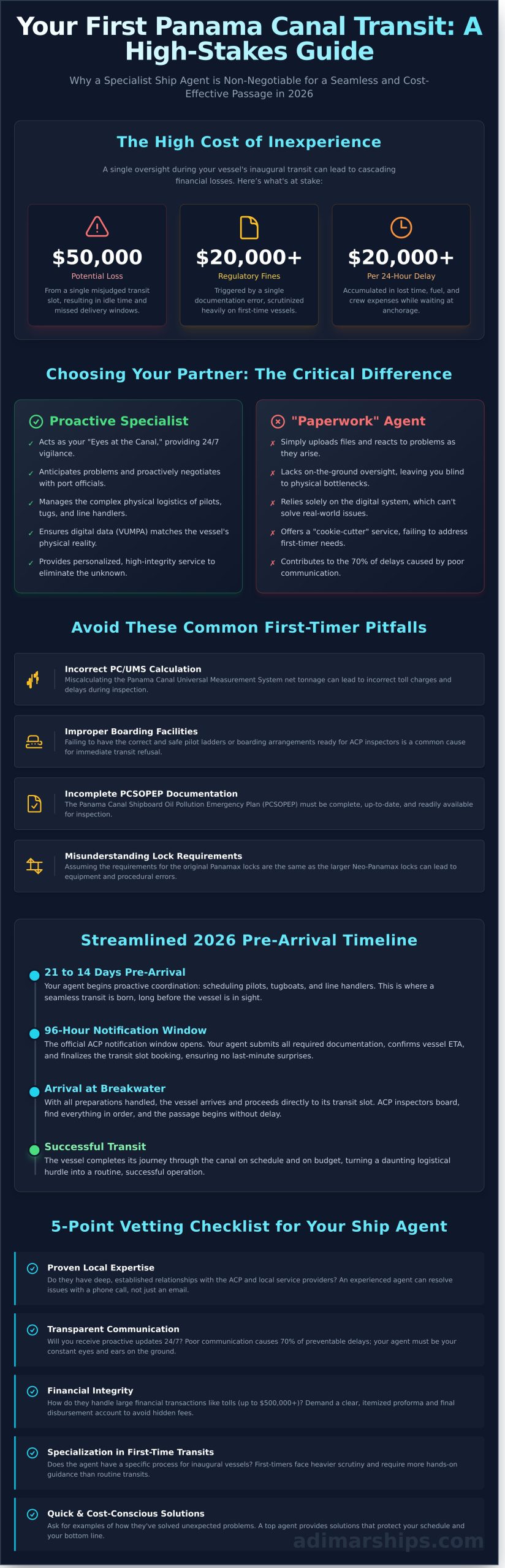
We’re experts so you don’t have to be. We serve as your eyes at the Panama Canal, protecting your interests from the moment you enter the 96 hour notification window. This guide will teach you how to choose a partner who eliminates confusion, manages your specific booking windows, and guarantees a seamless passage. You’ll learn the exact criteria to vet an agent so you can secure a stress-free transit with zero regulatory fines and predictable costs. We’ll show you how to turn a daunting logistical hurdle into a routine, successful operation.
Key Takeaways
- Understand why a single documentation error can trigger over $20,000 in fines and how a dedicated specialist protects your bottom line.
- Explore the complex pre-arrival coordination of pilots and line handlers that serves as your “eyes at the Canal” weeks before your vessel’s ETA.
- Apply a 5-point vetting checklist to choose a reliable ship agent for first time panama canal transit who prioritizes transparency and local expertise.
- Follow a streamlined 2026 pre-arrival timeline to ensure your vessel meets all ACP regulations and avoids the frustration of unexpected scheduling shifts.
- Learn how a personalized approach to ship agency services eliminates the “cookie-cutter” risks of larger firms to ensure a seamless, high-integrity passage.
Why Your First Panama Canal Transit Requires a Specialist Ship Agent
A Panama Canal ship agent is the legally required local representative who manages every interaction with the ACP (Panama Canal Authority). For a vessel’s inaugural journey through the Panama Canal, this role is critical. You aren’t just hiring a clerk to file paperwork; you’re appointing a specialized coordinator to manage a high-stakes maritime operation. The ACP requires a licensed agent to handle all official notifications, payments, and logistics because the local system is complex and unforgiving of errors. Hiring an experienced ship agent for first time panama canal transit is the only way to ensure your vessel meets the strict technical and administrative standards before it arrives at the breakwater.
The financial stakes of an inaugural transit are immense. A single documentation error or a minor miscalculation in the ship’s dimensions can lead to immediate delays or heavy fines. In the current maritime environment, a 24-hour delay can cost a ship owner upwards of $20,000 in lost time, fuel, and crew expenses. The ACP scrutinizes first-time vessels more heavily than routine transits because they have no historical data on the ship’s handling or equipment reliability. Adimar Shipping, Inc.’s philosophy is built on moving your operation from confusion to clarity. We believe we’re experts so you don’t have to be. By putting your transit in our hands, we eliminate the stress of the unknown with personalized, high-integrity service.
The Legal Requirement vs. The Operational Reality
Panamanian law mandates that every vessel must have local representation to interact with the ACP. While the “Single Window” system, known as VUMPA, has digitized many aspects of the process, it still requires human oversight to function correctly. A digital system can’t solve physical bottlenecks or negotiate with port officials when schedules shift. There’s a massive difference between a “paperwork agent” who simply uploads files and a proactive partner who anticipates problems. We see ourselves as your local office at the canal. We act as your eyes on the ground, ensuring that the digital data submitted via VUMPA matches the physical reality of your vessel and its cargo.
The High Cost of Inexperience
Inexperience often leads to costly mistakes, such as misjudging the arrival window at Balboa or Cristobal. If a ship misses its scheduled arrival time by even 30 minutes, it can lose its transit slot entirely, leading to days of waiting in the anchorage. Real-world data shows that 70% of preventable transit delays are caused by poor communication between the agency and the vessel. Time is money at the locks, and the ACP operates on a rigid schedule that doesn’t accommodate beginners’ luck. Common mistakes for first-timers include:
- Incorrectly calculating the Panama Canal Universal Measurement System (PC/UMS) net tonnage.
- Failing to have the correct boarding facilities or pilot ladders ready for ACP inspectors.
- Incomplete PCSOPEP (Panama Canal Shipboard Oil Pollution Emergency Plan) documentation.
- Misunderstanding the specific requirements for Neo-Panamax locks versus the original locks.
Since our 20th year in business, Adimar Shipping, Inc. has focused on providing quick solutions and cost-conscious coordination. We understand the commercial pressures you face. Our goal is to provide a seamless experience where your only focus is your business, while we handle the intricate details of the ship agent for first time panama canal transit. We provide transparency and integrity every time, ensuring your first transit is a success rather than a costly lesson.
The Anatomy of Ship Agency Services: What Happens Behind the Scenes
Successful transit coordination begins at least 14 to 21 days before your vessel reaches the breakwater. It’s a high-stakes logistical puzzle where timing is everything. A local agent manages the intricate scheduling of pilots, tugboats, and line handlers required for every mile of the 50-mile journey. Because the canal operates 24/7, 365 days a year, missing a scheduled window by even 60 minutes can result in thousands of dollars in wait-time fees. We act as your local office, managing these moving parts so you don’t have to worry about the friction of local bureaucracy.
We often describe ourselves as your “Eyes at the Canal.” This isn’t just a metaphor; it’s a commitment to vigilance. While an owner might be 5,000 miles away in a different time zone, the agent is physically present to monitor every development. This includes managing the financial flow, which is often the most stressful part for newcomers. Tolls for a single Neopanamax vessel can exceed $500,000 USD, and these funds must be settled precisely according to the Panama Canal Authority regulations. Beyond tolls, we handle husbandry fees and Cash to Master (CTM) deliveries with absolute transparency. In an environment where “time is money,” integrity in reporting is our most valuable asset. You receive real-time updates, not vague summaries, ensuring you’re never left guessing about your ship’s status or your capital.
Transit Clearance and Documentation
For a ship agent for first time panama canal transit, the primary hurdle is the Electronic Data Collection System (EDCS). This digital portal requires precise vessel data, cargo manifests, and crew lists submitted well in advance. If you’re operating a newer vessel designed for the Neopanamax locks, we manage the specific “Approval of Plans” process required by the ACP. This technical review ensures your ship’s mooring equipment and visibility meet the 2024 safety standards. When the ACP inspector boards your vessel at the anchorage, your agent is there to bridge the communication gap, ensuring the inspection goes smoothly without administrative hitches. Securing an experienced ship agent for first time panama canal transit ensures your documentation meets every revised standard.
Husbandry and Protective Services
The transit window is often the only time a vessel stops during a long voyage, making it the perfect time for husbandry. We coordinate crew changes, emergency medical evacuations, and the delivery of critical spare parts without disrupting the transit schedule. If a charterer has already appointed a primary agent, you should still consider the value of a Protective Agent. We serve as your dedicated advocate, double-checking every expense and ensuring the charterer’s agent prioritizes your vessel’s long-term interests. Whether it’s bunkering or fresh water delivery, we find quick solutions that keep your operations cost-conscious and efficient. Our goal is to eliminate the confusion of the canal, allowing you to focus on your core business while we handle the local complexities with the expertise gained from 20 years in the industry.
How to Evaluate a Ship Agent for Your Inaugural Transit
Choosing a ship agent for first time panama canal transit isn’t just a box to check on your voyage plan. It’s a strategic decision that affects your bottom line. A single day of delay at the Canal can cost a ship owner between $20,000 and $50,000 in lost charter hire and fuel. You need a partner who treats your capital with that level of respect. Use this 5-point checklist to vet potential agencies before you nominate them:
- 20+ Years of Local Presence: Look for an agency that has operated in Panama since at least 2004. Longevity means they’ve survived the transition to the Neopanamax locks and understand the evolving ACP (Panama Canal Authority) culture.
- Direct 24/7 Communication: Excellent communication means a response within 15 minutes, not 4 hours. You need an agent who provides real-time updates via WhatsApp or satellite phone.
- PCSOPEP Authorization: Ensure the agent is a certified “Authorized Person” for oil pollution plans. This is a legal requirement for vessels carrying 400 metric tons or more of oil as fuel or cargo.
- Financial Integrity: Your Proforma Disbursement Account (PDA) should be itemized to the cent. Avoid any agent who includes large “miscellaneous” or “contingency” fees without explanation.
- Technical Problem-Solving: Ask for a case study from the last 12 months where they resolved a mechanical or documentation crisis.
Financial transparency is where most first-timers get caught. We’ve seen PDAs where hidden surcharges for “transportation” or “administrative filing” added $3,000 to the final bill. A professional agent provides a transparent breakdown of ACP tolls, which can exceed $300,000 for larger vessels, ensuring every $1.00 is accounted for. We are experts so you don’t have to be. We see ourselves as your local office, protecting your interests from the moment you enter the Atlantic or Pacific anchorage.
Local Knowledge and Relationships
The Panama Canal isn’t just a waterway; it’s a community built on professional trust. Our team has spent two decades building relationships with ACP port captains and inspectors. These connections are vital when a vessel faces a sudden mechanical failure. If a steering gear issue arises, a well-connected agent can often coordinate a “Quick Solution” with the ACP to avoid a total transit cancellation. We are your eyes at the Panama Canal, providing the ground-level intel that a remote operations desk simply can’t see.
Compliance Specialization: PCSOPEP and Beyond
For a ship agent for first time panama canal transit, compliance is the steepest hurdle. Every vessel must adhere to strict safety standards, including U.S. regulations for the Panama Canal regarding dangerous cargo and vessel requirements. We manage your Panama Canal Shipboard Oil Pollution Emergency Plan (PCSOPEP) to ensure you’re ready for the 2026 environmental updates. This includes verifying that your ship’s equipment meets the latest ACP boarding officer requirements. We don’t just file paperwork; we ensure your crew is prepared for the specific boarding inspections that can delay a transit by 12 to 24 hours if not handled correctly.
The First-Timer’s Pre-Arrival Checklist for 2026
Preparing for a 2026 transit requires more than just showing up at the breakwater; it demands a structured roadmap to avoid expensive delays. The Autoridad del Canal de Panamá (ACP) maintains strict protocols that can be overwhelming for those without local support. To ensure your vessel moves through the locks without a hitch, follow these five essential steps.
- Step 1: Nominate your agent. You should select a ship agent for first time panama canal transit at least 30 days before your Estimated Time of Arrival (ETA). This lead time is necessary to register your vessel in the ACP’s Single Window for Maritime Commerce (VUMPA) and establish your customer code.
- Step 2: Submit vessel dimensions. Your agent must submit General Arrangement and Capacity plans for ACP approval. If your vessel’s dimensions are recorded incorrectly, you risk “non-compliant” surcharges that often exceed $5,000.
- Step 3: Secure your booking slot. Transit slots are divided by vessel size. Neopanamax ships (over 107 feet wide) have different booking windows than Panamax vessels. Your agent will help you decide if a pre-booking is necessary or if you should arrive for “first-come, first-served” transit.
- Step 4: Verify PCSOPEP and security. Vessels carrying 400 metric tons or more of oil as fuel or cargo must have a Panama Canal Shipboard Oil Pollution Emergency Plan (PCSOPEP) on file. Your agent ensures this documentation is verified before you hit the Cristobal or Balboa anchorages.
- Step 5: Finalize the PDA. The Proforma Disbursement Account (PDA) covers all tolls and fees. The ACP requires 100% of the estimated tolls to be paid in full via your agent at least 48 hours before transit. For a Neopanamax vessel, this figure often ranges between $250,000 and $450,000.
Booking and Scheduling Strategy
Timing your arrival is a financial decision. The ACP uses three distinct booking periods. The 1st period opens 365 days in advance, while the 2nd period begins 21 days before your transit date. If you miss these windows, the 3rd period opens just 96 hours before arrival. When slots are fully booked, we use the “Auction” system. In peak seasons, auction bids for a single slot have reached over $1,000,000, though average bids in 2025 have stabilized closer to $150,000. Your ship agent for first time panama canal transit monitors the live Canal Schedule to find the most cost-effective entry point for your specific hull type.
Technical Readiness for the Locks
Technical compliance is where most first-timers fail. The ACP requires specific hardware, including chocks and bitts that meet the 64-ton or 90-ton safe working load (SWL) requirements. Visibility is another critical factor; the pilot must have an unobstructed view of the water surface from the bridge. If deck cargo or containers block this view, the ACP will mandate extra tugboats, costing you roughly $5,000 per unit. We recommend having your crew perform a mock inspection of the pilot ladder and bridge equipment 24 hours before arrival to ensure everything is ready for the ACP boarding officer.
Don’t leave your transit to chance. We are your eyes at the Panama Canal, ensuring every technical and financial detail is handled with integrity. Nominate Adimar Shipping as your agent today to secure your 2026 transit slot.
Partnering with Adimar Shipping: Your Eyes at the Panama Canal
Choosing the right partner determines whether your first voyage through the Isthmus is a success or a costly lesson. Adimar Shipping brings a 20-year legacy of reliability to every vessel we represent. Since our founding in 2004, we’ve focused on integrity as our core metric. We understand that for ship owners, time is money. Misjudging a single window can lead to thousands of dollars in idling costs. We serve as your ship agent for first time panama canal transit needs by eliminating the guesswork. While “big agency” firms often provide a cookie-cutter approach that leaves smaller or first-time operators feeling lost, we prioritize personalized service. We are experts so you don’t have to be.
Our team treats your vessel as if it were our own. We don’t just process paperwork; we anticipate hurdles before they manifest. Whether it’s coordinating with the Panama Canal Authority (ACP) or managing crew changes, our 20 years of local experience ensures a seamless transition from the Atlantic to the Pacific. We provide high-quality, timely service with integrity, every time. By putting your transit in our hands, you eliminate the confusion and focus on your core business operations while we handle the complex logistics of the canal.
A Local Office for Global Owners
Adimar functions as your direct extension on the ground in Panama City. You aren’t just hiring a service; you’re gaining a local office. In 2023, we managed the inaugural transit for a European tanker fleet that had never used the canal. By providing 24/7 coordination, we reduced their expected port stay by 14 hours. Our clients enjoy direct access to senior management. Communication never fails because you have a dedicated expert watching your interests. We are your eyes at the Panama Canal, ensuring every detail is handled with precision and transparency.
Next Steps: Securing Your 2026 Transit
Planning for a 2026 transit requires early action to secure the best slots and minimize costs. Our process is transparent and efficient. We provide a detailed Proforma Disbursement Account (PDA) and a comprehensive transit estimate within 24 hours of your request. All costs are quoted in US Dollars ($), reflecting the official currency of Panama’s maritime sector. If you’re currently working with another firm but feel like a number, switching to us is simple. We handle the transition logistics so your operations remain uninterrupted. As a specialized ship agent for first time panama canal transit, we ensure your vessel meets all PCSOPEP and ACP requirements well in advance.
- Request a Quote: Send us your vessel specifications for a tailored PDA today.
- Review Estimates: We provide transparent, cost-conscious breakdowns with no hidden fees.
- Confirm Nomination: We take over the coordination with the ACP immediately to secure your slot.
Don’t leave your first transit to chance. Secure a partner that values your business and understands the pressure of the global supply chain. Nominate Adimar as your Panama Canal Ship Agent today and experience the difference that 20 years of integrity makes for your fleet.
Secure Your Spot in the 2026 Panama Canal Schedule
Navigating the world’s most famous shortcut doesn’t have to be a source of stress for your crew or your bottom line. Success in 2026 depends on early preparation and a deep understanding of the Panama Canal Authority’s evolving regulations. You need a partner who handles the heavy lifting of PCSOPEP compliance and local logistics to ensure your vessel stays on schedule. This prevents the frustration of unexpected delays and administrative hurdles during your inaugural voyage.
Adimar Shipping brings over 20 years of experience directly to your bridge. We’ve maintained a proven track record of zero-delay transits for first-time operators by acting as your eyes at the Panama Canal. As an authorized PCSOPEP person service provider, we manage the technical requirements so you don’t have to. Choosing the right ship agent for first time panama canal transit is the most critical decision you’ll make before reaching the locks. We’re ready to provide the transparency and integrity your fleet deserves.
Get a personalized transit quote and nominate Adimar as your agent to start your 2026 journey with confidence. We look forward to seeing you at the canal.
Frequently Asked Questions
Do I legally need a ship agent for a Panama Canal transit?
Yes, the Panama Canal Authority (ACP) regulations require every commercial vessel to appoint a local ship agent. You can’t navigate the waterway without a licensed representative to handle your legal and financial obligations. Your agent manages the mandatory guarantees and payments to the ACP. They act as your local office, ensuring your vessel meets all 2024 maritime regulations before you arrive at the breakwater.
What is the difference between an Owners Nominated Agency and a Charterers Agency?
An Owners Nominated Agency works directly for the ship owner to protect their long term interests. A Charterers Agency is appointed by the party leasing the vessel to handle cargo operations. Often, owners hire a Protective Agent even when a charterer picks the primary agency. This ensures someone is watching your costs and vessel safety during the 8 to 12 hour transit through the locks.
How much does a ship agent cost for a Panama Canal transit?
Standard agency fees for a single transit generally range from $2,500 to $5,000 depending on the vessel type. This fee covers the coordination of the transit and basic administrative work. It doesn’t include the ACP tolls, which can range from $150,000 to over $1,000,000 for large container ships. You should also budget for husbandry services like crew changes, which typically cost extra based on your specific needs.
What is PCSOPEP and why do I need an authorized person?
PCSOPEP is the Panama Canal Shipboard Oil Pollution Emergency Plan required for all vessels carrying 400 metric tons or more of oil as fuel or cargo. You must appoint an Authorized Person (AP) who lives in Panama and speaks fluent English and Spanish. This person is legally responsible for coordinating with the ACP in case of an oil spill. Your agent ensures your AP is registered and available 24/7 during your transit.
How far in advance should I contact a ship agent for my first transit?
You should contact a ship agent at least 30 to 45 days before your arrival. For a ship agent for first time panama canal transit, this lead time is crucial for vessel registration and tonnage measurement. The ACP requires documents like the International Tonnage Certificate and Ship’s Drawings well in advance. Starting early helps you secure a booking slot in the competitive 365 day auction calendar to avoid long delays.
Can my agent help if my vessel is delayed and misses its booking slot?
Your agent is your primary negotiator with the ACP when schedules shift. If you miss your slot, you could face cancellation fees starting at $10,000 or lose your spot in the queue entirely. A skilled agent works to reschedule your transit or find a “just in time” slot to minimize idle time. They monitor the transit backlog daily to provide you with the most accurate arrival windows and cost saving options.
What happens during the ACP boarding officer’s inspection?
An ACP inspector boards your vessel to verify the Panama Canal Tonnage Certificate and safety compliance. They check that your pilot ladders, chocks, and bitts meet the specific 2024 OP Notice to Shipping requirements. Your agent stays on board or remains in constant contact to handle any deficiencies found. If the inspector finds issues, your agent quickly coordinates repairs or equipment rentals to prevent the ACP from cancelling your transit.
Is there a difference in agency services for Panamax vs. Neopanamax vessels?
Yes, Neopanamax vessels require more intensive logistics due to their size and the complexity of the new locks. These vessels often face stricter visibility requirements and need more tugboat assistance during the transit. Agency fees for Neopanamax ships are typically 20 percent higher because the coordination workload is greater. Your agent must ensure your crew is specifically briefed on the mooring requirements for these 427 meter long lock chambers.