
Navigating the Panama Canal is a critical juncture in global shipping, where timing is everything. To manage the immense volume of traffic, the canal operates on a sophisticated reservation system that can seem complex to outsiders. This guide will help you understand exactly how the Panama Canal’s Transit Reservation System works, from booking slots to auctions, so you can plan your vessel’s transit with confidence and avoid costly delays.
What is the Panama Canal Booking System? (The Transit Reservation System)
While commonly referred to as the “booking system,” its official name is the Transit Reservation System. This system is meticulously managed by the Panama Canal Authority (ACP), the entity responsible for all canal operations. Its primary goal is not simply to schedule ships, but to ensure safe, efficient, and predictable transits for all vessels. It is crucial to understand that passage is not granted on a “first come, first served” basis; a confirmed reservation is paramount for a timely transit.
Why a Booking System is Essential for Canal Traffic
The Panama Canal is a marvel of engineering, but it is also a narrow waterway with finite capacity. The booking system is essential for several reasons:
- Manages Congestion: It prevents bottlenecks and long waiting times at the canal entrances, which would disrupt global supply chains.
- Provides Schedule Certainty: For shipping lines, predictability is profit. The system provides a reliable schedule, allowing companies to plan voyages, coordinate port calls, and meet contractual deadlines.
- Optimizes Resource Allocation: A scheduled transit allows the ACP to efficiently allocate critical resources, including pilots, tugboats, and line handlers, ensuring every vessel receives the support it needs for a safe passage.
Who Uses the System? Ship Owners, Charterers, and Agents
The Transit Reservation System is the interface between a vessel and the canal, and several parties are involved in its use:
- Ship Owners and Operators: As the primary users, they are ultimately responsible for ensuring their vessels have a secured slot for transit.
- Charterers: Parties who charter a vessel must factor in the canal’s booking requirements and potential transit times when drafting contracts and planning voyages.
- Ship Agents: Companies like Adimar Shipping act as the local experts and representatives on the ground. Agents navigate the complexities of the booking system on behalf of owners and charterers, handling the entire process to ensure a smooth transit.
How the Panama Canal Booking System Works: A Breakdown
The system is structured around different booking periods and slot types, with specific rules that apply to vessels of varying sizes. Understanding these components is key to successfully securing a transit reservation.
Standard Transit Slots: The Three Booking Periods
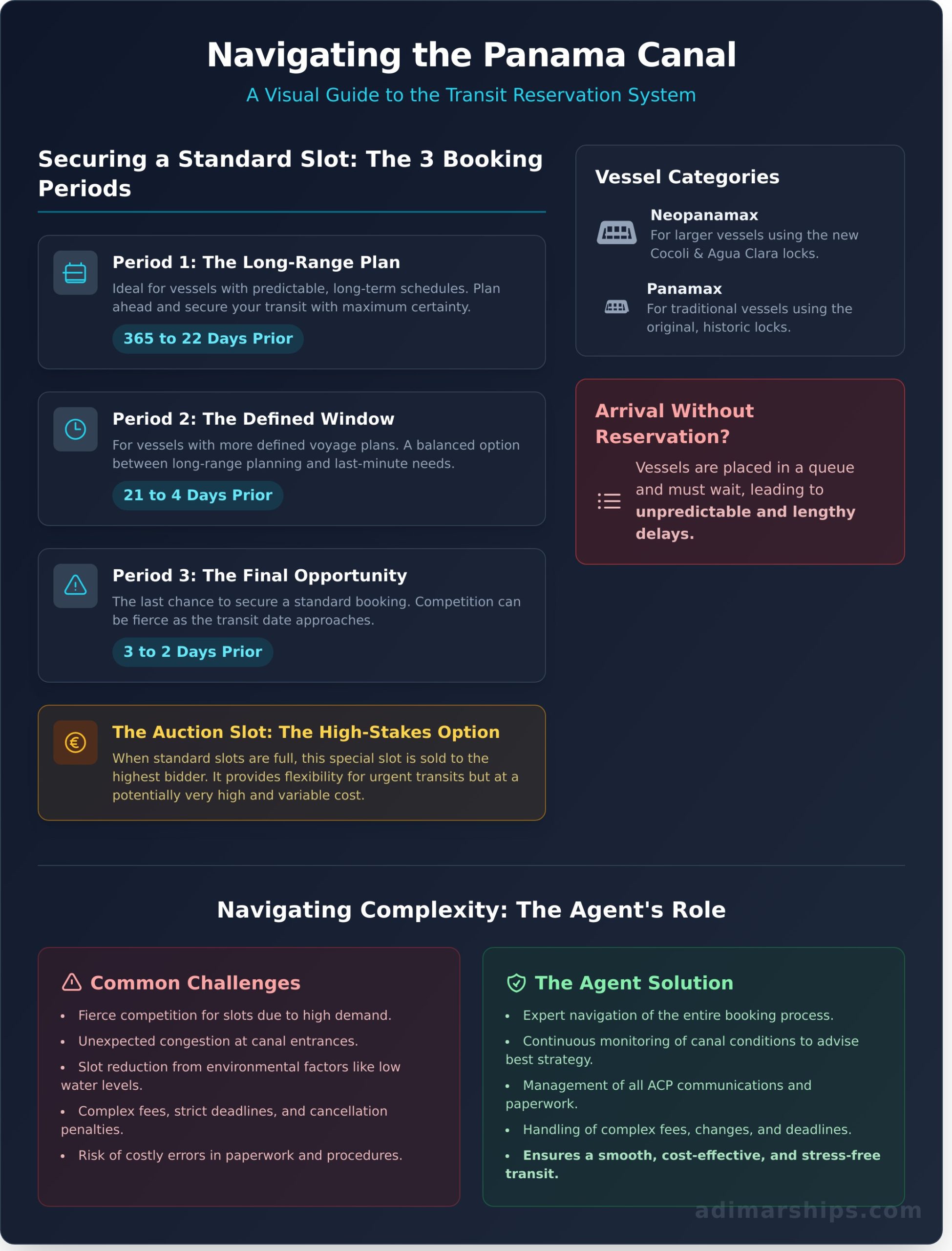
For regular, non-auctioned transits, the ACP offers slots across three distinct booking periods. These windows are designed to accommodate different planning horizons.
- Period 1: This is the earliest booking window, typically opening from 365 days up to 22 days prior to the requested transit date. It is ideal for vessels with long-term, predictable schedules.
- Period 2: A closer window for vessels with more defined schedules, this period generally runs from 21 days up to 4 days before transit.
- Period 3: This is the final opportunity to secure a regular booking slot, available from 3 days down to 2 days before the transit date. Competition in this period can be high.
The Auction Slot: Securing a Last-Minute Transit
What happens when all standard slots are full or a vessel needs to transit urgently? The ACP offers an auction slot. This is a special slot sold to the highest bidder, providing a path for last-minute or high-priority transits. While it offers flexibility, it is a major source of potentially high costs, as bids can escalate significantly during periods of high demand or congestion.
Vessel Categories: Panamax vs. Neopanamax Slots
With the canal’s expansion, the booking system now differentiates between two main vessel categories, as they use different sets of locks.
- Neopanamax Slots: These reservations are for the larger vessels that transit through the new, larger Cocoli and Agua Clara locks.
- Panamax Slots: These slots are for traditional-sized vessels that fit within the dimensions of the original, historic locks.
Each category has its own set of available slots, and it’s essential to book in the correct category for your vessel’s dimensions.
Navigating Common Challenges & Why an Agent is Your Solution
While the booking system provides order, its rules and real-world conditions create complexities that can cost ship owners significant time and money. A professional, local ship agent is the most effective way to mitigate these risks and ensure a smooth, cost-effective transit.
Challenge: High Demand, Congestion, and Water Levels
External factors constantly influence slot availability. Seasonal shipping peaks, unexpected congestion, and even environmental conditions like droughts that affect canal water levels can drastically reduce the number of available slots. During these times, competition becomes fierce, and auction prices can skyrocket. An experienced agent continuously monitors these conditions and advises on the best strategy to secure a slot without overpaying.
Challenge: Complex Fees, Changes, and Cancellations
Securing a slot involves more than just a reservation. There are booking fees (separate from the actual transit tolls) and strict deadlines and financial penalties for making changes, swapping slots, or canceling a reservation. A simple mistake in paperwork or a missed deadline can lead to the forfeiture of a slot and significant financial loss. An agent manages all these details, ensuring compliance and accuracy.
The Adimar Solution: Your Eyes and Ears at the Canal
At Adimar Shipping, we specialize in removing the stress and uncertainty from the Panama Canal transit process. We manage the entire booking process for you, leveraging our deep expertise to secure the optimal slots at the best possible cost. Our team handles all communications with the ACP, navigates the complex fee structures, and manages any necessary changes swiftly and efficiently. This allows you to focus on your business, not canal bureaucracy. Put your transit in our hands for a seamless experience.
Frequently Asked Questions (FAQs)
What is the official name of the Panama Canal booking system?
The official name is the Transit Reservation System, managed by the Panama Canal Authority (ACP).
How far in advance can I book a Panama Canal transit?
You can book a transit slot up to 365 days in advance through the first booking period.
What happens if a vessel arrives without a reservation?
A vessel arriving without a reservation, known as an “arrival” vessel, will be placed in a queue and must wait for an available slot after all reserved ships have passed. This can lead to unpredictable and often lengthy delays.
How much does a Panama Canal auction slot cost?
The cost of an auction slot is highly variable. It depends entirely on demand at the time of the auction. Prices can range from tens of thousands to, in extreme cases, millions of dollars.
Can I book a transit slot myself without a shipping agent?
While technically possible, it is highly discouraged. The system is complex, the rules are strict, and mistakes are costly. A licensed ship agent in Panama has the expertise, local knowledge, and direct lines of communication with the ACP to manage the process efficiently.
What is the difference between booking fees and transit tolls?
The booking fee is a reservation charge to secure your transit slot. The transit tolls are the actual fees for passage through the canal, calculated based on your vessel’s type, size, and cargo.
Navigating the Panama Canal booking system requires expertise, diligence, and local knowledge. Partnering with a trusted ship agent is the surest way to guarantee a predictable, efficient, and cost-effective transit for your vessel. With over 20 years of experience, Adimar Shipping is your expert partner at the canal, dedicated to protecting your interests every step of the way. Request a quote and let us handle your Panama Canal booking.