
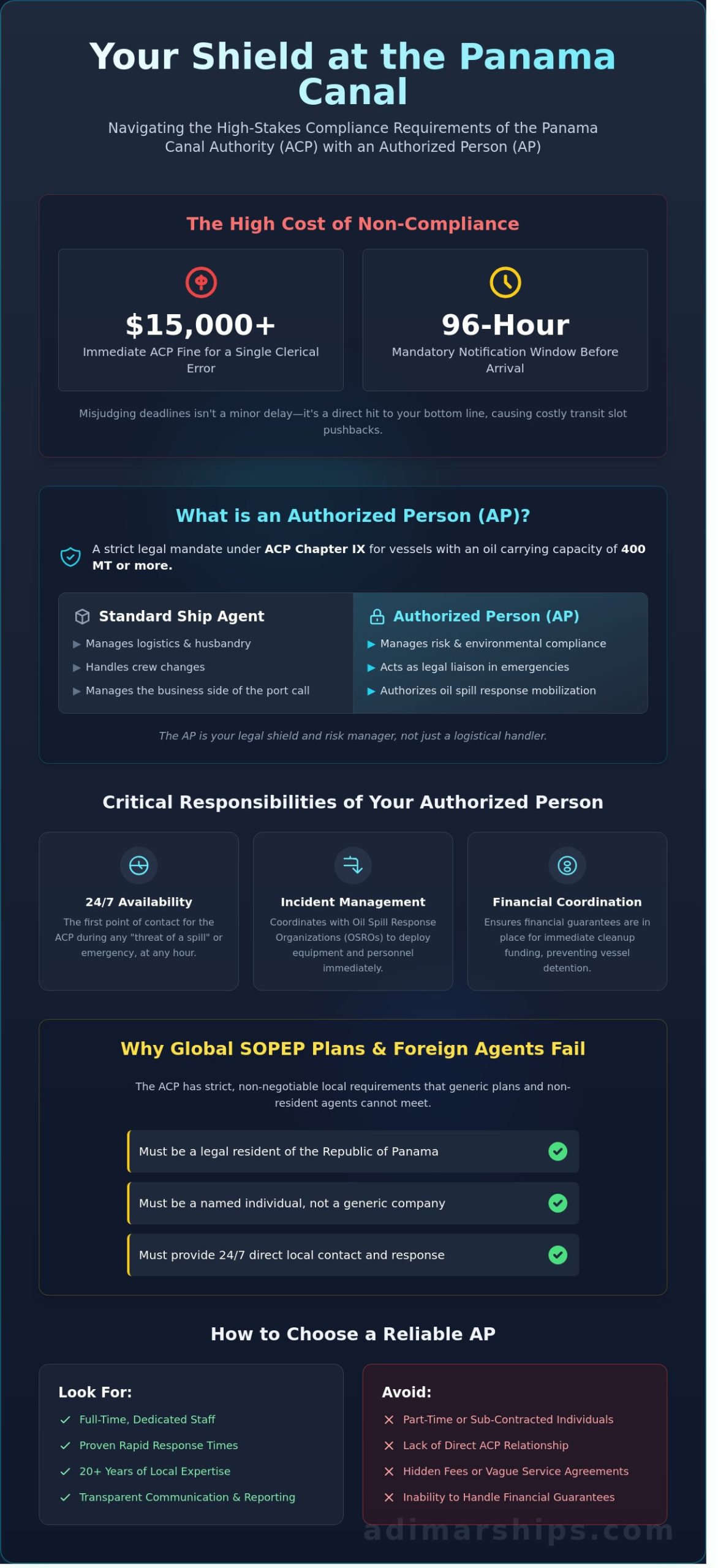
A single clerical error in your pre-arrival documentation can trigger an immediate Panama Canal Authority (ACP) fine of $15,000 or more. You’re likely already aware that timing and coordination at the locks are incredibly high-stakes. Misjudging a deadline isn’t just a minor delay; it’s a direct hit to your bottom line. Having YOUR “AUTHORIZED PERSON” AT THE PANAMA CANAL isn’t just a regulatory checkbox. It’s your local shield and your eyes at the water, protecting you against the complex, 24/7 demands of the ACP’s legal and financial framework.
We understand that the pressure to maintain 100% compliance is constant. This guide will show you how a dedicated local representative secures your transit by managing the urgency of the 96-hour notification window and mitigating your financial liability. We’ll examine the 2026 compliance landscape, clarify the differences between MARPOL and PCSOPEP requirements, and explain how to ensure your vessel moves through the locks without a single costly interruption.
Key Takeaways
- Understand the legal mandate under ACP Chapter IX that requires a qualified representative for all vessels with an oil carrying capacity of 400 MT or more.
- Learn why global SOPEP plans fail to meet local requirements and why YOUR “AUTHORIZED PERSON” AT THE PANAMA CANAL must be a legal resident of the Republic of Panama.
- Discover how 24/7 availability and expert communication during a “threat of a spill” serve as your most critical financial and legal safeguards during transit.
- Identify the essential selection criteria for an AP, focusing on full-time dedicated staff and proven response times to avoid the risks of part-time contractors.
- Explore how leveraging over 20 years of local expertise provides the “eyes and voice” necessary to protect your interests and ensure a seamless transit.
What is an Authorized Person (AP) at the Panama Canal?
Securing a smooth transit through the isthmus involves more than just scheduling a slot. According to the regulations set by the Panama Canal Authority (ACP) under Chapter IX, every vessel with an oil carrying capacity of 400 metric tons (MT) or more must designate an Authorized Person (AP). This isn’t just a suggestion; it’s a strict legal mandate. YOUR “AUTHORIZED PERSON” AT THE PANAMA CANAL serves as the vital link between your vessel and the ACP during any potential oil spill or emergency. They aren’t just a name on a form. They are the only individuals recognized by the ACP to act as a legal liaison and authorize the immediate mobilization of resources in the event of an incident.
Many operators confuse the AP with a standard ship agent. While your ship agent handles logistics, husbandry, and crew changes, the AP’s role is specifically tied to environmental compliance and emergency response. A ship agent manages the business; the AP manages the risk. You can’t have one without the other for a successful transit. We act as your eyes at the Panama Canal to ensure these roles never overlap in a way that compromises your compliance or safety.
The Legal Framework: PCSOPEP and Chapter IX
The Shipboard Oil Pollution Emergency Plan (PCSOPEP) is the foundation of this requirement. Chapter IX of the ACP regulations specifies that the AP must be a named individual living in Panama, not just a generic company name. This ensures accountability and immediate local contact. If you attempt to transit without a verified and approved AP, the ACP won’t allow you to enter canal waters. The consequences are immediate. You’ll face delays that can cost thousands of dollars in lost time and potential administrative fines starting at $2,500 for documentation errors.
Tier Classifications and AP Involvement
The scope of your AP’s work depends on your vessel’s Tier classification. Tiers 1, 2, and 3 are determined by the volume of oil your ship carries. Higher tiers require more intensive coordination and pre-approval of response resources. Regardless of your tier, the 96-hour rule is absolute. YOUR “AUTHORIZED PERSON” AT THE PANAMA CANAL needs all vessel data and documentation at least four days before you arrive. This window allows the AP to verify that your PCSOPEP is active and that all local resources are on standby. Don’t leave this to the last minute. Missing this deadline often results in the ACP pushing your transit slot back, which disrupts your entire supply chain. We are experts so you don’t have to be, ensuring every Tier requirement is met well before your ship reaches the locks.
The Critical Responsibilities of Your AP During Transit
The Panama Canal Authority (ACP) operates on a non-stop schedule, and they expect the same level of vigilance from your representative. Your YOUR “AUTHORIZED PERSON” AT THE PANAMA CANAL must remain reachable 24/7 throughout the entire transit process. This isn’t just a suggestion; it’s a regulatory mandate. If a vessel encounters a “threat of a spill” or a mechanical emergency at 02:00, the AP is the first point of contact the ACP will dial. They serve as the legal and operational bridge between the ship and the shore.
Speed is the most important factor during an emergency. The AP acts as the primary communicator during an oil spill, taking charge of the Incident Management System (IMS) framework. Beyond communication, they handle the heavy lifting of financial coordination. Cleanup operations in Panama require immediate funding in US Dollars ($). Your AP ensures that financial guarantees are in place so that response efforts start instantly, preventing the ACP from detaining the vessel for unpaid liabilities. We act as your eyes on the ground to ensure these high-stakes moments are handled with total transparency.
Incident Management and Liaison Duties
When an incident occurs, the AP interfaces directly with the ACP Pollution Control Unit. They don’t just relay messages. They actively coordinate with Oil Spill Response Organizations (OSROs) in Panama to deploy equipment and personnel. This proactive management helps eliminate the confusion and frustration that ship owners often feel when dealing with foreign regulatory bodies. By managing the flow of data, the AP keeps the ship owner informed while satisfying the ACP’s strict reporting requirements. This ensures the vessel can resume its journey as quickly as possible once the site is cleared.
Pre-Transit Compliance Audits
The work of an AP starts long before the vessel enters the locks. A critical duty involves reviewing all vessel documentation to catch “Panama-specific” discrepancies that could lead to fines or delays. For 2026, the AP must verify that the Panama Canal Shipboard Oil Pollution Emergency Plan (PCSOPEP) meets the latest updated standards. This includes cross-referencing vessel dimensions and crew contact lists against official ACP records. According to the Panama Canal Vessel Requirements, any mismatch in data can result in a loss of transit slot. We are experts in these details so you don’t have to be, ensuring every document is audit-ready before the pilot boards.
Why Global SOPEP Plans and Foreign Agents Fail the AP Test
Many ship owners assume their global Shipboard Oil Pollution Emergency Plan (SOPEP) covers every port. That is a mistake at the Panama Canal. The Panama Canal Authority (ACP) operates under its own legal framework, specifically the Panama Canal Shipboard Oil Pollution Emergency Plan (PCSOPEP). If your vessel relies on a foreign-based representative, you’re risking non-compliance. International plans often lack the specific response protocols required for the unique ecosystem of the Gatun Lake, which provides drinking water for nearly 2 million people.
Generic agents often treat the role of YOUR “AUTHORIZED PERSON” AT THE PANAMA CANAL as a clerical box to check. This is dangerous. An AP must have specialized Incident Management System (IMS) training to coordinate with the ACP’s Emergency Response Team. Without this specific training, an agent cannot legally represent you during a spill or mechanical failure. Language barriers and time zone differences add another layer of risk. If an incident occurs at 03:00 EST, a representative in London or Singapore cannot provide the immediate, on-the-ground coordination the ACP demands.
The Panama Residency Requirement
ACP regulations are clear: your AP must legally reside in the Republic of Panama. This isn’t just a suggestion; it’s a mandatory requirement for immediate physical response. Remote AP services are a direct violation of Canal regulations. The ACP requires a representative who can be physically present at the scene of an incident within hours. We see ourselves as your partner on the ground, and Adimar serves as your local office at the Panama Canal. This residency ensures we can sign legal documents and make financial commitments in USD ($) on your behalf without the delays of international couriers or digital signatures that local officials might reject.
Navigating Local Bureaucracy
The Panama Canal has its own set of rules that exist outside of standard maritime law. Established relationships with ACP officials are vital for a smooth transit. We are experts so you don’t have to be. Local expertise means knowing exactly which documents the ACP Inspector needs to see before they board. Global agents often overlook specific local documentation, such as the detailed crew lists or specific waste management declarations required under the 2026 guidelines. Using YOUR “AUTHORIZED PERSON” AT THE PANAMA CANAL who understands these nuances prevents costly delays. We eliminate the confusion by managing the following locally:
- Verification of PCSOPEP compliance before the vessel reaches the 12-mile limit.
- Direct communication with the ACP’s Maritime Traffic Control Center.
- Immediate handling of any port state control issues in Balboa or Cristobal.
Relying on a local expert ensures that your vessel meets every tiny detail of the Organic Law of the Panama Canal. We act as your eyes on the ground, protecting your interests and your schedule.
Selection Criteria: How to Choose a Reliable Authorized Person
Choosing YOUR “AUTHORIZED PERSON” AT THE PANAMA CANAL is a decision that directly impacts your vessel’s safety and your company’s bottom line. In 2026, the Panama Canal Authority (ACP) expects more than just a name on a document. They require a partner who is physically present, technically capable, and ready to act. You need a representative who serves as your eyes at the Panama Canal, ensuring every compliance detail is handled with integrity.
Infrastructure is the first thing you should evaluate. A reliable AP doesn’t operate from a home office with a single laptop. They maintain a dedicated 24/7/365 operations center equipped with redundant communication systems. This setup is vital because timing is everything. If an incident occurs at 2:00 AM, you can’t afford to wait for a part-time contractor to wake up. You should prioritize firms that employ full-time dedicated staff. Dedicated employees possess a deeper understanding of the evolving PCSOPEP regulations than freelancers who might juggle multiple roles for different agencies.
Experience with specific vessel classifications is another non-negotiable factor. Handling a Tier 2 vessel (vessels over 400 feet with oil carrying capacity under 180,000 barrels) requires significant coordination, but Tier 3 vessels (carrying 180,000 barrels or more) demand an even higher level of expertise. Your AP must have a proven track record of managing the complex financial guarantees and emergency resource coordination required for these larger tankers. Transparency in pricing is also a major indicator of reliability. A professional AP provides clear, upfront breakdowns of fees. They don’t hide costs in “miscellaneous” categories, as they understand that unexpected expenses can disrupt your voyage budget.
The AP Selection Checklist
- Does the AP maintain 24/7/365 operational capability with a physical office in Panama?
- Is the AP fully familiar with the latest PCSOPEP authorized person requirements for 2026?
- Can they provide verifiable references from ship owners or charterers who have transited Tier 2 or Tier 3 vessels?
- Do they have a documented protocol for incident management and reporting?
Red Flags to Avoid
Be wary of ship agents who offer “bundle” deals where the AP is included as an anonymous add-on. You must know exactly who is representing you. Another major red flag is a lack of clear Incident Management System (IMS) certification. If an AP can’t demonstrate how they organize a crisis response, they aren’t prepared for the job. Finally, pay attention to response times during your initial inquiry. If they’re slow to answer a simple email now, they’ll likely be slow when a real emergency happens on the water. We are experts so you don’t have to be; we eliminate the confusion with personalized service.
To ensure your next transit is managed by a team that prioritizes transparency and efficiency, nominate Adimar as your agent and secure a partner with over 20 years of local expertise.
Adimar Shipping: Your Expert Eyes and Voice in Panama
Adimar Shipping has spent over 20 years acting as the trusted local representative for global fleets navigating the complex waters of the Isthmus. We don’t just provide a service; we function as your local office in Panama. Our philosophy centers on protecting your interests at every lock, ensuring that your vessel’s transit is as efficient as possible. By combining our specialized duties as YOUR “AUTHORIZED PERSON” AT THE PANAMA CANAL with owner’s nominated agency support, we provide a seamless experience that minimizes administrative friction.
We’ve seen how easily confusion can arise when communication breaks down between offshore offices and local authorities. Adimar eliminates this confusion through personalized, high-integrity service. We manage the technicalities so you don’t have to. Our team stays on top of the latest Panama Canal Authority (ACP) requirements, ensuring that your documentation is flawless before the vessel even arrives at the breakwater. We understand that time is money, and our proactive approach prevents the costly idle time that results from paperwork errors.
The Adimar Advantage for 2026
Our commitment to “Integrity Every Time” isn’t just a slogan; it’s our standard for compliance reporting. For the 2026 season, the ACP has tightened its oversight on environmental and safety declarations. We manage the critical 96-hour notification window with precision to ensure zero delays for your fleet. Ship owners trust us as their “eyes at the Panama Canal” because we provide the ground-level visibility that remote offices lack. We verify equipment, check pilot ladders, and review PCSOPEP documents to ensure 100% readiness for YOUR “AUTHORIZED PERSON” AT THE PANAMA CANAL requirements.
Ready for a Seamless Transit?
Timing is everything in the maritime world. You can nominate Adimar as your Authorized Person today to protect your schedule and your bottom line. We recommend requesting a comprehensive compliance audit for your vessel at least 30 days before arrival. This proactive approach identifies potential hurdles before they become expensive problems. Contact our team for a transparent quote on AP and husbandry services. All our quotes are provided in USD ($), offering the transparency and clarity you need for accurate voyage budgeting. Let us handle the details so you can focus on your business.
Secure Your 2026 Transit with Local Expertise
Mismanaging your compliance at the Panama Canal isn’t just a minor delay; it’s a significant risk to your schedule and your bottom line. As the 2026 ACP Chapter IX regulations take full effect, the requirements for local representation have become more stringent than ever. Generic global SOPEP plans and foreign agents often fail the AP test because they lack the immediate, on-the-ground presence required by Panamanian authorities. You need a partner who acts as your local office and vigilant eyes on the water.
Selecting YOUR “AUTHORIZED PERSON” AT THE PANAMA CANAL is a decision that defines your operational success. Adimar Shipping provides over 20 years of specialized experience and a dedicated team of 24/7 IMS-trained staff to handle every technical detail. We ensure your vessel meets every 2026 compliance benchmark with total transparency and integrity. We’re the experts so you don’t have to be, allowing you to navigate these complex regulatory waters with complete confidence.
Nominate Adimar as your Authorized Person and secure your 2026 transit today.
We look forward to protecting your interests and ensuring a smooth passage through the canal for your entire fleet.
Frequently Asked Questions
Is it mandatory to have an Authorized Person for every Panama Canal transit?
Yes, an Authorized Person is mandatory for all vessels over 400 gross tons transiting the Panama Canal. According to Panama Canal Authority (ACP) OP Notice to Shipping N-1-2026, this requirement ensures a local representative is available 24/7 to manage oil spill responses. This regulation applies to the approximately 13,000 vessels that transit the waterway annually. Without a designated YOUR “AUTHORIZED PERSON” AT THE PANAMA CANAL, your vessel will face significant delays at the locks.
Can my regular ship agent also serve as my Authorized Person?
Yes, your regular ship agent can serve as your Authorized Person if they hold the specific ACP certification and residency. Many owners prefer this because it streamlines communication. We act as your eyes at the Panama Canal, ensuring that both agency duties and AP responsibilities align perfectly. This prevents the confusion that often occurs when managing two separate local entities during a tight transit window, making the process more efficient.
What is the difference between a MARPOL SOPEP and a PCSOPEP?
A MARPOL SOPEP is an international requirement, while a PCSOPEP is a mandatory, Panama-specific plan for vessels over 400 gross tons. The PCSOPEP requires a designated YOUR “AUTHORIZED PERSON” AT THE PANAMA CANAL and a contract with an Oil Spill Response Organization (OSRO). The ACP requires the PCSOPEP to be submitted 96 hours before arrival to ensure compliance with local environmental laws. It’s a specialized document that goes beyond standard international regulations.
What happens if my Authorized Person is not reachable during an incident?
If your Authorized Person is unreachable during an incident, the ACP can fine the vessel up to $50,000 and prohibit future transits. The ACP requires a 24/7 response capability to ensure safety. We take this responsibility seriously because timing is everything in the maritime world. Our team maintains constant readiness to ensure your vessel stays compliant and avoids the high costs associated with administrative delays or environmental penalties during an emergency.
Does the Authorized Person need to board the vessel during transit?
No, the Authorized Person doesn’t need to board the vessel during the transit process. They serve as a shore-based liaison between the ship’s master, the ACP, and emergency response teams. Their primary role is to coordinate logistics and financial guarantees from land. This setup allows the crew to focus on safe navigation while we handle the complex regulatory and communication requirements from our Panama office, ensuring a smooth passage.
How far in advance must I designate my Authorized Person to the ACP?
You must designate your Authorized Person at least 96 hours before your vessel arrives at Panama Canal waters. This deadline is strictly enforced by the ACP to allow for the verification of the PCSOPEP and response contracts. Missing this window can lead to your vessel losing its scheduled slot. This often results in thousands of dollars in lost operational time and additional anchorage fees that can impact your bottom line.
What are the specific residency requirements for an AP in Panama?
An Authorized Person must be a legal resident of Panama and maintain a physical presence in the country. The ACP mandates that the AP must speak both English and Spanish fluently to facilitate clear communication between international crews and local authorities. They must also have the legal authority to make financial commitments on behalf of the ship owner. We’ve met these requirements for 20 years, providing the stability your fleet needs.
Can one Authorized Person represent multiple vessels in a fleet?
Yes, one Authorized Person can represent multiple vessels within a single fleet simultaneously. This is a common practice for large shipping lines to maintain consistency in their emergency response protocols. We manage entire fleets for our clients, providing a single point of contact that understands the specific needs of each ship. This efficiency helps keep your operations cost-conscious while ensuring every vessel meets the latest 2026 compliance standards without extra overhead.