
For ship owners, charterers, and maritime professionals, the financial health of the Panama Canal is more than just a headline-it’s a leading indicator of future transit costs, operational efficiency, and global trade currents. Get a clear breakdown of the Panama Canal’s revenue trends, what drives the numbers, and what it means for your shipping operations.
Panama Canal Revenue & Traffic: The Big Picture (FY2023-FY2025)
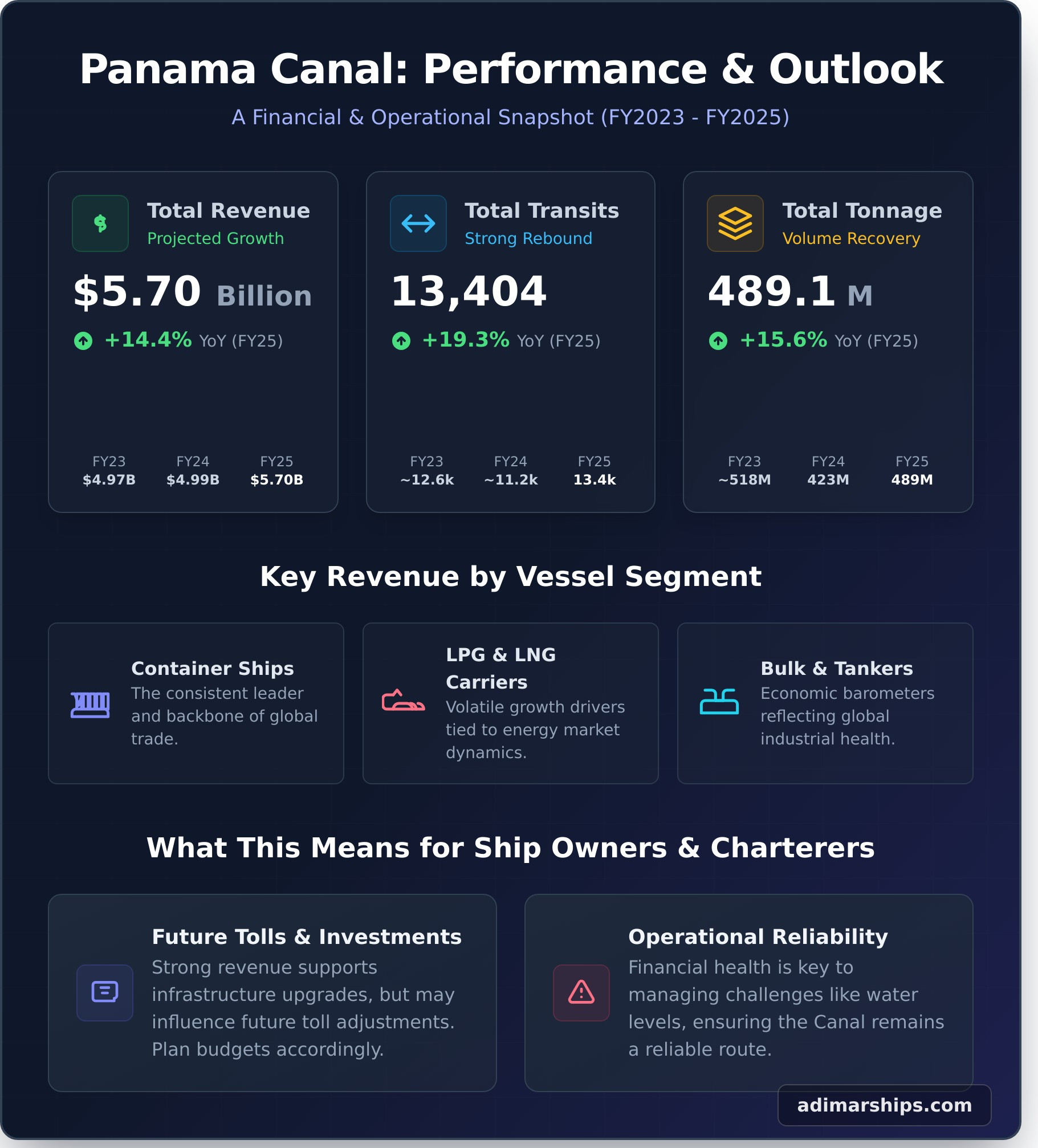
To understand where the Panama Canal is headed, we must first look at its recent performance. The latest fiscal years have been marked by recovery, adaptation to new trade patterns, and strategic management of resources. A summary of the Canal’s recent performance shows a waterway in a strong financial position, driven by increased transits and robust tonnage figures, reflecting its critical role in global commerce.
Key Panama Canal Statistics at a Glance (Table)
A side-by-side comparison of the last few fiscal years reveals a clear upward trend. This data, sourced from official Panama Canal Authority (ACP) reports, provides a snapshot of the Canal’s impressive performance despite global challenges.
| Metric | FY2023 (Actual) | FY2024 (Actual) | FY2025 (Preliminary) |
|---|---|---|---|
| Total Revenue (USD) | ~$4.97 Billion | $4.99 Billion | $5.70 Billion (+14.4% YoY) |
| Total Transits | ~12,600 | ~11,240 | 13,404 (+19.3% YoY) |
| Total Tonnage (PC/UMS) | ~518 Million Tons | 423.1 Million Tons | 489.1 Million Tons (+15.6% YoY) |
What’s Behind the Numbers? Major Growth Drivers
Several key factors have contributed to this strong financial performance. The implementation of an updated toll structure has better aligned fees with the value and service provided to different vessel segments. Furthermore, the global shipping industry has seen a significant recovery in specific market segments, driving more traffic through the waterway. The expanded Neopanamax locks continue to be a critical asset, accommodating larger vessels that generate higher revenue per transit and reaffirming the Canal’s importance on major trade routes.
A Deeper Dive: Revenue by Key Vessel Segment
The Canal’s total revenue is a composite of tolls from a diverse range of vessel types. By analyzing the performance of each segment, we can uncover the underlying trends in global trade that directly impact ship owners. This breakdown helps you understand how your specific market is performing and what to expect on future transits.
Container Ships: The Consistent Leader
As the backbone of global merchandise trade, container ships remain the single largest contributor to the Panama Canal’s revenue. The stability of this segment is a direct reflection of global consumer demand and supply chain dynamics. While subject to economic shifts, the container segment provides a consistent and reliable revenue stream for the Canal, ensuring its operational foundation remains secure.
LPG & LNG Carriers: The Volatile Growth Drivers
The energy sector has introduced a dynamic and often volatile element to the Canal’s revenue mix. Liquefied Petroleum Gas (LPG) and Liquefied Natural Gas (LNG) carriers have become significant growth drivers, with their transit numbers heavily influenced by fluctuating global energy markets, seasonal demand, and geopolitical events. The performance of this segment can shift rapidly, making it a key area to watch for future revenue trends.
Bulk Carriers and Tankers: The Economic Barometers
The performance of dry bulk carriers (transporting grains, coal, and ores) and tankers (carrying crude oil and refined products) serves as a powerful barometer for the health of the global industrial economy. The recovery and growth in these segments often signal an uptick in manufacturing and construction worldwide. Their steady traffic through the Canal is essential for its diversified revenue base and reflects broad economic trends.
What Do These Statistics Mean for Ship Owners & Charterers?
Translating these high-level statistics into practical, actionable insights is crucial for effective vessel management. The financial health of the Panama Canal Authority directly impacts every vessel that transits, from toll rates to the quality of service. Understanding these trends allows you to plan more effectively, anticipate changes, and mitigate potential risks to your operations.
Forecasting Future Tolls and Transit Costs
A financially strong Canal is one that can invest in its future. Healthy revenue figures enable the ACP to fund critical infrastructure maintenance, technological upgrades, and long-term projects to enhance capacity and efficiency. While strong performance ensures the Canal remains a reliable and modern route, owners should also be aware that revenue targets and investment needs can influence future toll adjustments. Staying informed helps in budgeting and forecasting voyage costs accurately.
Navigating Operational Challenges like Water Levels
Revenue is directly linked to the Canal’s ability to manage environmental challenges, most notably the water levels of Gatun Lake. Financial resources are essential for implementing both short-term water-saving measures and long-term water management solutions. Measures like the Freshwater Surcharge are a clear example of how the ACP uses financial tools to manage operational constraints, impacting both Canal revenue and transit costs for ship owners. A resilient financial position is key to ensuring the Canal’s operational reliability for years to come.
Why an Expert Ship Agent Matters More Than Ever
In a dynamic environment of fluctuating traffic, evolving regulations, and operational challenges, having expert local representation is not a luxury-it’s a necessity. A knowledgeable and proactive ship agent is your on-the-ground partner, helping you navigate the complexities of a Canal transit with efficiency and foresight. An experienced agent provides the critical insights needed to manage costs, avoid costly delays, and ensure your vessel’s passage is smooth and predictable. Let Adimar be your eyes at the Canal. Get a transit quote.
Frequently Asked Questions
How much revenue does the Panama Canal generate annually?
The Panama Canal’s annual revenue fluctuates with global trade but has been on an upward trend. For the 2025 fiscal year, preliminary figures show revenue reached a record $5.7 billion, a significant increase from the $4.99 billion recorded in FY2024.
What is the main source of revenue for the Panama Canal?
The primary source of revenue is tolls charged to vessels for transiting the waterway. The container ship segment is consistently the largest contributor to this revenue, followed by gas carriers (LPG and LNG), bulk carriers, and tankers.
How did the Panama Canal expansion affect its revenue?
The expansion, which opened in 2016 with the new Neopanamax locks, has had a profoundly positive effect on revenue. It allowed for the transit of much larger vessels, which pay significantly higher tolls, thereby increasing the Canal’s overall earning capacity and solidifying its competitiveness on major world trade routes.
How do water levels impact Panama Canal transits and revenue?
Low water levels in Gatun Lake, typically caused by drought conditions, can force the Panama Canal Authority to implement draft restrictions and reduce the number of daily transit slots. This can decrease the total number of vessels and the amount of cargo passing through, potentially impacting revenue. The ACP sometimes implements measures like a Freshwater Surcharge to manage demand and fund water-saving solutions.
Where can I find the official Panama Canal annual financial reports?
The Panama Canal Authority (ACP) publishes official press releases, traffic statistics, and annual reports on its official website, pancanal.com. These documents provide the most accurate and detailed financial and operational data for the waterway.
Navigating the Panama Canal requires more than just scheduling a transit; it demands foresight, local knowledge, and a partner dedicated to protecting your interests. With over 20 years of experience, Adimar Shipping has built a reputation for integrity and efficiency, serving as the trusted partner for global ship owners and charterers. We understand that time is money, and our mission is to ensure your transit is seamless and cost-effective. Request a transparent quote for your next Canal transit.