
In the world of shipping, time is money-and so is uncertainty. Budgeting for a future voyage through the Panama Canal can be a source of significant stress, filled with complex tariff structures and the constant worry of hidden surcharges. Accurately forecasting your Panama Canal tolls and fees 2026 is not just a financial exercise; it’s a critical component of a profitable journey. Miscalculate, and you risk eroding your margins before your vessel even reaches the locks.
We are experts so you don’t have to be. This comprehensive guide is designed to eliminate the confusion and provide the clarity you need for precise financial planning. Here, we will break down the official 2026 toll structure, detail every potential ancillary fee, and give you the tools to create an accurate proforma disbursement account (DA) with confidence. Consider this your financial roadmap, built to ensure your vessel’s transit is both smooth and cost-efficient from the very start.
Key Takeaways
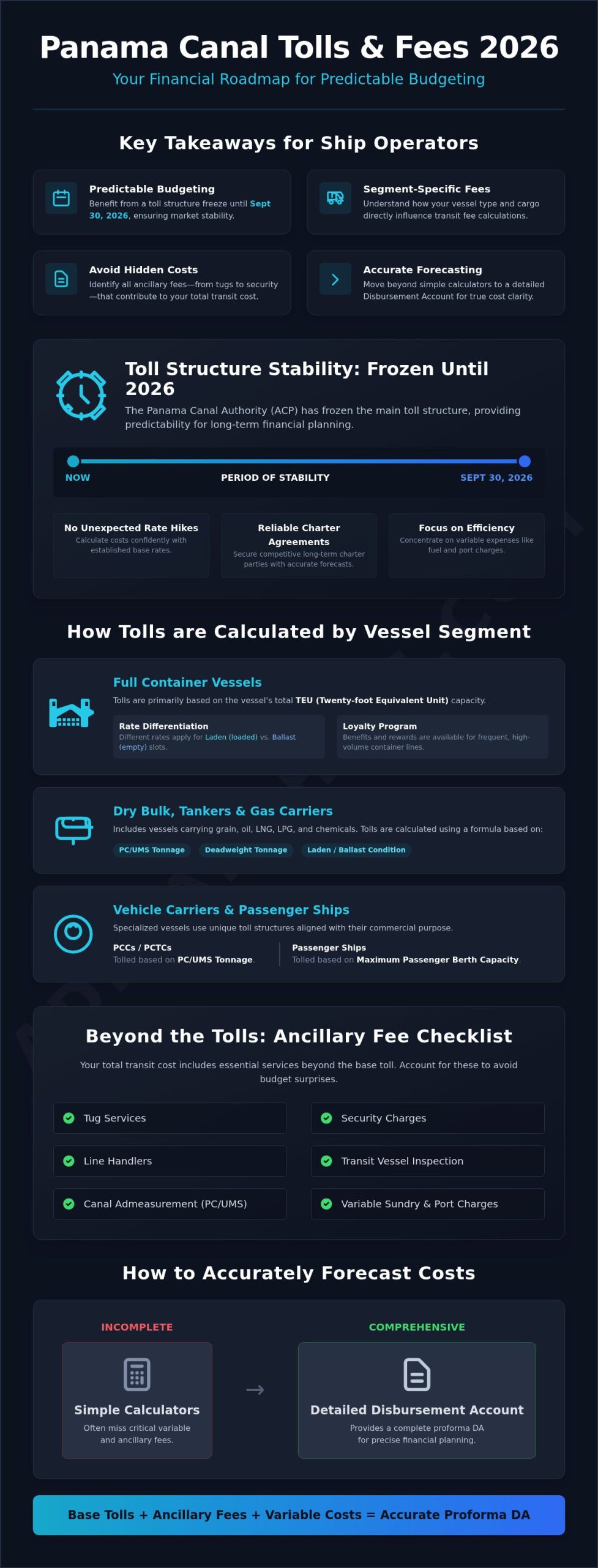
- Benefit from predictable budgeting, as the Panama Canal Authority has frozen the main toll structure until September 30, 2026, to provide market stability.
- Understand how your specific vessel segment and cargo directly influence how transit fees are calculated under the ACP’s market-based pricing model.
- Avoid budget surprises by identifying the essential ancillary fees-from tug services to security charges-that make up your total transit cost beyond the base toll.
- Accurately forecast your total Panama Canal tolls and fees 2026 by moving beyond simple calculators and learning to account for all variable costs in a detailed Disbursement Account.
The Official 2026 Panama Canal Toll Structure: Stability for Ship Operators
In a significant move to support the global maritime industry, the Panama Canal Authority (ACP) has announced a freeze on its toll structure, effective until September 30, 2026. This decision provides much-needed predictability for ship owners and charterers. After a period of global economic uncertainty and operational disruptions, this stability in the panama canal tolls and fees 2026 allows for confident, long-term financial planning.
The rationale behind the freeze is clear: to offer a stable, transparent cost framework that helps operators budget with accuracy. For companies planning transits through this critical waterway, this means the current toll system remains the benchmark for the foreseeable future. This proactive measure by the ACP underscores their commitment to partnership with the shipping community, ensuring the Canal remains a reliable and cost-effective route. It allows your business to focus on what matters most: efficient and timely cargo delivery.
What the Toll Freeze Means for Your Budget
This period of stability directly translates into tangible financial benefits and simplified planning. For ship operators, the key advantages include:
- No Unexpected Rate Hikes: You can confidently calculate transit costs based on the established toll structure without factoring in potential increases to the base rates.
- Reliable Charter Agreements: The ability to accurately forecast Canal costs allows for more secure and competitive long-term charter party agreements.
- Focus on Operational Efficiency: With fixed toll costs, your team can concentrate on managing variable expenses like fuel consumption, crew, and port charges to maximize profitability.
Understanding the Core Tolling System: PC/UMS
The foundation of the Panama Canal’s pricing is the Panama Canal Universal Measurement System (PC/UMS). This is not a simple fee but a detailed calculation based on a vessel’s total volume or earning capacity. Every vessel intending to transit must have a certified PC/UMS tonnage, which serves as the basis for its toll assessment. For a broader historical and operational context, this Panama Canal overview provides comprehensive background. Understanding how your vessel’s certified PC/UMS tonnage impacts the final cost is the first step in accurately projecting your panama canal tolls and fees 2026 budget.
Deconstructing the Tolls: How Fees Are Calculated by Vessel Segment
There is no one-size-fits-all fee for transiting the Panama Canal. Instead, the Panama Canal Authority (ACP) uses a sophisticated market segmentation approach to pricing. This strategy ensures that the tolls reflect the specific value the waterway provides to different shipping sectors, from high-volume container lines to specialized gas carriers. Understanding how your vessel fits into this structure is the first step to accurately forecasting your costs and interpreting your transit invoice.
The complete breakdown can be found in The Official 2026 Panama Canal Toll Structure, but we will outline the key segments here to simplify the process for you. A clear grasp of these categories is essential for managing the panama canal tolls and fees 2026 and optimizing your transit budget.
Full Container Vessels (TEU Capacity)
For container ships, the calculation is primarily based on the vessel’s total Twenty-foot Equivalent Unit (TEU) allowance-its maximum container capacity. The ACP applies different rates for TEU slots that are loaded with cargo (laden) versus those that are empty (ballast), offering a more precise cost structure. To encourage consistent traffic, the Canal also operates a loyalty program that provides benefits to frequent container line customers, rewarding high-volume usage.
Dry Bulk, Tankers, and Gas Carriers
This broad category, which includes vessels carrying everything from grain to crude oil, uses a different formula. Tolls are calculated based on the vessel’s Panama Canal Universal Measurement System (PC/UMS) tonnage and, for certain segments, its deadweight tonnage. As with container ships, distinct rates apply for laden and ballast conditions. Key segments in this group include:
- Dry Bulk Carriers
- Chemical and Product Tankers
- Liquefied Petroleum Gas (LPG) Carriers
- Liquefied Natural Gas (LNG) Carriers
Vehicle Carriers and Passenger Ships
The ACP recognizes the unique nature of specialized vessels with tailored toll structures. Pure Car and Truck Carriers (PCCs/PCTCs) are tolled based on their PC/UMS tonnage. In contrast, passenger ships, such as cruise liners, have their tolls determined by their maximum passenger berth capacity. These distinct methods ensure that the panama canal tolls and fees 2026 align fairly with the commercial purpose and earning potential of each vessel type transiting the waterway.
Beyond the Tolls: A Checklist of Ancillary and Variable Fees
When planning a vessel’s transit, focusing only on the base toll is a common but costly mistake. The final invoice is a composite figure, and understanding the full scope of the panama canal tolls and fees 2026 requires looking beyond that single number. Ancillary fees cover essential services for a safe passage, while variable surcharges can arise from operational or environmental conditions. Failing to budget for these can lead to significant cost overruns, turning a well-planned transit into a financial headache.
A professional ship agent is your expert on the ground, accounting for all these charges in advance to provide a clear and accurate cost projection. This eliminates confusion and allows you to focus on your business.
Standard Service Fees
Every transit requires a suite of non-negotiable services that are fundamental to a safe and efficient passage. These are not optional extras but mandatory costs built into the transit process. Key charges include:
- Tugboat Assistance: Fees vary based on the vessel’s size and whether it is transiting the Panamax or Neopanamax locks.
- Line Handler Charges: A mandatory fee for the specialized personnel who manage mooring lines within the locks.
- Locomotive Fees: The cost for the specialized ‘mules’ that guide vessels through the lock chambers.
- Vessel Inspection & Security: This includes a standard ACP (Panama Canal Authority) security charge applied to every transit.
Variable Surcharges and Other Costs
Beyond the fixed service fees, your total cost can fluctuate. The most significant variable is often the Freshwater Surcharge, which the ACP may implement when water levels in Gatun and Alhajuela Lakes drop below specific operational thresholds. Securing a transit slot also incurs costs, either through standard booking fees or by participating in auctions for high-demand periods. For a complete breakdown, the Panama Canal Authority provides the Official Panama Canal Tolls schedule, which details all current tariffs. Other necessary costs can include PCSOPEP (Panama Canal Shipboard Oil Pollution Emergency Plan) compliance and husbandry-related services like sludge or garbage disposal.
Potential Penalties and Fines
Time is money, and nowhere is that truer than at the Canal. The ACP operates on a precise schedule, and fines for missing an arrival window or submitting inaccurate vessel documentation can be substantial. These are entirely avoidable costs that directly impact your bottom line. An experienced agent acts as your eyes at the Canal, ensuring all paperwork is precise and deadlines are met, protecting your investment from unnecessary penalties. This proactive management is a core part of how a trusted Panama Canal agent delivers value and peace of mind.
How to Accurately Forecast Your 2026 Transit Costs
In the world of canal transits, time is money. Misjudging your expenses can be as costly as misjudging your timing. While online calculators provide a baseline, they rarely capture the full financial picture. Accurate forecasting requires a comprehensive Proforma Disbursement Account (DA), a detailed estimate of all potential expenses associated with your port call, from tolls to tugboats and security fees.
A precise Proforma DA is the only way to truly budget for the complete panama canal tolls and fees 2026. This document is prepared by your ship agent, who acts as your trusted partner and eyes at the Canal, ensuring there are no costly surprises.
Information Required for a Proforma DA
To create a reliable cost forecast, your agent needs specific details about your vessel and voyage. Providing complete and accurate information upfront is critical for an effective budget. Key inputs include:
- Vessel Particulars: Length Overall (LOA), beam, draft, and Panama Canal Universal Measurement System (PC/UMS) net tonnage.
- Cargo Details: Type of cargo, laden or ballast status, and TEU count for container ships.
- Voyage Information: Estimated time of arrival (ETA) and your desired transit date.
- Husbandry Needs: Any additional services required, such as crew changes, delivery of spares, or cash to master (CTM).
Booking Strategy: Reservation vs. Auction
Your booking strategy has a dramatic impact on your final costs. The standard reservation system allows you to secure a transit slot in advance for a set fee. However, during periods of high demand or for last-minute transits, you may need to enter the auction system. Auction slots are awarded to the highest bidder, and these premiums can significantly increase the total expense of your passage beyond the standard panama canal tolls and fees 2026.
The Role of Your Ship Agent in Cost Management
Your ship agent is your most valuable asset in managing transit costs effectively. We are experts so you don’t have to be. A dependable agent provides an accurate Proforma DA for budgeting, advises on the most cost-effective booking strategy for your specific needs, and manages all funds and payments to the Panama Canal Authority (ACP) on your behalf. This partnership eliminates confusion and allows you to focus on your business with confidence. Let our experts prepare a detailed 2026 cost estimate for you.
Navigate Your 2026 Transit with Financial Clarity and Confidence
Understanding the Panama Canal’s 2026 toll structure is the first step toward a successful and profitable transit. As we’ve seen, stability in the official tolls, a clear grasp of segment-specific calculations, and awareness of ancillary fees are all critical for accurate forecasting. Mastering the complete picture of the panama canal tolls and fees 2026 transforms a complex financial challenge into a manageable component of your voyage plan.
But you don’t have to be the expert. For over 20 years, Adimar Shipping, Inc. has served as a trusted Panama Canal partner, specializing in cost-conscious planning and transparent financial management. Our proactive communication eliminates confusion and prevents costly delays, giving you the peace of mind you deserve.
Take the guesswork out of your transit costs. Request a Transparent Proforma DA for Your 2026 Transit today and let our team provide the financial clarity your business depends on.
Frequently Asked Questions About Panama Canal Tolls
How much does it cost for a typical Panamax vessel to transit the Panama Canal in 2026?
A typical Panamax vessel, such as a bulk carrier of 45,000 PC/UMS tons, can expect transit costs ranging from $250,000 to $400,000 in 2026. This figure is an estimate, as the final cost depends on the vessel’s specific Panama Canal Universal Measurement System (PC/UMS) tonnage, the type of cargo carried, and any additional surcharges. For a precise calculation, working with an experienced ship agent is essential to navigate the complex toll structure and ensure cost efficiency for your transit.
What is the Panama Canal Freshwater Surcharge and how is it calculated?
The Freshwater Surcharge is a variable fee implemented by the Panama Canal Authority (ACP) to manage water resources, especially during periods of low rainfall. It is applied when the water level of Gatun Lake falls below a specific operational threshold. The surcharge is calculated based on the vessel’s beam and length overall (LOA), plus a fixed fee. This charge helps ensure the Canal remains operational and is a critical factor to include in your budget planning for any transit.
Can you pay Panama Canal tolls and fees in advance?
Yes, advance payment is a mandatory requirement for transit. All tolls, fees, and surcharges must be paid in full to the Panama Canal Authority (ACP) at least 48 hours before the vessel is scheduled to transit. This is typically handled through a registered ship agent who manages the funds and guarantees payment on your behalf. Proper and timely payment is crucial to avoid costly delays and ensure a smooth, uninterrupted passage through the Canal.
What are the most common reasons for unexpected fees during a Panama Canal transit?
Unexpected fees often arise from issues like admeasurement discrepancies, where the vessel’s declared tonnage differs from the ACP’s official measurement. Other common causes include charges for delays, security costs, line handler services, or non-compliance with Canal regulations (PCSOPEP). Working with a vigilant, on-the-ground agent helps anticipate these potential costs, ensuring transparent and accurate budgeting for your panama canal tolls and fees 2026 and preventing costly surprises upon arrival.
How does vessel size (e.g., Neopanamax vs. Panamax) affect the total toll cost?
Vessel size is a primary driver of toll costs. Neopanamax vessels, which transit the larger locks, face significantly higher tolls than smaller Panamax vessels. The toll structure is based on the vessel’s PC/UMS tonnage and, for container ships, TEU capacity. A larger vessel occupies more space and requires more resources, resulting in a higher base toll. This difference can amount to hundreds of thousands of dollars, making vessel class a critical factor in voyage cost estimation.
Is it cheaper for a vessel to transit in ballast versus fully laden?
Yes, it is significantly cheaper for a vessel to transit in ballast (empty) compared to fully laden (with cargo). The Panama Canal Authority uses a different, lower toll rate for ballast transits because the economic value of the passage is lower without cargo. The total panama canal tolls and fees 2026 for a ballast vessel are calculated based on its PC/UMS tonnage at a reduced rate, directly reflecting its non-revenue-generating status for that specific voyage.