
In the world of maritime logistics, time is money. Misjudge your timing at the Panama Canal, and you lose. A single missing document or a misunderstood regulation can trigger costly delays, hefty fines, and frustrating operational setbacks. The intricate web of requirements from the Panama Maritime Authority (AMP) and the Panama Canal Authority (ACP) often leaves even seasoned operators confused. Navigating the complete vessel clearance procedures in Panama demands precision, foresight, and local expertise.
We are experts so you don’t have to be. This guide is your trusted partner on the ground, designed to eliminate that confusion and put you in control. Here, we provide a step-by-step breakdown of every required procedure, document, and authority for a smooth commercial vessel clearance. Put your transit in our hands, and we will guide you toward a predictable, efficient, and timely port call or canal transit, allowing you to focus on your business with confidence and integrity.
Key Takeaways
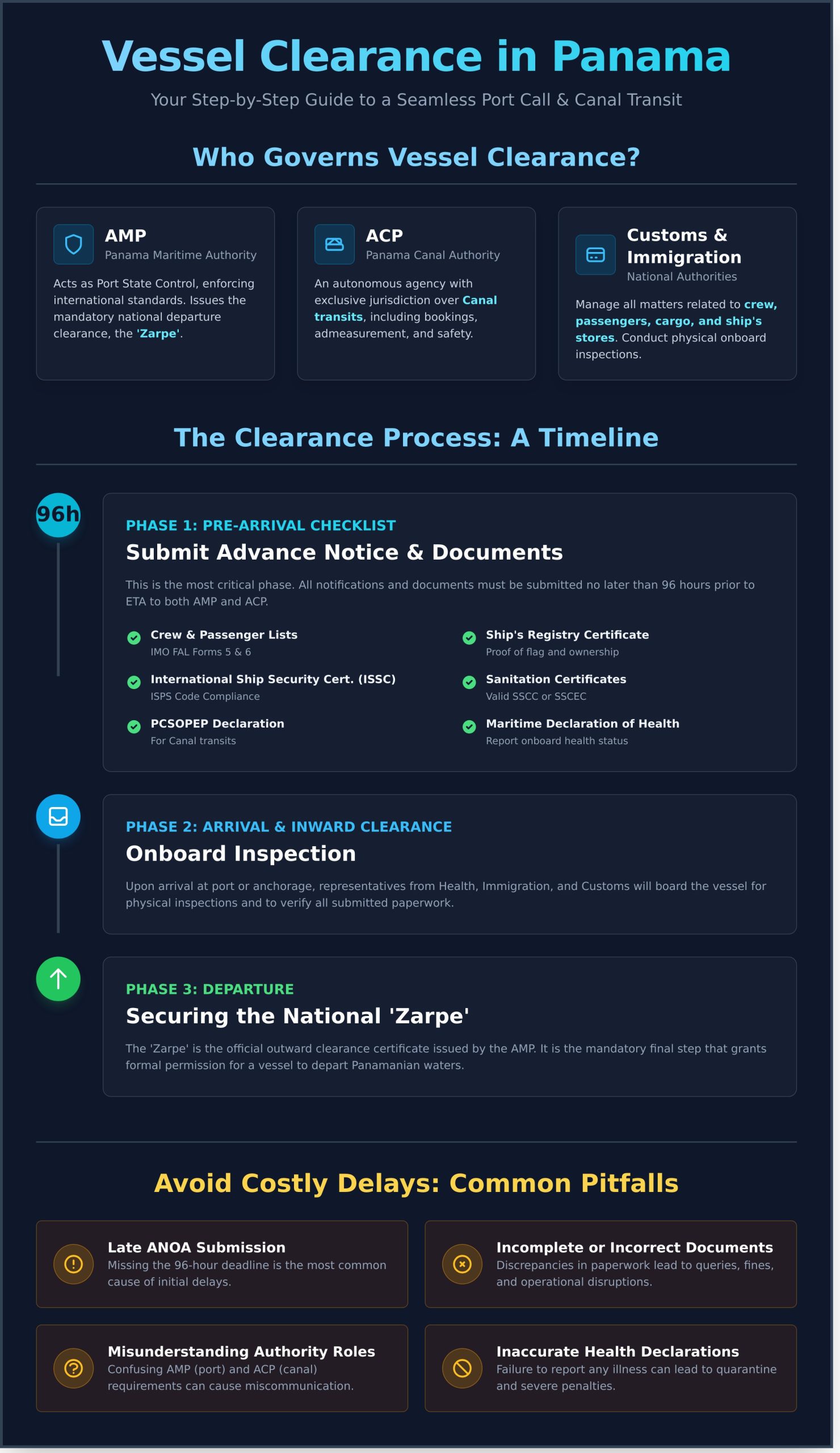
- Successful clearance in Panama begins long before arrival; a comprehensive 96-hour pre-arrival checklist is essential to prevent delays.
- Navigating the process requires interaction with multiple governing bodies, not just one, including the Panama Maritime Authority (AMP), Customs, and Health officials.
- Understanding the common pitfalls in vessel clearance procedures panama is the first step to avoiding costly fines and operational disruptions.
- A formal outward clearance, the national ‘Zarpe,’ is a mandatory final step that grants official permission for a vessel to depart Panamanian waters.
Key Authorities: Who Governs Vessel Clearance in Panama?
Navigating the bureaucratic landscape is often the most challenging part of port calls and Canal transits. The vessel clearance procedures panama requires interaction with several distinct government bodies, not a single entity. Miscommunication or delays with one can create a domino effect, costing valuable time and money. Understanding who governs each step is critical for a smooth, efficient, and timely operation. A trusted ship agent acts as your single point of contact, expertly coordinating with all these authorities on your behalf.
Panama Maritime Authority (AMP)
The Panama Maritime Authority (Autoridad Marítima de Panamá, or AMP) is the country’s primary national body for all maritime regulation. Acting as the Port State Control, the AMP is responsible for enforcing international safety, security, and environmental standards within Panama’s territorial waters. For any vessel calling at a Panamanian port, the AMP is the agency that issues the official national clearance certificate, known as a Zarpe, which is mandatory for departure.
Panama Canal Authority (ACP)
It is crucial to understand that the Panama Canal Authority (Autoridad del Canal de Panamá, or ACP) is an autonomous agency that operates independently from the AMP. While the AMP governs the nation’s ports, the ACP has exclusive jurisdiction over all aspects of Canal transit. This includes managing transit bookings, conducting vessel admeasurement to ensure compliance with Panamax and Neopanamax dimensions, and enforcing specific safety and operational requirements for a secure passage through the locks.
National Immigration and Customs Authorities
Upon arrival at a Panamanian port or anchorage, two other key authorities will be involved. The National Immigration Service (Servicio Nacional de Migración) handles all matters related to crew and passengers, requiring detailed lists and verifying documentation. Simultaneously, the National Customs Authority (Autoridad Nacional de Aduanas) manages all declarations for cargo, ship’s stores, spare parts, and any other goods onboard. Representatives from these agencies typically board the vessel together for physical inspections, making accurate and timely paperwork essential to avoid delays.
Pre-Arrival Procedures: Your Essential 96-Hour Checklist
In Panama, where time is money, a successful port call begins long before your vessel reaches the breakwater. Missteps in the pre-arrival phase can lead to costly delays and frustrating complications. The key to efficient vessel clearance procedures panama is meticulous preparation and timely communication. Think of the 96 hours before arrival as the critical window to ensure every requirement is met with integrity and precision. Put your transit in our hands, and we will eliminate the confusion by managing this entire process for you.
As your trusted partner at the Panama Canal, we act as your eyes and ears on the ground, coordinating with all relevant authorities to guarantee a seamless entry. This checklist outlines the essential steps your ship agent will manage on your behalf.
Advance Notice of Arrival (ANOA)
The first official step is submitting the Advance Notice of Arrival (ANOA) no later than 96 hours prior to your vessel’s ETA. This mandatory notification is the foundation of your port call. Your ship agent will compile and electronically submit all required information to both the Panama Maritime Authority (AMP) and the Panama Canal Authority (ACP), including vessel particulars, ETA, last port of call, and the specific purpose of your visit (e.g., transit, cargo operations, crew change).
Required Documentation for Submission
Concurrent with the ANOA, a complete package of digital documents must be prepared for submission. Delays often stem from incomplete or incorrect paperwork. Our team ensures every form is accurate and compliant. Key documents include:
- Crew and Passenger Lists: Standardized IMO FAL Forms 5 and 6.
- Ship’s Registry Certificate: Proof of the vessel’s flag and ownership.
- International Ship Security Certificate (ISSC): Verifying compliance with ISPS code.
- Sanitation Certificates: Valid Ship Sanitation Control Certificate (SSCC) or Ship Sanitation Control Exemption Certificate (SSCEC).
- PCSOPEP Declaration: For vessels transiting the Canal, the Panama Canal Shipboard Oil Pollution Emergency Plan is mandatory. Ensuring these documents precisely match the official Panama Canal Authority Vessel Requirements is critical to avoid queries.
Health and Security Declarations
Panamanian authorities place a high priority on maritime health and security. Your agent must submit a Maritime Declaration of Health, accurately reporting the health status on board. It is vital to declare any illness among crew or passengers to prevent quarantine and facilitate any necessary medical attention upon arrival. Furthermore, you must confirm the vessel’s current ISPS security level, ensuring it aligns with the port’s requirements for a safe and secure entry.
Arrival & Inward Clearance: What to Expect Onboard
Once your vessel is safely at anchor or alongside the berth in a Panamanian port, the formal inward clearance process begins. This is a critical phase where coordination and preparation are paramount. Having a dependable agent onboard is not just a convenience; it is essential for navigating the official formalities efficiently and avoiding costly delays. Your agent acts as your eyes and ears on the ground, ensuring every step is handled with integrity and precision.
The Boarding Process
Typically, your appointed ship agent will be the first person to board. Their primary role is to meet with the Master, review all documentation one last time, and prepare the vessel for the official inspections. Shortly after, the Panamanian authorities-usually representatives from Immigration, Customs, and Port Health-will board together. Your agent facilitates this entire interaction, clarifying requirements, answering officials’ questions, and providing translation if needed to ensure the vessel clearance procedures panama are followed correctly.
Immigration and Customs Formalities
The inspection is a systematic review of the vessel’s documentation, crew, and stores. Having all original documents organized and ready for presentation is non-negotiable to prevent unnecessary setbacks. The authorities will typically perform the following checks:
- Immigration (Servicio Nacional de Migración): Officers will meticulously verify the crew list against original passports and seaman’s books. They will also process any necessary landing passes for shore leave or stamp passports for crew members signing on or off in Panama.
- Customs (Autoridad Nacional de Aduanas): The customs officer will inspect the ship’s stores, bond, narcotics locker, and any declared firearms. They will verify these against the ship’s declarations and place seals on bonded stores for the duration of the port stay.
Receiving ‘Free Pratique’
One of the most important outcomes of the initial inspection is receiving ‘Free Pratique.’ This is the official term for the health clearance granted by the Port Health authority. It certifies that the vessel is free from contagious diseases and officially permits interaction with the shore, including crew changes, receiving provisions, or allowing visitors onboard. Without Free Pratique, the vessel remains under quarantine, and no shore-based operations can commence.
Timing and coordination can be difficult and frustrating. Put your transit and port call in our hands to eliminate confusion and ensure a smooth arrival. Appoint Adimar as your trusted agent.
Departure Procedures: Securing the National ‘Zarpe’
Just as arrival requires a meticulous process, a formal outward clearance is mandatory for every vessel departing from a Panamanian port. This final stage involves finalizing all port business and securing official permission to sail. The culmination of these efforts is the issuance of a National ‘Zarpe’, the official departure clearance document. Attempting to sail without a valid Zarpe is a serious violation of Panamanian maritime law, leading to significant fines and legal complications.
Navigating these final steps efficiently is crucial to maintaining your schedule. A misstep here can negate the time saved during port operations. This is a critical phase of the vessel clearance procedures panama where professional coordination is paramount.
Settling Port Accounts
Before authorities grant clearance, all financial obligations must be met. This includes settling any outstanding port dues, pilotage fees, towage, and agency fees. Your shipping agent provides a Final Disbursement Account (FDA) to the vessel’s owners or operators, which transparently itemizes all costs incurred during the port call. Proof of payment is required, and a trusted agent like Adimar Shipping, Inc. ensures all accounts are reconciled accurately and promptly to prevent any last-minute delays.
Final Declarations and Documentation
With accounts settled, the final set of documents must be submitted to the port authorities. This paperwork confirms the vessel’s status at the moment of departure and provides clear information about its onward journey. Key submissions include:
- An updated and final crew list.
- A final passenger list, if applicable.
- A formal declaration of the next port of call and the estimated voyage duration.
- Any other declarations required by Customs, who may reserve the right to conduct a final inspection before departure.
Issuance of the Zarpe
Once all accounts are paid and the required documentation has been approved, the Panama Maritime Authority (AMP) will issue the National ‘Zarpe’. This document is the vessel’s official exit permit from Panamanian waters. It serves as definitive proof that you have complied with all national regulations. The original Zarpe must be presented to the pilot upon sailing, acting as the final green light for your vessel to get underway. Without it, the pilot will not take the vessel out of port.
Common Pitfalls and How Your Ship Agent Prevents Them
In maritime operations, time is money. Navigating the complexities of Panamanian regulations can be challenging, and simple administrative errors can quickly spiral into costly delays and significant fines. An experienced local ship agent is your first line of defense, transforming potential liabilities into a smooth, efficient port call. They are the experts on the ground, ensuring your vessel clearance procedures in Panama are executed with precision and integrity.
Here are the most common pitfalls and how a dedicated agent like Adimar Shipping helps you avoid them.
Pitfall 1: Inaccurate or Incomplete Documentation
The most frequent cause of clearance delays is incorrect paperwork. A single mismatched name on a crew list, an incorrect IMO number, or an outdated certificate can bring the entire process to a halt. We act as your proactive partner, meticulously pre-vetting every document for accuracy before it’s submitted to the Panama Maritime Authority. This includes verifying crew documentation to prevent immigration issues, such as ensuring compliance with visa requirements for specific nationalities.
Pitfall 2: Missing Critical Deadlines
The Panama Canal Authority (ACP) and local port authorities operate on strict timelines. Failure to submit the 96-hour Advance Notice of Arrival (ANOA) can result in financial penalties. Even more costly is missing a booked Canal transit slot, which can disrupt schedules and have major financial repercussions. Our team uses robust systems to track every deadline, guaranteeing timely filings for Canal bookings, pre-arrival notifications, and all necessary declarations, protecting your schedule and your budget.
Pitfall 3: Misunderstanding Local Regulations
Panama has a unique and constantly evolving set of maritime rules. From specific protocols for waste disposal and ballast water management to complex requirements for crew changes, staying compliant requires up-to-the-minute local knowledge. As your eyes at the Canal, we provide clear, current guidance on all local maritime notices and regulations. We ensure your operations adhere to every requirement, eliminating the risk of non-compliance penalties.
Successfully managing the intricate vessel clearance procedures panama requires a trusted partner on the ground. Don’t risk delays. Let our experts manage your clearance.
Your Partner for Seamless Panama Clearance
Navigating Panama’s waterways successfully hinges on meticulous preparation. As we’ve covered, from the crucial 96-hour pre-arrival notifications to securing the final departure ‘Zarpe’, every step demands precision. Understanding the distinct roles of national authorities and the ACP is fundamental, but even the best-laid plans can face unexpected challenges that cause costly delays.
This is where an expert partner makes all the difference. Mastering the complete vessel clearance procedures panama requires more than a checklist; it demands local knowledge and constant vigilance. An experienced agent anticipates potential pitfalls, from documentation discrepancies to last-minute regulatory changes, ensuring your transit remains on schedule and cost-effective.
With over 20 years of experience, Adimar Shipping is your trusted, on-the-ground partner at the Panama Canal. Our expertise in all national and ACP regulations means we eliminate confusion and manage the process with integrity and efficiency. Ensure a smooth transit. Nominate Adimar as your trusted Panama Canal agent today.
Let us handle the complexities, so you can focus on a successful voyage.
Frequently Asked Questions About Vessel Clearance in Panama
What is the difference between Panama port clearance and Panama Canal transit clearance?
Port clearance is for vessels calling at a port like Balboa or Cristobal for cargo or husbandry services, governed by the Panama Maritime Authority (AMP). Canal transit clearance is a separate process managed by the Panama Canal Authority (ACP) for vessels passing through the waterway. While some documents overlap, these distinct vessel clearance procedures panama involve different authorities and operational requirements. A knowledgeable agent is essential to navigate both systems efficiently and ensure compliance with each entity.
How long does the vessel clearance process typically take upon arrival in Panama?
With proper pre-arrival coordination by an experienced ship agent, the vessel clearance process can be remarkably efficient, often completed within a few hours of arrival. The key is submitting all required documentation accurately and in advance. Delays typically arise from incomplete paperwork, undeclared goods, or sanitary issues identified during inspection. A proactive agent ensures all requirements are met beforehand to minimize port time and help you avoid costly hold-ups, because in shipping, time is money.
What is a ‘Zarpe’ and why is it essential for departing vessels?
A ‘Zarpe’ is the official international departure clearance certificate issued by the Panama Maritime Authority (AMP). It serves as legal proof that a vessel has settled all its obligations with local authorities, including customs, immigration, and port dues. This document is absolutely essential; without a valid Zarpe, a vessel is not legally permitted to depart from a Panamanian port or its anchorage. It is the final, critical step in the clearance-out process, authorizing your vessel to proceed.
Can a vessel be cleared in Panama without a local ship agent?
No, it is not possible. Panamanian regulations mandate that all foreign-flagged commercial vessels must appoint a licensed local ship agent to handle all clearance procedures. The agent acts as your official representative, interfacing with the Panama Maritime Authority, Canal Authority, customs, and immigration on your behalf. This requirement ensures that all complex local protocols are followed correctly and that a responsible party is present in-country to manage communications and financial transactions, guaranteeing a smooth and compliant port call.
What are the most common reasons for a vessel being fined during clearance in Panama?
Fines during clearance often stem from administrative errors or operational non-compliance. The most common reasons include discrepancies in the crew or passenger lists, failure to accurately declare bonded stores or firearms, and improper waste disposal that violates sanitary regulations. Another significant issue is any oil leak, no matter how small, which can lead to substantial fines. Ensuring all declarations are precise and that the vessel adheres strictly to environmental and safety protocols is crucial for avoiding these penalties.
Are the clearance procedures different for the Atlantic and Pacific ports?
The fundamental regulations mandated by the Panama Maritime Authority (AMP) are consistent for both Atlantic (e.g., Cristobal, Manzanillo) and Pacific (e.g., Balboa) ports. However, there can be minor operational differences in how local port offices and terminals handle the physical process. An experienced agent with a presence on both coasts understands these nuances, ensuring a seamless experience regardless of your port of call. The core legal requirements do not change, but local execution and logistics can vary.
What is the VUMPA system used by the Panama Canal Authority?
VUMPA, which stands for Ventanilla Única Marítima de Panamá (Maritime Single Window of Panama), is a crucial digital platform that centralizes the submission of all documentation required for a vessel’s arrival, stay, and departure. It streamlines communication between your ship agent and all relevant Panamanian governmental entities, including the Maritime Authority, Customs, and Health. This system significantly reduces paperwork and accelerates the entire clearance process, making it more transparent and efficient for all parties involved.
Yes, the procedures for private recreational vessels are significantly different and generally less complex than for commercial shipping. While they still require clearance, the focus is more on cruising permits and tourism. This world of leisure on the water, far from the demands of cargo logistics, is exemplified by companies like Old Plank Sailing Adventures, which specialize in luxury private sailing charters and aquatic expeditions.