
Every hour your vessel sits idle at the Pacific or Atlantic entrance of the Canal, you are essentially burning through $2,000 or more in daily hire costs. Misjudging your timing at the Panama Canal isn’t just a logistical error; it’s a direct hit to your vessel’s profitability. Achieving success in 2026 requires a shift from reactive waiting to proactive management focused on reducing vessel turnaround time in Panama. You already know that unpredictable wait times at Balboa or Cristobal can derail an entire voyage charter. It’s frustrating to watch a transit window slip away because a bunker barge was late or a crew change wasn’t synchronized with the pilot’s arrival.
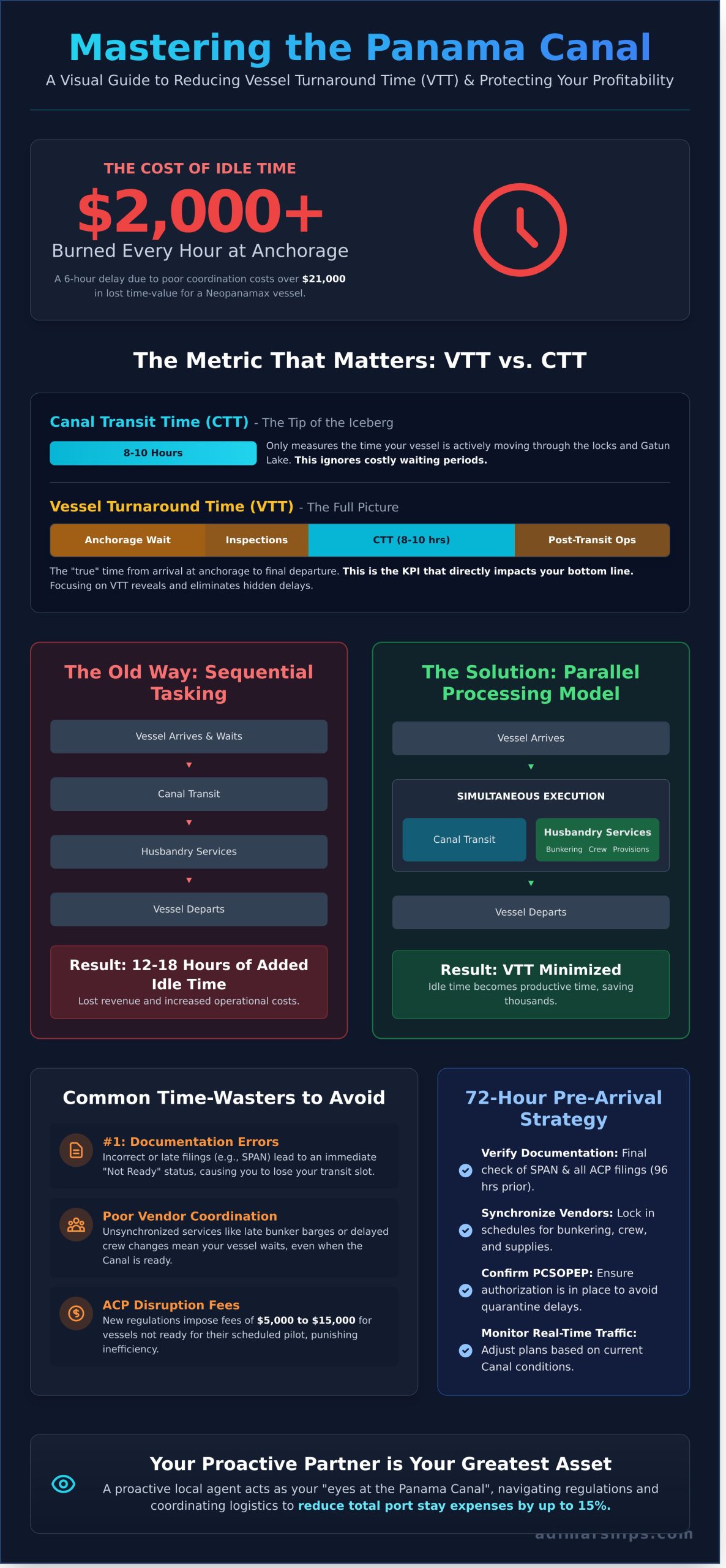
We understand that your goal is to keep your fleet moving while keeping port stay costs as low as possible. You’ll discover how to minimize costly delays and optimize every hour your vessel spends in Panamanian waters through proactive agency coordination. This guide explores the strategic shift toward parallel execution of husbandry tasks and transit requirements. By the end of this article, you’ll have a clear roadmap to secure predictable transit windows and reduce your total port stay expenses by as much as 15% through better local oversight.
Key Takeaways
- Understand why Vessel Turnaround Time (VTT) is the defining KPI for 2026 transits and how to measure it accurately from arrival to departure.
- Discover the “Parallel Processing” model to eliminate costly sequential tasking by overlapping husbandry services with your vessel’s transit window.
- Identify the #1 cause of lost transit slots and learn how to avoid the documentation errors that lead to a “Not Ready” status.
- Implement a 72-hour pre-arrival strategy for reducing vessel turnaround time in panama through precise coordination and PCSOPEP authorization.
- Learn how a proactive local partner acts as your “eyes at the Panama Canal” to navigate ACP regulations and protect your bottom line.
What is Vessel Turnaround Time (VTT) in Panama?
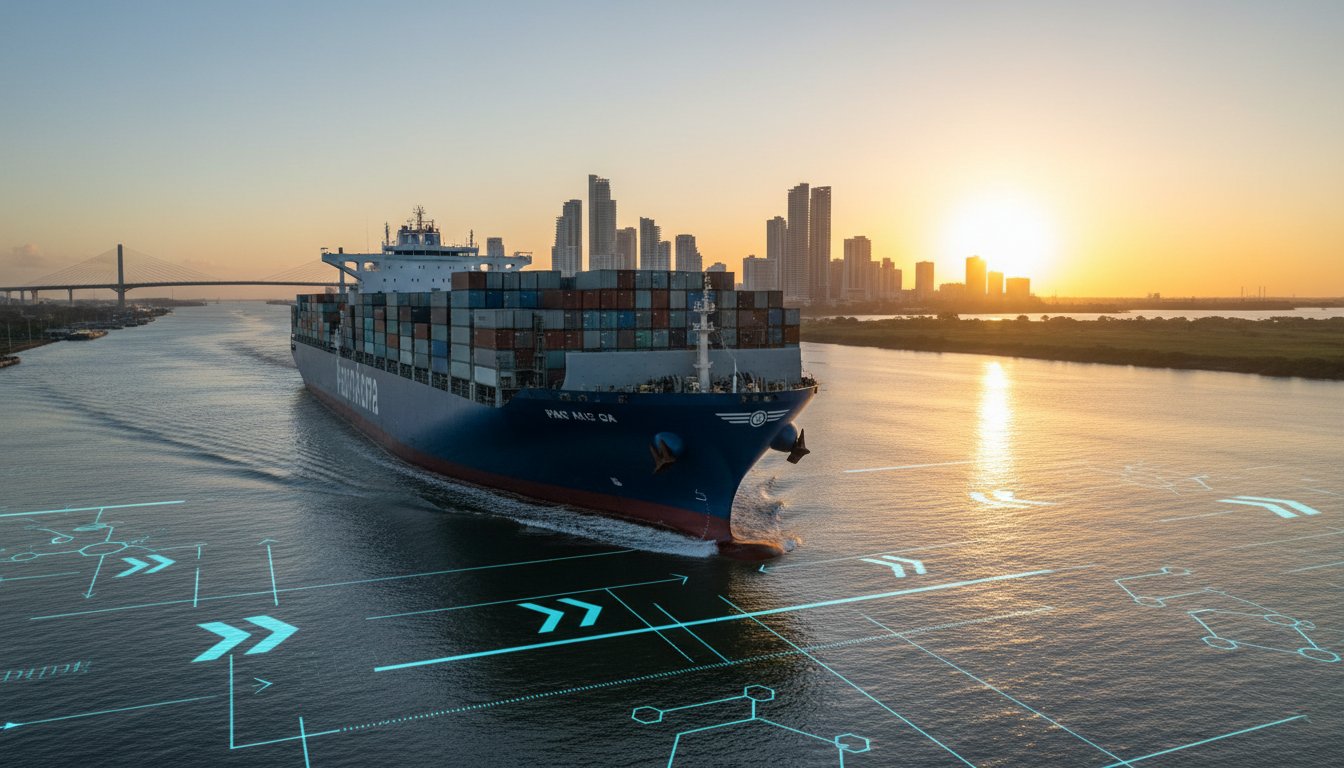
Vessel Turnaround Time (VTT) isn’t just a logistical metric; it’s the heartbeat of your voyage’s profitability. In the context of the Isthmus, we define VTT as the total elapsed time from the moment your vessel arrives at the Atlantic or Pacific anchorage until its final departure from the opposite side. It encompasses every minute spent waiting, maneuvering, and transiting. For ship owners and charterers, reducing vessel turnaround time in panama is the most direct way to protect margins against rising operational costs in 2026.
Don’t confuse Canal Transit Time (CTT) with VTT. CTT only tracks the hours your vessel spends moving through the locks and Gatun Lake, which usually takes 8 to 10 hours. VTT is the “true” time. It includes the 12 hours you might spend at anchorage waiting for a pilot or the 4 hours spent waiting for a health inspector. We focus on VTT because it represents the entire window where your vessel is earning nothing while burning fuel and crew costs. By focusing on reducing vessel turnaround time in panama, we address the hidden delays that CTT ignores.
The financial stakes are higher than ever. A Neopanamax vessel often carries daily charter rates between $85,000 and $120,000. If an agent’s poor coordination adds just six hours of unnecessary anchorage time, you’ve lost over $21,000 in pure time-value. We act as your eyes at the Panama Canal because we know your capital shouldn’t be sitting idle at the breakwater. High-ROI activity for owners now centers on shaving minutes off the administrative and logistical hurdles that occur before the first lock even opens.
The Components of a Panama Stay
- Pre-arrival Documentation: The Panama Canal Authority (ACP) requires specific filings, such as the Ship Pre-Arrival Notification (SPAN), at least 96 hours before arrival. Errors here lead to immediate delays and fines.
- Anchorage and Reservations: This is where the clock often stalls. The reservation system determines your place in line, and since 2025, the bidding for “just-in-time” slots has become a standard necessity for urgent cargo.
- The Actual Transit: This involves the physical passage through the locks. A deep dive into the history and operations of the Panama Canal shows how these locks function as a bottleneck that requires absolute precision in pilotage and tug coordination.
Why 2026 Operational Realities Matter
In 2026, water management is the primary driver of transit schedules. With Gatun Lake levels fluctuating due to changing weather patterns, the ACP frequently adjusts draft restrictions, often limiting vessels to 44 feet or less. Slot availability has become a high-stakes auction environment where prices for a single transit can exceed $250,000 during peak congestion. New ACP pricing structures introduced in January 2026 now include higher “disruption fees” for vessels that aren’t ready for their scheduled pilot. These fees can range from $5,000 to $15,000 depending on vessel size, making it vital to have an agent who anticipates problems before they manifest.
Vessel Turnaround Time stands as the ultimate metric of a local agency’s efficiency and its ability to protect the ship owner’s bottom line.
The ‘Parallel Processing’ Model: Reducing VTT Through Coordination
Misjudge your timing at the Panama Canal and you lose thousands of dollars in charter hire. Many operators still rely on sequential tasking; they wait for a vessel to complete its transit before initiating husbandry services. This traditional approach is a major time-killer that extends port stays by 12 to 18 hours on average. At Adimar, we view the transit window not just as a passage, but as a prime opportunity for parallel processing. By overlapping crew changes, bunkering, and provisioning with the mandatory waiting periods at the Pacific or Atlantic anchorages, we turn idle time into productive windows.
Effective logistics management is the cornerstone of reducing vessel turnaround time in panama, especially when dealing with the high-traffic environment of the canal. Analyzing the official Panama Canal transit statistics reveals that congestion can fluctuate rapidly, making static scheduling impossible. We act as your eyes at the Panama Canal, monitoring real-time traffic to ensure vendors are positioned the moment your ship hits the anchorage. We are experts so you don’t have to be; our role is to eliminate the confusion that arises when multiple service providers compete for the same narrow window of vessel availability.
Executing Husbandry Without Delays
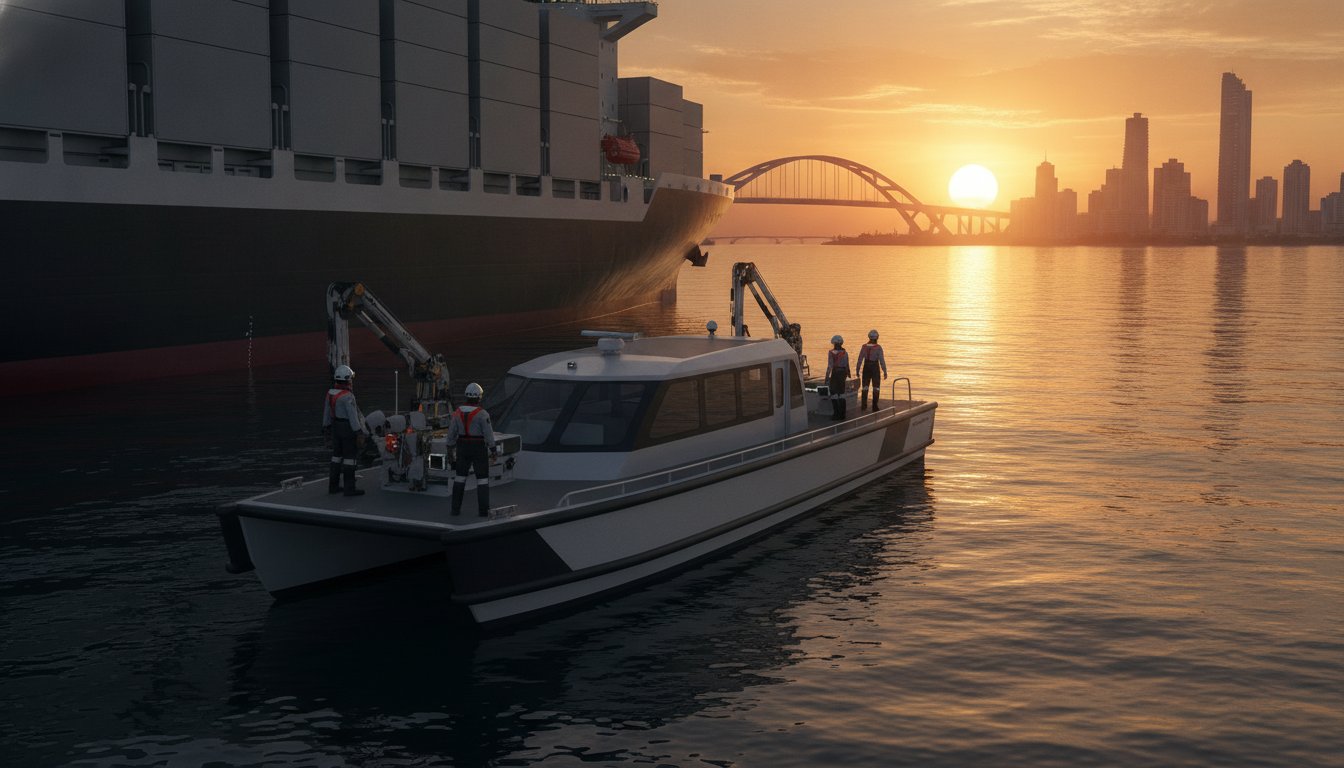
Coordinating launches for crew changes at Balboa or Cristobal requires precision timing. If a launch is 30 minutes late, the vessel might miss its scheduled pilot boarding time, leading to massive delays and potential fines. We manage these high-stakes handoffs by centralizing communication between the master, the terminal, and the transport providers. Our team also handles spare parts logistics with a sense of urgency. In 2023, we optimized our supply chain to move critical components from Tocumen International Airport to the ship’s deck in under six hours. During the transit wait, we simultaneously coordinate bunker surveys and quantity verification, ensuring that the vessel is fully fueled and ready to sail the moment it clears the final lock.
Compliance as a Time-Saving Tool
Regulatory hold-ups are often the result of poor planning rather than strict rules. We treat compliance as a proactive strategy for reducing vessel turnaround time in panama. Our PCSOPEP authorized person services ensure that all environmental and spill response protocols are met long before the vessel arrives. We also manage pre-cleaning and sludge disposal coordination to prevent sanitary hold-ups. By ensuring all ISPS and port security protocols are cleared 48 hours in advance, we remove the friction that typically slows down arrival procedures. This level of preparation means your vessel spends less time at the anchorage and more time moving toward its next destination. For a seamless experience, you can nominate Adimar as your agent to handle these complex regulatory requirements on your behalf.
- Zero-Wait Husbandry: We synchronize launches to meet the ship the moment it drops anchor.
- Bunker Verification: Surveys are conducted during the pre-transit window to avoid post-transit delays.
- Regulatory Pre-Clearance: All ISPS and PCSOPEP documentation is finalized 48 hours before arrival.
- Integrated Logistics: Spares and provisions are consolidated at our local warehouse for a single, efficient delivery.
We see ourselves as your local office at the Panama Canal. Our goal is to provide high quality, timely shipping services with integrity, ensuring that every hour your vessel spends in Panamanian waters is accounted for and optimized for efficiency.
Common Time-Wasters at the Panama Canal (And How to Avoid Them)
Time is the most expensive commodity in the maritime industry. At the Panama Canal, where transit slots are booked months in advance or won through high-stakes auctions, being “Not Ready” is a financial disaster. We’ve seen vessels lose their position because of a simple typo in the Electronic Data Collection System (EDCS). Documentation remains the primary hurdle for reducing vessel turnaround time in Panama. If the Panama Canal Authority (ACP) finds a discrepancy between the pre-arrival data and the physical ship, they’ll bump the vessel to the end of the line. This doesn’t just cost hours; it can cost $50,000 or more in lost time and fuel.
The Cost of Documentation Errors
The EDCS requires precise data on cargo, crew, and vessel dimensions. A common error involves the PCSOPEP (Panama Canal Shipboard Oil Pollution Emergency Plan). ACP regulations require this plan to be updated and verified at least 96 hours before arrival. Late filings or missing confirmation numbers will halt your transit immediately. Timing the “Ready to Transit” declaration is equally critical. Declaring readiness too early when the crew is still securing cargo or the draft isn’t stabilized leads to steep fines. A single missing signature can result in a 24-hour delay.
Operational Miscalculations
Draft and trim are not suggestions. They’re strict requirements. If a vessel arrives with a trim exceeding the ACP’s maximum allowance of 1.5 feet for specific lockages, it won’t enter. This forces the Master to ballast or shift cargo at the anchorage, wasting precious hours while other ships pass by. Bridge visibility is another frequent bottleneck. If the pilot’s view is obstructed by deck cargo or cranes, the ACP will require additional tugs or even a daylight-only transit. This adds $3,500 to $6,000 in extra tuggage fees per hour depending on the vessel’s size.
Communication often breaks down in the triangle between the Master, the Owner, and the ACP. The Master might think the agent has handled the “Arrival Message,” while the Owner assumes the Master sent it directly. We act as your local office to close these gaps. We ensure the Master knows exactly what the ACP expects 48 hours before the ship hits the breakwater. Our team monitors every detail because we are your eyes at the Panama Canal. We don’t just wait for problems to happen; we anticipate them based on the specific characteristics of your vessel.
- Verify EDCS Data: Double-check every field 72 hours before arrival to ensure 100% accuracy with the ship’s actual load.
- Pre-Arrival Inspection: Conduct a self-inspection of bridge visibility and pilot ladders to meet current ACP safety standards.
- Confirm PCSOPEP Status: Ensure the plan is not only submitted but also officially “Accepted” by the ACP environment division.
Focusing on these details is the only reliable way of reducing vessel turnaround time in Panama. We are experts so you don’t have to be. By putting your transit in our hands, you eliminate the confusion and the risk of being sidelined. Our goal is to get your ship through the locks and back to the open sea without a single minute of unnecessary idling. Experience and integrity are what keep your operations moving on schedule.
72-Hour Pre-Arrival Checklist for Minimized VTT
The final 72 hours before your vessel reaches the Panama Canal breakwater represent the most critical window for reducing vessel turnaround time in panama. Precision during this timeframe prevents the common 4 to 12-hour delays that occur when paperwork is missing or equipment fails a spot check. Your first priority is finalizing all Panama Canal Authority (ACP) documentation. You must verify that your PCSOPEP (Panama Canal Shipboard Oil Pollution Emergency Plan) authorization is active. If your plan has expired or requires an update, your transit will be suspended until the ACP receives a confirmation from your authorized person in Panama.
Managing crew changes and logistics requires early coordination with the National Migration Service. You need to confirm all crew change manifests and ensure seafarers possess the correct transit visas or shore passes. A single missing document for an incoming crew member can stall a scheduled launch boat; this often results in $600 to $900 in wasted husbandry costs and missed transit windows. We recommend executing a formal ‘Pre-Arrival Briefing’ between the Master and the Ship Agent at this stage. This briefing aligns the ship’s actual arrival time with the current transit queue and slot status. Since the ACP updates the transit schedule multiple times daily, your agent must verify if your vessel is assigned to a specific booking period or if it’s subject to the general queue.
- Finalize VUMPA entries: Ensure all data in the Maritime Single Window is accurate to avoid $1,000 fines for late declarations.
- Verify Pilot Access: Check that pilot ladders and boarding facilities meet the latest ACP Notice to Shipping requirements.
- Deck Cleanliness: Remove any obstructions from the deck that could interfere with the pilot’s line of sight or the tugboat operations.
The Vital Role of the 48-Hour Update
As the vessel nears the 48-hour mark, logistics must shift based on real-time Canal traffic. We monitor the current backlog at the Balboa and Cristobal anchorages to adjust your arrival speed, which helps save fuel and reduces idle time. This is the moment to confirm launch boat and barge availability for husbandry services like bunkering or provisioning. You can find more details on how to avoid common pitfalls in our guide on Common Causes of Panama Canal Transit Delays. Effective coordination here ensures that services meet the ship as soon as it drops anchor, rather than waiting for hours in the harbor.
Inspection Readiness
ACP inspectors are rigorous; they don’t tolerate equipment failures that could risk the safety of the locks. Every boarding facility must meet strict safety standards, and your engine room must be ready for immediate pilot testing upon arrival. Our team at Adimar emphasizes ‘Excellent Communication’ as our signature trait during this approach. We act as your eyes at the Panama Canal, ensuring the Master knows exactly what the inspectors will look for during the initial boarding. This proactive stance is essential for reducing vessel turnaround time in panama and ensuring a seamless transition from the anchorage to the first set of locks.
Don’t leave your transit to chance. Let our experts handle the details so you can focus on your business. Nominate Adimar as your agent today to secure a smooth passage.
Why Adimar is Your ‘Eyes at the Panama Canal’ for VTT Reduction
Adimar Shipping has spent 20 years mastering the shifting tides of the ACP. We don’t just watch the water; we watch your interests. Since our founding in 2004, we’ve treated every vessel as if it were managed by our own local office. This level of dedication is what sets us apart from high-volume, impersonal agencies that treat transits like a conveyor belt. We are experts so you don’t have to be.
We know that reducing vessel turnaround time in panama requires more than just filling out paperwork. It demands an intimate knowledge of the Neopanamax locks and the specific scheduling quirks of the Canal’s booking system. For a standard Neo-Panamax vessel, a four-hour delay can lead to over $15,000 in wasted fuel and missed berthing windows at the next port. We focus on these minutes so they don’t turn into expensive hours. Our strategies for reducing vessel turnaround time in panama focus on the 15% of logistical variables that most agencies ignore, such as pre-staging husbandry requirements and optimizing pilot boarding times.
Most agencies are reactive; they wait for a problem to occur and then report it to the ship’s Master. We operate on a proactive model. If a tug is delayed or a pilot change is pending, our team is already on the phone with the ACP. We solve logistical bottlenecks in the background before they ever reach the Master’s desk. Our goal is simple: when your ship arrives at the Cristobal or Balboa anchorage, the path is clear. This proactive stance directly impacts your bottom line by cutting down idle time and administrative friction.
Our Local Presence, Your Global Advantage
Our team maintains direct, daily contact with ACP pilots, tug operators, and port authorities. This isn’t just business; it’s a network built over two decades of consistent performance. We monitor traffic patterns in real-time to provide quick solutions when schedule changes hit. You get total transparency in all financial dealings. Whether it’s husbandry services or bunker coordination, we provide clear breakdowns in USD ($) so there are no surprises on your final disbursement account. We act as your local office, ensuring that integrity and efficiency go hand in hand.
Ready to Optimize Your Next Transit?
Transit confusion ends the moment you partner with Adimar. We act as your Owner’s Nominated Agency, providing a dedicated layer of protection that charterer-focused agents often overlook. We prioritize your vessel’s efficiency above all else, ensuring that crew changes, spare part deliveries, and inspections happen in parallel with transit preparations. Don’t let your next transit be defined by delays and high costs. Nominate Adimar as your agent and get a quote today.
Take Command of Your 2026 Panama Canal Transits
Efficiency at the Panama Canal isn’t a matter of luck; it’s the result of precise coordination and proactive planning. By implementing a strict 72-hour pre-arrival checklist and adopting a parallel processing model, you can eliminate the common bottlenecks that drain your budget. Every hour saved at the locks translates directly into thousands of dollars in operational costs. We understand that timing and coordination are difficult when you aren’t on the ground. That’s why having a partner who serves as your local office is essential for reducing vessel turnaround time in panama.
Adimar Shipping brings over 20 years of local expertise to every transit, ensuring your vessel doesn’t sit idle. As an authorized PCSOPEP person, we handle the complex regulatory requirements so you don’t have to. Our team provides personalized 24/7 coordination to resolve issues before they impact your schedule. We’re your eyes at the Panama Canal, protecting your interests and your bottom line. Put your next transit in our hands and experience the difference that professional, transparent ship agency services make.
Get a quote for your next Panama Canal transit with Adimar Shipping
We’re ready to help you navigate the waterway with total confidence.
Frequently Asked Questions
How much time can a proactive ship agent realistically save on a Panama transit?
A proactive ship agent can save your vessel between 12 and 24 hours by coordinating logistics before the ship arrives at the breakwater. We manage documentation and service scheduling simultaneously to ensure no idle time at the anchorage. By acting as your eyes at the Panama Canal, we prevent administrative delays that often cost owners $30,000 or more in daily operating expenses. Expert coordination is the key to reducing vessel turnaround time in panama.
Can crew changes be performed during the actual Canal transit?
No, the Panama Canal Authority (ACP) prohibits crew changes while a vessel is in actual transit through the locks or the Culebra Cut. These operations must occur at the Pacific or Atlantic anchorages before or after the transit. Our team schedules launches at Balboa or Cristobal to coincide with your arrival. This timing ensures that new crew members are on board without extending your stay beyond the required 24 to 48 hour window.
What is the current average turnaround time for a Panamax vessel in 2026?
In 2026, the average turnaround time for a Panamax vessel with a pre-booked slot is approximately 28 to 36 hours. This timeframe includes the arrival at the anchorage, the 8 to 10 hour canal transit, and any necessary husbandry services. Vessels without a booking currently face wait times of 5 to 8 days depending on the auction market. We monitor these daily fluctuations to help you decide if purchasing a slot is commercially viable.
Does having a PCSOPEP authorized person on-site speed up the process?
Having a PCSOPEP authorized person on-site can save 4 to 6 hours by ensuring all oil spill response documentation is compliant before the ACP inspector boards. We provide these authorized personnel to verify that your vessel meets the 2026 environmental standards immediately upon arrival. This proactive approach prevents the “not ready” status that forces ships to lose their scheduled slot and wait for a new inspection window.
What happens to my turnaround time if I miss my booked transit slot?
Missing a booked transit slot typically adds 3 to 5 days to your total turnaround time. The ACP cancels your priority status and moves the vessel to the “ready-to-transit” queue with non-booked ships. You may also face a booking cancellation fee ranging from $5,000 to $15,000 depending on the vessel size. We work around the clock to ensure your arrival window is met so you don’t face these expensive delays.
Are there specific ports in Panama that are faster for spare parts delivery?
The ports of Balboa on the Pacific side and Cristobal on the Atlantic side are the most efficient hubs for spare parts delivery. These locations offer direct access to international courier warehouses and specialized bonded transport. We utilize local logistics networks to deliver critical components to your vessel within 4 to 6 hours of customs clearance. Choosing these primary ports is a proven strategy for reducing vessel turnaround time in panama when repairs are needed.
How do water level restrictions in 2026 impact the VTT for Neopanamax ships?
Water level restrictions in Gatun Lake during the 2026 dry season have limited Neopanamax drafts to 44 feet instead of the maximum 50 feet. This requires more precise load planning to avoid transit denials at the locks. While the transit time through the canal remains roughly 10 hours, the pre-arrival inspection for draft compliance is now more rigorous. Our agents provide real-time draft monitoring to ensure your ship meets these strict 2026 depth requirements.
Is it possible to perform bunkering while waiting at the anchorage?
Yes, bunkering is a standard operation performed at the Pacific or Atlantic anchorages while you wait for your transit window. We coordinate with local barges to ensure fuel delivery happens concurrently with other husbandry tasks like victualling or crew changes. This multitasking approach ensures that your vessel is fully fueled and ready to sail the moment the ACP pilot boards. It’s an essential strategy to maximize your efficiency in Panamanian waters.