

A single missing signature on a bilingual form can trigger a $15,000 fine before your vessel even reaches the locks. You’ve likely felt the mounting pressure of navigating the “alphabet soup” of VUMPA, PCSOPEP, and PC/UMS requirements. It’s frustrating when administrative hurdles threaten your transit slot and your bottom line. We understand that the high stakes of maritime logistics leave no room for error, especially with the Panama Canal Authority’s strict enforcement of the 96-hour pre-arrival window.
This guide simplifies the 2026 panama canal transit documentation requirements so you can secure a rejection-proof submission and protect your investment. You’ll gain total confidence in meeting the latest ACP standards, from the enhanced invoice formats implemented in February to the mandatory crew credentials required for a smooth passage. We’ll walk you through a comprehensive compliance checklist, explain the nuances of the 96-hour critical window, and provide the clarity you need to avoid costly slot forfeitures. By the end of this article, you’ll have a clear roadmap to navigate the local regulatory landscape with the ease of a seasoned expert.
Key Takeaways
- Secure your transit slot by mastering the latest panama canal transit documentation requirements to eliminate the risk of $15,000 non-compliance fines.
- Manage the 96-hour submission window for VUMPA packages to prevent administrative errors from causing costly operational delays.
- Ensure your PCSOPEP filings meet mandatory bilingual standards and authorized person requirements to maintain strict environmental compliance.
- Identify the specialized documentation tiers required for Neopanamax vessels and high-density cargo like LNG or chemicals.
- Understand how a local ship agent acts as your vigilant on-the-ground partner to resolve ACP queries and ensure rejection-proof submissions.
Navigating the 2026 Panama Canal Documentation Landscape
The regulatory environment for the Panama Canal in 2026 is defined by a push for total transparency and operational efficiency. The Autoridad del Canal de Panamá (ACP) has moved beyond paper-heavy systems, making digital precision the only path to a successful transit. A “Canal-ready” documentation package is no longer just a folder of certificates. It’s a synchronized digital submission that aligns vessel dimensions, cargo manifests, and safety plans with the Canal’s real-time environmental constraints.
Water levels in Gatun Lake remain a critical factor for every voyage. When water levels fluctuate, the ACP issues strict draft restrictions. If your panama canal transit documentation requirements don’t match your vessel’s actual draft upon arrival, the consequences are immediate. Inaccurate reporting isn’t just a clerical error; it’s a safety risk that the ACP manages with heavy penalties. Using the Vessel Universal Measurement and Pre-Arrival (VUMPA) portal is now the mandatory industry standard for these submissions. It ensures that every data point is vetted before the ship reaches the breakwater.
The High Cost of Documentation Errors
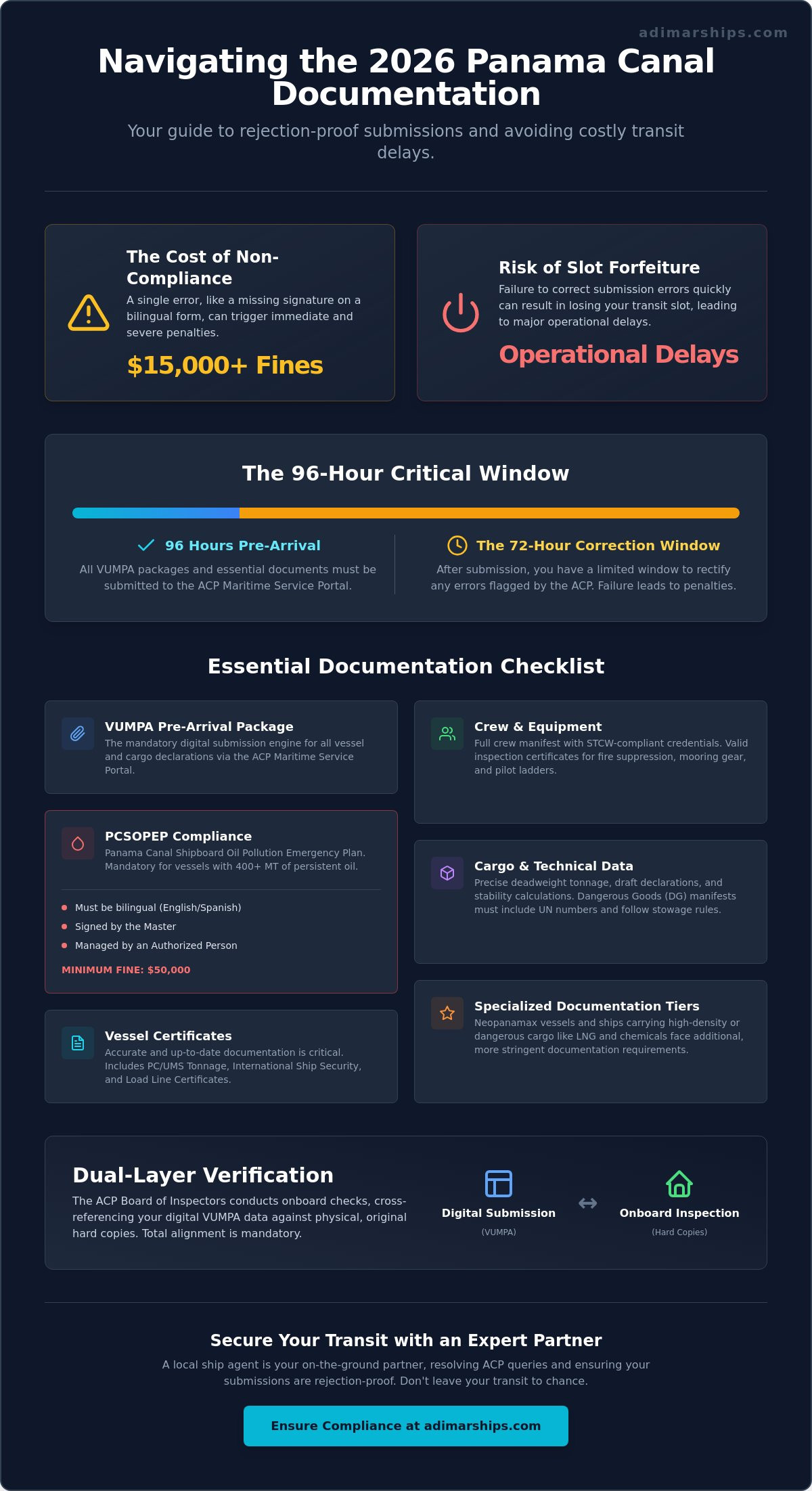
Precision is your best defense against financial loss. The ACP doesn’t offer leniency for administrative oversights. Fines for non-compliance or incomplete submissions start at $15,000, but the true cost often exceeds this figure. Consider the “72-Hour Rule” regarding slot management. While you must submit documents 96 hours before arrival, failing to rectify errors within the subsequent window can lead to immediate slot forfeiture. Losing a transit slot disrupts charterer relationships and erodes your operational ROI. It’s a high-stakes scenario where a single missing signature can force a vessel out of the queue, resulting in days of idle time and mounting port fees.
The Role of the ACP Board of Inspectors
Digital prep doesn’t replace physical vigilance. The ACP Board of Inspectors remains a vital part of the process. When inspectors board your vessel, they cross-reference digital VUMPA data against original hard copies. Masters must keep valid certificates, such as the International Ship Security Certificate and Load Line Certificate, ready for immediate inspection. The 2026 requirements demand higher transparency in vessel particulars than ever before. This dual-layer verification system ensures that what was promised in the digital portal matches the reality on the bridge. Maintaining this alignment is the only way to move through the locks without a hitch.
The 12 Essential Document Categories for ACP Compliance
Completing your panama canal transit documentation requirements involves more than just filling out forms. It’s a technical exercise in data synchronization. The VUMPA Pre-Arrival Package serves as the primary engine for your vessel and cargo declarations, and it must be submitted through the ACP Maritime Service Portal. Any discrepancy between your digital filing and the physical vessel particulars can stall your transit before it begins. Beyond the basics, you must provide a valid Panama Canal Shipboard Oil Pollution Emergency Plan (PCSOPEP). This plan is mandatory for vessels carrying 400 metric tons or more of persistent oil and must be bilingual, signed by the master, and managed by a PCSOPEP Authorized Person to avoid minimum fines of $50,000.
Mistakes in tonnage calculations don’t just cause delays; they trigger massive lock fee surcharges. Your PC/UMS Tonnage Certificate must be accurate and up to date. Additionally, the ACP requires a full crew manifest where every officer holds credentials that meet STCW requirements. Equipment inspection certificates are equally vital. Inspectors will verify the condition of your fire suppression systems, mooring gear, and pilot ladders to ensure they meet the specific safety standards required for the locks.
Primary Vessel and Cargo Declarations
Your technical declarations must be precise. The ACP requires detailed deadweight tonnage, draft declarations, and stability calculations for every transit. If you’re carrying dangerous goods, your DG manifests must include specific UN numbers and follow strict stowage segregation rules. These requirements are grounded in the U.S. Code of Federal Regulations regarding vessel reporting, which the Canal Authority enforces with zero tolerance. You must also provide MARPOL Annex compliance documents and detailed waste management declarations to satisfy environmental oversight during your time in the watershed.
Overlooked Husbandry and Security Documents
Operational success often hinges on the documents that don’t involve the locks themselves. Security is paramount, requiring a valid International Ship Security Certificate (ISSC) and full ISPS Code compliance. Many operators overlook the paperwork needed for husbandry services, such as crew medical declarations and provisioning manifests. If you’re coordinating a crew change or receiving spare parts, your logistics paperwork must be flawlessly integrated into the transit schedule. Managing Cash to Master (CTM) documentation and spare parts clearance requires a local partner who understands the nuances of Panamanian customs. Working with a dedicated provider of ship agency services ensures these secondary but vital document categories don’t become primary causes for delay.
The 96-Hour Window: Submission Timelines and Common Pitfalls
The 96-hour window is a strategic period where precision saves thousands in potential losses. It starts with the mandatory VUMPA submission through the Maritime Service Portal. This isn’t a “set and forget” task. Masters must ensure the declared draft matches the vessel’s actual condition upon arrival. Even a minor discrepancy can lead to a significant delay. The ACP uses these initial 96 hours to plan lockage capacity and pilot assignments based on your data. If the information is wrong, the plan fails, and your vessel loses its place in the queue.
One often-overlooked hurdle is the “Signature Trap.” The ACP enforces specific electronic signature formats for all panama canal transit documentation requirements. If your master’s digital signature doesn’t align with the ACP-approved encryption or layout, the entire package may be flagged as invalid. This requires immediate attention to avoid missing the critical entry window. Managing late-breaking cargo changes or crew substitutions requires a proactive agent who can update the portal in real-time before the deadline expires. We act as your on-the-ground representative to ensure these last-minute adjustments don’t compromise your compliance status.
Why Submissions Get Rejected in 2026
Rejections often stem from using outdated templates. The ACP issued updated Notices to Shipping for 2026, specifically N-5-2026 and N-11-2026, which supersede all 2025 versions. Using a 2025 PCSOPEP format is a guaranteed way to trigger a rejection. We also see frequent issues with expired STCW certifications for secondary officers. If a junior officer’s flag state endorsement has lapsed, the crew manifest is technically non-compliant. Finally, ensure your vessel dimensions are consistent. Any conflict between the Tonnage Certificate and the VUMPA declaration will halt the process until verified by a physical admeasurement.
The 48-Hour Visibility Condition Report
Forty-eight hours before arrival, you must submit the Visibility Condition Report. This is vital for vessels with restricted bridge visibility or those nearing Neopanamax dimensions. You must document pilot platform compliance and ensure all blind spots are accounted for according to ACP standards. Failing to report visibility deficiencies early doesn’t just lead to administrative fines. It can result in a transit suspension until a specialized pilot or additional tugs are arranged. Our role is to act as a vigilant partner, ensuring these technical reports are submitted accurately to maintain your operational rhythm.
Specialized Documentation for High-Density and Dangerous Goods Vessels
Technical complexity increases with vessel scale. While the baseline panama canal transit documentation requirements apply to all, specialized carriers face additional layers of scrutiny during the physical inspection process. The ACP categorizes vessels into distinct documentation tiers based on dimensions and cargo risk. Neopanamax vessels, for example, must provide detailed technical specifications for mooring gear and tug interface fittings that aren’t required for smaller Panamax ships. This ensures the vessel can safely interact with the high-performance tugs used in the Expanded Canal locks.
Bulk carriers and tankers face their own set of challenges. For bulkers, high cargo density declarations and precise stability data are non-negotiable to ensure safe passage through the lock chambers. Passenger vessels must prioritize detailed manifest requirements and valid sanitary inspection certificates to meet health and safety protocols. These documents are vetted long before the pilot boards, making early submission through the VUMPA portal essential for maintaining your transit schedule. If you are managing a complex fleet, delegating these technical filings to a professional Ship Agency ensures every specialized requirement is met without delay.
Neopanamax Beam and Draft Documentation
Operating in the new locks requires absolute precision in equipment documentation. For 2026, the ACP has clarified requirements for mooring line materials, specifically demanding high-modulus synthetic fibers for Neopanamax transits to handle the increased tension in the larger chambers. You must also document tug interface compliance, ensuring all chocks and bitts meet the specific safe working load (SWL) standards. Draft limitations in Gatun Lake often shift based on seasonal rainfall, requiring masters to provide updated seasonal documentation adjustments 96 hours before arrival. Failing to align your declared draft with these seasonal restrictions can lead to immediate cargo discharge requirements or transit cancellation.
Dangerous Goods and Environmental Compliance
Carrying IMDG-classified cargo triggers a separate manifest requirement. You must provide a clear validation of stowage segregation to prove that dangerous goods are positioned according to international safety standards. For LNG and chemical tankers, the environmental stakes are even higher. These vessels must satisfy the PCSOPEP authorized person requirement, ensuring a local representative is legally empowered to coordinate emergency responses. Additionally, vessels participating in the ‘Green Connection’ environmental recognition program must submit supporting documentation to verify their efficiency ratings. This proactive approach to environmental compliance can lead to prioritized scheduling, but only if the paperwork is flawlessly executed and verified by the ACP Board of Inspectors.
Beyond Paperwork: How a Local Ship Agent Secures Your Transit
Compliance isn’t just about clicking “submit” on a digital portal. It’s about having a vigilant presence on the ground to manage the unexpected variables of maritime logistics. While understanding the panama canal transit documentation requirements is the first step, real-world execution requires a partner who acts as your local office. We resolve ACP queries in real-time, preventing minor administrative questions from escalating into transit-stopping events. This level of personalized coordination between the Master, the Canal Authority, and the owner ensures that everyone stays aligned as the vessel approaches the breakwater.
Choosing an owner’s nominated agency provides a distinct advantage in vetting document accuracy. While other parties might focus solely on the immediate cargo interests, we prioritize the protection of the vessel and the owner’s regulatory standing. Our proactive vigilance starts long before the 96-hour countdown. We identify potential equipment expirations or certificate gaps weeks in advance, allowing you to rectify issues before they become part of an official ACP inspection report. This foresight is what separates a routine transit from a costly operational headache.
Adimar Shipping, Inc.: Your Expert Partner for Canal Readiness
Our approach is built on a foundation of ethical standards and transparent communication. We recognize that the maritime industry is often buried in an “alphabet soup” of acronyms like VUMPA and PCSOPEP. Our role is to translate these complex requirements into clear, actionable items for your crew. By delegating these specialized tasks to us, you gain the peace of mind that comes from working with a seasoned regional expert. Our ship agency panama services are designed to eliminate transit friction, allowing your team to focus on safe navigation while we handle the regulatory weight.
The Final Safeguard: Pre-Transit Document Audits
We don’t leave your compliance to chance. Adimar Shipping, Inc. performs a rigorous 120-hour internal audit before any official submission is made to the ACP. This final safeguard catches discrepancies in draft declarations or signature formats that automated systems might miss. Beyond the paperwork, we manage the complex financial logistics of your transit. This includes the precise handling of transit fees, husbandry costs, and Cash to Master (CTM) requirements. We ensure that all mandatory payments, such as the first-time admeasurement fee for the PC/UMS, are processed without delay to keep your vessel moving. Contact Adimar Shipping, Inc. to secure your 2026 Panama Canal transit.
Mastering Your 2026 Canal Transit Strategy
Navigating the locks in 2026 requires more than just meeting deadlines; it requires a commitment to technical accuracy and local coordination. Throughout this guide, we’ve highlighted how the 96-hour window and specialized vessel requirements demand absolute precision to protect your bottom line. By mastering the panama canal transit documentation requirements, you ensure that your vessel transitions from the open sea to the locks without administrative friction or costly slot forfeitures. Success at the Canal is built on preparation and the ability to anticipate regulatory shifts before they impact your schedule.
We act as your vigilant, on-the-ground representative, simplifying the “alphabet soup” of regulations into clear, actionable steps. As an authorized PCSOPEP representative with deep regional expertise, Adimar Shipping, Inc. provides the dedicated oversight necessary for both owners and charterers. We don’t just process forms; we secure your operational freedom by vetting every detail before the ACP Board of Inspectors ever sets foot on your bridge. Secure Your Seamless Panama Canal Transit with Adimar Shipping, Inc. Your next transit should be defined by efficiency and peace of mind. We’re ready to ensure your fleet moves forward with total confidence.
Frequently Asked Questions
What are the 12 core document categories required for Panama Canal transit?
The primary document categories include the VUMPA pre-arrival package, the Panama Canal Shipboard Oil Pollution Emergency Plan (PCSOPEP), and the PC/UMS Tonnage Certificate. You must also submit a full crew list with STCW credentials, equipment inspection certificates, and the International Ship Security Certificate (ISSC). Additional requirements cover cargo manifests, crew medical declarations, provisioning manifests, Cash to Master (CTM) paperwork, MARPOL compliance declarations, and valid Load Line certificates. Each category must be current and technically accurate.
When is the absolute deadline for submitting Panama Canal transit documents?
The absolute deadline for the Vessel Universal Measurement and Pre-Arrival (VUMPA) package is 96 hours before your vessel arrives at the Canal anchorage. This strict timeline allows the ACP to coordinate pilots and lock capacity. Failing to meet this window often results in the immediate forfeiture of your transit slot. We recommend a 120-hour internal audit to ensure every signature is perfect before the official 96-hour countdown begins.
Does the Panama Canal Authority (ACP) require documents to be in Spanish?
The ACP requires certain critical documents, most notably the PCSOPEP, to be submitted in a bilingual format featuring both English and Spanish. While many standard maritime certificates are accepted in English, your local ship agent ensures that all specific panama canal transit documentation requirements meet these linguistic standards. This prevents administrative rejections from the Board of Inspectors during the physical boarding process. It’s a small detail that prevents massive delays at the breakwater.
What happens if my vessel’s documentation is rejected by the ACP?
A rejection typically triggers immediate financial penalties and operational delays. Fines for non-compliance start at $15,000, while violations involving the PCSOPEP carry a minimum fine of $50,000. Beyond the fines, your vessel may lose its scheduled transit slot. This forces a renegotiation of arrival times and potentially causes days of idle waiting. Such disruptions lead to significant financial loss and strained relationships with charterers. It’s vital to get the paperwork right the first time.
Is a PCSOPEP plan mandatory for all vessels transiting the Panama Canal?
A PCSOPEP is mandatory for all vessels carrying 400 metric tons or more of persistent oil as cargo or fuel. This plan must be approved by the ACP and managed by a designated Authorized Person who coordinates with local authorities. If your vessel falls below this threshold, you aren’t required to maintain a full plan. However, you must still provide standard environmental safety declarations. We ensure your vessel stays compliant regardless of its cargo density.
How do Panama Canal tonnage certificates affect my transit fees?
Transit fees are calculated based on the Panama Canal Universal Measurement System (PC/UMS) tonnage listed on your certificate. Any inaccuracies in these vessel particulars can lead to significant toll surcharges or a mandatory first-time admeasurement fee of approximately $1,100. Ensuring your certificate is up to date prevents these unexpected costs. It’s the best way to ensure your voyage remains within the projected budget for 2026 without any administrative surprises.
Can a ship agent update my VUMPA submission after the 96-hour window?
Yes, a ship agent can facilitate updates to your VUMPA submission, but these must be completed before the vessel is boarded by ACP inspectors. While the 96-hour window is the primary deadline for initial filing, we manage late-breaking changes to crew manifests or cargo data. However, major revisions close to arrival increase the risk of a transit suspension while the ACP verifies the new data. It’s always safer to finalize details before the deadline.
What specific documents are required for Neopanamax vessels in 2026?
Neopanamax vessels must provide specialized documentation regarding mooring gear materials and tug interface fittings. This includes verifying that chocks and bitts meet the Safe Working Load (SWL) standards required for the high-performance tugs in the new locks. Additionally, you must submit a Visibility Condition Report 48 hours before arrival. This report proves that your bridge visibility and pilot platforms comply with panama canal transit documentation requirements for larger vessel dimensions. Precision here is non-negotiable.