

Last Tuesday, a charterer in Balboa opened a Final Disbursement Account only to find a $4,250 “miscellaneous” charge that never appeared on the initial estimate. It’s a common story at the Panama Canal, where manual tracking of ACP tariff changes often leads to expensive surprises. Mastering proforma disbursement account reconciliation is the only way to ensure that what you’re quoted at the start matches what you pay at the finish.
You already know that timing and coordination are frustrating, and unexplained charges on final accounts can ruin your voyage’s profitability. We understand that you need a predictable financial workflow and a way to eliminate slow turnaround times for FDA delivery. This guide provides the blueprint to master the complexities of PDA to FDA reconciliation and eliminate budget leaks in your transits. We’ll show you how to establish a predictable financial workflow and how a trusted local partner catches billing errors before they impact your bottom line.
Key Takeaways
- Understand the critical relationship between the PDA and FDA to maintain a transparent financial loop for every port call in Panama.
- Navigate the complexities of Panama Canal Authority (ACP) tariffs by identifying how Neo-Panamax and Panamax dimensions drastically shift your initial cost estimates.
- Implement a professional proforma disbursement account reconciliation framework to set tolerance thresholds and quickly flag suspicious budget leaks.
- Master a real-time auditing strategy that validates expenses against current ACP tariffs and logs services like tugs and pilots as they occur during transit.
- Learn how leveraging 20+ years of local expertise serves as your financial safeguard, ensuring every disbursement account is handled with integrity and cost-efficiency.
What is Proforma Disbursement Account Reconciliation in 2026?
As of January 2026, maritime logistics at the Panama Canal demand a level of financial precision that was impossible five years ago. A Proforma Disbursement Account (PDA) serves as the financial blueprint of a port call, providing ship owners with a detailed estimate of expected costs before the vessel even arrives at the breakwater. It’s the roadmap for your transit budget. However, the reality of port operations often shifts due to weather delays, scheduling changes, or unexpected husbandry needs. This is where proforma disbursement account reconciliation becomes the vital bridge between the initial estimate and the actual costs incurred during the stay.
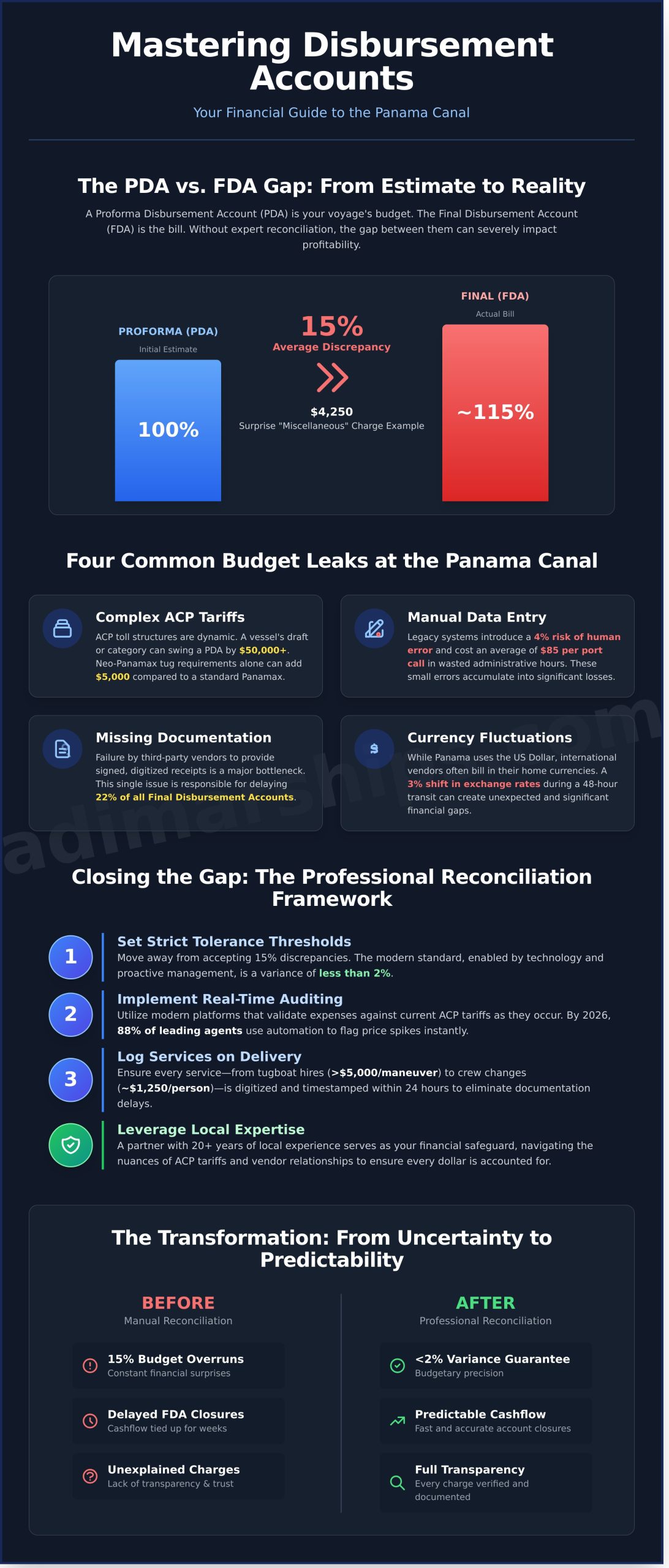
A Disbursement represents the actual payment of funds from a dedicated account; in the maritime world, this must be tracked with surgical precision. The Final Disbursement Account (FDA) acts as the definitive record that closes the maritime financial loop. Without a rigorous reconciliation process, owners often find themselves staring at a 15% discrepancy between what they approved in the PDA and what they are being billed in the FDA. In 2026, the standard for “acceptable” variance has dropped to less than 2% because digital transformation has replaced guesswork with real-time data feeds from the Panama Canal Authority (ACP) and local vendors.
Digital transformation has fundamentally changed how we handle these accounts. We’ve moved away from static PDF estimates to dynamic, cloud-based ledgers. By 2026, 88% of leading ship agents in Panama utilize automated platforms that flag price spikes the moment a vendor uploads an invoice. This shift means reconciliation isn’t just a post-voyage chore anymore. It’s a proactive strategy to protect your bottom line while your vessel is still in the water. We are your eyes at the Panama Canal, ensuring that every dollar stays where it belongs.
The Anatomy of a Disbursement Account (DA)
A Disbursement Account is the itemized record of all financial transactions between a ship and the port. Core components include fixed port dues, pilotage fees, and tug hire, which often exceed $5,000 per maneuver in the new Neo-Panamax locks. Variable costs add complexity. These involve husbandry services, crew changes which average $1,250 per person for transport and logistics, and Cash to Master (CTM) deliveries. Every line item requires a corresponding voucher. In the 2026 market, owners expect these documents to be digitized and timestamped within 24 hours of service delivery to ensure transparency.
Why Reconciliation Fails: Common Pitfalls for Owners
Even with advanced tech, proforma disbursement account reconciliation fails for predictable reasons. Currency fluctuations remain a thorn; while Panama uses the US Dollar, many international vendors bill in home currencies, and a 3% shift in exchange rates during a 48-hour transit can create significant gaps. Missing documentation is another hurdle. Statistics from 2025 show that 22% of FDAs are delayed because a third-party launch service or technician failed to provide a signed receipt. Finally, the hidden cost of manual data entry in legacy systems is staggering. Manual processing costs roughly $85 per port call in wasted administrative hours and introduces a 4% risk of human error. We eliminate this confusion with personalized service that prioritizes accuracy over shortcuts. We’re experts so you don’t have to be.
The Panama Canal Factor: Why Local PDAs are Unique
The Panama Canal isn’t just a shortcut; it’s one of the most complex financial environments in global shipping. When you handle proforma disbursement account reconciliation for a Canal transit, you aren’t just checking port dues. You’re auditing a moving target. The Panama Canal Authority (ACP) updated its toll structure in January 2023, moving toward a capacity-based system that can swing a PDA by $50,000 based on a single foot of draft or a slight change in vessel category.
A Neo-Panamax vessel, with its 160-foot beam, faces radically different tugboat requirements and lockage fees than a standard Panamax ship. If your agent uses a generic template, they might miss the $5,000 difference in transit vessel charges. In November 2023, during the height of the recent drought-related restrictions, slot auction prices hit record highs of $4 million for a single transit. A standard PDA won’t account for these variables, leading to massive discrepancies during the final audit. While the Federal Maritime Commission (FMC) oversees the regulatory framework for ocean transportation in the U.S., the local nuances in Panama require a boots-on-the-ground approach to financial accuracy.
ACP Fee Structures and Pilotage Variables
The ACP dictates exactly how many tugs a ship needs. You might budget for two tugs at $5,000 each, but if the Canal pilots demand a third for safety due to weather or mechanical issues, your PDA is immediately $5,000 short. We also see the “Freshwater Surcharge” fluctuating based on Gatun Lake levels. As of June 2024, these levels have started to stabilize, but your 2026 budget must still account for a variable percentage based on the daily lake index. Compliance costs also include the PCSOPEP authorized person, a mandatory local representative that generic agents often under-quote by $500 to $1,000.
The Importance of Real-Time Coordination
At Adimar Shipping, we act as your eyes at the Canal. We don’t just wait for the invoice; we verify the service as it happens. If a crew change involves a $1,200 launch fee, we ensure the boat was actually alongside. This level of detail is vital for effective proforma disbursement account reconciliation. Tracking husbandry services like spare parts delivery or garbage disposal in real-time prevents “FDA bloat,” where small, unverified costs add up to $10,000 in overages per transit. We see ourselves as your local office, ensuring that every dollar spent is a dollar earned in transit efficiency.
Effective cost-control starts with local expertise. You can request a precise quote to see how our team mitigates these financial risks with transparent, real-time reporting.
PDA vs. FDA: Identifying and Resolving the Reconciliation Gap
Closing the gap between the Proforma Disbursement Account (PDA) and the Final Disbursement Account (FDA) is where most operational friction occurs. We recommend a side-by-side comparison framework for every Panama Canal transit. This process isn’t just about checking boxes; it’s about verifying that the $45,000 estimated for tugs matches the $48,200 actually billed. An academic study on disbursement accounts highlights that systematic errors in port cost estimation often stem from a lack of real-time data integration. At Adimar, we act as your local eyes to ensure those estimates remain grounded in reality.
Effective proforma disbursement account reconciliation relies on setting strict tolerance thresholds. For standard transits, a variance of 3% to 5% is often considered normal due to minor fluctuations in exchange rates or utility consumption. However, any discrepancy exceeding 10% should be flagged as suspicious. These outliers usually point to deeper issues, such as miscalculated vessel dimensions or unauthorized service charges. By establishing these benchmarks, owners can automate the approval of minor differences and focus their energy on high-value disputes.
The psychological aspect of this process is just as vital as the numbers. Trust between owners and agents is built through radical transparency. When an agent proactively explains why a cost shifted before the FDA is even issued, it eliminates the “sticker shock” that leads to long payment delays. Sometimes, conditions change mid-voyage. If Gatun Lake water levels drop suddenly, as they did during the 2023 drought, your vessel might face new draft restrictions. In these cases, we issue Supplemental PDAs immediately. This ensures the master and the onshore team aren’t surprised by $15,000 in additional lightened cargo costs or transit adjustments.
The 5 Most Common Discrepancies at the Panama Canal
Discrepancies often cluster around three specific areas. First, pilotage delays frequently lead to overtime charges, which can add $2,500 per hour to the bill if the vessel isn’t ready at the scheduled time. Second, unexpected garbage disposal or sludge removal fees often vary by $500 to $1,200 depending on the volume verified by the barge captain versus the initial estimate. Third, tug usage variations during lockage are common. While a PDA might estimate three tugs, a Neopanamax vessel might require four depending on wind speeds exceeding 15 knots, significantly impacting the final total.
The Dispute Protocol: A Step-by-Step Resolution
When proforma disbursement account reconciliation reveals a mismatch, follow this protocol:
- Step 1: Issue a formal query of the FDA line item with the local agent. Don’t settle for vague explanations; ask for the specific time logs or service entries that triggered the extra cost.
- Step 2: Request original ACP (Panama Canal Authority) invoices and third-party vendor receipts. We believe in “trust but verify,” so we provide these documents as a standard practice to prove every dollar spent.
- Step 3: Negotiate “Agency Fee” adjustments if the discrepancy resulted from poor performance or clerical errors. If an agent fails to coordinate a launch properly, resulting in a $3,000 delay, they should be held accountable for that loss.
We are experts so you don’t have to be. By following this structured approach, you turn reconciliation from a stressful administrative burden into a strategic tool for cost control. Your transit is in safe hands when every cent is accounted for with integrity.
A Professional Framework for Auditing Disbursement Accounts
Effective proforma disbursement account reconciliation starts before the ship even reaches the breakwater. It’s a proactive process that requires constant vigilance. In the Panama Canal, where transit costs can exceed $300,000 for a single Neo-Panamax vessel, even a 2% discrepancy in tug usage or line-handling fees results in thousands of dollars in lost capital. You need a structured framework to protect your bottom line.
Pre-arrival verification is your first line of defense. You must validate the initial PDA against the current Autoridad del Canal de Panamá (ACP) tariffs. As of the 2024/2025 updates, the ACP has adjusted several maritime service fees. If your agent uses outdated 2023 figures, your initial funding will be inaccurate. Cross-reference every line item with the official tariff tables to ensure the estimate reflects reality.
During the transit, real-time logging is essential. You can’t wait for the final bill to find out how many tugs were actually used. Your crew or your on-the-ground representative should log the exact time for pilots, the number of tugboats engaged, and any additional launches for crew changes. If a vessel requires three tugs for safety reasons instead of the estimated two, this must be recorded immediately to avoid surprises during the final review.
The post-transit phase begins the moment the vessel clears the locks. The industry standard provides a 30-day window for the delivery and review of the Final Disbursement Account (FDA). During this period, you compare the actual vendor invoices against the initial proforma. This is the core of proforma disbursement account reconciliation. You’re looking for exact matches between the logged services and the billed amounts. Finally, ensure all “Cash to Master” (CTM) payments and spare part delivery fees, which often carry a $350 to $600 handling charge in Panama, are documented with signed receipts.
Best Practices for Financial Controllers
Standardization is the greatest tool for a controller managing global fleets. You should require all agents to use a uniform DA format regardless of the port. Looking ahead, 65% of leading maritime agencies plan to implement OCR and AI-driven auditing tools by 2026. These systems automatically flag discrepancies between the PDA and FDA. You should also maintain a historical database of port costs. If the pilotage fee in Balboa jumps 12% without a corresponding ACP tariff hike, your database will alert you to investigate the vendor’s math.
The Role of the Protective Agent in Reconciliation
An Owner’s Protective Agent (OPA) acts as your eyes and ears at the Panama Canal. While the Charterer’s Nominated Agent handles the primary logistics, the OPA serves as a second set of eyes to protect the owner’s interests. They verify the nominated agent’s calculations and ensure vendor selections are cost-effective rather than just convenient. Using an OPA often reduces the final bill by 5% through diligent oversight. Learn more about Owner’s vs. Charterer’s Nominated Agency to see how this dual-layer protection works in practice.
Don’t let hidden fees erode your voyage profits. Nominate Adimar as your trusted agent to ensure every dollar is accounted for with total transparency.
Beyond Software: Why Adimar Shipping is Your Financial Safeguard
Software tools are helpful, but they don’t have eyes on the ground at the Miraflores Locks. At Adimar Shipping, we believe that effective proforma disbursement account reconciliation requires more than just an algorithm. It demands a partner who treats your balance sheet with the same integrity as their own. We’ve spent over 20 years managing Panama Canal transits with a focus on cost-conscious management. We don’t just process numbers; we protect your capital by integrating transparency into every document we produce.
Our team understands that the maritime industry is built on trust. When you receive a Final Disbursement Account (FDA) from us, it isn’t just a list of costs. It’s a verified record of service. We take the time to explain every line item because we know that clarity eliminates the reconciliation headache. You won’t find yourself chasing down missing receipts or questioning vague vendor fees. We are your eyes at the Panama Canal, ensuring that what you pay matches the service your vessel actually received.
Confusion often stems from a lack of communication between the ship and the shore. We bridge that gap. By serving as your local office in Panama, we handle all vendor payments with a level of scrutiny that automated systems can’t match. We’ve spent two decades building relationships with local suppliers, which gives us the leverage to ensure you get fair pricing and honest billing every time your ship transits the waterway.
The Adimar Advantage: Local Expertise Meets Financial Transparency
We’re committed to a ‘no-surprise’ billing philosophy. This starts with our initial PDAs, which are calculated using real-time data and 20 years of historical cost analysis. We don’t low-ball estimates just to get the nomination; we provide accurate figures so your treasury department can plan effectively. If the ACP (Panama Canal Authority) applies unfair lockage charges or unexpected tariffs, we don’t just accept them. We use our local presence to dispute unjustified costs directly with the authorities. This proactive stance has saved our clients thousands of dollars in unnecessary fees over the years. We act as your advocate, ensuring that proforma disbursement account reconciliation is a smooth verification of facts rather than a battle over discrepancies.
Get Started with a Trusted Panama Canal Partner
Choosing the right agent is the most effective way to control your transit expenses. We invite you to Request a Proforma Quote for your next Panama Canal transit and see our precision firsthand. When you nominate Adimar Shipping, you’re choosing a partner that values efficiency and honesty above all else. We’re proud to be celebrating our 20th year in business. This milestone is a mark of stability and trust in an industry that never stops moving. We’re experts so you don’t have to be. Put your next transit in our hands and experience the peace of mind that comes with working with a cost-conscious agent who truly understands the Panama market. Don’t let your bottom line suffer from poor coordination or lack of local oversight. Contact us today to secure your financial interests at the canal.
Secure Your Maritime Margins at the Panama Canal
Managing maritime costs in 2026 requires more than basic oversight; it demands a rigorous approach to proforma disbursement account reconciliation. By closing the gap between initial estimates and final invoices, owners can prevent the 5% to 15% overspend often hidden in unverified port expenses. Local expertise is the only way to navigate the specific tariff structures of the Panama Canal Authority. You need a partner who understands the difference between a standard quote and the actual USD ($) costs incurred during a transit.
Adimar Shipping serves as your local office and your eyes at the Panama Canal. With 20+ years of Panama Canal expertise, we’ve built a reputation for integrity and precision. As an authorized PCSOPEP representative, we ensure every cent is accounted for through our proven track record of cost-conscious agency services. We’re experts so you don’t have to be. Let us eliminate the confusion and safeguard your financial interests while your vessel moves through the waterway. It’s time to trade uncertainty for transparency and professional accountability.
Nominate Adimar Shipping as your Panama Canal Agent today to protect your bottom line and ensure a seamless transit experience.
Frequently Asked Questions
What does PDA stand for in shipping and why is it important?
PDA stands for Proforma Disbursement Account, which is a preliminary estimate of the total costs a vessel will incur during a port call or Panama Canal transit. It’s essential because it allows ship owners to set aside the necessary funds and manage cash flow before operations begin. At the Panama Canal, getting this right ensures there are no delays in transit due to insufficient funds in the ACP maritime payment system. We provide these estimates with precision so you can budget with confidence.
How long should it take for a ship agent to provide a Final Disbursement Account (FDA)?
A ship agent should typically provide the Final Disbursement Account within 30 to 45 days after the vessel completes its transit or port stay. This timeframe allows the agent to collect all third-party invoices from tug companies, pilots, and the Panama Canal Authority. While some complex cases might take up to 60 days, we aim for efficiency to help you close your voyage accounts quickly. Our team prioritizes speed and accuracy to ensure your financial records stay up to date.
Can I dispute a Panama Canal Authority (ACP) charge on my FDA?
You can dispute ACP charges, but you must do so within 30 days of the invoice date to be considered by the authority. Disputing a charge requires documented evidence, such as a deck log or a master’s protest, to prove the discrepancy in services like tug usage or transit time. We act as your eyes at the Panama Canal to verify these charges in real-time. This makes the proforma disbursement account reconciliation process much smoother when errors occur.
What is the difference between a Disbursement Account and an Invoice?
A Disbursement Account is a comprehensive statement of all expenses paid by the agent on behalf of the ship owner, while an invoice is a single bill for a specific service. The DA acts as a summary that includes the agency fee, canal tolls, and husbandry costs. Think of the DA as the final balance sheet for the port call. Individual invoices are the supporting documents used during the proforma disbursement account reconciliation to ensure every penny is accounted for correctly.
Who is responsible for paying the disbursement account in a charter party?
The responsibility for paying the disbursement account depends on the specific terms of the charter party agreement, such as NYPE or ASBATANKVOY. In a Time Charter, the charterer typically covers port charges and canal tolls, while the owner pays for vessel-related expenses like crew changes or repairs. In a Voyage Charter, the owner usually handles the full disbursement account. We ensure all costs are allocated correctly based on your specific contract to avoid legal friction between parties.
How can I reduce the discrepancies between my PDA and FDA?
You can reduce discrepancies by working with an agent who provides real-time updates and uses historical data to create accurate estimates. Discrepancies often drop below 5% when you use a local expert who understands the 2024 and 2025 tariff changes and ACP surcharges. We cross-check every line item against current port tariffs and service agreements. This proactive approach eliminates surprises and ensures the final bill aligns closely with your initial budget, saving you from unexpected costs.
What are the typical agency fees for a Panama Canal transit in 2026?
Typical agency fees for a Panama Canal transit in 2026 are expected to range from $3,800 to $6,500 per transit, depending on the vessel’s size and the complexity of the services required. These fees cover the agent’s 24/7 coordination with the ACP, document processing, and logistics management. While some agents might offer lower rates, our 20 years of experience ensures you receive high-quality service with integrity. This prevents costly delays that far exceed the initial agency fee.
Is software enough to handle PDA reconciliation at the Panama Canal?
Software is a helpful tool for data entry, but it’s not enough to handle the complexities of the Panama Canal’s regulatory environment. You need a human expert to catch nuances that algorithms miss, such as sudden changes in draft restrictions or specific terminal requirements. We are your eyes at the Panama Canal, providing the oversight needed to challenge incorrect charges. We manage the human elements of shipping that software simply can’t navigate, ensuring your interests are always protected.