
A single paperwork error can trigger a $15,000 fine, but for a Neo-Panamax vessel, the real cost of a transit delay often exceeds $65,000 in lost revenue every day. You understand that the Panama Canal Authority (ACP) maintains a zero-tolerance policy for compliance gaps. The role of pcsopep authorized person is central to this process. They aren’t just a name on a document; they’re your 24/7/365 liaison for emergency response and regulatory peace of mind. Without a resident expert to activate local resources, your transit is at risk before it even begins.
We’ve designed this definitive roadmap to help you secure a valid, ACP-approved plan for 2026 and avoid the anxiety of high pollution fines. You’ll gain a clear understanding of the latest OP Notice to Shipping N-12-2026 requirements and the precise steps to manage your VUMPA submissions. This guide previews the essential vessel tiering classifications and explains how to select a dependable partner who acts as a vigilant extension of your own team on the ground in Panama. Let’s ensure your next transit is defined by efficiency and total compliance.
Key Takeaways
- Identify the specific legal mandates under ACP Chapter IX regulations to ensure your vessel meets the latest 2026 environmental safeguards.
- Understand the critical role of pcsopep authorized person as your resident 24/7/365 liaison for emergency coordination and regulatory compliance.
- Master the vessel tiering system and documentation requirements for fuel and cargo capacity to prevent administrative rejections.
- Follow a proven five-step roadmap from technical data collection to final plan approval for a seamless, zero-delay transit.
- Discover how delegating specialized compliance to a local expert protects your operations from $15,000 non-compliance fines and costly bottlenecks.
What is a PCSOPEP Plan and Why is it Mandatory?
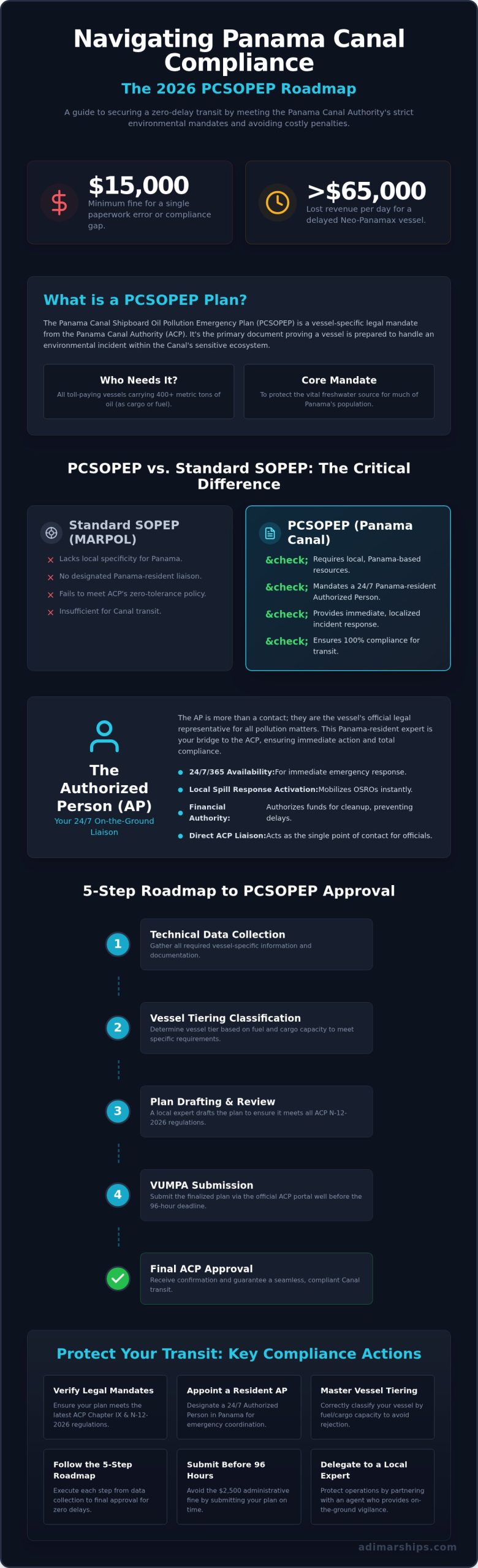
The Panama Canal Shipboard Oil Pollution Emergency Plan (PCSOPEP) serves as a vessel-specific environmental safeguard. It’s a strict legal mandate from the Panama Canal Authority (ACP) under Chapter IX of the Navigation Regulations. This requirement applies to all toll-paying vessels with a carrying capacity of 400 metric tons (MT) or more of oil, whether that oil is carried as cargo or as fuel. For ship operators, this plan is the primary document that proves a vessel is prepared to handle an environmental incident within the specific confines of the Canal.
Protecting the Canal is about more than logistics; it’s about protecting a vital freshwater ecosystem. The waterway provides drinking water for a significant portion of Panama’s population. Because the stakes are so high, the ACP enforces a zero-tolerance policy regarding environmental safety. The role of pcsopep authorized person is crucial in this context. They act as the resident expert who ensures your vessel remains in total alignment with these local protection standards, providing a bridge between international maritime operations and Panamanian law.
PCSOPEP vs. Standard MARPOL SOPEP
Shipowners often ask why their existing international documentation isn’t sufficient for a transit. While a standard Shipboard Oil Pollution Emergency Plan (SOPEP) meets MARPOL requirements, it lacks the local specificity the ACP demands. A PCSOPEP requires detailed contact information for Panama-based response resources and the mandatory designation of a Panama-resident Authorized Person. The role of pcsopep authorized person is to be available 24/7/365 to coordinate with the ACP if an incident occurs. An international SOPEP simply doesn’t provide this localized, immediate layer of protection required for the unique geography of the Canal.
Consequences of Non-Compliance in 2026
Regulatory vigilance is at an all-time high. Under the “OP NOTICE TO SHIPPING N-12-2026,” the ACP identifies clear penalties for compliance failures. If your plan is missing, outdated, or if your Authorized Person is unreachable, the impacts are immediate and expensive. Vessels without an approved plan are denied entry into Canal waters, which triggers massive scheduling disruptions. The minimum fine for PCSOPEP non-compliance is $15,000. Additionally, a $2,500 administrative fine applies if the plan is rejected or submitted past the 96-hour pre-arrival window. Beyond the fines, a single day of delay for a Neo-Panamax vessel can cost over $65,000 in lost revenue, damaging your reputation with charterers and potentially increasing insurance premiums.
The Critical Role of the PCSOPEP Authorized Person (AP)
The role of pcsopep authorized person is defined by legal accountability and local vigilance. Per the Panama Canal Authority (ACP), this individual serves as the vessel’s official legal liaison. They aren’t just a point of contact; they’re the primary representative for all oil pollution emergency matters. This person acts as a bridge between the ship’s master and the Panamanian authorities, ensuring that every environmental regulation is met with precision.
A core requirement for this position is 24/7/365 availability. If a spill occurs at 2:00 AM in the Culebra Cut, the ACP expects an immediate response. The AP must reside in Panama and possess a deep mastery of the Maritime Incident Management System. This local expertise ensures that emergency protocols translate into immediate action. One of the most critical duties involves activating local Spill Response Organizations (OSROs). The AP has the pre-authorized power to mobilize these resources instantly, bypassing the delays of international communication during a crisis.
Legal and Operational Duties of the AP
The AP serves as the direct link to ACP inspectors and officials. They don’t just relay messages; they authorize the expenditure of funds for emergency cleanup operations. This financial authority is a heavy responsibility that ensures cleanup efforts never stall due to payment disputes while an incident is unfolding. Throughout the entire transit window, the AP monitors the vessel to ensure it remains in total compliance with all local environmental mandates. Partnering with an experienced ship agency in Panama provides the vigilance and local oversight necessary to protect your fleet from these operational bottlenecks.
Why a Local Agent is Superior to Remote Services
Choosing a local agent over a remote service offers a distinct tactical advantage. A local partner provides an immediate physical presence. If an ACP official has a query at the Miraflores or Gatun locks, a local representative can often resolve it on-site. These agents maintain established, long-standing relationships with Panamanian environmental authorities, which streamlines communication and fosters trust. Real-time monitoring of transit schedules allows for proactive adjustments. This level of oversight ensures your passage remains smooth and predictable, even when conditions at the Canal change rapidly.
Understanding Vessel Tiering and Documentation Requirements
Technical precision is the foundation of a successful Canal transit. When submitting your PCSOPEP through the VUMPA (Ventanilla Única Marítima de Panamá) portal, the Panama Canal Authority (ACP) requires exhaustive data. This documentation must be finalized at least 96 hours before your arrival in Canal waters. Any discrepancy between your submitted plan and the actual state of the vessel can lead to administrative fines of $2,500 or significant transit delays. Your documentation package must include exact vessel general particulars, such as dimensions, engine types, and precise tonnage data.
Beyond basic dimensions, you must provide a detailed breakdown of fuel and cargo capacity. This isn’t a general estimate. The ACP demands a specific inventory of all oil types currently on board. This data determines your spill response tiering, which dictates the level of resources you must have available. You also need to maintain an updated inventory of shipboard equipment. This includes a verified list of booms, sorbents, and pumps ready for immediate deployment. The role of pcsopep authorized person is to verify this data before submission, ensuring your vessel doesn’t face rejection during the digital vetting process.
Tier 1 vs. Tier 2 Vessel Classifications
Your vessel’s total oil carrying capacity determines your compliance level and the associated ACP fees. These classifications apply to both fuel and cargo, meaning even vessels in ballast must be tiered correctly based on their potential capacity. For 2026, Tier 1 classification applies to vessels with a total oil carrying capacity, including both fuel and cargo, of 400 metric tons up to 7,000 metric tons. Vessels exceeding 7,000 metric tons up to 15,000 metric tons fall into Tier 2. Tier 2 vessels, especially those carrying oil as cargo, face more rigorous notification requirements and higher response capability expectations. Misclassifying your vessel can lead to an immediate $15,000 fine for non-compliance upon inspection.
The Role of the Oil Spill Response Organization (OSRO)
A valid PCSOPEP must integrate seamlessly with local Panamanian response contractors. You can’t rely on international contractors who lack the physical assets within Panama’s jurisdiction. Your plan must list specific, ACP-certified Oil Spill Response Organizations (OSROs) that are contracted to provide immediate assistance. The role of pcsopep authorized person is vital here, as they’re the only individual with the standing authority to activate these local resources during an emergency. They ensure that the OSROs listed in your plan are currently certified and capable of meeting the response times mandated by the ACP. This local coordination eliminates the confusion that often arises when trying to manage a crisis from a remote corporate office.
A 5-Step Roadmap to Obtaining Your PCSOPEP Approval
Obtaining an ACP-approved plan requires a methodical approach. The process starts with Data Collection. You must gather all technical vessel data, including engine specifications and exact fuel capacities. Next, the Drafting phase begins. Your plan must align with the latest 2026 ACP templates as outlined in Notice N-12-2026. A generic document won’t pass the digital vetting process because it lacks the vessel-specific response protocols required for Panama’s unique locks and channels.
The third step is the AP Appointment. You must formally designate a Panama-resident representative to handle emergency coordination. The role of pcsopep authorized person is to serve as your local vanguard; they ensure your interests are protected during the entire transit. Once the plan is drafted and the AP is appointed, you move to Digital Submission. All documents are uploaded via the official Maritime Single Window, known as VUMPA. Finally, you must reach the Verification stage. This involves securing the final ACP approval letter at least 96 hours before your vessel enters Canal waters.
Navigating the Digital Submission Process
The VUMPA system has streamlined document turnaround for 2026. It’s a fully digital environment where paper declarations are no longer accepted. To avoid automatic rejection, ensure all digital signatures are valid and file formats match ACP requirements exactly. Common errors often involve uploading low-resolution scans or missing mandatory fields in the vessel particulars section. You can track your approval status in real-time through the portal, allowing you to address issues immediately rather than waiting for a manual response. This local oversight is why the role of pcsopep authorized person remains the most critical component of your compliance strategy.
Avoiding Common Submission Pitfalls
Timing is the most frequent cause of transit disruptions. While the 96-hour window is the legal minimum, submitting your plan earlier provides a necessary buffer for corrections. If the ACP identifies inconsistencies between your PCSOPEP and the vessel’s actual equipment, they’ll issue a deficiency notice. Handling these notices effectively requires a local partner who can verify shipboard assets and update the digital file without delay. Inconsistencies often arise when a vessel undergoes equipment upgrades that aren’t reflected in the current plan. If you’re ready to secure your passage, you can appoint our team as your Authorized Person to manage these complexities on your behalf.
Securing Your Transit: Why Adimar is Your Preferred PCSOPEP Partner
Adimar provides the essential Authorized Person (AP) services required by the Panama Canal Authority with a focus on unwavering local vigilance. The role of pcsopep authorized person at Adimar is to act as your vigilant local eyes and ears. We treat every vessel as if it were our own, ensuring that no detail is overlooked during the compliance process. This proactive mindset allows us to resolve complex ACP queries quickly, preventing the costly anchor time that disrupts global supply chains. By choosing Adimar, you benefit from the seamless integration of compliance with our Ship Agency Panama services. We simplify the transit process by serving as a single, dependable point of contact for all regulatory and operational needs.
Beyond Compliance: A Holistic Agency Approach
Our philosophy centers on the idea that specialized tasks are best handled by dedicated local experts. Real efficiency is found when you combine mandatory PCSOPEP oversight with our comprehensive Husbandry Services. This holistic approach ensures that crew changes, spare part deliveries, and environmental compliance happen in parallel, not in isolation. Protecting your interests remains our primary objective. Through our Owner’s Nominated Agency expertise, we provide an extra layer of oversight that guards against unnecessary expenses. We manage the financial and logistical nuances of your passage, allowing you to focus on the broader goals of your fleet.
Get Started with Your Compliance Audit
Secure your 2026 transit schedule by initiating a compliance review today. You can request a PCSOPEP audit from the Adimar team to ensure your documentation aligns with the latest N-12-2026 requirements. To begin your plan development, we need your vessel’s technical data, including fuel capacities and current spill response equipment inventories. The role of pcsopep authorized person is to verify this information before it reaches the VUMPA portal, eliminating the risk of administrative rejection. Delegating these complex tasks to a knowledgeable partner ensures your vessel transits without friction. Contact Adimar for a customized transit and compliance quote to begin our partnership.
Secure Your Vessel’s Future in the Panama Canal
Success in the Panama Canal requires more than just following a checklist. It’s about maintaining a vigilant operational shield that protects your fleet from environmental risks and administrative bottlenecks. You now understand the necessity of precise vessel tiering and the strict 96-hour submission window via the VUMPA portal. Most importantly, you recognize that the role of pcsopep authorized person is the cornerstone of your compliance strategy, providing the local legal standing required by the ACP.
Don’t let paperwork errors or an unreachable representative jeopardize your transit schedule. Adimar offers ACP-recognized Authorized Person services backed by a 24/7/365 emergency response capability. Our specialized Panama Canal transit expertise ensures your vessel remains in total compliance from the moment it enters the anchorage until it clears the final set of locks. We act as your dedicated local partner, resolving queries before they become delays.
Ready to streamline your next passage? Contact Adimar Shipping for Expert PCSOPEP Assistance and gain the peace of mind that comes with professional local oversight. We’re here to ensure your journey through the Canal is efficient, secure, and entirely predictable.
Frequently Asked Questions
Can our existing ship agent in Panama act as our Authorized Person?
Yes, provided they meet the ACP residency and 24/7/365 availability requirements. Many shipowners prefer this integrated approach because it simplifies communication. The role of pcsopep authorized person requires specific expertise in the Maritime Incident Management System. Choosing a partner like Adimar allows you to combine husbandry services with specialized environmental compliance, ensuring a single point of accountability for your entire transit and reducing the risk of coordination errors.
What happens if a vessel arrives at the Panama Canal without an approved PCSOPEP?
The vessel will be denied entry into Canal waters and will face immediate financial penalties. A minimum fine of $15,000 applies for non-compliance with PCSOPEP regulations. You may also incur a $2,500 administrative fine if the plan was never submitted or was rejected. These costs don’t include the massive revenue losses caused by transit delays, which can exceed $65,000 per day for Neo-Panamax ships in lost revenue.
How long does it take for the Panama Canal Authority to approve a new plan?
Approval times vary, but you must submit your plan at least 96 hours before arrival via the VUMPA portal. While the digital system has sped up processing in 2026, it’s wise to allow 10 to 14 days for initial drafting and vetting. Early submission provides a buffer to address any deficiency notices from the ACP without risking your scheduled transit slot or incurring late submission administrative fines.
Does a PCSOPEP plan expire, or does it need periodic renewal?
A PCSOPEP plan remains valid as long as the vessel’s technical particulars and the Authorized Person’s contact information remain unchanged. You must update the plan whenever there are modifications to fuel capacity, engine types, or spill response equipment. Any change in your Panama-resident representative requires an immediate update to ensure the role of pcsopep authorized person is always filled by a verified contact who can coordinate with the ACP instantly.
What is the difference between a Tier 1 and a Tier 2 vessel under PCSOPEP?
Classification depends on the vessel’s total oil carrying capacity, including fuel and cargo. For 2026, Tier 1 vessels have a capacity of 400 MT up to 7,000 MT. Tier 2 vessels carry more than 7,000 MT up to 15,000 MT. Vessels in higher tiers face more stringent notification requirements and are assessed higher fees because they represent a greater potential environmental impact to the Canal’s freshwater ecosystem in the event of a spill.
Is a PCSOPEP plan required for vessels transiting in ballast?
Yes, the requirement applies to any toll-paying vessel with a carrying capacity of 400 MT or more of oil. Even if a vessel isn’t carrying oil as cargo, its fuel tanks often exceed the 400 MT threshold. The ACP views the potential for a fuel spill as a significant risk to the Canal’s freshwater ecosystem, making the plan mandatory regardless of whether the ship is in ballast or carrying cargo.
Can one Authorized Person represent multiple vessels in the same fleet?
Yes, a single Authorized Person or agency can represent an entire fleet of vessels. This is often the most efficient strategy for ship managers. Having one dedicated contact in Panama ensures consistency across your fleet’s compliance documentation. It also streamlines the emergency activation process. The AP is already familiar with your company’s internal protocols and decision-making structure, which speeds up response times for all your transiting assets during an incident.
How much does it cost to get a PCSOPEP plan in 2026?
Total costs include the fees for drafting the plan, the annual retainer for the Authorized Person, and the ACP’s administrative fees. While we don’t provide fixed pricing here, remember that the cost of compliance is minimal compared to the $15,000 fine for non-compliance. Most operators view these services as a necessary operational investment that protects against the volatile costs of transit delays and environmental penalties during the 2026 season.