
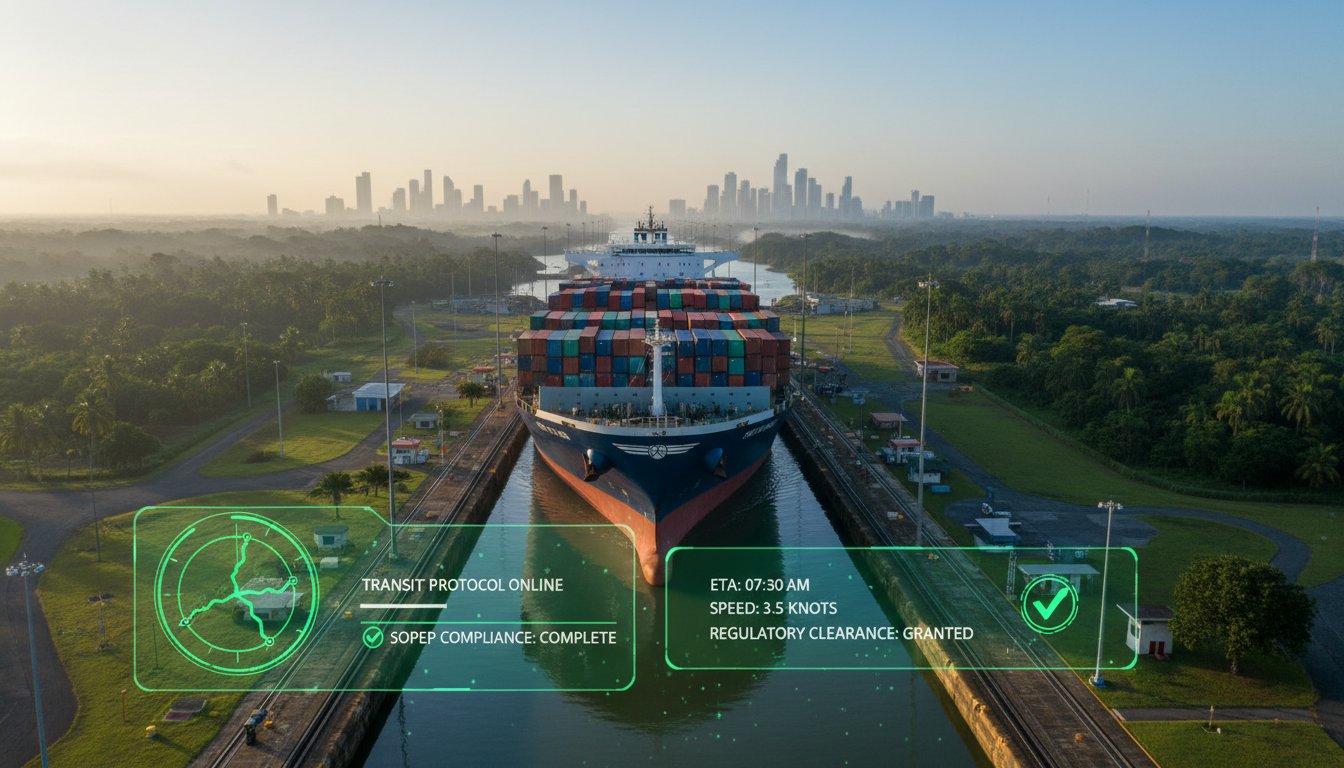
A single administrative oversight in your panama canal sopep plan can trigger a $15,000 fine before your vessel even reaches the Gatun Locks. For many operators, the strict 96-hour notification window is a source of constant pressure that leaves no room for error. We understand that the distinction between global MARPOL standards and specific ACP requirements often creates more questions than answers. You shouldn’t have to gamble with your transit schedule or your budget because of regulatory nuances.
We are experts at the Canal so you don’t have to be. This 2026 comprehensive guide provides the exact framework you need to master PCSOPEP compliance, avoid heavy financial penalties, and ensure your vessel moves through the waterway without a single hour of lost time. We will walk you through the Tier classifications, the digital submission process, and the specific local response requirements that differ from international norms. Consider us your eyes at the Panama Canal as we provide a clear roadmap for a seamless, zero-delay transit through one of the world’s most demanding maritime routes.
Key Takeaways
- Understand the legal framework of Chapter IX to ensure your vessel meets mandatory maritime regulations before entering the canal.
- Identify your vessel’s specific tier classification to tailor your compliance strategy based on oil carrying capacity and technical requirements.
- Navigate the critical 96-hour pre-arrival notification window to submit your panama canal sopep plan without risking costly transit delays.
- Learn why appointing a Panama-resident Authorized Person (AP) serves as your essential 24/7 legal shield and liaison with the ACP.
- Discover how to safeguard your operations against fines exceeding $15,000 by leveraging professional drafting and local regulatory expertise.
What is the Panama Canal SOPEP (PCSOPEP) and Why Is It Mandatory?
Transiting the Isthmus requires more than just standard maritime documentation. Every vessel manager must understand that the panama canal sopep plan, officially known as the PCSOPEP, is a localized legal requirement that stands apart from international filings. While most crews are familiar with the basic What is a Shipboard Oil Pollution Emergency Plan (SOPEP)?, the Panama Canal Authority (ACP) mandates a version specifically tailored to the unique geography and ecological sensitivity of the waterway. It’s the primary tool the ACP uses to ensure that any oil spill is met with an immediate, coordinated response.
The legal weight behind this document comes from Chapter IX of the Maritime Regulations for the Operation of the Panama Canal. These rules state that no vessel can enter Canal waters without an approved plan on file. This isn’t a suggestion. It’s a strict gatekeeping mechanism. The ACP enforces this to protect the freshwater supply of Gatun Lake, which provides drinking water for over 2,000,000 Panamanian citizens. We see many operators realize too late that their global certificates don’t satisfy local inspectors.
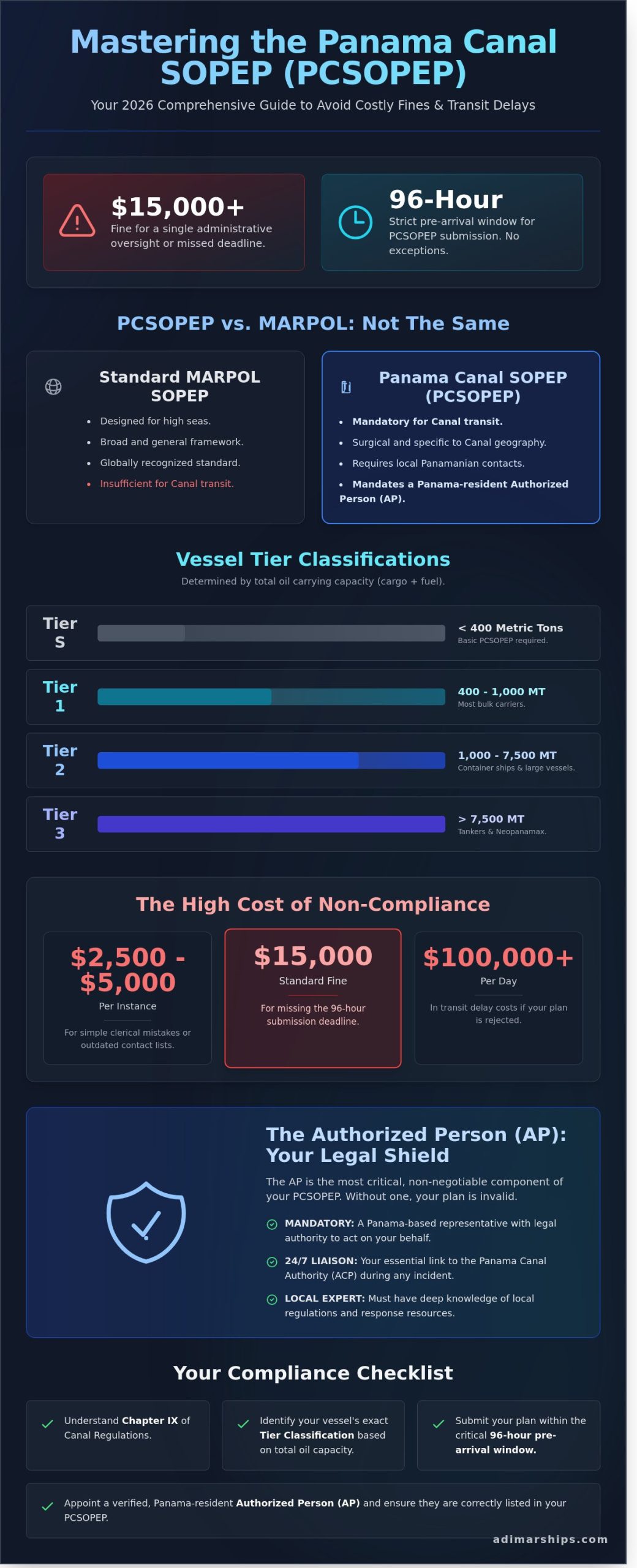
The 400 Metric Tons (MT) threshold is the deciding factor for compliance. If your vessel carries 400 MT or more of oil, whether as cargo or as fuel for propulsion, you must have a verified panama canal sopep plan. This captures nearly every commercial ship transiting today, from mid-sized bulkers to the largest Neopanamax container ships. If you fall under this category, the document must be submitted and approved well before your vessel reaches the breakwater.
MARPOL vs. PCSOPEP: Key Differences
A standard MARPOL plan is designed for the high seas. It’s broad and general. In contrast, the PCSOPEP is surgical. It requires a specific list of Panamanian emergency contacts, local spill response resources, and precise communication protocols that are unique to the ACP. The most vital difference is the mandatory inclusion of the Authorized Person (AP). This is a Panama-based representative who has the legal authority to act on your behalf during an emergency. Without a designated, ACP-approved AP listed in your document, the plan is considered null and void.
The Financial Risk of Non-Compliance
The ACP doesn’t tolerate paperwork errors. Clerical mistakes or outdated contact lists often result in fines ranging from $2,500 to $5,000 per instance. However, the real danger lies in the timing. The regulations require plan submission at least 96 hours before arrival. We’ve seen cases where missing this window results in a “standard” fine of $15,000. That’s a steep price for a avoidable administrative delay.
Beyond the fines, the cost of a rejected plan impacts your bottom line through transit delays. If your plan is rejected, your vessel stays at anchor. Daily hire rates for a Neopanamax can exceed $100,000. Losing your scheduled slot because of a missing signature or an unverified AP is a risk you don’t need to take. We act as your eyes at the Panama Canal to ensure these details are perfect before the ACP even looks at them. Time is money, and in the shipping industry, a single day of delay can erase the profit margin of an entire voyage.
Understanding PCSOPEP Tiers and Vessel Classifications
The Panama Canal Authority (ACP) categorizes every vessel based on its potential environmental impact. This classification determines the specific response resources you must have on standby during your transit. It’s not just about the physical dimensions of the ship. The ACP looks at the total oil carrying capacity. This includes every drop of oil on board, whether it’s heavy fuel oil for the engines or crude oil carried as cargo. Miscalculating these volumes leads to expensive fines and transit denials.
Classification hinges on three main thresholds: 400 MT, 1,000 MT, and 7,500 MT. Smaller vessels with less than 400 MT of oil capacity are designated as Tier S. While Tier S ships don’t require the same level of external spill response contracts as larger vessels, they must still maintain a basic panama canal sopep plan. Since January 2024, the ACP has increased its scrutiny of these plans. By 2026, new updates to the Panama Canal Authority regulations will mandate even more precise volume reporting. You’ll need to account for specific fuel tank locations and provide certified capacity plans to ensure your tier assignment is accurate.
Tier 1 and Tier 2: The Bulk of Commercial Transit
Most container ships, bulk carriers, and general cargo vessels fall into these two categories. Tier 1 covers vessels with an oil capacity between 400 MT and 1,000 MT. Tier 2 applies to ships carrying between 1,000 MT and 7,500 MT. For these classifications, the ACP requires a verified contract with an authorized Oil Spill Response Organization (OSRO). You must prove that you have access to specialized equipment like containment booms and skimmers within the Canal’s waters. Our team acts as your local office to verify these contracts are in place before you arrive at the locks.
The response resources for Tier 2 are significantly more demanding than Tier 1. You’re required to have a designated Authorized Representative (AR) who is based in Panama and available 24/7. This representative must have the legal authority to initiate response actions and commit the funds necessary for cleanup. If your panama canal sopep plan doesn’t clearly name this individual and their contact details, the ACP will likely reject your transit request during the initial document review.
Tier 3: Large Scale Compliance for Tankers
Tier 3 is the most rigorous classification. It’s reserved for vessels with an oil carrying capacity exceeding 7,500 MT. This category almost exclusively includes large tankers, Suezmax ships, and some of the largest Neo-Panamax container vessels. Because the environmental risk is higher, the ACP demands enhanced documentation and a much tighter coordination with local emergency services. You’ll need to provide evidence of high-level spill response coordination that involves multiple OSROs if necessary.
Insurance requirements for Tier 3 are also more complex. You must provide a financial guarantee or a P&I Club letter of undertaking that covers potential pollution damages. In many cases, this involves a minimum coverage of $20 million to satisfy Panamanian maritime law. We are experts so you don’t have to be. We handle these complex filings daily to ensure your vessel meets every criteria without a hitch. If you’re unsure which tier your upcoming transit falls under, you can consult with our local experts for a full vessel audit.
The Submission Process: Meeting the 96-Hour Rule
Timing isn’t just a suggestion at the Panama Canal; it’s a rigid operational requirement. The Panama Canal Authority (ACP) mandates that every vessel exceeding 400 gross tons submits its panama canal sopep plan at least 96 hours before arriving at Canal waters. If your vessel is arriving from a port less than 96 hours away, you’ve got to submit the plan before departing that last port of call. Missing this window often results in transit delays or administrative fines that typically start at $2,500. We’ve seen many owners lose their scheduled slot simply because they misjudged the verification timeline.
Submissions happen through the Maritime Service Portal, known as VUMPA (Vessel Traffic Business System). This digital gateway serves as the official channel for all documentation. You don’t just upload a PDF and walk away. The ACP verification process involves a detailed review of your vessel’s specific spill response capabilities. While the International SOPEP requirements established by the IMO form the global foundation for shipboard safety, the Panama-specific plan requires additional localized data. VUMPA validators check your submission against their unique environmental standards and response tiers to ensure total compliance before granting entry.
Updates are another critical area where ship owners often stumble. Any change in the vessel’s name, the ship manager, or the technical specifications requires a formal plan revision. You can’t simply cross out the old name and write in the new one. The ACP requires a fresh submission through VUMPA to ensure their database remains 100% accurate. We’ve seen transits halted because a vessel changed its P&I club but failed to update its documentation in time. We act as your local office to ensure these small details don’t become expensive roadblocks. We are experts so you don’t have to be.
Timeline for Approval and Renewals
Don’t wait until your ship is mid-ocean to start this process. We recommend beginning the drafting or renewal phase at least 60 days before your scheduled transit. Once the ACP approves a panama canal sopep plan, it remains valid for 4 years. However, you must track this expiration date closely. A plan that expires even one day before arrival is considered invalid; the vessel won’t be cleared for transit. Revisions become mandatory if you change your Oil Spill Response Organization (OSRO) or if the vessel undergoes structural modifications that alter its fuel capacity.
Documentation Checklist for Submission
Preparation is the key to a fast approval. You’ll need a specific set of technical documents ready for the VUMPA upload. The ACP inspectors look for consistency across all files. Ensure you have the following ready:
- General Arrangement and Capacity Plans: These must clearly show all fuel and oil tanks with updated capacities.
- OSRO Contract: Evidence of a valid contract with an ACP-certified Oil Spill Response Organization is non-negotiable.
- Authorized Person (AP) Letter: A formal document appointing the individual or entity authorized to implement the plan and spend funds during an emergency.
- Vessel Technical Data: Accurate measurements of total oil carrying capacity, including fuel, lubricants, and waste oils.
Every document must be legible and match the vessel’s current configuration. If the data in your VUMPA profile doesn’t match the physical drawings, the ACP will reject the submission, forcing you to restart the 96-hour clock. We provide the vigilance needed to catch these discrepancies before they reach the inspector’s desk.
The Role of the Authorized Person (AP): Your Legal Shield
Every vessel transiting the waterway must designate an Authorized Person (AP) who resides within the Republic of Panama. This isn’t a suggestion; it’s a strict legal requirement under the ACP regulations governing your panama canal sopep plan. Think of the AP as your local legal representative and operational anchor. They serve as the 24/7 liaison between your vessel’s Master and the Panama Canal Authority (ACP). When a ship enters Panama waters, the shipowner’s headquarters might be thousands of miles away. The AP fills that gap, providing a physical presence that the ACP can hold accountable at any hour of the day or night.
Your AP manages the critical financial guarantees required for transit. Before a vessel even arrives, the AP ensures that the ship has the liquid financial backing to cover potential environmental damages. In the maritime world, time is money. If there’s a discrepancy in your financial standing or your panama canal sopep plan documentation, the ACP won’t hesitate to delay your slot. A professional AP prevents these bottlenecks by verifying that response funding is secured and ready for immediate deployment. They act as your eyes at the Panama Canal, monitoring local conditions and regulatory shifts so you don’t have to.
AP Responsibilities During a Spill Incident
If a spill occurs, the AP’s role shifts from administrative to emergency management. They must execute immediate notification protocols to the ACP, often within minutes of the initial report. The AP coordinates directly with local cleanup crews and specialized Oil Spill Response Organizations (OSROs). Their most vital task is managing the cleanup budget in real-time. By providing immediate financial assurance to local authorities, the AP prevents vessel arrest, a legal nightmare where your ship is detained in Panama until all potential costs are settled. This rapid financial intervention can save shipowners upwards of $50,000 per day in lost charter hire fees.
Choosing the Right AP in Panama
Selecting an AP requires looking beyond a simple checklist. You need a partner with deep roots in ship agency work because they understand the logistical pressure of a transit. High communication standards are non-negotiable. If your AP doesn’t answer the phone at 3:00 AM, your vessel is at risk. Integrity is the cornerstone of this relationship. Since the AP manages significant financial guarantees and interacts with government officials on your behalf, transparency in their accounting and reporting is essential. Look for a provider with a proven track record of managing PCSOPEP requirements for at least 15 to 20 years to ensure they have the local clout to resolve disputes quickly.
The ACP maintains a zero-tolerance policy for communication delays during an emergency. Your AP must be prepared to provide a written report to the Canal authorities within the first few hours of an incident. They handle the complex paperwork that follows a spill, ensuring that every dollar spent on remediation is documented and every regulatory box is checked. Without a competent AP, a minor technical issue can spiral into a major legal battle with the Panamanian government. They are your first line of defense against fines that can easily reach $1,000,000 or more for serious environmental violations.
We take the stress out of compliance by acting as your dedicated local office. Don’t leave your transit to chance; nominate Adimar as your agent to ensure your vessel is protected by the most reliable AP services in Panama.
Adimar Shipping: Your Expert PCSOPEP Partner for 2026
Adimar Shipping, Inc. celebrates 20 years of active service navigating the rigorous regulatory environment of the Panama Canal. We’ve seen every change in policy since the turn of the century. We know that for ship owners and charterers, time is the most expensive commodity. A single administrative error in your panama canal sopep plan can result in fines or, worse, a lost transit slot that costs your company upwards of $60,000 in operational expenses. We act as your local office on the ground to prevent these scenarios.
Our team provides personalized drafting and submission services that go beyond generic templates. We tailor each plan to the specific vessel, ensuring it meets the exact standards set by the Panama Canal Authority (ACP) for the 2026 season. We serve as your eyes at the Panama Canal. This means we monitor every update to the OP Notice to Shipping N-1-2026 so you stay ahead of the curve. We’re experts so you don’t have to be.
One of our most critical roles is acting as your Authorized Person (AP). This role requires 24/7 emergency readiness and a deep understanding of local spill response protocols. If an incident occurs, our team is ready to coordinate immediately with the ACP and oil spill response organizations (OSROs). We eliminate the confusion of language barriers and local bureaucracy, providing a cost-conscious path to full compliance and environmental protection.
Why Adimar Shipping, Inc. is the Trusted Choice
Our reputation is built on integrity and direct coordination with the ACP. We don’t just mail a document and hope for the best; we actively track the approval process to ensure your vessel is cleared for transit well before it reaches the breakwater. This proactive approach has allowed us to maintain a record of zero compliance-related delays over the last 20 years. We treat your fleet as if it were our own.
We offer more than just a panama canal sopep plan. Adimar Shipping, Inc. is a full-service ship agency. We handle husbandry services, spare parts logistics, and crew changes with the same level of precision. By consolidating these services, you reduce the administrative burden on your shore-based staff and ensure a seamless experience through the waterway. Our communication is quick, transparent, and focused on your bottom line.
Secure Your 2026 Transit Today
Securing your transit starts with a clear, transparent quote. We provide detailed pricing in USD so you can budget accurately for your 2026 voyages without worrying about hidden surcharges. Our “Expert so you don’t have to be” philosophy means we handle the technical heavy lifting, from initial data collection to final ACP certification. We focus on the details so you can focus on your business.
The maritime industry moves fast, but the Panama Canal moves according to its own strict set of rules. Having a partner with two decades of local experience makes the difference between a profitable voyage and a costly delay. You can Nominate Adimar Shipping, Inc. as your PCSOPEP Authorized Person to lock in your compliance partner for the coming year. We’re ready to protect your interests and keep your fleet moving through the canal with confidence.
Secure Your 2026 Panama Canal Transit Today
Navigating strict maritime regulations requires more than just a checklist; it demands a proactive strategy. You’ve seen how the 96-hour submission window and specific vessel tier classifications leave no room for error. Missing these deadlines or miscalculating your tier can lead to costly delays and unexpected expenses in USD. Your Authorized Person isn’t just a regulatory requirement. They’re your local advocate and legal shield on the ground. Adimar Shipping brings 20+ years of Panama Canal agency experience to your fleet. We manage every detail of your panama canal sopep plan to ensure zero-fine compliance management. Our Authorized Person services are available 24/7, acting as your eyes at the Canal so you can focus on your business. We’re the experts so you don’t have to be. Get a PCSOPEP Compliance Quote for Your Next Transit and let us handle the complexities of your 2026 crossing with integrity. We look forward to seeing your vessel safely through the locks.
Frequently Asked Questions
Is a MARPOL SOPEP enough for the Panama Canal?
No, a standard MARPOL SOPEP isn’t sufficient for transiting the Panama Canal. The Panama Canal Authority (ACP) requires a dedicated PCSOPEP plan that complies with local regulations under OP Notice to Shipping N-1-2024. Your plan must specifically name a Panama-based Authorized Person and a certified Oil Spill Response Organization. Without this specific document, your vessel won’t be allowed to transit and will face additional inspection fees.
What happens if I miss the 96-hour PCSOPEP notification deadline?
Missing the 96-hour notification deadline results in an automatic fine of $2,500 and the potential loss of your scheduled transit slot. The ACP uses this time to verify your plan and ensure responders are ready. If you’re late, we must submit a formal letter of explanation immediately. We’ve seen vessels delayed by 48 hours because their documentation wasn’t submitted through the VUMPA system within the required timeframe.
How long is a Panama Canal SOPEP plan valid?
A Panama Canal SOPEP plan stays valid for 4 years from its initial approval date by the ACP. You’ll need to re-verify or update the plan if there’s a change in the vessel’s ISM manager or technical specifications. It’s smart to start the renewal process 90 days before expiration. We track these dates for our clients so they don’t have to worry about sudden compliance gaps.
Can my ship agent also be my PCSOPEP Authorized Person?
Yes, your ship agent can serve as your Authorized Person if they’re officially registered and certified by the ACP. The AP must be a resident of Panama and available 24/7 to coordinate with the Canal authorities during any incident. We act as your eyes at the Panama Canal and provide this service to ensure seamless communication. We’re experts so you don’t have to be when managing these local requirements.
What are the specific Tier 2 requirements for 2026?
Starting in 2026, Tier 2 requirements mandate that vessels have access to resources capable of recovering 15,000 barrels of oil within 48 hours. This is a 20% increase in capacity compared to previous standards to protect the Gatun Lake watershed. Your panama canal sopep plan must include contracts with OSROs that have verified this specific equipment inventory. We help you confirm that your chosen responders meet these 2026 technical benchmarks today.
How much are the fines for PCSOPEP non-compliance?
Fines for non-compliance typically range from $2,500 for administrative errors to over $10,000 for failing to have an approved plan on board. If you enter Canal waters without a valid plan, the ACP will also charge for a mandatory extraordinary inspection. These costs don’t include the commercial losses from transit delays, which often exceed $50,000 per day for larger container ships or tankers. It’s much cheaper to stay compliant.
Does the PCSOPEP apply to vessels not carrying oil as cargo?
Yes, the regulation applies to every vessel with a carrying capacity of 400 metric tons or more of oil as fuel or cargo. Even if you’re a dry bulk carrier or a cruise ship, your bunkers count toward this limit. Statistics show that 95% of commercial vessels transiting the canal fall under these rules. Don’t assume you’re exempt just because you aren’t a tanker; a panama canal sopep plan is a universal requirement for most large ships.
How do I update my PCSOPEP if the vessel name changes?
You must submit a formal amendment to the ACP through the VUMPA system within 30 days of any name change. This update requires a new cover page and a revised Appendix A that lists the new name, Call Sign, and IMO number. We handle these administrative updates quickly to keep your documentation current. It’s vital that the name on your physical plan matches your vessel’s AIS signal exactly to avoid boarding delays.