
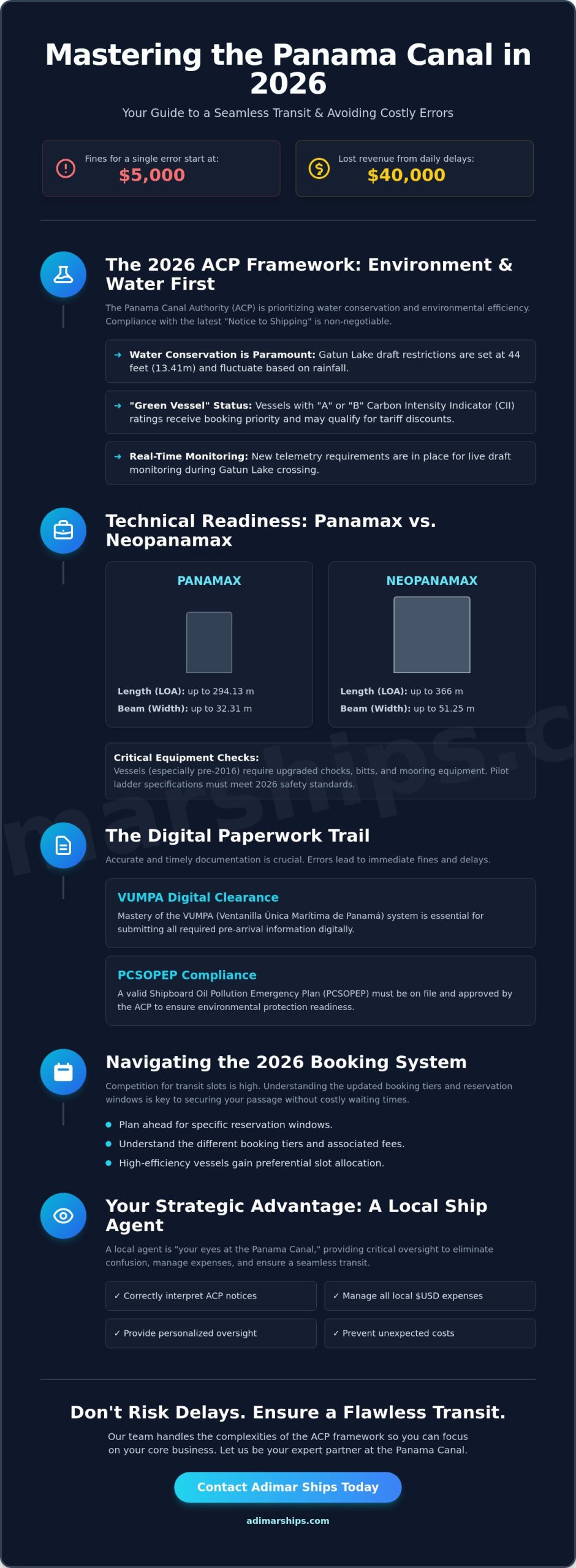
A single documentation error or a misinterpreted technical specification can trigger fines starting at $5,000 and escalate to administrative delays that cost your vessel $40,000 in daily lost revenue. As the ACP prepares for new operational adjustments in 2026, the margin for error is shrinking. You likely feel the pressure of tracking every new Advisory to Shipping while trying to coordinate arrival windows across different time zones. Staying ahead of the updated Panama Canal transit requirements is the only way to ensure your vessel doesn’t become another statistic in the Canal’s congestion reports.
We understand that time is money; we believe you shouldn’t have to be a regulatory expert to move your cargo efficiently. This guide provides the tools you need to master the complex web of ACP regulations, technical specifications, and documentation required for a seamless passage in 2026. You’ll find a clear checklist for technical compliance, an explanation of the shifting Neopanamax standards, and insights on why having a local office at the Canal is your best defense against unexpected costs.
Key Takeaways
- Understand the shift toward environmental compliance and water conservation in the 2026 ACP framework to ensure your vessel meets the latest “Notice to Shipping” standards.
- Verify if your vessel is truly “Canal Ready” by reviewing updated technical specifications for chocks, bitts, and mooring equipment for both Panamax and Neopanamax dimensions.
- Simplify your documentation process by mastering the VUMPA digital clearance system and essential Panama Canal transit requirements like the Shipboard Oil Pollution Emergency Plan (PCSOPEP).
- Navigate the updated 2026 booking tiers and reservation windows to secure your transit slot and avoid costly delays in a competitive maritime landscape.
- Learn how a local ship agent acts as “your eyes at the Panama Canal” to eliminate confusion, manage $USD expenses, and provide the personalized oversight needed for a seamless transit.
Understanding the Panama Canal Authority (ACP) Framework in 2026
Managing a vessel through the Isthmus requires more than just a skilled crew; it demands a deep understanding of the Panama Canal Authority (ACP) and its rigid regulatory hierarchy. In 2026, the primary mechanism for communication remains the “Notice to Shipping” system. These documents aren’t just suggestions. They’re the legal backbone of every transit. For a foundational history and overview of the Panama Canal, owners should recognize that the ACP functions as a sovereign entity with total control over the waterway’s safety and flow. Compliance is the only path to a successful passage.
The Role of the ACP in 2026 Operations
The ACP oversees approximately 13,500 transits annually, and their role in 2026 has shifted toward aggressive water management and traffic optimization. According to the latest ACP Panama Annual Report, the authority is now prioritizing vessels that demonstrate high operational efficiency and environmental stewardship. The legal weight of OP (Operations) notices is absolute for shipmasters. If your vessel doesn’t meet the specific Panama Canal transit requirements outlined in the latest OP 26-1 document, you face immediate delays or fines that can reach thousands of USD ($). We serve as your local eyes on the ground to ensure these notices are interpreted correctly before your arrival at the breakwater.
Key Regulatory Changes for the Current Year
Water conservation is the defining challenge of 2026. Draft restrictions for Gatun Lake are currently set at 44 feet (13.41 meters) for Neopanamax locks, though this fluctuates based on seasonal rainfall patterns. A major shift this year is the integration of Carbon Intensity Indicator (CII) ratings into transit priority. Vessels with an “A” or “B” rating often receive preference in booking slots over less efficient ships. Additionally, older vessels built before 2016 must now show proof of specific equipment upgrades, such as modernized mooring bitts and chocks, to handle the tugboat-assisted maneuvers in the new locks. Key 2026 updates include:
- Mandatory submission of the “Green Vessel” certificate to qualify for tiered tariff discounts.
- New telemetry requirements for real-time draft monitoring during the Gatun Lake crossing.
- Updated pilot ladder specifications to meet the 2026 safety audit standards.
“Canal Readiness” isn’t just a status; it’s a financial metric. Vessels that arrive with all paperwork verified and equipment tested move through the queue faster. Misjudge your timing and you lose significant capital in idling costs. We are experts so you don’t have to be. Our team ensures your ship meets every one of the Panama Canal transit requirements so you can focus on your core business while we handle the complexity of the ACP framework.
Technical & Structural Requirements: Is Your Vessel “Canal Ready”?
Getting your vessel “Canal Ready” involves more than just a basic inspection. It’s a rigorous technical alignment with local laws. The Panama Canal Authority (ACP) maintains strict structural standards that every operator must meet before arrival. If your hardware or dimensions don’t match their specific criteria, you’ll face expensive delays or even a total refusal of entry. We are your eyes at the Panama Canal, ensuring your vessel meets every requirement before you reach the breakwater.
Panamax vs. Neopanamax Dimensions
The 2016 expansion changed the game for global logistics. Original Panamax vessels are limited to a length overall (LOA) of 294.13 meters and a beam of 32.31 meters. In contrast, Neopanamax vessels can reach up to 366 meters in length and 51.25 meters in beam. Draft limitations are the most volatile factor. While the maximum tropical fresh water (TFW) draft is technically 15.24 meters (50 feet), seasonal rainfall in Gatun Lake dictates the actual limit. During the 2024 drought, drafts were restricted to 44 feet; owners must plan for similar fluctuations in 2026 based on ACP advisory notices.
Required Onboard Equipment & Pilot Safety
Specific hardware is non-negotiable for a safe transit. Meeting the Panama Canal transit requirements means having heavy-duty towing chocks and bitts that can handle the stress of locomotives in the old locks or powerful tugs in the new locks. Your bridge must offer unobstructed visibility, and pilot platforms must be positioned according to ACP’s exact height and safety specs. Every vessel must also have a fully functioning Automatic Identification System (AIS) and updated radar. If your pilot ladder or boarding facilities don’t meet IMO and ACP safety standards, the pilot won’t board, and your slot will be forfeited.
Sanitary and Ballast Water Regulations
Panama enforces a zero-discharge policy within Canal waters. This means all greywater and sewage valves must be closed and sealed. ACP boarding officers conduct thorough pre-arrival inspections to verify your Ballast Water Management Plan. You must show that your vessel has performed a ballast water exchange or carries an approved treatment system to prevent the introduction of invasive species. These environmental checks are strict; even a minor leak or paperwork error can lead to heavy fines. Adhering to these Panama Canal transit requirements is essential for a smooth, penalty-free journey.
We see ourselves as your local office at the Panama Canal. If you’re unsure about your vessel’s current configuration or the plan approval process for modified ships, consult with our team to review your technical documentation before you arrive.
Operational & Documentation Compliance: The Paperwork Trail
Managing the paperwork for a transit is as critical as the navigation itself. The Panama Canal Authority (ACP) demands strict adherence to reporting timelines. Your vessel must provide pre-arrival notifications at specific intervals: 96 hours, 48 hours, and 24 hours before reaching the pilot station. We see many operators struggle with these windows when schedules shift. If your arrival time changes by more than three hours, you must update the ACP immediately. Precision here prevents your ship from being bumped to the end of the queue, which can cost you thousands in daily operating expenses.
PCSOPEP and Environmental Compliance
Environmental safety is a top priority for the ACP. Every vessel over 400 gross registered tons (GRT) must carry a Panama Canal Shipboard Oil Pollution Emergency Plan (PCSOPEP). It’s a legal requirement to appoint a PCSOPEP authorized person who resides in Panama. This individual serves as the primary contact for the ACP in the event of a spill. The U.S. role in the Panama Canal’s development set the foundation for the complex management systems we use today. You’ll need to select a coverage tier based on your vessel’s oil carrying capacity:
- Tier 1: Vessels carrying less than 1,000 barrels of oil.
- Tier 2: Vessels carrying between 1,000 and 7,000 barrels.
- Tier 3: Vessels carrying more than 7,000 barrels.
Non-compliance isn’t just a delay; it’s a financial hit. Fines for inadequate oil spill response readiness or missing documentation can exceed $5,000 per incident.
The VUMPA System and Cargo Declarations
The VUMPA system (Panama’s Maritime Single Window) is the digital gateway for all Panama Canal transit requirements. You must submit your cargo manifests and crew lists through this portal with absolute accuracy. “Incorrect Declaration” fees are common for operators who rush this process. Beyond the manifest, several specific certificates are mandatory for a smooth clearance:
- Panama Canal Tonnage Certificate: Essential for toll calculation; standard international certificates aren’t accepted for this purpose.
- International Load Line Certificate: Verifies the vessel’s buoyancy and safety limits.
- Safety Construction Certificate: Confirms the structural integrity of the hull.
If you’re transporting dangerous goods (DG), you must secure ACP approval at least 48 hours before arrival. We act as your local eyes to ensure these documents are processed correctly, so you don’t face “vessel not ready” status upon arrival. Following Panama Canal transit requirements precisely is the only way to avoid the $2,500+ administrative fees associated with late or corrected cargo declarations.
Navigating the Booking System and Transit Slots in 2026
Mismanaging your slot reservation can cost hundreds of thousands of dollars in idling fees and lost contracts. The Panama Canal Authority (ACP) uses a complex Transit Reservation System that requires precision timing. Understanding the 2026 Panama Canal transit requirements for booking is the only way to ensure your cargo stays on schedule. We are experts in this process so you don’t have to be; we see ourselves as your local office at the canal.
Securing Your Slot: The Booking Windows
The 2026 booking structure remains divided into three tiers based on vessel size and lock type. Tier 1 is reserved for Neo-Panamax vessels, Tier 2 covers Panamax Plus vessels, and Tier 3 is for standard Panamax ships. The first booking period opens a full 365 days in advance. This is followed by the second period at 21 days and the third period at just 4 days before transit. If you miss these windows, your vessel joins the “Queue,” where wait times depend entirely on daily water levels and traffic volume.
- Tier 1: Neo-Panamax vessels using the expanded locks.
- Tier 2: Large Panamax vessels with a beam over 100 feet.
- Tier 3: Smaller vessels under 100 feet in beam.
Cancellation fees are steep. If you cancel within 48 hours of your slot, you may forfeit the entire booking fee. However, “Swap” rules allow operators to exchange slots between two vessels under the same ownership, provided they meet the same size category and direction requirements. We manage these swaps to ensure you keep your priority status even if your fleet schedule shifts unexpectedly.
The Auction Market: Strategy for Urgent Transits
When slots are fully booked, the daily auction system serves as a relief valve for urgent transits. These auctions are highly competitive. Prices fluctuate based on real-time demand and seasonal weather patterns. Staying updated on the Panama Canal transit requirements for 2026 allows you to navigate the auction market without overextending your budget.
A Panama Canal transit agent plays a vital role here. We act as your eyes at the canal, monitoring the portal 24/7 to identify bidding opportunities that save you both time and fuel. Strategic bidding is about more than just the highest price; it’s about calculating the cost of delay versus the premium of the slot. We provide the data you need to make that call with confidence, ensuring your transit is handled with integrity.
Don’t leave your 2026 transit to chance. Nominate Adimar as your agent to secure your slot today.
The Strategic Role of a Panama Canal Ship Agent
Misjudge your timing at the Canal and you lose. The Panama Canal Authority (ACP) updates its regulations frequently, making it difficult for operators thousands of miles away to stay compliant. Meeting the Panama Canal transit requirements in 2026 involves more than just filling out paperwork. It requires an on-the-ground partner who understands the nuances of the booking system and the variable costs of tugs and line handlers. We are the experts so you don’t have to be. By putting your transit in our hands, we eliminate the confusion with personalized service that addresses the specific needs of your vessel type.
Managing the financial side of a transit is a complex balancing act. Between the transit tolls, which can run into hundreds of thousands of dollars, and various husbandry expenses, owners need total transparency. We manage these costs in US Dollars ($), providing clear and accurate disbursement accounts. Our team handles the administrative burden of tolls and port fees, ensuring your funds are used efficiently. We see ourselves as your local office, protecting your interests against unnecessary surcharges or delays caused by simple clerical errors.
Husbandry & Protective Agency Services
While your vessel waits at anchor in the Pacific or Atlantic entrances, time shouldn’t be wasted. We coordinate husbandry services to maximize every hour of your stay. This includes managing crew changes and medical evacuations with speed and care. We understand that a healthy crew is vital to a safe transit. Our logistics team also manages the delivery of spare parts and Cash to Master (CTM), ensuring your ship has everything it needs before entering the locks. Proactive coordination at the anchorage prevents the vessel from missing its scheduled slot, which is a critical part of meeting Panama Canal transit requirements without incurring heavy fines.
Why Adimar Shipping is Your Local Office in Panama
There is a significant difference between a generic agent and a dedicated Panama Canal ships agent with local eyes. Our “Eyes at the Canal” philosophy means we spot potential issues before they become expensive bottlenecks. With 20 years of experience in the Panamanian market, we provide quick solutions based on real-time conditions. We maintain a cost-conscious approach for both Owner’s and Charterer’s interests, ensuring that quality service doesn’t come with a hidden price tag. We pride ourselves on being a service provider with integrity, offering excellent communication from the moment you request a quote until the vessel clears the last set of locks. Nominate Adimar Shipping as your agent to ensure your 2026 transits are handled with the highest level of professionalism and local expertise.
Master Your Transit Strategy for 2026
Success in the coming year requires more than just following a checklist. The 2026 ACP framework demands rigorous technical readiness and a deep understanding of the updated booking windows. Mismanaging your timing means losing thousands of dollars in idling costs. You need to ensure your vessel meets every structural standard while maintaining flawless documentation for the new year.
Navigating the complex Panama Canal transit requirements doesn’t have to be a source of frustration for your team. Adimar Shipping provides the local expertise you need to stay compliant and on schedule. With over 20 years of experience, we serve as your eyes at the Panama Canal. We offer specialized PCSOPEP authorized person services and a boutique, personalized approach that prioritizes your bottom line. We’re the experts on the ground so you don’t have to be.
Eliminate transit confusion and get a custom quote from Adimar Shipping today.
We’re ready to help you navigate the canal with confidence and integrity.
Frequently Asked Questions
What are the maximum dimensions for a Neopanamax vessel in 2026?
The maximum dimensions for Neopanamax vessels are 366 meters in length, 51.25 meters in beam, and 15.24 meters in tropical freshwater draft. These limits remain the standard for the expanded locks. You should check Gatun Lake water levels daily as the Panama Canal Authority adjusts draft restrictions based on seasonal rainfall. Adimar Shipping monitors these changes to ensure your vessel meets all 2026 Panama Canal transit requirements without delay.
How much does it cost to transit the Panama Canal for a standard bulk carrier?
A standard bulk carrier typically pays between $200,000 and $450,000 for a full transit. This total includes the PC/UMS net tonnage toll, the Freshwater Surcharge, and various maritime services like tugboat assistance. Costs fluctuate based on whether the ship is laden or in ballast. We provide transparent, detailed proforma DAs so you don’t have to guess about your final port expenses.
Is a PCSOPEP authorized person mandatory for all vessels?
A PCSOPEP authorized person is mandatory for every vessel with an oil carrying capacity of 400 metric tons or more. This representative must be a Panama resident who can act as a liaison with the authorities during an oil spill emergency. It’s a critical safety regulation that ensures immediate response. We act as your eyes at the Panama Canal to ensure this requirement is fully satisfied before your arrival.
What is the VUMPA system and how do I access it?
The VUMPA system is the Maritime Single Window for Panama that handles all digital documentation for vessel arrivals and departures. You access this platform through the Panama Maritime Authority’s official web portal. It integrates data for Customs, Immigration, and the Health Ministry into one interface. Your local ship agent manages the data entry to satisfy Panama Canal transit requirements and prevent administrative hold-ups.
How far in advance should I book my Panama Canal transit slot?
You can book a transit slot up to 365 days in advance during the first booking period. Most ship operators secure their slots at least 30 to 90 days before arrival to avoid the competitive auction process. Waiting until the last minute often leads to high auction prices or long wait times at anchor. We help you navigate these booking windows so you don’t lose money on idle time.
Can my vessel transit the Panama Canal without a local ship agent?
No, you cannot transit the canal without a licensed local ship agent to represent your vessel. The Panama Canal Authority requires a local entity to guarantee toll payments and coordinate with the pilotage office. We see ourselves as your local office at the Panama Canal. We handle the complex logistics and official communications so you can stay focused on your core business operations.
What happens if my vessel fails the ACP technical inspection?
The Panama Canal Authority will delay your transit and may order your vessel to an anchorage if it fails the technical inspection. You must correct all deficiencies before the canal inspectors allow the ship to proceed. Sometimes the ACP permits a conditional transit with extra tugs or pilots at the owner’s expense. These extra services often cost $5,000 or more, making it vital to pass the first time.
Are there specific requirements for bunkering in Panama before transit?
Bunkering in Panama requires strict adherence to MARPOL Annex VI and local environmental standards. You must use fuel with a sulfur content of 0.50% or less unless your vessel has an operational scrubber system. Most bunkering operations occur at the Balboa or Cristobal anchorages. We coordinate these deliveries with trusted suppliers to ensure your ship is fueled and ready for its scheduled transit window.