

A single oversight in your pre-arrival notification can result in a $15,000 fine before your vessel even reaches the Panama Canal anchorage. We understand that managing these logistics is increasingly stressful, especially with the 2026 shift toward machine-validated documentation and dynamic draft restrictions. You’re likely concerned about missing critical auction windows or facing the 250% late cancellation surcharges that can devastate a voyage’s profitability. Knowing how to book panama canal transit effectively requires more than just logging into a portal; it demands a precise, proactive strategy. This guide provides the expert strategic guidance you need to master the Panama Canal reservation system, ensuring you secure a guaranteed slot while maintaining full compliance with ACP regulations. We’ll break down the LoTSA 2.5 sealed-bid process, explain the three critical booking periods, and show you how to maintain financial predictability. By delegating the complexities of VUMPA submissions and PCSOPEP cross-referencing to a dedicated ship agency, you can focus on your vessel’s operational success while we handle the local oversight.
Key Takeaways
- Identify the critical differences between reserved and arrival-based transits to minimize idle time and ensure operational predictability for your fleet.
- Master the three distinct booking periods, including the vital 365-day lead window, to secure priority slots before they reach the competitive auction stage.
- Follow a detailed, step-by-step process on how to book panama canal transit, from verifying technical dimensions to navigating the TRS portal.
- Gain strategic insights into the daily slot auction system to successfully secure transit windows when standard availability is exhausted.
- Learn why professional ship agency representation is essential for managing financial guarantees, customer codes, and regulatory compliance with the ACP.
Understanding the Panama Canal Transit Booking Framework
Securing a transit slot in 2026 is no longer a simple administrative task; it’s a strategic financial decision that dictates the profitability of a voyage. For operators evaluating how to book panama canal transit, the first hurdle is choosing between the Transit Reservation System (TRS) and a non-booked arrival. While a Panama Canal overview shows its historical importance, the modern reality is a high-tech environment where timing is everything. The TRS acts as a vital safeguard against the volatility of global shipping schedules and fluctuating environmental conditions.
Reservation System vs. Non-Booked Transit
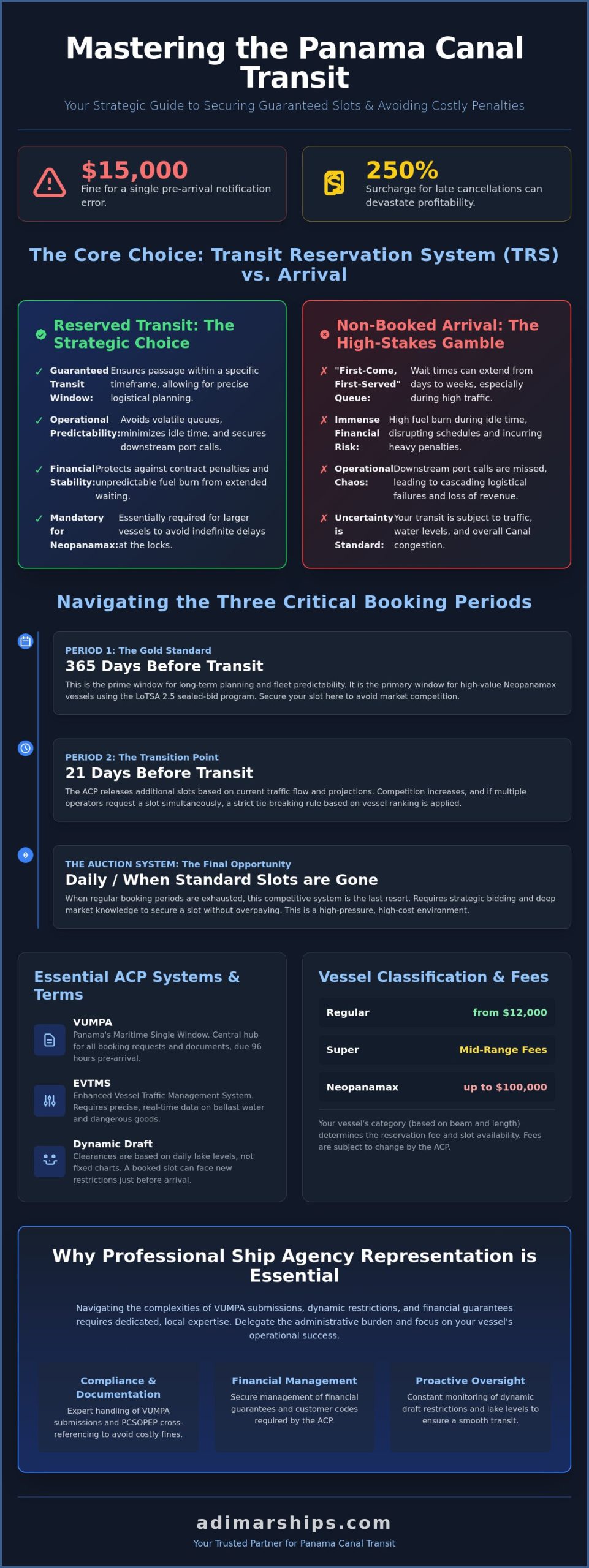
Choosing a non-booked transit is a high-stakes gamble. Vessels without a reservation enter a “first-come, first-served” queue. During high-traffic months or periods of strict draught restrictions, this wait can extend from days into weeks. The financial risks are immense. Idle time burns fuel, disrupts downstream port calls, and often triggers heavy contract penalties. It’s also important to understand that a booking provides a “transit window” rather than a fixed arrival hour. This window ensures your vessel moves within a specific timeframe, allowing for precise logistical planning. For Neopanamax vessels, the reservation system is essentially mandatory to avoid indefinite delays at the locks.
Key Terminology for 2026 Operations
Effective coordination requires familiarity with the digital architecture and classifications maintained by the Panama Canal Authority (ACP). Navigating these systems without local expertise often leads to data errors and costly fines.
- VUMPA: This is Panama’s Maritime Single Window. It’s the central hub where all booking requests and pre-arrival document packages must be submitted at least 96 hours before reaching the anchorage.
- EVTMS: The Enhanced Vessel Traffic Management System tracks vessel data in real-time. It requires precise reporting of ballast water status and dangerous goods, which the ACP now cross-references with machine-validated documentation.
- Vessel Classification: The ACP categorizes ships as Regular, Super, or Neopanamax based on beam and length. Your category determines your reservation fee, which currently ranges from $12,000 for small regulars to $100,000 for Neopanamax slots.
Dynamic water management has also changed the booking landscape. The ACP now issues draught clearances based on daily lake levels rather than fixed seasonal charts. This means a slot booked months in advance might face new restrictions just days before arrival. We help operators monitor these shifts constantly. By integrating real-time lake data with your vessel’s technical specs, we ensure you don’t arrive with a load that exceeds the day’s specific limits. This proactive oversight is the difference between a smooth transit and a forced cargo discharge.
Navigating the Three Booking Periods
The Panama Canal Authority (ACP) doesn’t just open the gates to all vessels at once. It releases transit slots in controlled, chronological stages. Each window represents a different level of competition, cost, and availability. For any ship operator, mastering how to book panama canal transit requires a deep understanding of this timeline. Missing a specific opening by even a few minutes can force your vessel into a costly auction or an indefinite wait at the anchorage. Strategic planning begins a full year out, allowing you to secure slots before the market becomes saturated.
Period 1 & 2: Long-term Planning
Period 1 is the gold standard for fleet predictability. It opens 365 days before the intended transit date. For high-value Neopanamax operations, this is the primary window for the Long-Term Slot Allocation (LoTSA) 2.5 program. If you’re looking for stability, participating in the sealed-bid competitions starting April 28, 2026, is the most effective way to lock in your 2026 and early 2027 dates. This period is built for those who prioritize operational freedom over last-minute adjustments.
Period 2 begins 21 days before transit. This is a critical transition point where the ACP releases additional slots based on current traffic flow. Effective April 13, 2026, the ACP often opens more slots once thresholds reach 19 for Super vessels and 5 for Regular vessels. If multiple operators request the same slot simultaneously, the ACP applies a strict tie-breaking rule. Priority is given to vessels with the highest ranking, a metric determined by your historical transit frequency and conduct. Partnering with an Owner’s Nominated Agency provides the vigilant oversight needed to manage these rankings and hit these windows with precision.
Period 3: The Short-Window Rush
Period 3 is a high-stakes environment that covers the final 96-hour window before transit. By this stage, the inventory of available slots is extremely limited. This period is the most common time for intense slot competition, as it accounts for vessels that have faced unexpected delays at previous ports. It’s also the window most affected by maintenance schedules. If the ACP schedules a lock overhaul, Period 3 slots are often the first to be reduced or eliminated.
Operators booking in Period 3 must be prepared for the financial reality of the auction system. When demand exceeds the remaining supply, the only way to guarantee a date is through a competitive bid. We act as your on-the-ground eyes and ears during this rush, monitoring the TRS portal in real-time to identify openings the moment they appear. Our role is to simplify these logistical complexities, ensuring your vessel doesn’t fall victim to the “first-come, first-served” queue that can lead to days of idle time and mounting fuel costs.
Avoiding Delays: The Auction System and Slot Scarcity
Standard reservation periods offer stability, but they don’t always account for the realities of a global supply chain. When slots are oversubscribed, the Panama Canal Authority (ACP) triggers a competitive bidding environment. This is where understanding how to book panama canal transit through the auction system becomes a critical skill for any operator. It’s a high-stakes scenario where the cost of entry can multiply quickly, far exceeding the standard reservation fees of $50,000 for Super vessels or $100,000 for Neopanamax locks. During peak seasons, the auction is often the only path forward for vessels that didn’t secure a slot in Periods 1 or 2.
How the Daily Auction Works
The Daily Slot Auction is the final opportunity to secure a transit date when the standard windows have closed. Bidding occurs through the TRS portal and follows a strict, time-sensitive protocol. The process starts with a base bid published in the Official Maritime Tariff. From there, price discovery is driven entirely by market demand. A Panama Canal ship agent is indispensable during this phase. We don’t just enter numbers; we provide the local intelligence needed to gauge the competitive landscape. We monitor the number of bidders and historical clearing prices to ensure your bid is high enough to win but not unnecessarily inflated.
During periods of extreme congestion or lock maintenance, the ACP may initiate “Special Auctions.” These are often announced with very short notice and carry even higher financial stakes. Having a representative on the ground ensures you can react to these announcements within minutes. This vigilance protects your schedule from sudden bottlenecks that would otherwise result in days of costly anchorage time.
Strategies for High-Demand Seasons
Preparation for auction-based entry should begin by analyzing the ACP Panama Annual Report. This data identifies peak traffic months when slot scarcity is most acute. During these windows, we recommend operators maintain a dedicated contingency budget. An auction win provides the same certainty as a Period 1 booking, but the premium paid is the price of operational flexibility. It’s a strategic tool for maintaining your delivery commitments when the traditional system is at capacity.
Operators should also utilize the “substitution” rule to maximize fleet efficiency. If a booked vessel is delayed at a previous port, you can often swap it for another vessel in your fleet of similar dimensions. This prevents the loss of a valuable slot and avoids the steep cancellation fees that reach 100% of the reservation tariff if done within four days of arrival. We manage these technical requests directly with the ACP to ensure the substitution is approved without disrupting your transit window. This level of fleet-wide coordination turns a potential logistical failure into a manageable shift in resources.
Step-by-Step: How to Book Your Transit Slot
Executing a successful booking is a multi-layered process that begins with technical verification and ends with complex financial guarantees. While the ACP provides the digital tools, the responsibility for data accuracy and regulatory compliance rests solely on the operator. Understanding how to book panama canal transit requires a clear workflow that starts well before your vessel reaches the anchorage. Missing a single step in this sequence can lead to the rejection of your request or significant fines during the inspection phase.
Pre-Registration and Documentation
Every vessel must have a valid Ship Identification Number (SIN) before any booking can be initiated. If your vessel is new to the waterway, we manage the ‘Customer Code’ issuance to ensure your ship is recognized by the ACP’s systems. Technical accuracy is paramount during this stage. You must verify your Panamax vessel dimensions against the latest lock constraints, as even a minor discrepancy in beam or draft can result in a transit denial. Once dimensions are confirmed, we submit the required Vessel Information Control System (VICS) data. This digital profile serves as the foundation for all future transit requests and must be updated to reflect any structural changes to the vessel.
Compliance and Financial Guarantees
The ACP will not finalize a booking until all financial and environmental requirements are met. A common oversight for many operators is the role of the PCSOPEP authorized person. This individual is a mandatory requirement for oil pollution compliance and must be officially designated before transit eligibility is granted. We serve as your authorized representative, ensuring your spill response plans are cross-referenced with the latest IMDG lists and ACP standards.
Simultaneously, we establish the ‘Guarantee of Payment’ required by the ACP. Unlike standard port calls, the Canal Authority requires full financial security for all tolls and reservation fees before a slot is confirmed. We manage this through the VUMPA/TRS interface, posting the necessary guarantees to secure your specific transit window. This process includes managing the reservation fee payment, which currently stands at $50,000 for Super vessels and $100,000 for Neopanamax locks. By appointing an experienced Owner’s Nominated Agency, you ensure that these high-value transactions are handled with total transparency and speed. Once the guarantee is accepted, the ACP issues a formal confirmation, and your vessel is officially added to the daily transit schedule. We then monitor your ETA continuously, making any necessary adjustments to avoid the steep late arrival fees that can reach 100% of the reservation tariff.
Why Professional Agency Representation is Mandatory for Success
The Panama Canal Authority requires foreign vessels to have local representation, but the value of a dedicated agent goes far beyond legal compliance. In a high-stakes environment where a single delay can cascade into weeks of lost revenue, the agent serves as your vigilant, on-the-ground representative. We don’t just manage the TRS portal; we act as the primary bridge between your operational goals and the ACP’s strict regulatory framework. For new operators, we simplify the complex ‘Customer Code’ issuance, ensuring your vessel is properly registered and recognized by the Canal’s digital architecture from day one. This administrative hurdle is often where unrepresented owners face their first significant delays.
Coordinating with the ACP (Panama Canal Authority)
Operating conditions in the Canal change by the hour. We provide real-time monitoring of traffic flow and slot availability shifts that standard tracking software cannot capture. This oversight is vital when navigating the ‘Notices to Shipping’ that frequently update booking rules and technical requirements. If the ACP issues a new directive regarding pilotage or mooring equipment, we ensure your crew is informed and compliant before the inspection. We also handle the intricate calculation of maritime tariffs and tolls, ensuring every payment is processed without delay to prevent your transit window from being forfeited. Our role is to act as an extension of your own team, providing the regional expertise necessary to navigate these shifting regulations.
The Adimar Shipping, Inc. Advantage: Local Expertise in Panama
Success in the 2026 transit environment depends on the synergy of timing and local intelligence. As a premier ship agency in Panama, Adimar Shipping, Inc. provides the specialized oversight needed to streamline the entire process. We understand that a transit isn’t just about moving through locks; it’s an opportunity to manage essential vessel maintenance. We expertly coordinate husbandry services, such as crew changes, spare parts delivery, and bunker coordination, alongside your scheduled transit. This ensures your vessel remains productive without adding unnecessary time at the anchorage.
Knowing how to book panama canal transit is only half the battle. The other half is having a partner who treats your vessel as an extension of their own team. Our deep historical knowledge and commitment to ethical standards provide the security you need to navigate this complex waterway with confidence. We eliminate the stress of logistical coordination, giving you the operational freedom to focus on your global fleet. Contact Adimar Shipping, Inc. today to secure your 2026 Panama Canal transit slot and experience the reliability of a true regional specialist. By delegating these complex tasks to a knowledgeable partner, you ensure your voyage remains on schedule and within budget.
Securing Your Vessel’s Passage Through the 2026 Canal Landscape
Successful navigation of the Panama Canal in 2026 requires a synergy of forward-looking fleet planning and on-the-ground technical expertise. As we’ve explored, mastering how to book panama canal transit is no longer just about meeting a deadline; it’s about managing a complex ecosystem of chronological booking periods, sealed-bid auctions, and dynamic water restrictions. By ensuring your vessel dimensions are verified and your PCSOPEP documentation is machine-validated, you protect your voyage from the high-stakes financial penalties and delays that define the current maritime environment.
Adimar Shipping, Inc. stands ready to act as your vigilant representative in this demanding zone. As an authorized PCSOPEP representative and experienced Panama Canal ship agent, we provide the local oversight necessary to manage the TRS portal and secure your transit windows. Whether you require an owner’s nominated agency or a charterer’s nominated agency, our team simplifies the delegation of these specialized logistical tasks. Secure Your Panama Canal Transit with Adimar Shipping, Inc. today. We’re committed to providing the reliability and security your fleet deserves as you navigate one of the world’s most vital shipping routes. Let’s ensure your next transit is your most efficient yet.
Transit Logistics: Frequently Asked Questions
How far in advance should I book my Panama Canal transit?
You can reserve a slot up to 365 days before your transit date during Booking Period 1. For those planning transits from July 5, 2026, through January 2, 2027, the LoTSA 2.5 sealed-bid competition begins on April 28, 2026. Early action ensures you secure a window before the high-demand periods saturate the system. This lead time is essential for strategic fleet planning and avoiding the volatility of last-minute auctions.
Can I cancel or change a booked transit slot without penalty?
Cancellation fees are strictly tiered based on when you notify the ACP. If you cancel more than 90 days out, you’ll pay 50% of the reservation tariff. This fee increases to 100% if the cancellation occurs 4 days or less before arrival. A late cancellation surcharge of 250% applies if notice is given less than 2 days before the scheduled transit. We help you manage these timelines to minimize financial exposure.
What is the difference between Period 1, 2, and 3 booking windows?
These periods represent different lead times and slot availability. Period 1 covers 365 to 22 days before transit. Period 2 runs from 21 to 8 days before transit, often opening more slots once specific thresholds are met. Period 3 is the final 7 to 2-day window, which is the most competitive and auction-heavy. Each window requires a different bidding strategy to ensure success.
How much does a Panama Canal booking slot cost in 2026?
Standard reservation fees for Panamax super vessels are $50,000 and Neopanamax vessels are $100,000. For regular vessels, the fee is $12,000. If you’re looking at how to book panama canal transit in the final 96-hour window, these costs double to $100,000 for supers and $200,000 for Neopanamax slots. These rates are currently confirmed through September 2026.
Is a local ship agent required for the booking process?
Yes, the ACP requires all foreign vessels to appoint a local ship agency to manage the booking. We handle the technical VUMPA submissions, establish the required financial guarantees, and act as your primary link to the Canal Authority. This representation is essential for navigating the TRS portal and ensuring full regulatory compliance. Our local oversight protects your vessel from administrative errors that cause delays.
What happens if my vessel arrives late for its booked transit slot?
Arriving late triggers significant financial penalties based on the length of the delay. You’ll pay 25% of the reservation tariff for a delay of up to one hour and 50% for up to two hours. If your vessel is more than two hours late, the penalty is 100% of the reservation fee. We monitor your ETA constantly to help you avoid these costly surcharges.
How do I participate in a Panama Canal slot auction?
Auctions take place through the TRS portal when demand for slots exceeds the daily limit. Your agent enters a competitive bid starting from a base price published in the Official Maritime Tariff. We monitor these auctions in real-time to execute bids that secure your transit without overpaying. This process requires quick decision-making and a clear understanding of current market clearing prices.
Can I book a transit slot for a Neopanamax vessel through the same system?
Neopanamax vessels use the same Transit Reservation System but face different technical requirements. You must use the updated Maritime Service Portal for real-time reporting of ballast water and dangerous goods. While the process is similar, the higher fees and stricter draft restrictions require more precise coordination from your local representative. We ensure your documentation is machine-validated to prevent inspection failures.