

Why should a standard vessel transit result in a six-week delay for a final invoice? In the high-stakes world of maritime logistics, waiting over a month for financial closure isn’t just an inconvenience; it’s a drain on your operational liquidity. Managing these costs requires more than just a spreadsheet. It demands a proactive approach to disbursement account management panama that bridges the gap between estimated proformas and actual expenditures.
We recognize that unexpected ACP disruption charges and a lack of transparency in third-party husbandry costs make budgeting feel like guesswork. You deserve a financial process that is as reliable as your crew. This article explores how to master the complexities of the Panama Canal financial closing with expert strategies for transparency and local oversight. We will examine how local vigilance and strict ethical standards eliminate billing discrepancies, ensuring your port and canal expenses remain predictable from start to finish.
Key Takeaways
- Understand the full lifecycle of vessel funds to ensure a seamless transition from the initial Pro-forma estimate to the Final Disbursement Account.
- Master the complexities of disbursement account management panama to eliminate unexpected ACP disruption charges and gain total control over your transit budget.
- Identify the common high-risk line items where billing errors occur and learn how local vigilance protects your bottom line from hidden costs.
- Shorten your financial closing cycles by implementing real-time communication strategies that address husbandry expenses as they happen.
- Establish a predictable cost structure for every canal passage through a focus on transparency, ethical accounting, and expert local oversight.
Navigating the Financial Complexities of Panama Canal Transits
Managing a vessel’s finances through the Isthmus is a high-stakes endeavor. Disbursement Account (DA) management in the context of the Panama Canal involves the precise coordination of pre-payments, operational fees, and local service costs. For ship operators, this isn’t merely bookkeeping. It’s a strategic necessity to ensure a vessel isn’t delayed due to funding shortages. Effective disbursement account management panama serves as the financial backbone of every successful transit.
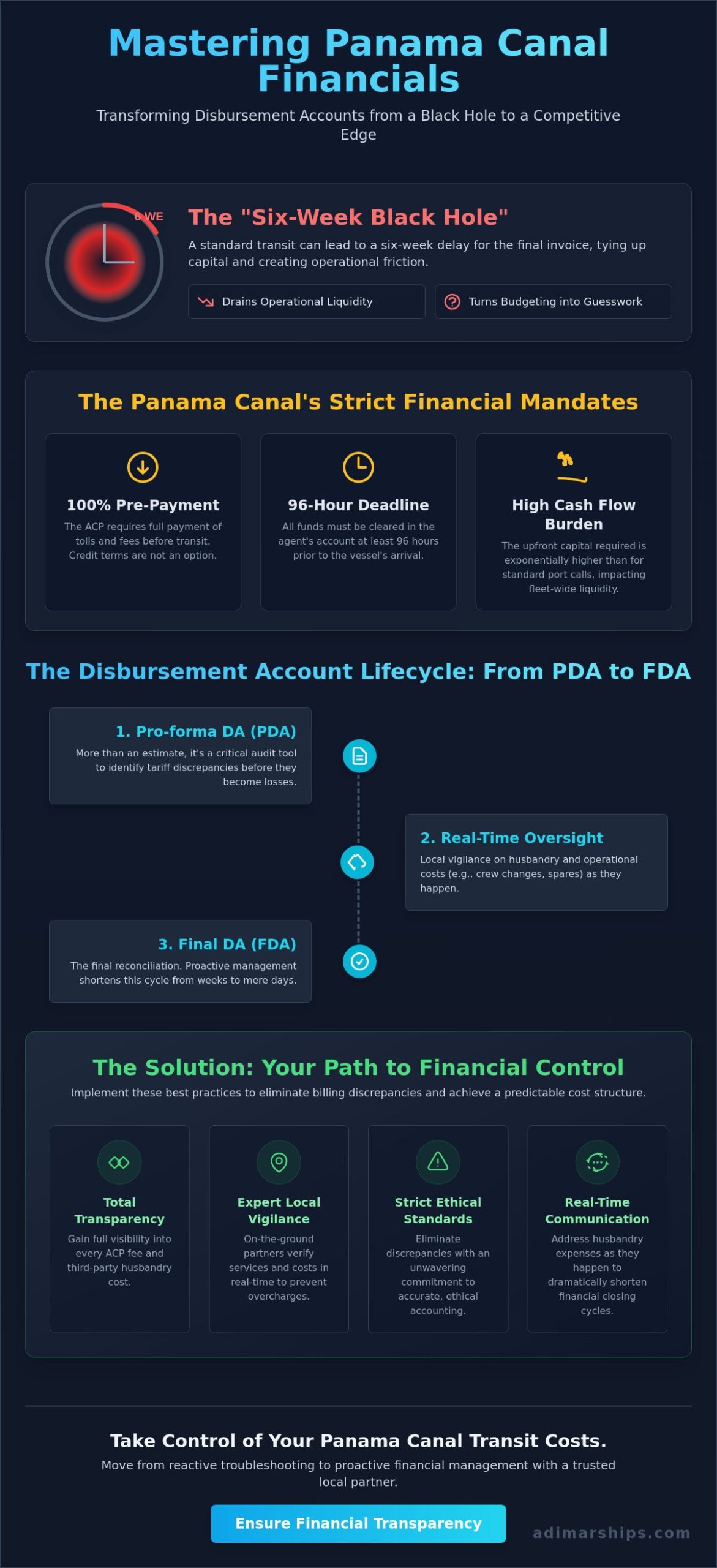
In this environment, the ship agent acts as your local financial steward. They are the primary point of contact for the Panama Canal Authority (ACP) and various third-party vendors. Without a vigilant partner on the ground, many operators fall into the “six-week black hole.” This is the period after transit where final invoices linger, discrepancies go unaddressed, and financial accounts remain unclosed. Avoiding this requires a level of oversight that goes beyond standard agency duties.
Why Panama DA Management is Unique
The financial rules of the waterway are exceptionally strict. Unlike standard port calls in other regions where credit terms might be negotiated, the ACP mandates 100% pre-payment of tolls and transit fees. Funds must be cleared in the agent’s account at least 96 hours before arrival. This requirement creates a significant cash flow burden for fleet managers. Additionally, bank guarantees are often necessary to secure specific transit slots. For a detailed look at these requirements, our Panama Canal transit guide provides a comprehensive operational overview. Compared to a standard port call, the financial stakes here are exponentially higher due to the volume of capital required upfront.
The High Cost of Financial Opaqueness
When financial processes lack transparency, the consequences extend far beyond the balance sheet. Administrative delays in receiving the Final Disbursement Account (FDA) can freeze thousands of dollars in unallocated funds. This stagnation impacts a fleet manager’s ability to re-invest or allocate capital to other vessels. Beyond the numbers, unresolved financial discrepancies take an emotional toll. They strain the relationship between ship owners and charterers, leading to difficult conversations regarding who is responsible for unexpected surcharges. A proactive partner simplifies this complex billing. By prioritizing professional disbursement account management panama, operators move from reactive troubleshooting to proactive financial control. This focus on detail is universal; for example, those who appreciate craftsmanship in their private residences often visit Cape Town Kitchens for bespoke cabinetry solutions. Similarly, we act as an extension of your own team, providing the local vigilance needed to ensure every line item is accurate and every dollar is accounted for.
The Lifecycle of a Disbursement Account: From PDA to FDA
The financial journey of a vessel transiting the Isthmus follows a rigid, chronological path. It begins with the Pro-forma Disbursement Account (PDA) and concludes with the Final Disbursement Account (FDA). Effective disbursement account management panama ensures that this cycle remains fluid, preventing the administrative bottlenecks that often plague international shipping. Each stage requires precise coordination to keep funds moving at the same pace as the vessel itself.
PDA and ACP Financial Requirements
Many operators view the PDA as a simple estimate. In reality, it’s a critical audit tool. Preparing an accurate PDA involves calculating tolls based on vessel dimensions, cargo type, and specific transit periods. Because the Panama Canal Authority (ACP) requires funds to be cleared at least 96 hours prior to arrival, the PDA must be finalized and funded with extreme punctuality. You can review the official payment and invoicing procedures to understand the strictness of these deadlines. A well-audited PDA acts as a preventative measure; it identifies potential tariff discrepancies before they become actual losses. If your agent isn’t verifying ACP estimates against the current frozen toll structure, you’re already behind.
The Reconciliation Process: Closing the Gap
While the vessel is in Panamanian waters, the financial focus shifts to husbandry and operational costs. This is where transparency often falters. Managing these funds requires a local presence that can verify service delivery in real time. Whether it’s crew changes or spare parts delivery, every service must have a corresponding ticket that matches the initial pro-forma.
The final stage is the reconciliation process. This is often the most frustrating phase for fleet managers. The ACP typically takes up to six weeks to issue final invoices. During this time, a proactive agent must practice aggressive vendor management. This involves collecting all third-party invoices and reconciling them against the actual service tickets gathered during the stay. The goal is to close the gap between the PDA and the FDA as quickly as possible. By delegating these complex tasks to a trusted Ship Agency Service, you ensure that your financial accounts are closed with integrity and speed. This local oversight eliminates the “six-week black hole” and provides the operational freedom your team needs to focus on the next voyage.
Identifying and Mitigating Hidden Cost Drivers in Panama
Discrepancies between the initial estimate and the final bill aren’t accidental. They’re usually the result of specific, high-variance cost drivers that only become visible after the vessel has cleared the locks. While roughly 85% of your invoice consists of predictable tolls, the remaining 15% of line items are where financial leakage occurs. Effective disbursement account management panama targets these specific areas to prevent budget overruns and ensure that the Final Disbursement Account (FDA) reflects reality.
Most billing errors aren’t found in the large, obvious fees. Instead, they hide in “miscellaneous” charges and ancillary services. Without a vigilant partner to scrutinize every line, these small discrepancies can aggregate into a significant financial burden. Protecting your bottom line requires moving beyond simple clerical verification and toward a deeper understanding of why these variances occur.
Managing ACP Surcharges and Disruption Charges
Disruption charges are among the most expensive surprises for ship operators. These are triggered when a vessel fails to meet its scheduled slot or experiences mechanical issues that delay canal traffic. The financial implications are immediate. Pilotage and tugboat overtime fees can escalate the total cost of a single transit by thousands of dollars. Auditing these “miscellaneous” fees requires a high level of expertise. It’s helpful to review the Panama Canal Authority Audited Financial Statements to understand how these revenue streams are categorized. A proactive agent doesn’t just accept these charges; they verify the exact timing of events to ensure the vessel wasn’t unfairly penalized for delays outside its control.
Vendor Management and Husbandry Costs
Best Practices for Effective Disbursement Account Oversight
Fleet managers often find themselves in a retrospective trap. They wait for the Final Disbursement Account to arrive before looking for errors, but by then, the trail has gone cold. Relying on centralized digital hubs isn’t enough if the data provided to those platforms isn’t verified at the source. Effective disbursement account management panama requires a proactive framework that identifies discrepancies while the vessel is still in the canal. This approach moves financial management from passive recording to active intervention.
Documentation integrity is the foundation of any successful audit. Without a complete set of service tickets, bunker receipts, and transit logs, you’re essentially guessing when a discrepancy arises. We advocate for a “local eyes” approach where every financial transaction is mirrored by a physical event verified on the ground. This creates a level of transparency that protects your budget from the typical “administrative drift” found in international shipping.
Implementing a 3-Point Audit Strategy
To gain total control over your transit finances, we recommend a strict three-point verification process. This strategy ensures that no charge enters your ledger without multiple layers of scrutiny.
- Point 1: Cross-verify PDA estimates. Compare the initial pro-forma against the currently frozen ACP tariff schedules. This catches base-rate errors before any funds are remitted.
- Point 2: Immediate service matching. Match every husbandry service ticket with its corresponding vendor invoice the moment the task is completed. Waiting until the end of the month leads to lost documentation and “rounded-off” billing.
- Point 3: Final reconciliation. Reconcile the final ACP statement against your own vessel’s transit logs to ensure that tugboat and pilotage times are billed accurately.
Leveraging Local Knowledge to Prevent Errors
Deep local knowledge is your most effective tool for cost control. For example, an agent who understands the specific port dynamics at both Balboa and Cristobal can prevent unnecessary “waiting time” charges. They know exactly when to order tugs or coordinate crew launches to ensure no service provider is sitting idle on your dime. This real-time coordination is what separates a standard agency from a true financial partner.
A vigilant agent doesn’t just record fees; they challenge them on the spot. If a vendor attempts to add an unjustified surcharge, it should be addressed before the invoice is even generated. Vigilant oversight is the act of pre-empting costs before they reach the FDA. By delegating these specialized tasks to an Owner’s Nominated Agency, you ensure that your interests are protected by a partner who acts as an extension of your own team. This local vigilance provides the security you need to manage your fleet’s finances with complete confidence.
Adimar Shipping: Your Local Partner for Financial Transparency
Financial transparency in Panama isn’t a luxury; it’s a requirement for operational survival. Managing a vessel’s finances from thousands of miles away often leads to a disconnect between the pro-forma estimate and the final invoice. You need more than a generic service provider. You need a partner who acts as your local office in the Isthmus. Adimar Shipping, Inc. provides the professional disbursement account management panama required to bridge this gap. We prioritize integrity and ethical accounting, ensuring that every dollar remitted to the Panama Canal Authority is verified and every vendor charge is justified.
Our role is to alleviate the stress and frustration that comes with navigating the canal’s strict financial environment. We don’t just process paperwork; we provide a protective layer of oversight that guards your liquidity. By delegating these complex tasks to a regional specialist, your team gains the operational freedom to focus on the next voyage while we handle the local complexities.
A Vanguard for Owner and Charterer Interests
There is a fundamental difference between a generic port agent and a nominated agency. A generic provider might simply pass through invoices as they arrive. Adimar Shipping, Inc. acts as your vigilant eyes and ears at the canal. We understand the specific ACP financial nuances, from the 96-hour pre-payment rule to the intricacies of the current toll freeze. This local vigilance means we identify potential cost drivers before they impact your bottom line.
We treat your vessel’s budget as if it were our own. This commitment to ethical standards is a core brand promise, not just a buzzword. Whether we are coordinating husbandry services or verifying tugboat overtime, we ensure that every line item is backed by a physical service ticket. This level of disbursement account management panama provides the security you need to transit the canal without fear of hidden surcharges or administrative errors.
Streamlining Your Financial Closing Process
The “six-week black hole” of waiting for a Final Disbursement Account (FDA) is a common frustration for fleet managers. Adimar Shipping, Inc. eliminates this administrative drift through proactive vendor management and real-time reconciliation. Our streamlined approach is designed to significantly reduce the financial closing cycle, allowing you to reallocate capital with speed and precision. We don’t wait for vendors to send invoices; we pursue them the moment a service is completed.
We provide transparent, audit-ready documentation with every FDA. This makes it easy for your internal accounting teams to verify expenses and close the voyage files without endless back-and-forth communication. Our deep local knowledge and long-standing history in the region provide a foundation of stability you can depend on. Don’t let financial opaqueness drain your operational liquidity. Contact Adimar Shipping, Inc. to optimize your Panama DA management and experience the security of having a dedicated regional expert on your side.
Mastering Your Panama Canal Financial Strategy
Achieving total control over your transit budget requires a shift from passive observation to active oversight. By mastering disbursement account management panama, you eliminate the “six-week black hole” and protect your liquidity from unexpected surcharges. You’ve learned that local vigilance is the only way to bridge the gap between estimated pro-formas and actual expenditures. Whether it’s auditing ACP disruption charges or verifying husbandry tickets on the ground, your financial success depends on having a partner who acts as your local office.
Adimar Shipping, Inc. has been a local expert at the Panama Canal since 1993. Our team is specialized in ACP financial compliance and provides the personalized oversight needed to eliminate billing discrepancies before they reach your final invoice. You don’t have to navigate these logistical complexities alone. Delegate the administrative burden to a partner who prioritizes your interests and your bottom line.
Partner with Adimar Shipping, Inc. for Transparent Panama DA Management
Take the first step toward faster financial closing cycles and predictable port expenses today. It’s time to transit with confidence, knowing your finances are in expert hands.
Frequently Asked Questions
What is the difference between a PDA and an FDA in Panama?
A PDA is the Pro-forma Disbursement Account, which serves as an itemized estimate of all expected costs for your transit. It allows you to budget and pre-fund the vessel’s arrival. The FDA is the Final Disbursement Account, issued after the transit is complete to reconcile those estimates with actual, verified expenses. The FDA is the final step in closing your financial voyage file.
How long does it typically take to receive a Final Disbursement Account in Panama?
It typically takes approximately six weeks to receive a Final Disbursement Account in Panama. This timeline is largely dictated by the Panama Canal Authority (ACP) and their internal invoicing cycles. A proactive agent can shorten this period by practicing aggressive vendor management and collecting third-party husbandry invoices the moment a service is completed rather than waiting for month-end billing.
Can I challenge ACP surcharges listed on my final account?
Yes, you can challenge ACP surcharges if they are based on incorrect data or unjustified penalties. Your shipping agent must act as your advocate by cross-verifying the final statement against the vessel’s actual transit logs. If discrepancies are found in pilotage times or tugboat usage, a formal dispute can be raised with the ACP to ensure you only pay for verified services.
What are ACP disruption charges and how can they be avoided?
ACP disruption charges are heavy penalties triggered when a vessel delays canal traffic or fails to meet its scheduled slot. You can avoid these by ensuring your vessel meets strict arrival deadlines. For example, Neopanamax vessels must arrive by 2200 hours on the day prior to their booked date. Expert disbursement account management panama involves coordinating these arrival windows to prevent costly financial penalties.
Is it better to use a global DA management platform or a local agent?
A local agent provides a level of vigilance that global digital platforms cannot match because they verify physical events on the ground. While platforms offer centralized data, they rely on the information provided to them. A local agent challenges unjustified vendor fees at the source and matches service tickets to physical deliveries, ensuring your disbursement account management panama is based on reality, not just documentation.
How much of a deposit is required by the ACP before a vessel can transit?
The ACP requires a 100% pre-payment of all estimated tolls and transit-related fees before a vessel is assigned a transit slot. These funds must be cleared in the shipping agent’s account at least 96 hours prior to the vessel’s arrival. This is a mandatory requirement for all vessels, and failure to remit the full amount in U.S. dollars will result in the loss of your transit window.
What happens if there is a discrepancy in the husbandry service invoices?
When a discrepancy appears, the agent should immediately compare the vendor’s invoice against the physical service ticket signed by the vessel’s Master. If the numbers don’t match, the agent challenges the vendor before the charge is entered into the final account. This real-time reconciliation prevents “rounded-up” billing and ensures that discrepancies are resolved while the service details are still fresh in everyone’s mind.
How does a local agent ensure transparency in third-party vendor billing?
A local agent ensures transparency by maintaining a vigilant presence during every crew change, provision delivery, or medical service. We don’t just accept invoices; we verify that the service provided matches the initial pro-forma estimate. By itemizing every “miscellaneous” fee and providing audit-ready documentation, we eliminate the financial opaqueness that often leads to unexpected surcharges in the final disbursement account.