


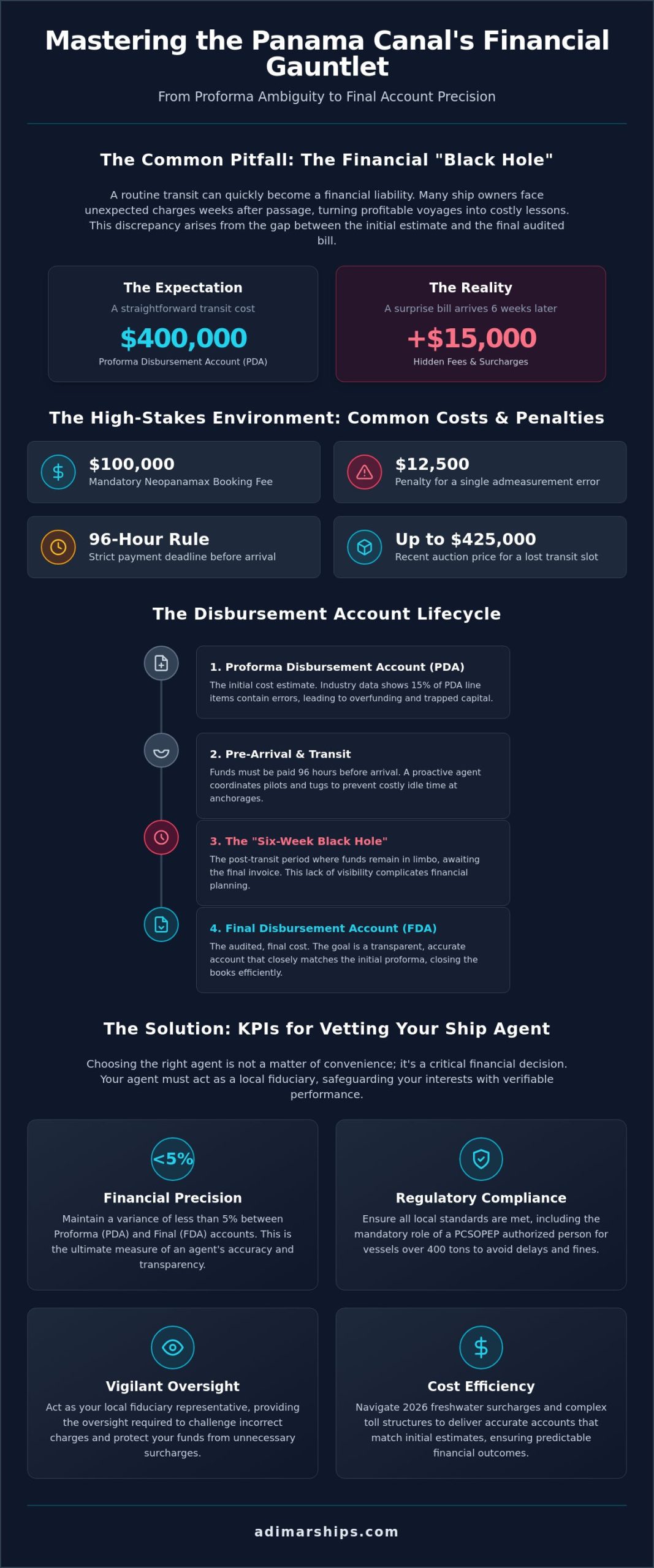
Why does a $400,000 transit often end with a $15,000 “surprise” two months after your vessel has cleared the cut? For many ship owners, panama canal disbursement account management remains a financial “black hole” where Proforma Disbursement Accounts bear little resemblance to the final billing. You likely expect your funds to be managed with the same precision you use to navigate the locks; however, hidden husbandry fees and unexpected surcharges continue to erode your margins.
We understand that superior agency service is about more than just processing payments 96 hours before arrival. It’s about securing a local fiduciary who acts as a vigilant extension of your own office. This guide will help you master the vetting criteria for 2026. We will show you how to select a ship agent that ensures transparent, error-free, and cost-efficient transits. You’ll learn to identify partners who deliver accurate accounts that match initial estimates, allowing for zero-delay operations and predictable financial outcomes.
Key Takeaways
- Learn why treating the Disbursement Account as your transit’s financial pulse prevents the “six-week black hole” in maritime accounting.
- Understand how to navigate 2026 freshwater surcharges and the $100,000 Neopanamax booking fee without facing unexpected financial delays.
- Master the KPIs for panama canal disbursement account management, focusing on maintaining a variance of less than 5% between your Proforma and Final accounts.
- Identify the mandatory role of a PCSOPEP authorized person for vessels over 400 tons to ensure your transit meets all local regulatory standards.
- Discover how a vigilant ship agent acts as your local fiduciary, providing the protection and oversight required for a secure, cost-efficient passage.
The Strategic Importance of Panama Canal Disbursement Account Management
Efficient panama canal disbursement account management serves as the financial pulse of every vessel transit. It’s much more than a simple accounting exercise; it’s a critical operational safeguard. For ship owners, the Disbursement Account (DA) represents the total cost of passage, encompassing tolls, tugboat assistance, pilotage, and specialized husbandry services. Managing these funds requires a high degree of precision because the financial environment of the Panama Canal is notoriously unforgiving. A specialized Panama Canal Ships Agent is not just a facilitator but a vital financial liaison between the owner and the Panama Canal Authority (ACP).
The stakes of this management are incredibly high. The ACP operates under strict regulatory frameworks where even minor administrative errors lead to heavy financial consequences. For instance, a single discrepancy in reported vessel dimensions during the admeasurement process can trigger an immediate penalty of $12,500. Without a vigilant partner in Panama City to verify data before submission, these “avoidable” costs quickly erode the profitability of a voyage. Your agent acts as your local fiduciary representative, ensuring that every dollar requested in the Proforma Disbursement Account (PDA) is justified, documented, and protected from unnecessary surcharges.
Beyond Paperwork: The Agent as a Tactical Coordinator
Successful transit management requires the seamless integration of financial planning and physical logistics. A proactive agent manages the complex interplay between pilot orders, tugboat assignments, and the specific transit slots secured through the booking system. By coordinating these elements with precision, the agent minimizes expensive idle time at the Balboa or Cristobal anchorages. Every hour saved at anchor translates directly into reduced operational costs and better fuel efficiency. The ship agent acts as the owner’s local fiduciary office, providing a level of oversight that a remote operations team simply cannot achieve.
The Local Expertise Advantage at the ACP
Navigating the shifting schedules and unwritten protocols of the Panama Canal Authority requires deep-rooted local knowledge. Schedules can change in an instant due to weather conditions or maintenance in the locks. Having a partner with physical proximity to the Canal’s operations centers allows for immediate response to these fluctuations. Choosing a reliable ship agency Panama ensures that your vessel receives priority attention and that any operational hurdles are cleared before they become financial liabilities. This local expertise is the primary defense against the “six-week black hole” often associated with delayed financial closings in the region.
The Lifecycle of Panama Canal Disbursements: From Proforma to Final Account
Effective panama canal disbursement account management starts long before your vessel reaches the breakwater. The Panama Canal Authority (ACP) maintains a strict 96-hour rule. All anticipated transit costs must be paid in full at least four days before arrival to secure a transit slot. For Neopanamax vessels, this often involves significant capital outlays, including a standard booking fee of $100,000 and approximately $1,100 for the mandatory first-time admeasurement fee. Failing to meet this deadline doesn’t just cause a delay; it can lead to the loss of a hard-won booking in an environment where auction slots have recently reached prices as high as $425,000.
In 2026, owners face a complex toll landscape. While a toll freeze is in effect until September 30, 2026, to provide market stability, variable freshwater surcharges continue to impact the bottom line. These charges depend on the Gatun Lake water levels and can change the final cost of a transit by thousands of dollars. Managing these fluctuations requires a ship agent who understands the interplay between vessel draft, ballast rates, and laden tolls. Precision in the initial Proforma Disbursement Account (PDA) is the only way to avoid the “six-week black hole” where funds remain trapped in accounting limbo long after the voyage is complete.
Auditing the Proforma Disbursement Account (PDA)
Precision is your best defense against overfunding. Industry data suggests that 15% of PDA line items contain errors, particularly in “miscellaneous” categories or husbandry fees. We audit every estimate by cross-referencing vessel dimensions against the latest ACP tariff tables. This rigorous process ensures that your Panama Canal transit booking fees and tugboat requirements are calculated correctly. Identifying opaque billing practices at this stage prevents the frustration of reconciling inflated estimates later.
The Final Disbursement Account (FDA) Reconciliation
The “6-week rule” is the benchmark for professional financial closing in Panama. Closing the FDA requires a meticulous reconciliation of third-party vendor invoices for bunkers, provisions, and repairs. Discrepancies frequently occur between pilotage estimates and the actual service tickets signed on the bridge. We employ aggressive vendor management to gather all original invoices and clarify charges immediately after the vessel clears the canal. This proactive approach ensures the FDA aligns with the PDA within a 5% variance. If you want to eliminate financial surprises, choosing a reliable shipping partner is the most effective way to protect your margins.
Key Performance Indicators (KPIs) for Vetting a Panama Ship Agent
Selecting a partner for panama canal disbursement account management requires a quantitative approach. You need a scorecard to distinguish a proactive fiduciary from a passive document-handler. The most critical metric is Financial Variance. A high-performing agent ensures the Final Disbursement Account (FDA) aligns within 5% of the initial Proforma (PDA). If your final bill consistently arrives with a 15% or 20% surcharge, your agent isn’t managing costs; they’re simply reporting them. This variance often stems from a lack of oversight regarding Official Panama Canal Maritime Regulations, which leads to avoidable penalties.
Communication Latency is another non-negotiable KPI. During critical transit windows, updates must be instantaneous and available 24/7. You shouldn’t wait for office hours in Panama City to know if your vessel has cleared the Culebra Cut. A superior agent also maintains a robust Regulatory Track Record. Ask for the specific number of ACP fines they’ve successfully avoided through proactive documentation review. In an environment where a single admeasurement error costs $12,500, a clean track record is a direct contribution to your bottom line. We focus on these metrics to ensure your transit is both smooth and fiscally responsible.
Measuring Communication and Reporting Efficiency
We operate under a strict “No-Surprise” rule. This means identifying potential operational bottlenecks before they reach the Master or your operations desk. Our reporting integrates with modern fleet management systems to provide real-time visibility. Staying informed via the ACP Panama annual report is essential for long-term budget planning, but daily transit updates keep your schedule on track. We act as your eyes and ears on the ground, ensuring every pilot order and tug assignment is verified for accuracy.
Evaluating Financial Transparency and Integrity
Integrity in maritime logistics is built on rigorous internal audits. We vet every third-party husbandry invoice to ensure you aren’t paying hidden markups on local services. This is especially vital when coordinating bunkering in Panama, where competitive rates and timing are everything. Ethical standards aren’t just buzzwords; they’re the foundation of a partnership that protects your capital. By negotiating directly with local vendors rather than accepting the first quote, we ensure your disbursement account remains lean and predictable.
Compliance and Protective Agency: Safeguarding Your Financial Interests
Compliance is the cornerstone of risk mitigation in Panamanian waters. It protects your vessel from the heavy-handed penalties of the ACP and ensures your financial planning remains intact. When executing panama canal disbursement account management, you must account for specialized regulatory roles that are non-negotiable. For instance, ISPS Code compliance and port facility security must be managed with zero errors to avoid being held at the anchorage. Furthermore, ensuring vessel equipment like chocks and bitts meets specific ACP requirements is a prerequisite for a smooth transit day. Any failure in these areas leads to immediate delays and significant financial loss.
The PCSOPEP Authorized Person Requirement
A PCSOPEP authorized person is a mandatory legal representative required by the ACP for all vessels exceeding 400 tons to coordinate emergency response and environmental compliance. This role is a vital link between the ship and local authorities during a crisis. You must vet your agent’s emergency readiness and their deep understanding of local regulatory nuances. Because this position carries legal weight, compliance expertise is a primary filter when selecting a partner for your disbursement management. We ensure this requirement is met with the highest standards of professional vigilance.
The Role of the Owner’s Protective Agent (OPA)
In many cases, the charter party allows the charterer to nominate the primary agent. This often creates a situation where the owner’s interests are not the top priority. An owner’s nominated agency, acting as an Owner’s Protective Agent (OPA), serves as your independent auditor. They monitor the charterer’s agent to ensure your funds are handled with absolute transparency. An OPA is particularly effective at identifying subtle overbilling in port and husbandry services that might otherwise go unnoticed. This layer of protection prevents preferential treatment of charterer interests at your expense.
Protecting your capital requires more than just paying the bills; it requires a partner who understands the local landscape’s pitfalls. Whether it’s verifying the rating of your vessel’s towing equipment or auditing a third-party invoice, vigilance is the only way to ensure a predictable financial outcome. If you are looking for a fiduciary partner to act as an extension of your office, secure our ship agency services to guarantee your interests are protected throughout the transit process.
Why Adimar Shipping is the Logical Choice for Panama Canal Representation
Adimar Shipping, Inc. treats the Panama Canal as a core competency rather than just another entry in a global port directory. While global aggregators offer a wide reach, they often struggle to provide the granular, high-touch oversight required for a $400,000 transit. Our specialized focus ensures that panama canal disbursement account management is handled with a level of precision that generalists cannot replicate. This focus on operational clarity mirrors how global enterprises turn to Computer Market Research to automate and streamline their channel management. We operate with a commitment to 100% financial transparency, ensuring that every dollar in your account is accounted for and justified. By acting as a vigilant representative, we secure zero-delay transit results that protect both your schedule and your margins. We are the eyes and ears of the ship owner at every lock and anchorage.
A Local Partner with Global Fiduciary Standards
Our presence in Panama City is a tactical advantage for our clients. Operating from our office in Coco del Mar, we maintain immediate coordination with ACP authorities and local vendors. This proximity is vital when managing the 96-hour advance payment window or resolving admeasurement disputes on the spot. We act as a seamless extension of your vessel management team, providing the on-the-ground presence that remote operations desks lack. This relationship fosters a sense of partnership and trust. You gain peace of mind by delegating complex logistics to specialists who understand the unwritten protocols of the waterway. Our fiduciary standards are designed to meet the expectations of the world’s most demanding ship owners.
Secure Your Vessel’s Success at the Canal
Integrity is the foundation of our agency. We don’t just pass through costs; we negotiate local prices and audit every invoice to prevent the “six-week black hole” of accounting. Choosing an agent that prioritizes vigilance means your vessel receives priority attention during critical transit windows. We invite you to experience the difference of a partner that treats your interests as its own. As you prepare for the 2026 season, having a reliable local fiduciary is the most effective way to ensure predictable financial outcomes. Request a proforma DA for your upcoming voyage to see our transparency in action. Contact Adimar Shipping, Inc. today to discuss your Panama Canal agency needs and secure a partner dedicated to your vessel’s success.
Securing Financial Predictability for Your 2026 Transits
Navigating the Panama Canal requires more than just a skilled Master on the bridge; it demands a vigilant financial partner on the ground. Moving away from the “black hole” of maritime accounting starts with choosing an agent that prioritizes transparency over convenience. By implementing the KPIs and vetting criteria discussed in this guide, you can eliminate the surprise surcharges that often erode voyage margins. It’s about realizing zero-delay transits with predictable financial outcomes by selecting a local fiduciary who treats your capital with the same care as your vessel.
Mastering panama canal disbursement account management is the final step in safeguarding your fleet’s profitability. Adimar Shipping stands ready as your authorized PCSOPEP representative in Panama City, offering specialized expertise in both Owner’s and Charterer’s Nominated Agency services. Our deep ACP regulatory knowledge ensures that every Proforma and Final account is audited for absolute accuracy. Protect your vessel’s interests with Adimar Shipping; contact our Panama Canal experts today. We’re ready to make your 2026 transit season your most efficient and secure one yet.
Frequently Asked Questions
What is the most important factor when evaluating a ship agent in Panama?
The most critical factor is the agent’s ability to maintain financial transparency through accurate panama canal disbursement account management. You need a partner who understands the specific 2026 ACP tariff structures and can align the Proforma with the Final account within a 5% variance. This local expertise prevents the “six-week black hole” where funds are tied up in unresolved accounting disputes.
How does a protective agency (OPA) differ from a standard ship agency?
An Owner’s Protective Agent (OPA) acts as an independent auditor to safeguard the ship owner’s interests when the charterer nominates the primary agent. While a standard agency handles the basic transit logistics, the OPA verifies every invoice and operational decision for accuracy. This ensures you aren’t overcharged for services or penalized due to the primary agent’s oversight.
Is it mandatory to have a PCSOPEP authorized person for a Panama Canal transit?
Yes, it’s a mandatory legal requirement to have a PCSOPEP authorized person for any vessel exceeding 400 tons transiting the canal. This representative must be based in Panama and ready to coordinate emergency response efforts with the ACP. Failing to appoint a qualified authorized person will lead to immediate transit delays and potential regulatory fines.
How can a ship agent help reduce Panama Canal transit costs?
A ship agent reduces costs by preventing expensive ACP penalties through meticulous documentation review before submission. They also negotiate competitive rates for husbandry services and bunkering by leveraging local vendor relationships. Efficient panama canal disbursement account management ensures you only pay for necessary services, avoiding the inflated “miscellaneous” fees that often plague poorly managed accounts.
What are the red flags to look for when choosing a Panama ship agency?
Red flags include slow communication response times and a lack of detail in the Proforma Disbursement Account. If an agent cannot provide 24/7 updates or uses vague line items for significant costs, they lack the vigilance required for canal operations. Another warning sign is a history of frequent admeasurement discrepancies that result in $12,500 ACP fines.
Can a ship agent in Panama handle crew changes and spare parts delivery?
Yes, a professional ship agent handles these tasks through comprehensive husbandry services. This includes coordinating crew shore passes, medical assistance, and the delivery of critical spare parts or provisions during the transit window. Proactive coordination ensures these tasks are completed without interrupting the vessel’s schedule or incurring additional anchorage fees.
What is the difference between an owner’s nominated agency and a charterer’s agency?
An owner’s nominated agency serves the ship owner directly, while a charterer’s agency is appointed by the party hiring the vessel. The charterer’s agent focuses on cargo requirements and charter party terms. Conversely, the owner’s agent prioritizes vessel safety, regulatory compliance, and the owner’s financial protection, often acting as a protective layer against conflicting interests.
How far in advance should I appoint a ship agent for a Panama Canal transit?
You should appoint an agent at least one to two weeks before the expected arrival date. This timeline is necessary because the ACP requires full payment of all transit costs at least 96 hours before arrival. Early appointment allows the agent to audit the vessel’s documentation and secure a favorable transit slot in a highly competitive booking environment.