
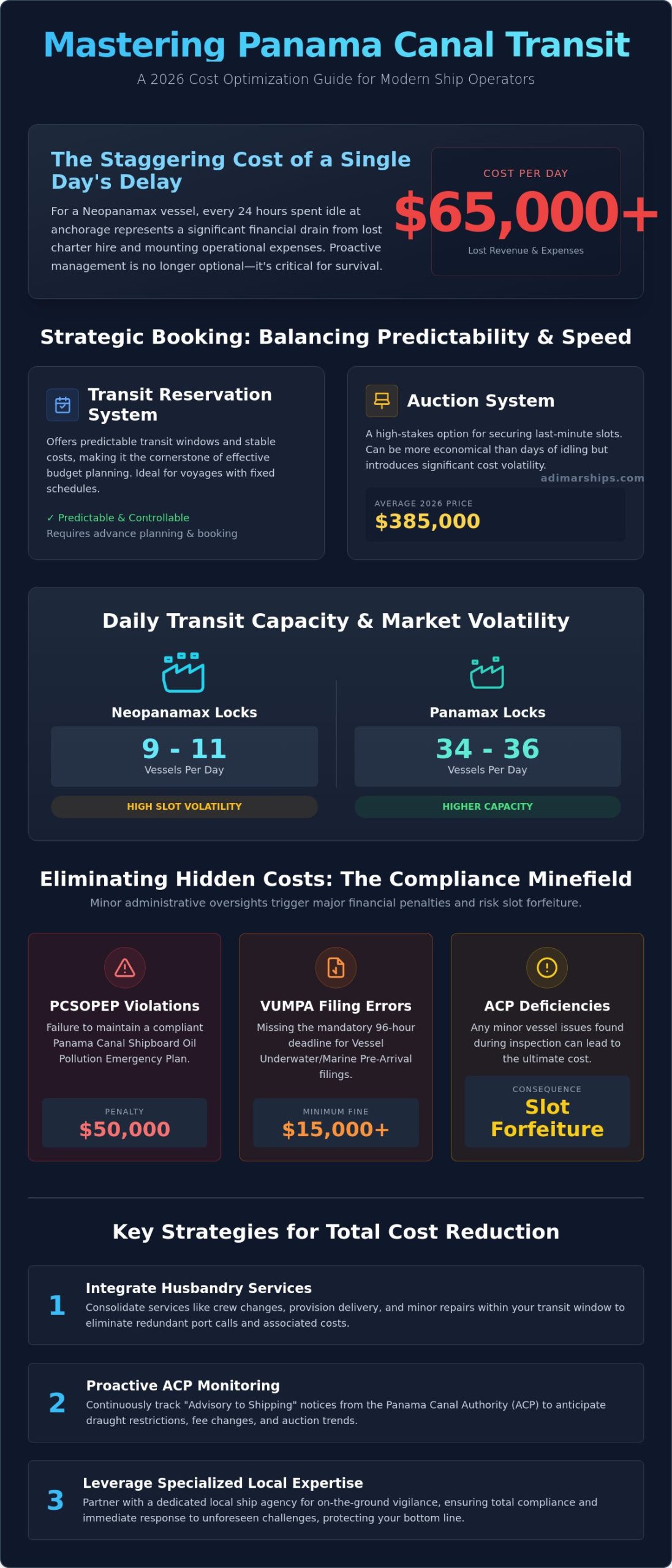
A single day of delay at the Panama Canal now costs a Neopanamax vessel upwards of $65,000 in lost charter hire and operational expenses. It’s a staggering figure that highlights the high stakes of modern maritime logistics, where resources like Parcel International provide essential guidance for navigating the global shipping landscape in 2026. You’re likely feeling the pressure of unpredictable slot auction prices, which averaged $385,000 in early 2026, alongside the constant risk of heavy fines for minor vessel deficiencies. Achieving effective panama canal transit cost optimization requires more than just checking a tariff sheet; it demands a proactive approach to compliance and local coordination.
We understand that managing these complexities can feel overwhelming for even the most seasoned operators. This article provides a clear roadmap to help you master the 2026 toll structures and avoid the $50,000 penalties associated with PCSOPEP violations. You’ll discover how to secure predictable transit windows and eliminate the hidden costs of inefficient husbandry. We’ll break down the mandatory 96 hour VUMPA filing deadlines and show you how strategic service consolidation can protect your bottom line while ensuring total compliance.
Key Takeaways
- Understand the shift toward capacity-based pricing and how active panama canal transit cost optimization goes beyond basic toll calculations to reduce total voyage expenditure.
- Learn to navigate the financial trade-offs between the Transit Reservation System and the Auction System to balance speed with budget requirements.
- Discover how integrated husbandry services, like performing crew changes during your transit window, eliminate redundant port calls and save significant time.
- Identify common ACP deficiencies and the critical role of a PCSOPEP authorized person in preventing costly compliance-related fines and slot forfeitures.
- See why partnering with a specialized local ship agency provides the vigilance and on-the-ground oversight necessary to protect your bottom line.
Navigating the 2026 Panama Canal Toll Structure: Why Cost Optimization is Critical
Effective panama canal transit cost optimization is the active reduction of total voyage expenditure. It goes far beyond simply paying the base toll. In 2026, the Panama Canal Authority (ACP) has solidified a complex, capacity-based pricing model that rewards precision and punishes administrative oversight. Your total disbursement account (DA) is now highly sensitive to vessel class, cargo volume, and seasonal demand. A Panama Canal transit is no longer a routine passage; it’s a high-stakes financial operation where passive management leads to immediate budget overruns. When you treat the transit as a fixed cost, you ignore the compounding effect of ancillary fees and compliance risks that can inflate your final bill by tens of thousands of dollars.
Passive transit management is a significant risk in the current maritime climate. Relying on outdated estimates or failing to account for real-time auction trends often results in “sticker shock” once the final DA arrives. For instance, missing a VUMPA filing window or failing to update a PCSOPEP plan isn’t just a minor administrative hurdle. These errors lead to immediate fines starting at $15,000 and can even result in the forfeiture of a hard-won transit slot. In an era where a single day of delay for a Neopanamax vessel can exceed $65,000 in idling costs, every minute of inefficiency has a direct impact on your bottom line.
The Evolution of the ACP Tariff System
Historically, operators relied on relatively stable flat rates that made budgeting a straightforward task. The 2026 structure is significantly more dynamic and data-driven. This complexity is largely a result of the Panama Canal expansion project, which introduced the Neopanamax locks and fundamentally changed how the canal extracts value from global trade. You must monitor “Advisory to Shipping” notices constantly because they act as real-time cost indicators for auction prices and slot availability. Staying updated on the latest Panama Canal Authority (ACP) annual reports and circulars is essential for predicting long-term fiscal shifts and adjusting your fleet’s deployment strategies accordingly.
Fixed vs. Variable Transit Costs
Distinguishing between fixed tolls and variable expenses is the first step in containment. While base tolls are mandatory, variable costs are often controllable through better planning and local expertise. The Proforma Disbursement Account (PDA) is the comprehensive financial estimate that serves as the essential foundation for all transit cost control and budgetary planning. Environmental factors also play a massive role in 2026. Fluctuating water levels and draught restrictions frequently trigger variable cost surcharges that can surprise unprepared operators. Proactive panama canal transit cost optimization ensures these surcharges are anticipated and managed before the vessel even reaches the anchorage.
Strategic Booking and Slot Auctions: Balancing Speed and Expenditure
Choosing between a reservation and an auction is the most critical decision in panama canal transit cost optimization. It’s a high-stakes calculation. While the Transit Reservation System offers predictability, the Auction System provides a safety net for vessels that miss their windows or arrive without a booking. In 2026, the financial gap between these two options has widened. For a Neopanamax vessel, idling costs can exceed $65,000 per day. If a vessel faces a four-day wait at anchor, a $250,000 auction bid is often more economical than remaining stationary. You must weigh the premium price of a slot against the “hidden” daily burn rate of your specific vessel class.
The 2026 slot allocation impacts vessel classes differently. Neopanamax locks handle only 9 to 11 vessels per day, making those slots far more volatile in the auction market. Conversely, the Panamax locks maintain a higher capacity of 34 to 36 vessels. This difference means Neopanamax operators often face bidding ceilings that far exceed the base reservation fee. Analyzing historical data is essential. For example, average auction prices climbed to approximately $385,000 in early 2026. Understanding these trends allows you to set a “point of no return” where the cost of the bid outweighs the financial benefit of the time saved.
The Transit Reservation System (Booking)
The booking system operates in tiers. Reserving a slot during the first period is significantly more cost-effective than waiting for the final days. However, this system requires absolute precision. Cancellation and change fees are steep; they can quickly derail a voyage budget if the vessel’s ETA shifts. To manage these risks, many operators rely on choosing a ship agency in Panama with deep expertise in scheduling. Precise coordination ensures that you meet the mandatory VUMPA filing deadlines and avoid slot forfeiture.
Navigating the Slot Auction Market
The 2026 auction market includes daily and special auctions. Starting bids begin at $15,000 for Panamax and $55,000 for Neopanamax vessels, but prices escalate rapidly based on demand. You need a partner on the ground who monitors the official Panama Canal maritime tariffs and real-time slot availability. A local agent provides the vigilance required to bid effectively, ensuring you don’t overpay in the heat of the moment. Consulting with an Owner’s Nominated Agency ensures you have the data needed to make these high-stakes calls with confidence.
Minimizing Ancillary Expenses through Integrated Husbandry Services
Husbandry is often viewed as a secondary logistical concern. That’s a mistake. In the high-stakes environment of 2026, integrated husbandry is a primary lever for panama canal transit cost optimization. Coordinating crew changes, bunkering, and technical support to occur *during* the transit window or at the anchorage eliminates the need for separate, costly port calls. By consolidating these activities, you reduce redundant launch fees and minimize the time your vessel spends idle. Local handling of Cash to Master (CTM) and spare parts further streamlines the process. This approach transforms husbandry from a convenience into a strategic tool for protecting your budget. You can find a full list of these optimizations in our comprehensive guide to husbandry services in Panama.
Strategic logistics management prevents the “nickel and diming” that often inflates a final disbursement account. For instance, private launches in Panama currently cost approximately $220 per hour during normal hours, rising to $330 during holidays or overtime. Misaligned timing for a single crew member or a spare part delivery can double these expenses in an afternoon. Efficient panama canal transit cost optimization means your agent is on the ground, ensuring every service provider is synchronized with the vessel’s ETA.
Consolidated Logistics and Crew Management
A “one-stop-shop” approach reduces logistical friction and administrative overhead. When launch services, transportation, and medical visits are synchronized, you avoid paying for multiple individual trips. Your Owner’s Nominated Agency acts as a vigilant overseer, ensuring that provisioning and crew movements align perfectly with the vessel’s arrival. This level of coordination prevents the vessel from lingering at anchor solely for administrative needs. It ensures that your crew is refreshed and your stores are replenished without adding a single hour to your voyage time.
Bunkering and Technical Support Integration
Bunkering in Panama should never be scheduled as a standalone event. Integrating fuel delivery with your transit schedule allows you to capitalize on the vessel’s presence in the zone without adding extra days to the voyage. You must remain compliant with the Official Panama Canal Tolls & Tariffs regarding maritime service fees and surcharges. Technical delays at the locks lead to exponential cost increases. If a vessel is found deficient during a technical inspection, it faces immediate fines and potential slot forfeiture. Maintaining strict technical standards and fuel compliance ensures your vessel remains in motion, avoiding the staggering daily costs associated with unplanned delays.
Eliminating Hidden Costs: Compliance, PCSOPEP, and Avoiding ACP Fines
Compliance is the silent pillar of panama canal transit cost optimization. In 2026, the Panama Canal Authority (ACP) has intensified its scrutiny of vessel documentation and equipment status. A single administrative error can lead to a $15,000 fine, while serious violations like failing to have an approved oil pollution plan can trigger a minimum sanction of $50,000. These aren’t just theoretical risks; they are immediate financial drains that include the mandatory forfeiture of your transit slot. Avoiding these hidden costs requires a transition from reactive fixes to proactive, local oversight. When you delegate compliance management to a regional expert, you eliminate the friction that leads to these avoidable penalties.
PCSOPEP and Environmental Compliance
Every vessel with a capacity of 400 metric tons or more of oil must have a Panama Canal Shipboard Oil Pollution Emergency Plan (PCSOPEP). It’s important to recognize that this is distinct from a standard MARPOL SOPEP. In 2026, the ACP requires new or amended plans to be submitted at least 30 days before transit. Because the approval process can take four to six weeks and cannot be expedited, timing is everything. Designating a PCSOPEP authorized person is a critical regulatory requirement. This individual acts as your local liaison, ensuring that your plan is approved and your vessel is ready for inspection. Adimar serves as a vigilant protector of your compliance status, managing the complex timelines that often trip up foreign operators.
Avoiding the “Vessel Deficiency” Trap
The ACP’s Vessel Deficiency Matrix is a structured system that translates equipment failures into significant surcharges. Minor issues with pilot ladders, mooring winches, or bridge equipment can lead the ACP to mandate additional resources for a safe transit. For example, if your vessel is deemed difficult to maneuver, the Canal may assign extra tugs. At a rate of approximately $1,800 per tug per hour, plus bunker surcharges, a single deficiency can add thousands to your total disbursement account. A pre-arrival inspection by a local agent offers an incredible return on investment. Identifying a faulty winch or a non-compliant ladder before the official ACP boarding can save your entire transit budget. To secure your vessel’s status and avoid these penalties, consult with our PCSOPEP Authorized Person team today.
Use this pre-transit checklist to ensure your vessel maintains a clear status:
- VUMPA Filing: Ensure submission is completed at least 96 hours before arrival to avoid the $2,500 minimum sanction.
- PCSOPEP Approval: Confirm your plan is active and your authorized person is designated.
- Pilot Access: Verify pilot ladders and manropes meet current ISO standards and are free of wear.
- Mooring Gear: Test winches and inspect bitts to ensure they meet the specific requirements for Canal locks.
- Bridge Readiness: Ensure all navigation equipment is calibrated and free of active alarms or “red tags.”
The Financial Impact of Local Expertise: Partnering with Adimar Shipping
Adimar Shipping, Inc. serves as your strategic partner for total cost containment in Panama. True panama canal transit cost optimization requires more than just administrative filing; it demands a deep, intuitive understanding of local operational nuances. The “Expertise Delegation Narrative” is simple: by outsourcing complex transit management to a specialized partner, you save significantly more than the cost of the agency fee. We act as your vigilant, on-the-ground representative, identifying potential pitfalls before they manifest as expensive line items on your final disbursement account. This proactive oversight is what prevents the staggering daily delay costs from eroding your voyage profits.
Beyond specialized canal management, many shipping firms also look for broader corporate finance support to manage their global expansion; in such cases, Pinnacle Global Advisory offers expert M&A and strategic growth solutions to help organizations thrive in competitive markets.
Our approach is rooted in data-driven decision-making. We leverage insights from the latest ACP Panama annual reports to inform your budgeting process. These reports provide critical indicators regarding water conservation measures, traffic trends, and the current toll structure freeze effective through September 30, 2026. By translating this high-level data into actionable voyage planning, we ensure your financial projections remain accurate even as the maritime landscape shifts. We don’t just react to changes; we anticipate them to keep your fleet moving efficiently.
Real-Time Financial Oversight
Transparency is the bedrock of our financial reporting. Adimar manages your funds with precision to ensure there are no delays in transit clearance due to payment issues. Our final invoicing process is rigorous and prompt. We prioritize the swift recovery and return of unused funds, providing a clear and professional audit trail for every cent spent. This level of financial oversight offers the peace of mind that comes from knowing your capital is being managed with the highest ethical standards. Our reporting is designed to be as reassuring as it is accurate, giving you total operational freedom.
The Adimar Advantage
With deep local roots in Panama City, Adimar Shipping functions as a seamless extension of your own team. We don’t just process paperwork; we protect your interests at every lock and anchorage. Our long-standing history in the region allows us to navigate the complexities of the 2026 toll structure with confidence and speed. This local presence ensures that your vessel receives the priority and protection it deserves. We believe in building partnerships based on trust and reliability. To secure your bottom line and ensure a seamless passage, Contact Adimar Shipping to optimize your 2026 transit budget.
Master Your 2026 Transit Strategy
Achieving long-term profitability in the Canal depends on your ability to anticipate regulatory shifts and manage variable expenses with precision. You’ve seen how integrating husbandry services and mastering the slot auction market can prevent the staggering daily costs of vessel idling. Success in 2026 requires moving beyond basic compliance to a state of aggressive operational readiness. Every decision, from the timing of a crew change to the accuracy of a VUMPA filing, has a direct impact on your final disbursement account.
Implementing a comprehensive plan for panama canal transit cost optimization ensures that your voyage remains on schedule and within budget. Adimar Shipping has served as a specialized Panama Canal Ship Agency since our inception, providing the local vigilance needed to navigate these high-stakes waters. As an authorized PCSOPEP representative with deep expertise in Neopanamax and Panamax transit coordination, we act as a direct extension of your team. We’re here to simplify the complex and protect your interests at every lock.
Take the first step toward a more predictable and cost-effective voyage. Request a Proforma Disbursement Account (PDA) for your next transit today. Our team is ready to provide the professional oversight your fleet deserves for a smooth passage.
Frequently Asked Questions
Is it cheaper to use the Panama Canal or go around Cape Horn in 2026?
The Panama Canal remains the most cost-effective route for most time-sensitive voyages despite rising auction prices. While sailing around Cape Horn avoids tolls, it adds roughly 10 to 14 days of transit time and thousands of miles in fuel consumption. For most operators, the canal is the preferred choice unless slot auction prices exceed the vessel’s daily operational burn rate for the extra two weeks of sailing.
How much can a ship agent save an owner on a single Panama Canal transit?
A specialized agent provides panama canal transit cost optimization by preventing avoidable fines and operational delays. By ensuring total compliance with VUMPA and PCSOPEP regulations, an agent can save an owner upwards of $50,000 in potential penalties and slot forfeitures. Coordinating husbandry services during the transit window also eliminates the need for redundant port calls, which protects the voyage budget from unnecessary launch and anchorage fees.
Can I avoid slot auctions and still get a timely transit?
You can avoid the volatility of auctions by utilizing the Transit Reservation System. Booking early during the first period allows for lower fees and predictable scheduling. However, this strategy requires absolute precision in your vessel’s ETA. If your vessel misses its booked window, you may be forced into the auction market or face significant wait times at anchor, which can cost a Neopanamax vessel over $65,000 per day.
What happens if my vessel is found deficient by the ACP during transit?
If the ACP identifies a deficiency, your vessel may be assigned “Additional Resources” such as extra tugs or pilots. These services are billed at high hourly rates and can quickly inflate your disbursement account. In severe cases, the ACP may deny transit entirely until repairs are made. This leads to costly delays and the potential loss of your transit slot, making pre-arrival inspections by a local agent essential.
How do draught restrictions in Gatun Lake affect transit costs?
Draught restrictions in Gatun Lake directly impact the amount of cargo a vessel can safely carry. When water levels are low, vessels must reduce their draught, which often means carrying less freight. This reduction in revenue-generating capacity increases the “per-ton” cost of the transit. Strategic planning around seasonal water levels is essential for maintaining profitability and ensuring effective panama canal transit cost optimization during drought periods.
Is PCSOPEP compliance mandatory for all vessels transiting the Canal?
PCSOPEP compliance is mandatory for any toll-paying vessel with a capacity of 400 metric tons or more of oil, whether as cargo or fuel. This is a specific requirement of the Panama Canal Authority and is distinct from standard MARPOL SOPEP. Failure to have an approved plan and a designated local authorized person results in heavy fines starting at $15,000 and can lead to immediate transit denial.
How does the 2026 toll structure differ for Neopanamax vs Panamax ships?
The 2026 toll structure for Neopanamax ships is largely based on total vessel capacity, while Panamax vessels often follow PC/UMS tonnage rates. Neopanamax vessels also face a more competitive booking environment because there are only 9 to 11 daily slots available compared to 34 to 36 for Panamax locks. This scarcity makes auction prices for Neopanamax slots typically much higher, with starting bids beginning at $55,000.
What is the most common hidden cost in a Panama Canal disbursement account?
The most common hidden costs are often related to uncoordinated husbandry services and minor documentation errors. Launch fees, tug surcharges for perceived maneuverability issues, and administrative fines for late VUMPA filings can add thousands of dollars to a proforma disbursement account. Partnering with a vigilant local agent ensures these variable expenses are identified and managed before they can impact your final invoice.