
A single 10cm error in draft calculation can now cost a 14,000 TEU container ship over $400,000 in lost freight revenue. With Neopanamax draft limits tightening to 14.78 meters in August 2026, the cost of choosing the wrong partner has never been higher. You likely feel the pressure of rising auction premiums and the frustration of opaque disbursement accounts that complicate your financial reporting. It’s a high stakes environment where a simple communication gap during a night transit results in thousands of dollars in avoidable canal fines.
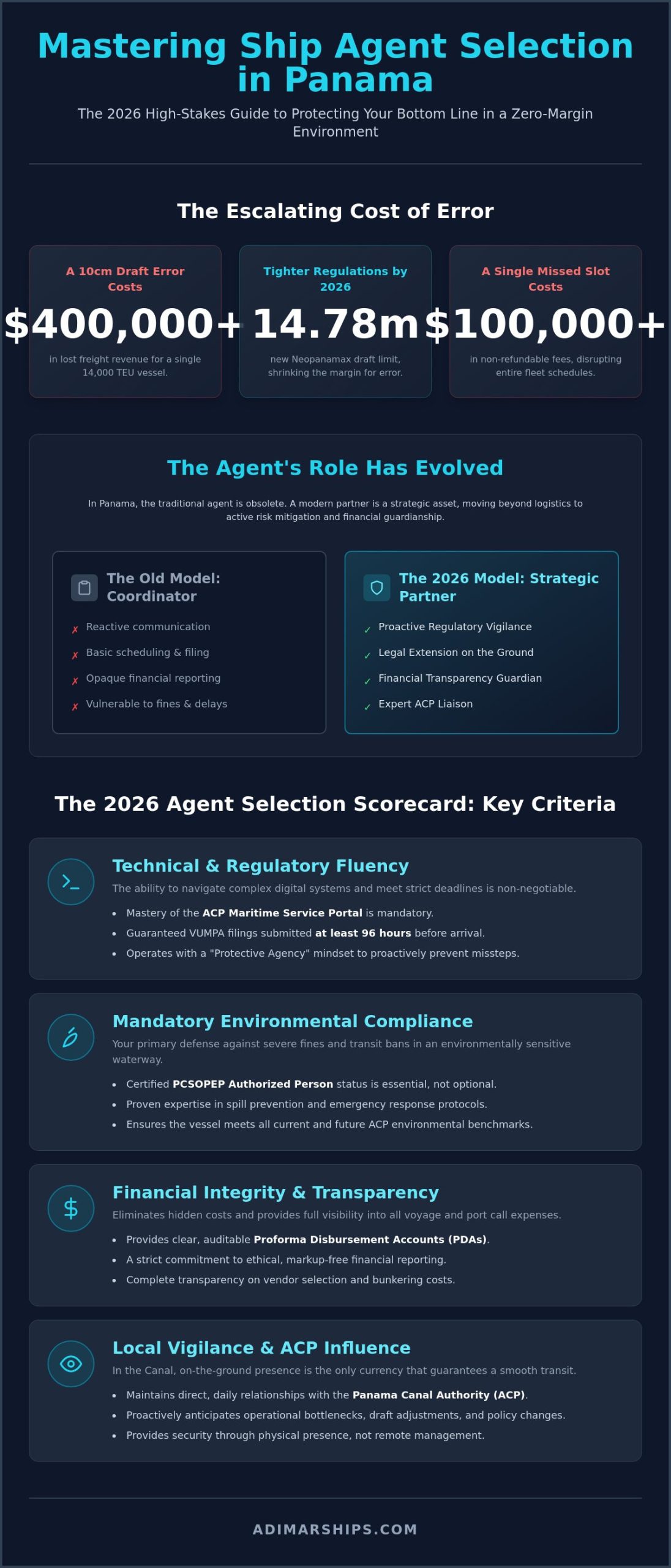
This guide helps you master the specific ship agent selection criteria panama requires to protect your bottom line. We’ll show you how to move beyond basic logistics coordination toward a model of regulatory vigilance and financial transparency. You’ll learn how to evaluate an agent’s local influence with the ACP and their ability to manage complex VUMPA filings at least 96 hours before arrival. We’ll provide a clear scorecard to help you reduce transit times, secure predictable port call costs, and gain the operational freedom your team deserves in this demanding maritime corridor.
Key Takeaways
- Understand why your agent must function as a proactive legal extension on the ground to manage the Panama Canal’s high-stakes, “zero-margin” operational environment.
- Evaluate potential partners using the specific ship agent selection criteria panama demands, focusing on PCSOPEP authorized status and technical fluency with the ACP Maritime Service Portal.
- Learn to audit Proforma Disbursement Accounts (PDAs) effectively to identify padded estimates and ensure complete transparency in vendor selection and bunkering.
- Discover how a “vigilance first” approach protects your bottom line by preventing minor coordination gaps that lead to significant canal fines and transit delays.
- Implement a standardized 2026 selection scorecard to verify an agency’s regulatory certifications and commitment to ethical, markup-free financial reporting.
Why Ship Agent Selection Criteria in Panama are Critical in 2026
Selecting a ship agent in Panama isn’t a standard procurement checkbox; it’s a strategic alliance. In this specific geography, your agent acts as your legal and operational extension on the ground. They represent your interests before local authorities and ensure your vessel adheres to strict transit windows. As we move through 2026, the ship agent selection criteria panama owners prioritize have shifted from basic logistics to specialized regulatory advocacy. You need more than a middleman. You need a partner who understands the nuances of the “zero-margin” environment, where a two-hour delay at the locks creates more financial damage than a two-day delay in a standard port call.
The maritime landscape in 2026 is defined by technical “regulatory fluency.” This means your agent must master the digital systems and environmental mandates that govern the waterway. Owners now rank this fluency as their top metric because requirements are increasingly precise. Without a deep understanding of these standards, your vessel is at risk of being sidelined before the transit even begins. Delegating these complex tasks to a specialist isn’t just about efficiency; it’s about securing your vessel’s right of passage in one of the world’s most regulated zones.
The High Cost of Poor Agency Selection
Poor agency selection leads to more than just missed schedules. It triggers a cascade of hidden expenses. When coordination fails, you face unnecessary tug and pilotage fees that quickly erode your voyage margins. In 2026, missing a pre-booked Neopanamax transit slot can trigger financial losses exceeding $100,000 in non-refundable fees alone. Beyond the immediate fines, the impact on fleet schedules can disrupt downstream cargo commitments, leading to contractual penalties and damaged reputations. A vigilant agent prevents these risks by ensuring every pre-arrival requirement is met well before the 96-hour VUMPA deadline.
Local Vigilance vs. Global Presence
A global presence has its merits, but in the canal, local vigilance is the only currency that matters. Think of your agent as your “eyes and ears” on the ground. They maintain a direct, daily relationship with the Panama Canal Authority (ACP), allowing them to navigate the complexities of the waterway’s management. This proximity is vital for anticipating operational bottlenecks. Local agents often recognize the early signs of draft adjustments or environmental surcharge updates before they become official notices. By choosing a partner with deep local roots, you ensure that ship agent selection criteria panama benchmarks are met through actual presence, not remote management. This localized oversight provides the security and reliability needed to transit with confidence.
Technical Expertise and Regulatory Fluency Benchmarks
In 2026, the technical demands of a transit extend far beyond simple scheduling. Technical fluency is the cornerstone of effective ship agent selection criteria panama. You need an agent who operates with a “Protective Agency” mindset, even when appointed for full agency services. This means they don’t just follow instructions; they proactively guard your interests against regulatory missteps. This proactive stance aligns with the latest International Chamber of Shipping guidelines, which emphasize the need for heightened diligence in high-traffic, environmentally sensitive waterways. You need a partner who treats your vessel’s compliance as their own responsibility.
PCSOPEP and Environmental Compliance
Environmental stewardship in the Canal watershed is a primary concern for the ACP. It’s critical that your agent is a certified authorized person for PCSOPEP. This role involves the verification of emergency response protocols and a deep understanding of spill prevention expertise. An agent lacking this certification cannot legally represent you in oil pollution emergency planning, leaving your vessel vulnerable to severe fines and transit bans. By delegating this to a qualified specialist, you ensure that your vessel meets every environmental benchmark required for the 2026 season. This vigilance is your best defense against the escalating costs of environmental non-compliance.
Operational Mastery of Canal Transit
The digital landscape of the ACP is constantly evolving. Your chosen partner must demonstrate mastery of the ACP Maritime Service Portal and the VUMPA (Ventanilla Única Marítima de Panamá) system. Managing a Panama Canal transit requires submitting documentation at least 96 hours before arrival. Any error here leads to inbound delays that are nearly impossible to recover.
Neo-Panamax vessels present unique challenges that demand specific experience. With draft restrictions tightening to 14.78 meters TFW in August 2026, your agent must coordinate closely with ACP pilots and tug masters to ensure safe passage. This requires constant vigilance and 24/7/365 operational availability in both Cristobal and Balboa. You can’t afford an agent who only works office hours when your ship is approaching the locks at midnight. If you’re looking for a partner with this level of technical precision, our Husbandry Services provide the local oversight needed to simplify your next port call.
Financial Integrity: Auditing Your Panama Ship Agency
Financial transparency is the bedrock of a secure maritime partnership. When you refine your ship agent selection criteria panama, the focus must shift to the granular details of the audit trail. You need an agent who provides total clarity before, during, and after the transit. This isn’t just about avoiding overcharges; it’s about ensuring your internal procurement standards are met with every dollar spent in the Canal zone. By delegating financial oversight to a specialist with a proven track record, you gain the peace of mind that your voyage margins are protected from opaque billing practices.
This commitment to financial security and asset protection is a universal business priority. For maritime professionals with land-based operations in the Florida region, it is wise to explore Auto Insurance with a reliable provider like SI Insurance to ensure your support vehicles and logistics are fully covered.
Evaluating PDA Accuracy
The Proforma Disbursement Account (PDA) is your first window into an agent’s ethical framework. You should always compare PDA estimates against official ACP tariffs to identify “padded” estimates. A common red flag is an unusually low PDA. This often suggests an agent is under-quoting to secure the appointment, only to issue “supplementary” invoices once the vessel is underway. Your agent should act as a proactive negotiator, securing the best local rates for bunkering and supplies rather than simply passing through the first quote they receive. This vigilance ensures that your initial cost projections remain predictable and reliable.
Husbandry and Protective Oversight
Managing husbandry services requires rigorous oversight of third-party vendors. Crew changes, medical assistance, and provisioning involve a complex web of costs that are easily obscured without proper documentation. This is why many principals appoint an Owner’s Nominated Agency to protect their interests when a charterer handles the primary agency duties. This role ensures that all operations comply with Panama Maritime Authority regulations and international anti-corruption standards, such as those set by the Maritime Anti-Corruption Network (MACN). Establishing these ethical benchmarks early prevents the legal and financial fallout associated with non-compliant vendor interactions.
Cash to Master (CTM) security protocols are equally vital. Your agent must provide a clear, signed audit trail for every cash delivery to prevent disputes or loss. Finally, the speed of the Final Disbursement Account (FDA) settlement serves as a key performance indicator. A reliable agent closes accounts within a standard timeframe, providing all necessary vouchers and receipts. This efficiency allows your team to finalize voyage accounts without the frustration of waiting months for a clear financial picture of your Panama port call.
The 2026 Panama Ship Agent Selection Scorecard
A scorecard transforms subjective impressions into objective data. In the 2026 maritime market, your ship agent selection criteria panama must be rigorous enough to filter out generalists. You need a partner who can prove their worth through technical benchmarks and historical performance. Use the following five criteria to evaluate potential partners during your next procurement cycle:
- Criterion 1: Regulatory Certifications. Verify the agent’s status as a PCSOPEP Authorized Person and their registration in the ACP Maritime Service Portal. Without these, they cannot legally represent your vessel’s environmental or operational interests.
- Criterion 2: Financial Transparency. Look for standardized PDA formats with clear line items. Ensure there are no hidden markups on third-party services like launches or medical assistance.
- Criterion 3: Communication Infrastructure. Demand 24/7 responsiveness. Your agent must provide real-time tracking of transit progress and immediate notification of any changes in lock schedules.
- Criterion 4: Local Resource Network. Assess their established relationships with Balboa and Cristobal port authorities. A strong local network ensures priority access to husbandry resources during peak transit periods.
- Criterion 5: Historical Performance. Request references from owners with similar vessel types, especially Neopanamax container ships or tankers. Proven experience with your specific hull size is non-negotiable.
Weighting Your Selection Criteria
Technical compliance should always outweigh price in the Panama Canal. A low agency fee is irrelevant if the agent fails to manage a draft restriction change, leading to a $400,000 freight loss. Conduct a remote audit by requesting a copy of their latest internal SOPs for VUMPA filings. If they can’t provide a clear checklist for pre-arrival documentation, it’s a major red flag. Walk away from any proposal that lacks specific details on how they handle emergency husbandry or last-minute slot auctions. You need a proactive partner, not a reactive clerk.
Questions to Ask During the RFP Process
The RFP process is your opportunity to test an agent’s depth of knowledge. Don’t settle for generic marketing brochures. Instead, pose these three specific inquiries to gauge their operational readiness:
- “How do you manage unexpected draft restrictions or water level changes, specifically regarding the 14.78 meter TFW limit effective August 2026?”
- “What is your average variance between PDA and FDA over the last 12 months for vessels of our size?”
- “Can you provide a case study of a complex transit you salvaged after a vessel was initially denied entry by the ACP?”
These questions reveal the difference between a desk-bound agency and a vigilant on-the-ground representative. If you’re ready to partner with a team that meets every benchmark on this scorecard, explore our Ship Agency Services to see how we protect your interests at every lock.
Adimar Shipping: Setting the Standard for Panama Agency Services
Adimar Shipping doesn’t just meet the ship agent selection criteria panama procurement teams demand; we define them. Our “Vigilance First” philosophy is built on the reality that in the Panama Canal, observation is the best form of protection. While global giants often rely on corporate automation and remote call centers, we prioritize a specialized, on-the-ground presence. This ensures that every vessel under our care receives the personalized attention required to navigate the waterway’s evolving draft limits and lock schedules. We operate as a premier ship agency in Panama, focusing on zero-delay transits and a level of financial reporting that eliminates the stress of year-end audits.
A Strategic Extension of Your Team
We act as your local office in Panama. This eliminates the confusion often caused by time zone gaps and language barriers. Whether we serve as your Owner’s Nominated Agency or Charterer’s Nominated Agency, our loyalty remains with the safety and efficiency of the port call. Our status as a PCSOPEP Authorized Person allows us to manage environmental compliance with surgical precision. We don’t just file paperwork. We actively monitor your vessel’s status to preempt issues before they trigger ACP fines. This proactive stance ensures that your ship remains in full compliance with the 2026 Maritime Regulations for Transiting the Panama Canal.
Partnering for Success in Panama
Leading ship owners trust Adimar because we understand that their reputation is on the line with every transit. Our commitment to ethical standards and transparent accounting provides a foundation of security that standard agencies cannot match. We provide a clear, line-item breakdown of all costs in our disbursement accounts, ensuring that you never face “padded” estimates or hidden vendor markups. This financial integrity is a core brand promise that we integrate into every service we offer.
If you’re ready to upgrade your operations, your next step is simple. Request a sample PDA from our team or schedule a technical consultation to discuss your 2026 fleet schedule. We’re prepared to demonstrate how our local expertise translates into reduced transit times and predictable costs. Contact us today to secure your vessel’s interests and experience the peace of mind that comes with true local oversight at the Panama Canal.
Mastering Your Next Panama Canal Transit
The 2026 maritime landscape demands a departure from traditional procurement habits. You’ve seen how technical benchmarks, like VUMPA mastery and PCSOPEP authorized status, now dictate the success of a voyage. By applying rigorous ship agent selection criteria panama owners can effectively shield themselves from the financial volatility of draft restrictions and unexpected canal fines. True operational freedom comes from delegating these specialized tasks to a partner who functions as a vigilant, on-the-ground extension of your own team. This proactive approach ensures your fleet remains compliant and your voyage margins stay protected.
As specialists in Panama Canal transit coordination, we provide the 24/7 local vigilance required to navigate this high-stakes environment. Our role as an Authorized PCSOPEP Person ensures your vessel meets every environmental mandate without delay. We don’t just process paperwork; we actively safeguard your interests at every lock. Partner with Adimar Shipping for reliable Panama Canal representation and secure the predictable port call costs your fleet deserves. We’re ready to help you navigate the challenges of the year ahead with confidence and total transparency.
Frequently Asked Questions
What are the most important ship agent selection criteria for the Panama Canal?
The most important ship agent selection criteria panama owners should prioritize include technical fluency with the ACP Maritime Service Portal, a proven track record of financial transparency, and a vigilant local presence. You need an agent who understands the specific “zero-margin” environment of the canal. This ensures every pre-arrival document is filed accurately to avoid costly fines or missed transit windows.
Does a Panama ship agent need to be authorized by the ACP?
Yes, any agency representing a vessel must be officially registered and authorized by the Panama Canal Authority (ACP). This authorization allows the agent to access the Maritime Service Portal, book transit slots, and communicate directly with canal pilots. You should always verify that your chosen partner maintains active standing with the ACP to ensure they can legally fulfill their operational duties on your behalf.
How does a ship agent help avoid Panama Canal transit delays?
Agents avoid delays by acting as your local eyes and ears, anticipating regulatory changes before they become bottlenecks. They manage the mandatory VUMPA digital filings at least 96 hours before arrival and monitor real-time draft restrictions. This proactive coordination ensures your vessel meets all technical requirements for its assigned lock, preventing the schedule disruptions that often plague less experienced operators.
What is the difference between a full agent and a protective agent in Panama?
A full agent manages all operational and legal requirements for a vessel’s transit or port call. In contrast, a protective agent is appointed by the ship owner to oversee and audit the activities of a charterer-appointed agent. This dual-layer approach provides an extra level of security, ensuring your financial and technical interests are protected from potential biases or coordination gaps during complex operations.
How can I verify the financial transparency of a Panama shipping agency?
You can verify transparency by requesting standardized Proforma Disbursement Accounts (PDAs) and auditing them against official ACP tariffs. Look for agencies that adhere to the Maritime Anti-Corruption Network (MACN) standards and provide clear, line-item receipts for all third-party services. A trustworthy partner will always offer a transparent audit trail for every dollar spent, from husbandry costs to Cash to Master deliveries.
Why is PCSOPEP authorization a critical criterion for ship agents?
PCSOPEP authorization is critical because the Panama Canal Authority requires a local authorized person to manage oil pollution emergency plans. Without this specific certification, an agent cannot legally represent your vessel in environmental compliance matters. Selecting an authorized partner ensures your vessel meets all watershed protection standards, which is vital for avoiding the severe penalties associated with environmental non-compliance in the canal zone.
Can one agent handle both husbandry and canal transit coordination?
Yes, a specialized agency can manage both husbandry services and canal transit coordination to improve efficiency. Consolidating these tasks under one partner reduces communication gaps and ensures that crew changes or supply deliveries don’t interfere with your transit schedule. This integrated approach allows for better resource management in Cristobal and Balboa, providing the operational freedom you need to focus on broader fleet goals.
How much does a ship agent in Panama typically cost?
Fees for ship agency services in Panama depend on the vessel’s size and the complexity of the husbandry requirements. While specific rates vary across the industry, owners should focus on the value provided through delay prevention and cost-saving coordination. It’s best to request a detailed quote that outlines all service fees and potential third-party costs to ensure your budget remains predictable and manageable.