
For operators, managing crew welfare in Panama starts before arrival: vessels transiting the Panama Canal must submit the VUMPA package at least 96 hours before scheduled arrival at the Canal anchorage. Panama also requires digital health certificates, passports and signed employment contracts to be uploaded at least 48 hours before a crew member’s arrival.
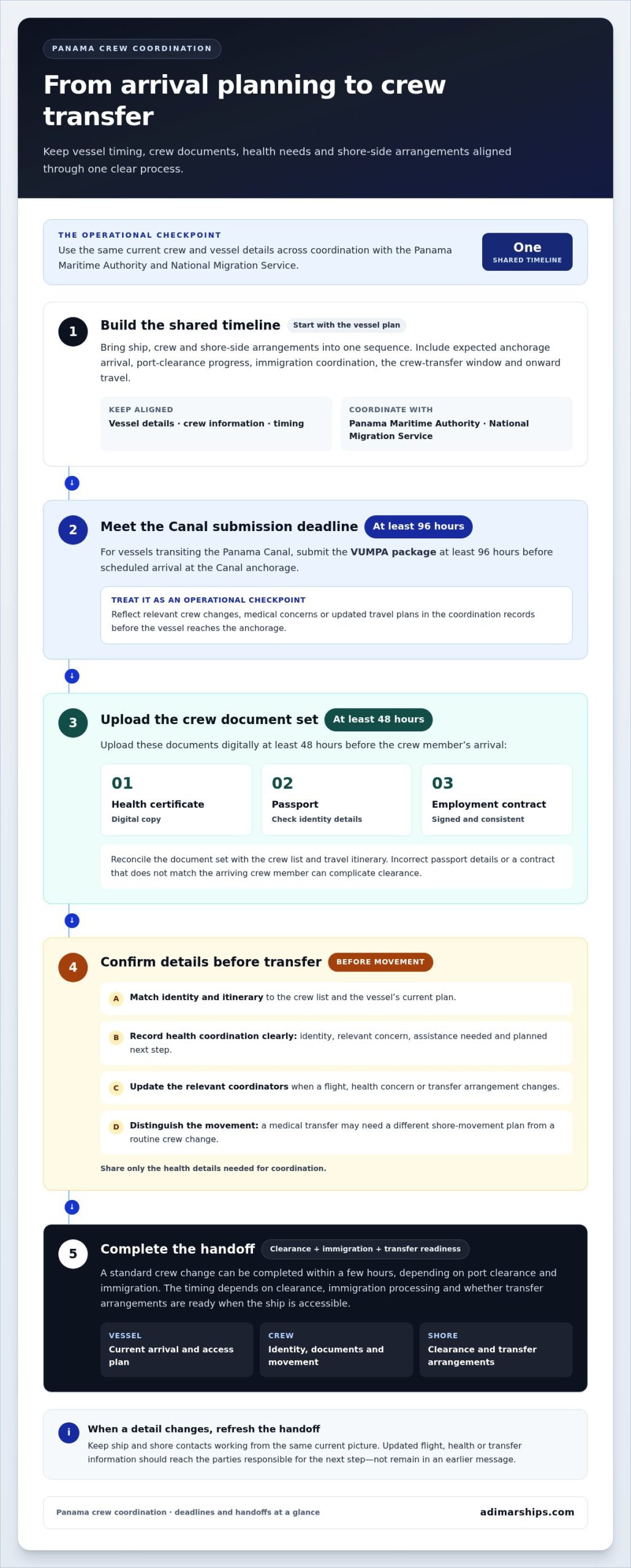
That preparation matters. Crew changes may require coordination with the Panama Maritime Authority and National Migration Service, while health concerns, immigration documents, and travel arrangements must be handled in step. A clear process keeps crew needs visible alongside vessel schedules and compliance obligations.
This guide explains how to organize crew health information, coordinate with relevant authorities, understand Maritime Labour Convention (MLC) implications, and plan crew changes, medical transfers, and repatriation. It also covers practical ways to support seafarer wellbeing during a Panama call, so you can prepare the necessary details and manage each handoff with confidence.
Key Takeaways
- Understand how maritime and immigration coordination can shape crew-change timing and vessel planning in Panama.
- Learn how MLC responsibilities connect crew health protection with practical repatriation planning.
- See how crew changes and medical transfers fit into a vessel’s schedule, and what can support seafarer wellbeing during the process.
- Explore how port-area welfare facilities can help crews access support while ashore.
- Identify the travel and identity documents, visa considerations, and advance preparation involved in crew entry or shore leave.
Coordination with maritime and immigration authorities
Managing crew welfare in Panama starts with aligning crew movements with the vessel’s arrival and transit plan. Coordination may involve the Panama Maritime Authority and National Migration Service. Each has a distinct role, so keep vessel details, crew information, and timing consistent across communications.
For vessels transiting the Panama Canal, the VUMPA package must be submitted at least 96 hours before scheduled arrival at the Canal anchorage. Treat that submission deadline as an operational checkpoint. A crew change, medical concern, or updated travel plan should be reflected in the relevant coordination records before the vessel reaches the anchorage.
Build one shared timeline for the vessel, crew, and shore-side arrangements. Include expected anchorage arrival, port-clearance progress, immigration coordination, the crew-transfer window, and onward travel. If a joining crew member’s flight changes, update the travel details and notify those coordinating the movement. This sequence helps prevent an outdated detail from disrupting the wider plan.
Prepare crew health information in a clear, consistent format. Record the crew member’s identity, relevant health concern, assistance needed, and planned next step. Share only the health details needed for coordination, and distinguish a medical transfer from a routine crew change. For example, a crew member needing medical attention may require a different shore-movement plan from a joining seafarer.
Panama requires digital health certificates, passports, and signed employment contracts to be uploaded at least 48 hours before a crew member’s arrival. Keep the document set aligned with the crew list and travel itinerary. An incorrect passport detail or a contract that does not match the arriving crew member can complicate clearance, so reconcile those records before submission.
With effective coordination, a standard crew change in Panama can be completed within a few hours, depending on port clearance and immigration. That timing is not a substitute for preparation. The sequence depends on the vessel’s clearance, the crew member’s immigration processing, and whether transfer arrangements are ready when the ship is accessible.
- Before arrival: Track the 96-hour VUMPA deadline and the 48-hour crew-document upload deadline.
- Before transfer: Match each crew member’s identity and itinerary to the vessel’s current plan.
- When plans change: Communicate revised flight, health, or transfer details to the relevant coordinators.
These checks give the Panama Maritime Authority and National Migration Service a consistent operational picture. They also help ship staff respond to health needs while keeping clearance and transit timing in view.
The Panama Canal connects more than 140 maritime routes worldwide. That reach makes clear, consistent coordination useful beyond the immediate port call: keep the ship’s operational plan and crew movement details aligned as information is passed between the vessel and shore-side contacts. When any detail changes, make the update available to the parties responsible for the next step, rather than relying on an earlier message. A concise handover can help each party work from the same current picture and support a smoother transition for the crew.
MLC compliance and seafarer repatriation
The Maritime Labour Convention (MLC) is relevant to shipowners’ crew-change compliance. The Maritime Labour Convention 2006 requires shipowners to provide comprehensive health protection. In practice, that responsibility connects onboard health concerns with decisions about medical support, crew replacement, and onward travel. A Panama call can bring these needs together within a vessel’s tight operational schedule.
Keep a clear record for each affected seafarer. Include the reported concern, assistance requested, actions already taken, and current travel or duty status. Separate confirmed details from pending arrangements. For example, document the handover for a crew member leaving the vessel for medical attention separately from the joining details of a replacement.
Repatriation is a coordinated transition, not just an airline booking. The shipowner’s team needs to connect the seafarer’s condition and fitness to travel with immigration arrangements, transport, flights, and the vessel’s schedule. If medical care is involved, the travel plan should reflect the treatment plan and any support needed during the journey. Keep responsible parties informed when these details change.
A practical case file helps shore and ship teams work from the same information. Keep relevant identity and employment records together with the itinerary, medical coordination notes, and movement updates. Limit health information to what support coordinators need. This protects privacy and reduces confusion during handovers between the vessel, shore coordinators, and travel contacts.
Use a straightforward sequence when a crew member must leave the vessel:
- Establish the need: Record the seafarer’s stated concern and the immediate assistance required.
- Coordinate the transition: Align vessel timing, shore movement, medical arrangements, and immigration steps.
- Plan onward travel: Match the itinerary to the seafarer’s condition and required support.
- Close the handover: Share relevant updates with the appropriate ship and shore contacts.
This sequence also distinguishes repatriation from a routine crew change. A replacement may be ready to join, but the departing seafarer’s health and travel needs remain a separate responsibility. Clear records make that distinction visible and help teams track each movement without mixing personal health details into general crew lists.
For a Panama vessel call, shore-side coordination can connect vessel timing with crew movement and related arrangements. A well-organized Panama vessel-call coordination plan can help keep those operational handovers aligned with the ship’s schedule.
Crew change and seafarer wellbeing
Panama crew welfare depends on matching transfer arrangements to the vessel’s location and schedule, as well as each seafarer’s needs. Port access, medical support, and time ashore shape the practical options.
Crew Changes and Local Welfare Services
A crew change is the planned transfer of joining and departing seafarers between a vessel and shore. Panama City, Colón, and Balboa differ in their relationship to the vessel’s location and transfer arrangements, so the port call determines which logistics matter most. Panama crew changes and medical transfers can take place simultaneously at designated Balboa or Cristobal anchorages. Crew changes and medical transfers require careful coordination around a vessel’s transit.
Seafarer Centers and Port Facilities
Seafarer centers and welfare facilities provide practical support ashore during port calls. The right facility depends on the vessel’s port, permitted shore access, and the crew member’s available time. Match the destination to the ship’s location and transport plan rather than assuming it is accessible from every anchorage. Operators can also ask crew what support would be useful before arranging a shore visit.
Mental health, counseling, and family support are distinct needs. Ship operators can provide a private way to raise concerns, maintain contact with family, and connect a seafarer with support channels available through the vessel or employer.
Welfare Costs, Transport, and Shore Leave
Costs for welfare services, transport, and shore leave vary with the route, transfer method, destination, and support required. The price depends on the case and is given after a quote request; cost factors include transport distance, launch arrangements, and any additional coordination. Panama crew-change logistics may involve movement between airports, hotels, medical facilities, and ports, so each leg can affect the overall plan.
For shore leave, match the destination to the vessel’s location and the crew member’s return arrangements. Confirm the pickup point and return plan with the crew member before departure. A clear schedule helps prevent missed transfers and confusion about where to rejoin the vessel.
Medical Care and Emergency Assistance
Ship operators can arrange medical assistance by sharing the crew member’s condition, required support, vessel position, and transfer needs with relevant shore-side contacts. Panama permits crew changes and medical transfers simultaneously at designated Balboa or Cristobal anchorages, but not after a vessel begins transiting the locks. Share essential updates with the vessel team and those coordinating the transfer.
For safer shore movements, give crew a clear destination, transport plan, return time, and vessel contact. The Panama Maritime Authority and National Migration Service are relevant to maritime and immigration coordination. Route crew welfare or counseling support through the shipowner’s established channels and the seafarer’s union or welfare organization.
Crew change services in Panama are offered 24/7, including weekends and holidays.
Where are Panama’s main seafarer centers and welfare facilities near ports?
In Panama, plan welfare access around the vessel’s actual port or anchorage, not a city name alone. Panama City, Colón, Balboa, and Cristobal are useful location references, but each crew member’s destination must suit the ship’s position, transfer arrangements, and available time ashore.
Match welfare support to the vessel’s location
A seafarer center is a shore-side place where crew can seek practical or social support. For a Panama call, first identify whether the vessel is near Balboa or Cristobal, then align any visit with the authorized transfer route. A facility across the city may be impractical if the crew has little time ashore or the vessel must resume operations.
Panama crew-change logistics can include transport between ports, airports, hotels, and medical facilities. The same transport planning helps determine whether a welfare visit can fit safely into the call. For example, a crew member traveling between a vessel and an airport may have little time for another stop unless the route and schedule allow it.
Plan for access, not just proximity
A map pin does not mean a seafarer can reach a facility. The transfer point, shore-access arrangements, transport, and return timing all affect practical access. Before the crew leaves, provide the destination, pickup location, expected return, and a shipboard contact. This gives the seafarer a usable plan, not just a street address.
For a medical visit, prioritize the medical destination and required transfer over a general welfare stop. Panama allows crew changes and medical transfers simultaneously at designated Balboa or Cristobal anchorages. However, both are prohibited after a vessel begins transiting the Panama Canal locks. The anchorage and transit sequence are therefore central to planning.
Build a useful port-call support map
Operators can prepare a simple location sheet for each call. Include the vessel’s port or anchorage, planned transfer point, relevant shore destinations, and transport route. Keep separate entries for medical support, crew-change movements, and voluntary welfare visits. This helps prevent crew from being sent to the wrong destination when their purpose or timing differs.
- Balboa or Cristobal: Match any crew movement to the designated anchorage and vessel schedule.
- Panama City or Colón: Use the relevant city reference to plan shore transport and return logistics.
- Medical facility: Keep the crew member’s care needs and transfer arrangements central to the route.
Port clearance and immigration coordination also affect when crew can move ashore. The Panama Maritime Authority and National Migration Service may be involved in crew-change coordination, so keep the movement plan consistent with the vessel’s clearance process. A port-specific support map helps ship staff communicate the same destination and timing to crew and shore-side contacts.
What documents and visas do crew members need to enter Panama or go ashore?
Panama crew movements depend on matching identity, employment, health, and travel records. For a crew member’s arrival, Panama requires digital health certificates, passports, and signed employment contracts to be uploaded at least 48 hours beforehand. Prepare one consistent file for each person, so names and travel details match across the documents.
Prepare the core crew documents
Typical crew-change documents in Panama include a valid passport, seaman’s book, employment contract or Letter of Guarantee, and flight itinerary. These records serve different purposes: identity, seafarer status, proof of employment, and onward travel. Compare names and identifying details before sharing the documents. A mismatch between a passport and flight itinerary can complicate the crew member’s movement.
- Passport: Match the name and details against the crew list and itinerary.
- Seaman’s book: Review its validity alongside the planned arrival date.
- Employment record: Prepare the signed contract or Letter of Guarantee.
- Travel plan: Keep the flight itinerary aligned with the vessel’s crew-change schedule.
- Health record: Include the required digital health certificate for arrival.
Account for visas and validity periods
Panama crew changes may require temporary visas or shore passes. Visa requirements depend on the crew member’s nationality and planned movement. For seafarers of restricted nationalities, visa applications must be submitted 15 business days in advance.
Validity checks matter for shore leave and crew entry or exit. For medical shore leave, Panama requires crew members’ passports to have at least six months of remaining validity. Panama does not permit crew entry or exit if a Seaman’s Book expires within six months of the arrival date. Review both documents before finalizing flights or transfer arrangements.
Keep submission and movement details aligned
Use the 48-hour upload deadline as a document-control checkpoint, not the start of preparation. Gather the passport, health certificate, and signed employment contract early enough to correct conflicting details. Then compare the uploaded records with the crew list, flight itinerary, and vessel schedule. If a flight changes, revise the itinerary details used for the crew movement.
For medical shore leave, link the passport-validity check to the planned transfer and destination. For a restricted-nationality crew member, place the 15-business-day visa submission milestone ahead of the expected movement. Temporary visas or shore passes may be part of the arrangement, depending on the crew member’s circumstances.
Coordinating crew documentation alongside vessel movements can reduce avoidable handoff confusion. Coordinate Panama crew documentation as part of the port-call plan.
Adimar Shipping: Ship Agency Services
Adimar Shipping, Inc. supports vessel calls in Panama through Ship Agency Services, coordinating communication and port-call requirements for owners and charterers. Turn to the team when crew movements, welfare arrangements, and vessel schedules need to come together as part of a Panama call. Owners may appoint an Owner’s Nominated Agency, while charterers can use a Charterer’s Nominated Agency. Husbandry Services can support related vessel and crew needs during the call. Clear coordination helps align planned crew movements with other husbandry requirements, while shipowners retain responsibility for seafarer welfare and MLC compliance.
Contact Adimar Shipping, Inc. to discuss your Panama vessel call, or visit adimarships.com.
Make Crew Welfare Part of the Port-Call Plan
Strong crew welfare planning is an operational discipline, not a task to leave until a vessel reaches port. Assign clear ownership for crew movements, document preparation, medical coordination, and updates to the shipboard team. This helps shore-side arrangements stay aligned with the vessel’s changing priorities.
A practical next step is to map the upcoming Panama call and identify where local coordination can support your crew plan. Adimar Shipping, Inc. offers Ship Agency Services, including Owner’s Nominated Agency and Charterer’s Nominated Agency. These agency arrangements give owners and charterers a clear point of coordination for vessel-call requirements. Shipowners remain responsible for their crew welfare obligations.
With a defined plan and responsibilities, managing crew welfare in Panama becomes easier to integrate into everyday voyage preparation. Contact Adimar Shipping, Inc. to discuss your Panama vessel call and take the next step with a clear operational plan.
Frequently Asked Questions
What crew welfare services are available for seafarers in Panama?
Panama crew welfare arrangements can include crew transfers, flights, inland transport, and medical attention. For example, a departing seafarer may need transport coordinated with a flight, while a joining crew member needs a transfer to the vessel. Husbandry support can coordinate these separate logistics around the port call. The right arrangement depends on the crew member’s needs, vessel location, and planned movement ashore.
What are the requirements for shore leave and crew changes in Panama?
Requirements depend on whether the crew member is joining, departing, or going ashore temporarily. A joining seafarer’s travel plan differs from a crew member’s shore leave, and either movement may involve a temporary visa or shore pass. For example, match the shore-pass or visa arrangement to the crew member’s role and movement, then coordinate the transfer and return plan with the vessel.
What labor laws and international conventions protect seafarers working on ships in Panama?
The Maritime Labour Convention (MLC), 2006, is relevant to shipowners’ crew-change compliance and requires comprehensive health protection. The STCW Convention also matters to Panama Canal crew changes: its latest amendments set medical-fitness standards relevant to those movements. For operators, these frameworks connect a seafarer’s health and fitness to duty with crew-change planning. Keep the applicable employment and health records organized for the individual movement.