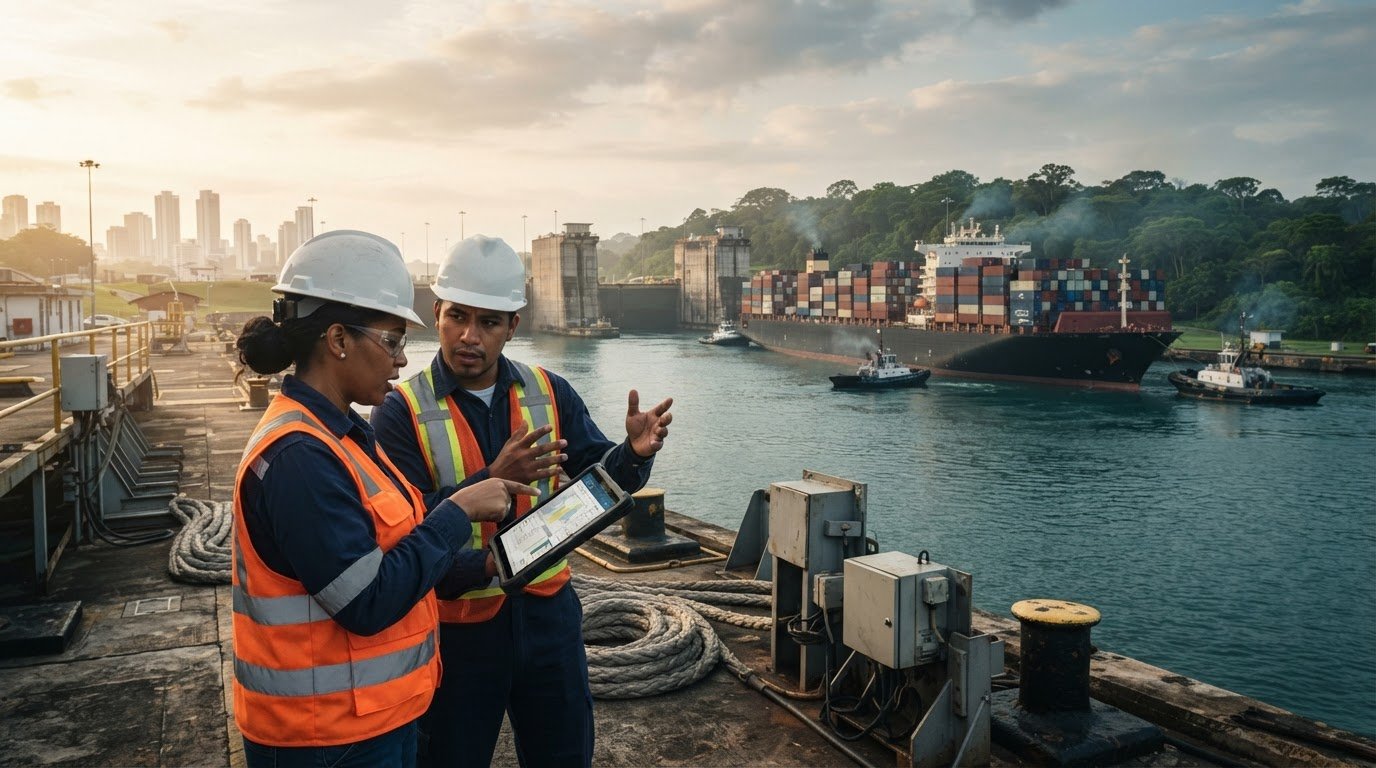


Use a template designed for the task: an acknowledgment to confirm receipt and ownership, or a logistics template for requests, confirmations, delivery notices, and compliance checks. This guide explains how ship agent communication standards make messages clearer through defined fields, shared expectations, and an explicit next action.
That structure matters when a port call brings ship operators, agents, authorities, and service providers together. A missing berth detail or unanswered request can leave people working from different assumptions. Short, task-specific messages clarify what is agreed, what remains pending, and who needs to act.
This guide covers coordination with port stakeholders, acknowledgment and logistics templates, and clear multilingual messages. It also explains where the IMO Standard Marine Communication Phrases fit: according to the International Maritime Organization, they include standardized phrases for safety-related shore-to-ship, ship-to-ship, and onboard communications. The goal is practical clarity, with each message supporting the next operational decision.
Key Takeaways
- Use acknowledgment messages to make receipt, responsibility, and the next action clear to everyone involved.
- Choose logistics templates that fit the task, then align key fields and expectations with port stakeholders before operations begin.
- Consistent data formats help different systems share port-call information and reduce avoidable documentation errors.
- Keep multilingual notes concise, and use approved maritime phrases for safety-related communications where they apply.
- Clear roles, timely updates, and a shared view of changing arrangements help limit confusion during a port call.
Communication with port authorities and stakeholders
A port call brings the vessel, agent, authorities, and service providers into one time-sensitive operation. Clear communication aligns each party’s next action and helps limit avoidable delays.
Country and Port Communication Differences
Ship agent communication standards vary because each country and port has its own procedures, authorities, reporting formats, and working language. For a vessel calling at a Panamanian port, the agent must coordinate messages around local requirements rather than assume another port’s process applies. A missing document or unclear handoff can disrupt the port-call sequence.
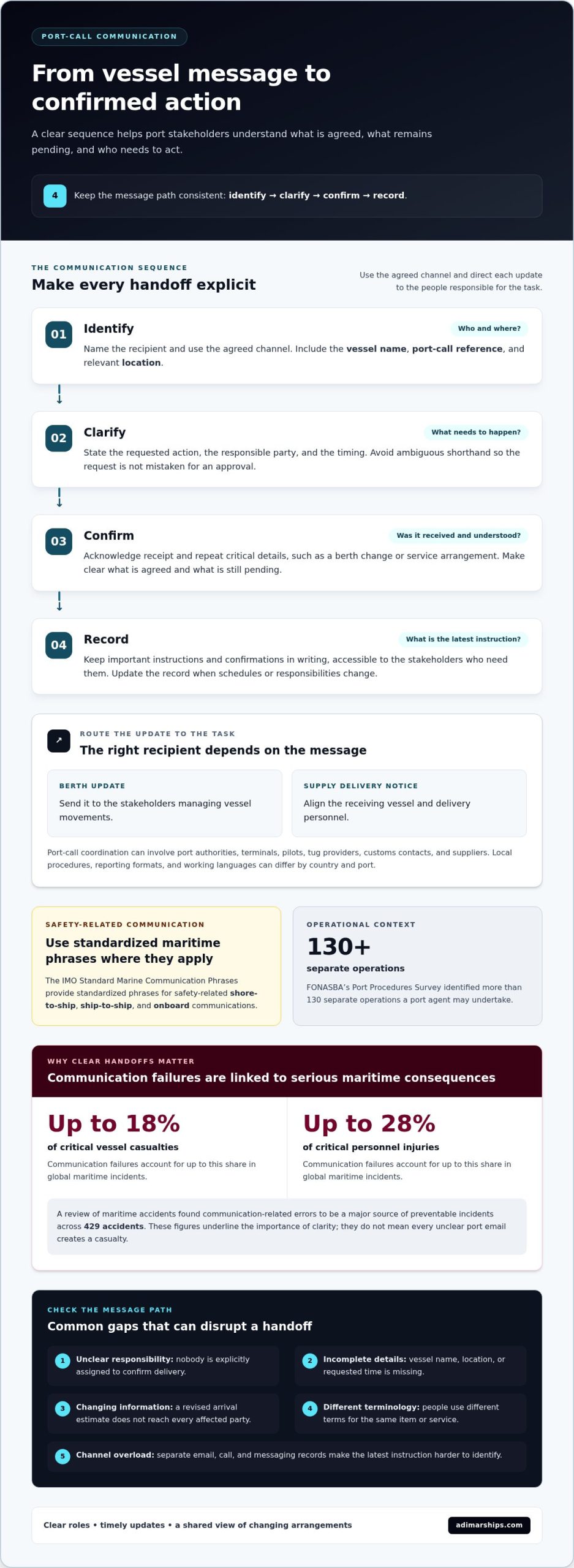
Local port knowledge helps identify who needs each update and when. An agent representing the ship’s interests coordinates with port stakeholders on arrival, services, and departure. This may involve port authorities, terminals, pilots, tug providers, customs contacts, and suppliers. The right recipient depends on the task: a berth update goes to those managing vessel movements, while a supply delivery notice needs to align the receiving vessel and delivery personnel.
Coordination can support port-call efficiency and environmental gains. When arrival information reaches relevant stakeholders promptly, they can better align berth arrangements and service timing. This may reduce waiting and unnecessary operational activity, although results depend on port conditions and vessel schedules. Local relationships matter alongside digital updates: a contact familiar with the port ecosystem can clarify a changed instruction, while written records preserve the agreed details.
Clear and Compliant Vessel Communications
To keep vessel communications clear, identify the recipient, use the agreed channel, state the vessel and port-call reference, specify the requested action, and record the response. These steps distinguish an acknowledgment from an approval. They also clarify whether a request concerns berth arrangements, customs documents, a service, or a supply delivery.
Radio communication requires concise, standardized wording, especially for safety-related exchanges. The IMO Standard Marine Communication Phrases, published by the International Maritime Organization, provide standardized phrases for safety-related shore-to-ship, ship-to-ship, and onboard communications. Agents can coordinate operational details with port stakeholders through designated channels, then record important instructions and confirmations in writing. This creates a traceable reference when schedules or responsibilities change.
- Identify: Include the vessel name, port-call reference, and relevant location.
- Clarify: State the requested action, responsible party, and timing without ambiguous shorthand.
- Confirm: Acknowledge receipt and repeat critical details, such as a berth change or service arrangement.
- Record: Keep the latest instruction accessible to the stakeholders who need it.
These practices reduce confusion when several parties handle linked tasks. FONASBA’s Port Procedures Survey identified more than 130 separate operations a port agent may undertake, illustrating why clear ownership and consistent updates matter. A delayed customs document, for example, can affect a later handoff if the responsible party and next step remain unclear. Timely communication helps stakeholders respond before a small gap becomes a wider delay.
Causes of miscommunication in maritime operations
Maritime operations depend on accurate exchanges between a vessel, its agent, port contacts, and service providers. A small message gap can disrupt a wider supply chain sequence. For example, if a crew change time changes but only one party receives the update, transport arrangements and vessel access may no longer align. Similar coordination challenges occur throughout overland transport networks, where vehicle logistics providers like GAATCO rely on structured dispatch notices and schedule updates to keep shipments on track. The problem is often not simply a late message, but a mismatch between what someone sent and what another person understood or acted on.
Communication failures account for up to 18% of critical vessel casualties and up to 28% of critical personnel injuries in global maritime incidents. A review of maritime accidents found communication-related errors to be a major source of preventable incidents across 429 accidents. These figures underline why clarity matters, especially where a message affects safety or a time-sensitive decision. They do not mean every unclear port email creates a casualty; they show that communication quality can have serious consequences.
Several recurring conditions make errors more likely:
- Unclear responsibility: A request for provisions may reach several contacts, but none is explicitly assigned to confirm delivery.
- Incomplete details: A service message without the vessel name, location, or requested time can be difficult to match to the correct operation.
- Changing information: A revised arrival estimate may not reach every party using an earlier schedule.
- Different terminology: A crew member, agent, and supplier may use different terms for the same item or service.
- Channel overload: Email, calls, and messaging applications can create separate records, making the latest instruction harder to identify.
Managing these risks requires attention to the full message path. The sender should identify the recipient and action, and the receiver should acknowledge important instructions. If a vessel’s arrival time changes, clearly mark the revised estimate and share it with stakeholders whose arrangements depend on it. Recording the change helps prevent an outdated schedule from carrying through later handoffs.
Local port knowledge also helps identify where a communication chain can break. In Panama, a port call may involve separate contacts for vessel movements, customs documentation, crew matters, and supply arrangements. A local representative can help coordinate those interfaces and keep information connected to the right operation. For vessel calls requiring this kind of on-the-ground coordination, local port-call support can help keep updates organized across the relevant parties.
Clear responsibilities, complete details, and reliable records give each stakeholder a stronger basis for action. When an instruction changes, communicate the update and its operational effect to reduce confusion before it reaches the next handoff.
Acknowledgment and logistics templates
Acknowledgment templates show that a message was received, who owns the next action, and what happens next. After receiving a request for provisions, for example, the recipient can confirm the vessel, requested items, delivery location, and any outstanding details. This distinguishes receipt from approval: “Received” confirms arrival of the message, while “Approved for delivery” records a decision. The distinction helps everyone coordinate without treating silence as consent.
Logistics templates work best when tailored to a specific task. A request form, order confirmation, delivery notice, and compliance checklist each serve a different stage of the operation. A ship supply delivery notice can record the date and time, ship name, berth, and IMO number, along with supply details, safety requirements, authorization, and contact information. These fields give sender and recipient a shared reference.
Use clear labels and required fields to prevent avoidable omissions. For example, require the berth and vessel name before sending a delivery notice. Mandatory checkboxes can prevent transmission while a critical field remains blank. Tie every field to a real decision or handoff, so the form stays practical rather than becoming a long document people bypass.
- Request: Identify the vessel, requested item or service, delivery location, and relevant timing.
- Confirmation: Record what has been accepted, the responsible contact, and any outstanding detail.
- Delivery notice: Include arrival details, supply information, safety instructions, and authorization.
- Compliance checklist: List required documentation and applicable regulations for the task.
Share each template with the relevant stakeholders before the operation begins. A supplier, vessel contact, and agent can then use consistent fields instead of exchanging separate versions based on different assumptions. For a Panama port call, customs documentation may differ from the information needed for a supply handoff, so tailor templates to the task and its participants. Make the latest approved version easy to identify, and record changes rather than circulating competing copies.
A template-based supply workflow can map each stage from request for quotation through Proof of Delivery. The request captures the need; the quotation response records the proposed supply; the order confirmation documents acceptance; the delivery notice aligns timing and access; and Proof of Delivery records completion. These structured tracking stages also extend beyond the port terminal, where fulfillment and warehousing specialists like Boost3PL rely on clear handoffs and milestone confirmations to keep inventory moving smoothly. Give each stage a clear sender, recipient, status, and confirmation point. This sequence makes gaps visible, supports consistent documentation, and provides a practical basis for reviewing operational performance.
Templates support clear coordination, but they do not replace task-specific judgment. A checklist helps flag missing information, while stakeholders still need to assess the details against the operation and applicable regulations. When a delivery plan changes, update the relevant record and notify affected participants so the next handoff uses current information.
Interoperability and standardized data exchange
Interoperability allows a ship agent’s information to move between systems without losing its meaning. During a Panama port call, vessel details, arrival updates, and supporting documents may pass among agents, ship operators, and port stakeholders. Shared data formats help recipients interpret the same fields, reducing duplicate entry and avoidable documentation errors. The challenge is keeping information reliable across differing systems and reporting processes.
The International Maritime Organization provides an international framework for maritime facilitation and communication. Its FAL Convention defines a ship agent as a party representing a ship’s owner and/or charterer in port, and the convention became effective in January 2018. The IMO Assembly adopted the IMO Standard Marine Communication Phrases in November 2001 through resolution A.918(22). Those phrases support standardized maritime communication, especially for safety-related exchanges.
For ship-to-shore communications, the IMO Standard Marine Communication Phrases include standardized phrases for safety-related shore-to-ship, ship-to-ship, and onboard communication. They help reduce ambiguity in safety messages, but do not replace port-call reporting formats or task-specific instructions. An agent can use structured data for a berth update, while the vessel and shore parties use approved phrases for a safety-related exchange.
A maritime single window gives reporting parties a shared electronic channel for submitting required information to relevant authorities. For ship agents, this affects communication by consolidating submissions and helping reduce repeated data entry; each message still needs accurate vessel details and clear status. The International Maritime Organization states that since 9 April 2019, electronic exchange of information is mandatory, with a transition period of no less than 12 months.
Interoperability depends on mapping information consistently across systems. A vessel name, IMO number, arrival estimate, and port-call identifier should keep the same meaning when transferred. If one system labels a field “arrival time” and another expects “estimated time of arrival,” a data-mapping rule can connect them. Use established exchange standards, validate required fields, and flag mismatches before onward submission.
Cybersecurity and data protection for ship-agent communications rely on practical controls: restrict access to authorized users, protect account credentials, use secure transfer channels, and share only information the operation needs. For example, a crew document should reach only the parties handling that task. Keep an auditable record of submissions and changes so teams can identify who updated a vessel record and when.
- Standardize: Use consistent identifiers, field names, and document versions.
- Validate: Check required data before sending it to a reporting system.
- Protect: Limit access and sharing according to each operational role.
- Reconcile: Compare acknowledgments with submitted information and correct discrepancies.
These practices make ship agent communication standards useful for both digital reporting and direct coordination. In Panama, consistent records help stakeholders work from the same vessel information, while clear ownership of each update supports compliance and operational reliability.
Multilingual notes and approved phrases
A multilingual message should preserve the same operational meaning for every stakeholder. During a Panama port call, an agent might send an English update to a vessel contact and a Portuguese version to a supplier. Both versions should identify the same vessel, requested action, location, and timing. A translation that turns “requested” into “approved,” for example, can create a false expectation about a service or delivery.
Use approved maritime phrases for safety-related communication, not as a substitute for translating every administrative message. The International Maritime Organization (IMO) states that its Standard Marine Communication Phrases include standardized phrases for safety-related shore-to-ship, ship-to-ship, and onboard communications. The IMO Assembly adopted the phrases in November 2001 through resolution A.918(22). For clearance documents or supply arrangements, plain operational wording and the applicable reporting format remain important.
Keep multilingual notes short and structured. Start with the vessel name and subject, then state the required action and relevant status. A note about a clearance document, for example, can say whether it has been received, is pending, or needs correction. Avoid idioms, unexplained abbreviations, and long sentences. If a technical term must remain unchanged, add its plain-language meaning.
- Use one fact pattern: Keep dates, times, vessel identifiers, and locations identical across language versions.
- Separate status from action: Distinguish “received” from “approved,” and state who must respond.
- Preserve technical terms: Keep an established maritime term where translation could change its meaning.
- Mark the controlling version: Identify the version used for the operational record, especially after revisions.
- Review critical details: Compare names, quantities, locations, and instructions before sending.
For global operations, a shared glossary helps everyone use consistent terms across messages. Include vessel references, berth terminology, common service names, and status labels used by the port-call team. A glossary supports reliable translation but does not establish regulatory meaning. For customs or other clearance communication, use the wording and documentation required for that process, and keep the translated note aligned with the source record.
When an instruction changes, issue the revision in each language used by affected stakeholders. Mark what changed, identify the current version, and request acknowledgment from the relevant recipient. This is especially useful when a vessel schedule or delivery location changes, as an outdated translation can continue circulating after the original message is corrected.
For multilingual coordination around a Panama port call, discuss ship agency coordination with a local representative familiar with the stakeholders and operational context.
Adimar Shipping: Ship Agency Services
Adimar Shipping, Inc. coordinates Panama Canal transits for vessel owners and charterers. Its Ship Agency Services help manage port-call communication and operational arrangements, providing ship interests with a local point of coordination. Engage the team when you need an agent to represent the owner or charterer and align arrangements for a vessel’s passage.
With Owner’s Nominated Agency or Charterer’s Nominated Agency, the appointment reflects which party nominates the agent. Husbandry Services support vessel and crew needs during the port call. These services depend on clear communication: the nominated representative can keep operational details moving among the parties involved.
To discuss ship agency support for a vessel’s Panama transit, contact Adimar Shipping, Inc.
Make Clear Communication Part of Every Port Call
Reliable ship agent communication standards involve more than message templates. They are a shared operating discipline: each stakeholder knows who owns an update, where the current record is, and how a change moves through the team. Build that discipline into port-call planning, then review it after each call to identify handoffs that need clearer ownership.
For vessel owners and charterers coordinating a Panama Canal transit, Adimar Shipping, Inc. provides Ship Agency Services, including Owner’s Nominated Agency and Charterer’s Nominated Agency. These options align representation with the party nominating the agent, supporting communication and coordination around the vessel’s passage.
If you’re planning a transit and want local ship-agency support, contact Adimar Shipping, Inc. to discuss your requirements. Clear responsibilities are a practical foundation for a more coordinated port call, and the next one can start with a stronger communication plan.
Frequently Asked Questions
Where can I find template examples?
Start with a task-specific acknowledgment or logistics template, then adapt its fields to the operation. For example, an acknowledgment email could read: “Received: [vessel] / [request]. We’ll coordinate [action]. Please confirm [open detail].” Add a clear subject line, such as “MV Example: berth update,” so recipients can find it quickly. Keep a controlled copy with your port-call documents and update it when the workflow changes.
What communication standards are used between ship agents and vessels?
Ship agents and vessels use agreed operational channels, consistent vessel identifiers, and concise messages. Safety-related exchanges can use the IMO Standard Marine Communication Phrases. Keep routine requests distinct from safety communications. For example, a supply update should identify its operational purpose, while a safety message should use clear, recognized phrasing. The term ship agent communication standards covers this combination of clear wording, defined responsibilities, and consistent information handling.
What are the standard message formats used for port call and ship agency communications?
There is no universal message layout for every port call. Use a recognizable subject, vessel and port-call identifiers, message purpose, requested action, relevant timing, and the sender’s role. For a revised arrival estimate, mark the message as an update and state which earlier estimate it replaces. Name attachments clearly and identify their version so recipients can distinguish current documents from superseded files.
Which systems and protocols do ship agents use to exchange documents with ports, terminals, and ships?
Exchange methods include email, digital port platforms, and electronic reporting systems such as a Maritime Single Window, where applicable. Interoperability depends on using an established data-exchange standard and keeping identifiers consistent across systems. For example, use the same vessel reference in a submitted form and its supporting document. The appropriate channel and format depend on the recipient and port-call reporting process.
What are common communication failures between ship agents and vessels, and how can they be prevented?
A common failure is acting on an outdated instruction after a schedule or document changes. Prevent this by marking revisions clearly, identifying the message they replace, and asking recipients responsible for affected actions to acknowledge the update. If an expected acknowledgment does not arrive, follow up through the agreed channel and record the response. This creates a useful audit trail and reduces the risk of conflicting instructions remaining in circulation.