
A MARPOL-compliant SOPEP is the gold standard for global trade, but for a Panama Canal transit, it’s essentially incomplete. You’ve likely spent years perfecting your vessel’s international compliance, yet the unique demands of SOPEP vs PCSOPEP can trigger significant stress for even the most seasoned operators. It’s frustrating to face a potential fine or a lost transit slot because of a documentation mismatch you thought was already covered by international law.
Mastering these local regulations is the only way to ensure your 2026 transits remain seamless and fine-free. We’re here to help you navigate these complexities so you can approach the Canal with total confidence. In this article, we’ll clarify the mandatory submission timelines, the essential role of a Panama-based representative, and how to correctly identify your vessel’s tier to avoid default penalties. By delegating these technical tasks to a local partner, you protect your schedule and your operational freedom.
Key Takeaways
- Understand why a standard MARPOL plan is insufficient and how the SOPEP vs PCSOPEP requirements differ under local Panama Canal Authority (ACP) mandates.
- Learn how to correctly categorize your vessel into one of the four technical tiers to avoid being defaulted to Tier 3 penalties.
- Identify the critical 96-hour pre-arrival submission window and the documentation needed to prevent costly transit slot forfeitures.
- Discover the mandatory legal requirements for appointing a Panama-based Authorized Person to act as your 24/7 liaison during emergencies.
- Master the technical nuances of the updated OP Notice to Shipping N-12-2026 to ensure a seamless, fine-free transit for your fleet.
SOPEP vs PCSOPEP: Defining the Regulatory Landscape
For maritime operators, an oil pollution plan is a standard part of doing business. However, the Panama Canal operates under a unique legal framework that layers local requirements over international conventions. Understanding the distinction between SOPEP vs PCSOPEP is essential for any fleet manager planning a 2026 transit. It isn’t a matter of choosing one over the other; it’s about ensuring your global compliance meets the strict local standards of the Panama Canal Authority (ACP).
Regulatory Comparison at a Glance:
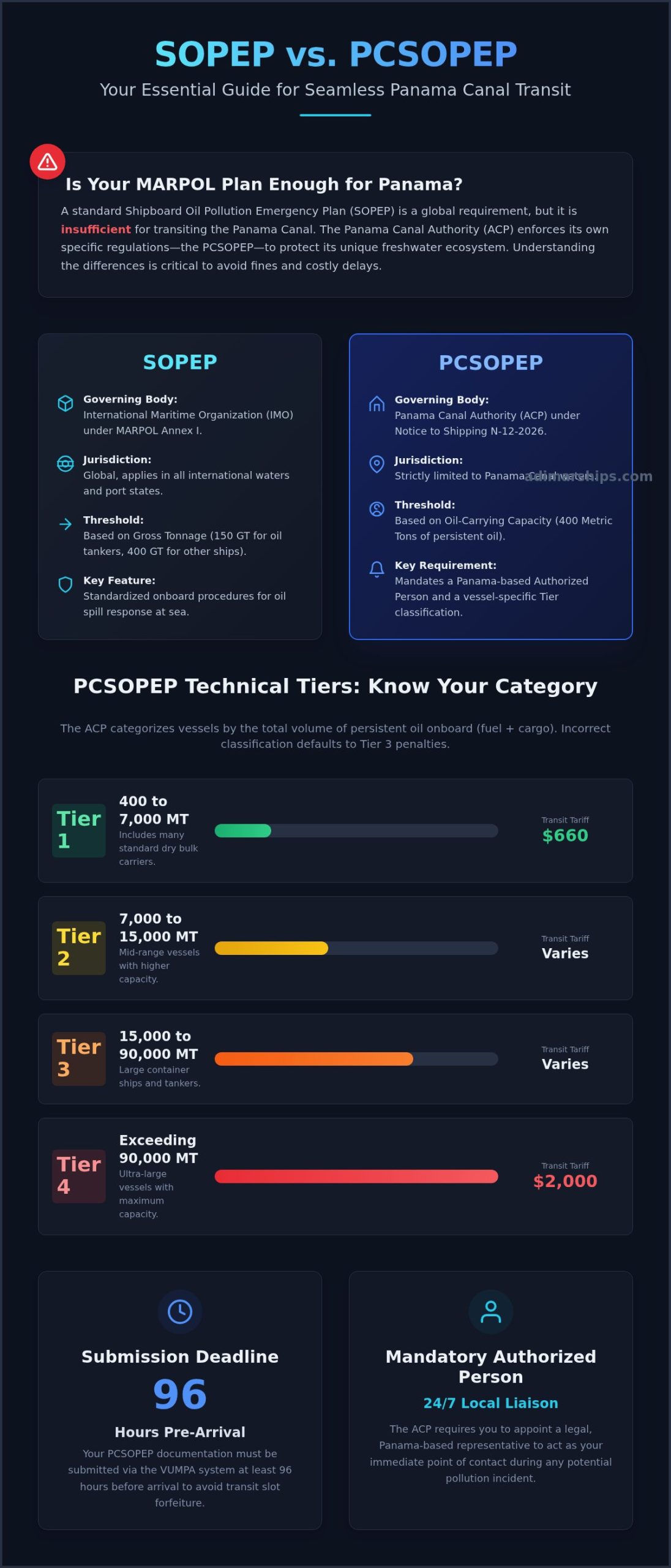
- Governing Body: SOPEP follows IMO (MARPOL) standards, while PCSOPEP is governed solely by the Panama Canal Authority (ACP).
- Jurisdiction: SOPEP is a global requirement; PCSOPEP applies only within Panama Canal waters.
- Mandatory Threshold: SOPEP applies based on Gross Tonnage (150/400 GT), but PCSOPEP uses a 400 MT oil-carrying capacity threshold.
- Key Local Requirement: PCSOPEP requires an ACP-approved plan and a Panama-based Authorized Person, which a standard SOPEP does not include.
The core conflict stems from the differing priorities of the IMO and the ACP. While the IMO focuses on broad safety standards for the open ocean, the ACP is tasked with protecting a critical, landlocked freshwater system. This discrepancy means your global plan often lacks the specific local contact points and immediate response protocols required by the Canal. Without these localized details, your vessel’s entry into the Isthmus is legally and operationally restricted.
What is SOPEP (MARPOL Annex I)?
The Shipboard Oil Pollution Emergency Plan (SOPEP) is a mandatory requirement for all ships under MARPOL Annex I. It serves as a standardized response manual for oil spill incidents at sea. Flag States and Port State Control enforce these rules globally to ensure every crew knows how to react to a leak or discharge. While it’s a robust foundation, the SOPEP is designed for the open ocean. It doesn’t account for the specific environmental sensitivities or the complex logistics of the Panama Canal’s freshwater locks and lakes. Because it’s a global standard, it lacks the localized contact information and resource allocation required by Panamanian law.
What is PCSOPEP (Notice N-12)?
Since 2005, the ACP has mandated a specialized plan for vessels transiting the Isthmus. The PCSOPEP is triggered when a vessel carries 400 metric tons or more of persistent oil. This includes both fuel and cargo. Compliance is managed through the “OP NOTICE TO SHIPPING N-12-2026,” which requires digital submission via the Vessel Universal Measurement and Pre-Arrival (VUMPA) system. The ACP doesn’t accept a standard SOPEP as a substitute. Local rules require a specific tiered classification based on oil capacity and the appointment of a resident Authorized Person to manage potential incidents on the ground. Without this local layer of protection, your vessel is effectively non-compliant the moment it enters Canal waters.
The Technical Tiers: How PCSOPEP Categories Differ
While a standard SOPEP focuses on the ship’s gross tonnage to define compliance, the Panama Canal Authority (ACP) looks specifically at the volume of persistent oil onboard. This is a fundamental distinction in the SOPEP vs PCSOPEP comparison. Your vessel’s classification isn’t just a label; it dictates your transit tariff, your response equipment requirements, and the level of scrutiny your VUMPA submission will receive. The ACP calculates this capacity by combining the volume of all fuel tanks with any persistent oil carried as cargo.
PCSOPEP Category Breakdown
The 2026 regulations, detailed in the OP Notice to Shipping N-12-2026, divide vessels into four distinct tiers based on their total oil-carrying capacity. Understanding where your vessel sits is the first step toward a successful transit. The international regulatory framework established by the IMO provides the baseline, but the ACP’s tiers are more demanding:
- Tier 1: 400 MT up to 7,000 MT. This category includes many standard dry bulkers and carries a transit tariff of $660.
- Tier 2: 7,000 MT to 15,000 MT of persistent oil.
- Tier 3: 15,000 MT to 90,000 MT. This bracket often includes large container ships and tankers.
- Tier 4: Exceeding 90,000 MT. These ultra-large vessels carry a transit tariff of $2,000.
Why Tiers Matter for Response Readiness
The higher your vessel’s tier, the greater the financial and logistical stakes. For vessels in Tier 2 and above, the ACP mandates a more robust relationship with an Oil Spill Response Organization (OSRO). These ships must demonstrate that they have immediate access to specialized personnel and heavy-duty cleanup equipment. If your plan is rejected or miscategorized, you risk an immediate administrative fine of $50,000. Even worse, the daily cost of a lost transit slot for a Neo-Panamax vessel can exceed $65,000, creating a massive financial ripple effect for your fleet.
The classification also impacts the legal duties of your local representative. As tiers increase, the Authorized Person must be prepared to manage larger potential incidents and authorize higher emergency expenditures instantly. Coordinating your documentation with a proactive PCSOPEP Authorized Person ensures your vessel is correctly tiered from the start, preventing the 30% rejection rate often seen with manual VUMPA submissions. We act as your vigilant eyes on the ground, making sure your technical data aligns perfectly with ACP expectations before you ever reach the locks.
Submission Deadlines and the Cost of Non-Compliance
The clock starts ticking long before your vessel reaches the locks. For a successful transit, the 96-hour submission window is the most critical hurdle in the regulatory landscape. Understanding the timing nuances of SOPEP vs PCSOPEP is often the difference between a smooth voyage and a costly administrative nightmare. While your international SOPEP is always onboard, the PCSOPEP requires active, digital validation from the Panama Canal Authority (ACP) before you enter their jurisdiction.
The 96-Hour Submission Rule
Wait until the last minute, and you risk everything. The ACP requires a complete VUMPA package, including your approved PCSOPEP, to be submitted at least 96 hours before arrival at the Canal anchorage. There’s no grace period for this requirement. A specialized Panama Canal ships agent plays a vital role here. We act as a vigilant second set of eyes, verifying technical documentation before it hits the ACP’s automated validation system. Industry data shows that clerical errors or minor data mismatches lead to a rejection rate of up to 30%. When a package is rejected, the 96-hour clock restarts immediately, which often forces a vessel to miss its original transit window.
Penalties and Transit Delays
The financial penalties for missing these marks are severe. Arriving without an ACP-approved plan results in a minimum administrative fine of $50,000. Even minor clerical errors or documentation discrepancies can trigger a $15,000 sanction. If you simply miss the 96-hour deadline, you face a minimum late submission fee of $2,500. These are just the direct costs; the indirect impact on your bottom line is often much higher.
One of the most significant risks is the “Tier 3 default” status. If a vessel’s PCSOPEP is found non-compliant or is submitted late, the ACP defaults the ship to Tier 3 response charges. This happens regardless of the ship’s actual oil-carrying capacity. For a smaller Tier 1 vessel, this jump in classification leads to significantly higher transit tariffs and mandatory OSRO fees that weren’t in the original budget. It’s a heavy price to pay for a simple administrative oversight.
Beyond the fines, the operational impact is devastating. Non-compliance results in the immediate forfeiture of your transit slot. For a Neo-Panamax vessel, the daily cost of a lost slot can exceed $65,000. Your vessel is deprioritized, and you may face cargo claims from late delivery. The only “green light” for your operation is the Notice of Acknowledgement (NOA). Until you receive this specific confirmation from the ACP, your transit isn’t secure. We focus on securing that NOA early, giving you the peace of mind that your schedule and your reputation are protected.
The Mandatory Role of the Authorized Person
Every vessel requiring a PCSOPEP must designate a Panama-based Authorized Person (AP). This is perhaps the most significant operational difference when comparing SOPEP vs PCSOPEP. While your global SOPEP relies on your crew and a Designated Person Ashore (DPA) who might be thousands of miles away, the Panama Canal Authority (ACP) requires a local representative with the legal and financial authority to act immediately. This individual serves as your 24/7 liaison, ensuring that if an incident occurs, response efforts aren’t delayed by time zones or administrative hurdles.
A global insurer or a remote DPA cannot fulfill this local role. The ACP mandate is clear: the Authorized Person must be a resident of Panama. They’re empowered to authorize emergency expenditures and coordinate directly with the Canal’s spill response teams. Selecting a reliable representative is a strategic decision that protects your fleet from being defaulted to Tier 3 status or facing transit forfeiture due to communication gaps.
Local Representation Requirements
The role of the AP is active, not passive. During your vessel’s transit, this representative must be available 24/7 to respond to ACP inquiries or emergency calls. Technical competence is only half the requirement; the AP must also be bilingual. Fluent communication in both Spanish and English is essential for coordinating between ship masters, ACP lock officials, and local response teams. Without this on-the-ground presence, even a minor documentation query can escalate into a transit delay. Your AP acts as a vigilant protector of your schedule, managing the interface between your vessel and the local regulatory environment.
Adimar’s Approach to PCSOPEP Compliance
We act as your dedicated, on-the-ground representative to ensure every transit is handled with precision. Our team focuses on streamlining the PCSOPEP authorized person process, taking the burden of local coordination off your shoulders. We don’t just wait for an incident; we proactively verify that your documentation aligns perfectly with the latest ACP Notice N-12 updates before your vessel ever reaches the anchorage. By delegating these specialized tasks to our local experts, you gain the operational freedom to focus on your global logistics while we handle the technical nuances of the Canal.
Ensure your 2026 transits are protected by experienced local oversight. Contact our team today to appoint a proactive PCSOPEP Authorized Person for your fleet.
Conclusion: Streamlining Your 2026 Transit Compliance
Success in the Panama Canal requires more than just standard maritime compliance. While your SOPEP provides a global foundation, the PCSOPEP is your specific local requirement for entry. The core differences in SOPEP vs PCSOPEP center on local geography, tiered oil-carrying capacities, and strict digital submission windows. Proactive management isn’t just a best practice; it’s a financial necessity. A single administrative error can lead to a Tier 3 default status, resulting in thousands of dollars in unexpected tariffs and the immediate loss of your transit slot.
PCSOPEP Readiness Checklist
Preparing for a 2026 transit shouldn’t be a source of stress. By following a structured approach, you ensure your vessel meets every ACP requirement without last-minute panic. Use this checklist to verify your readiness:
- Calculate Capacity: Total your vessel’s persistent oil-carrying capacity, including all fuel and cargo tanks.
- Appoint an Authorized Person: Secure a local Panama ship agency to act as your mandatory resident representative.
- Verify Documentation: Ensure your plan aligns with the latest OP Notice to Shipping N-12-2026.
- Submit Early: Upload your complete VUMPA package at least 96 hours before arrival at Cristobal or Balboa anchorage.
Secure Your Transit with Adimar Shipping
Navigating the complexities of a Panama Canal transit requires a partner who understands the local regulatory landscape. We act as your vigilant eyes on the ground, protecting your interests and your schedule. Our team handles the technical nuances of the SOPEP vs PCSOPEP transition, ensuring your Authorized Person is always ready to respond to ACP inquiries in real-time. We’ve built our reputation on reliability and transparency, serving as an extension of your own team to simplify the clearance process.
Don’t leave your compliance to chance or automated systems that might miss critical details. Delegating these specialized tasks to our experts gives you the peace of mind to focus on your core operations. We’re here to ensure your fleet moves through the Isthmus without delays, fines, or friction. Partner with Adimar for expert PCSOPEP representation and secure your 2026 transit slots today.
Protect Your Fleet with Local Compliance Expertise
Managing the technical divide between SOPEP vs PCSOPEP doesn’t have to be a source of operational stress. While a global plan offers a foundation, the Panama Canal Authority demands a specialized, localized approach to protect its unique watershed. Success in 2026 depends on your ability to handle the strict 96-hour submission window and correctly classify your vessel’s technical tier to avoid default penalties. By appointing a Panama-based Authorized Person, you ensure that your fleet has a vigilant representative ready to handle any emergency coordination in real-time.
Our team specializes in ACP Notice N-12 regulations and provides the local expertise needed for seamless transit coordination. We act as an extension of your own team. We manage the documentation and local liaison duties that keep your schedule on track. Delegating these complexities to a dedicated partner is the most cost-effective way to protect your bottom line and maintain operational freedom. Take the first step toward a worry-free voyage today.
Secure Your PCSOPEP Compliance with Adimar Shipping and approach the locks with total confidence. Don’t let technical hurdles slow you down; we’re ready to guide you through every mile of the Canal.
Frequently Asked Questions
Is PCSOPEP mandatory for all vessels transiting the Panama Canal?
PCSOPEP is mandatory for any vessel carrying 400 metric tons or more of persistent oil as fuel or cargo. This includes most commercial ships transiting the waterway. If your vessel falls below this 400 MT threshold, you aren’t required to maintain a local plan, though you must still comply with standard MARPOL regulations. We recommend verifying your specific oil-carrying capacity early to confirm your compliance status before scheduling.
Can I use my existing SOPEP for the Panama Canal transit?
You cannot use a standard MARPOL SOPEP to satisfy Panama Canal requirements. While the SOPEP vs PCSOPEP documentation shares some technical data, the ACP requires a localized plan tailored to the Canal’s geography. The PCSOPEP must include an ACP-approved tiered classification and the designation of a Panama-resident Authorized Person. Relying on a global plan alone will lead to an immediate $50,000 fine and transit forfeiture.
What is the 96-hour rule for PCSOPEP submission?
The 96-hour rule requires a complete VUMPA submission at least four days before your vessel arrives at the Canal anchorage. This deadline is strictly enforced with no grace periods. Missing this window results in a minimum $2,500 sanction and often causes the forfeiture of your scheduled transit slot. Our team proactively manages this timeline to ensure your Notice of Acknowledgement is secured well in advance.
What happens if my vessel is categorized as Tier 3 due to non-compliance?
Vessels found non-compliant are automatically defaulted to Tier 3 status, which carries the highest transit tariffs and mandatory OSRO fees. This penalty applies even if your vessel’s actual capacity qualifies it for Tier 1 or Tier 2. It’s a costly consequence of administrative oversight that can inflate your transit budget by thousands of dollars. Proactive documentation management prevents this default and keeps your costs aligned with your vessel’s actual size.
What is an Authorized Person in the context of PCSOPEP?
An Authorized Person (AP) is a mandatory, Panama-based representative who serves as a 24/7 liaison with the ACP. This individual must have the legal and financial authority to authorize emergency expenditures and coordinate spill response efforts immediately. Your AP must be fluent in both Spanish and English to manage high-stakes communications during an incident. We provide these specialized services to ensure your fleet has expert local representation at all times.
How often does a PCSOPEP need to be renewed or updated?
An approved PCSOPEP remains valid for four years from the date of ACP approval. However, you must update the plan immediately if there are significant changes to the vessel’s name, ownership, or oil-carrying capacity. Any amendments must be submitted to the ACP at least 30 days before the vessel’s next transit to allow for proper review. Keeping these details current is essential for maintaining your Notice of Acknowledgement.
What is a Notice of Acknowledgement (NOA) in the Panama Canal?
The Notice of Acknowledgement (NOA) is the official confirmation from the ACP that your PCSOPEP has been reviewed and accepted. You must receive this digital “green light” before your vessel is permitted to begin its transit. Without an active NOA, your ship will be held at the anchorage, leading to significant delays and potential late submission fines. We focus on securing this confirmation early to protect your schedule.
Does PCSOPEP apply to vessels transiting in ballast?
Yes, the PCSOPEP requirement applies to vessels transiting in ballast if they carry 400 MT or more of persistent oil as fuel. The ACP’s calculation is based on total oil-carrying capacity, not just active cargo. Many large vessels in ballast still exceed the threshold due to their bunker tank volumes. It’s critical to calculate your total fuel capacity to determine if the SOPEP vs PCSOPEP distinction applies to your specific voyage.