

Could a single oversight in your agency appointment cost your company $50,000 in daily demurrage? In the high-stakes maritime environment of 2026, the choice between a charterer’s agent vs owner’s agent Panama is your most critical financial firewall. With Neopanamax auction premiums reaching $425,000 and draft restrictions tightening to 48.5 feet, you cannot afford to have your interests diluted by a conflict of interest. A shared representative might prioritize speed for one party while ignoring the vessel safety or husbandry needs of the other.
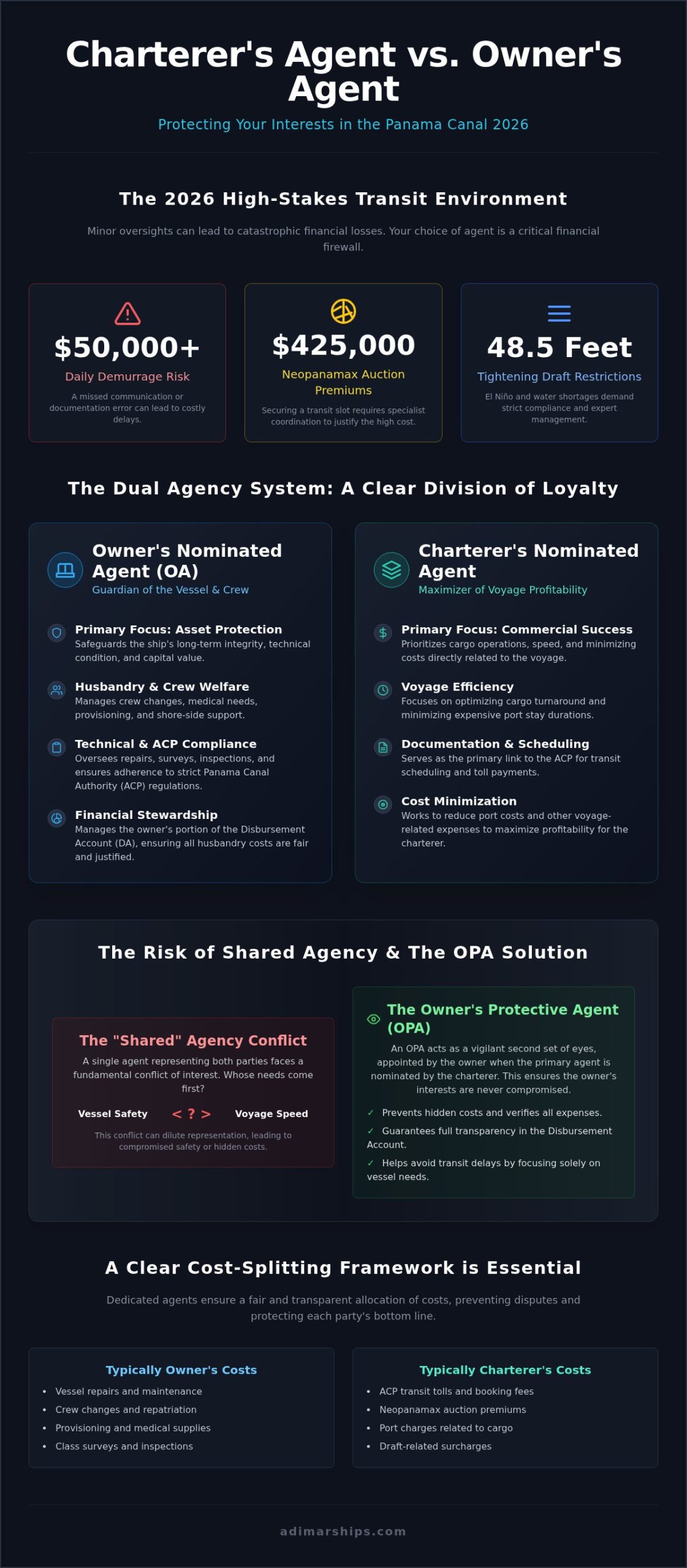
We recognize the stress that comes with the ACP’s strict regulatory environment and the looming threat of El Niño water shortages. This guide promises to show you how to protect your assets and your bottom line by ensuring every party has dedicated, ethical representation. We will break down the specific roles of each agent, provide a clear cost-splitting framework, and explain how an Owner’s Protective Agent (OPA) guarantees zero transit delays and full transparency for your 2026 operations.
Key Takeaways
- Understand the critical distinction between a charterer’s agent vs owner’s agent Panama to ensure your specific interests aren’t compromised during high-stakes transit periods.
- Learn how a Nominated Owner’s Agent acts as your technical guardian, managing essential husbandry services and ACP compliance to protect the vessel’s long-term integrity.
- Discover the commercial advantages of a Charterer’s Agent, from optimizing cargo turnaround to minimizing expensive port stays and maximizing voyage profitability.
- Identify the risks of a “shared” agency and how an Owner’s Protective Agent (OPA) serves as a vigilant second set of eyes to prevent hidden costs.
- Gain a clear cost-splitting framework to navigate the 2026 fee structures, including Neopanamax auction premiums and draft-related surcharges.
The Dual Agency System: Why Panama Requires Specialized Representation
Every vessel entering the Panama Canal’s waters must have a local representative recognized by the Panama Canal Authority (ACP). This isn’t just a matter of convenience; it’s a legal requirement. In the canal’s complex ecosystem, this representative is known as the Nominated Agent. They serve as the primary link between the ship and the ACP, handling everything from transit scheduling to the payment of tolls. Because the ACP doesn’t interact directly with foreign shipowners or charterers, your choice of Shipping agency determines how smoothly your vessel moves through the locks.
The stakes are incredibly high. A minor documentation error or a missed communication window can lead to your vessel losing its slot. In today’s market, missteps often result in daily demurrage bills exceeding $50,000. This financial pressure creates a natural tension between the parties involved in a voyage. It introduces the central dilemma for any maritime professional: the charterer’s agent vs owner’s agent Panama conflict. While one agent can technically handle the transit, the question is whether they can effectively protect two different sets of interests simultaneously.
The ACP Factor: A Unique Regulatory Environment
General shipping experience isn’t enough to navigate the Panama Canal. The ACP operates under a rigid set of regulations that differ significantly from standard port operations. Documentation must be precise, and scheduling is managed with down-to-the-minute accuracy. If an agent lacks deep local expertise, the vessel risks being pushed to the back of the queue or facing heavy fines for non-compliance. The Panama Canal Ships Agent acts as a critical financial firewall between your vessel and the Authority’s steep penalties.
Financial Risks of Poor Agency Selection in 2026
The financial landscape of the canal has become more volatile in 2026. Neopanamax auction slots have reached record highs, with premiums hitting $425,000 in May 2026. When you are paying such a high price just to secure a transit time, you need an agent who is a specialist in coordination. A specialized local partner ensures that every dollar in your Disbursement Account (DA) is accounted for and justified. They prevent hidden costs that often creep into the final bill when a representative isn’t fully focused on your specific bottom line.
Poor selection also leads to the risk of non-compliance with local maritime laws. Panama’s regulations regarding crew changes, waste disposal, and technical inspections are strict. Without a vigilant partner on the ground, you might find yourself facing unexpected surcharges or legal delays. Choosing between a charterer’s agent vs owner’s agent Panama isn’t just about who signs the paperwork; it’s about who is watching your assets when the pressure of the canal’s schedule is at its peak.
The Owner’s Nominated Agent: Safeguarding the Vessel and Crew
The Owner’s Nominated Agent (OA) serves as the primary guardian of the shipowner’s capital assets. When comparing a charterer’s agent vs owner’s agent Panama, the fundamental distinction lies in where the loyalty rests. The OA focuses on the ship’s long-term integrity and the welfare of the people on board. They don’t just facilitate a transit; they manage technical oversight, including essential repairs, surveys, and class inspections that must occur within the canal’s jurisdiction. This specialized role of the ship agent ensures that the vessel remains compliant with international standards while navigating local waters.
Financial stewardship is another core duty of the owner’s representative. They handle the owner’s specific portion of the Disbursement Account (DA), ensuring that all technical and husbandry costs are fair, transparent, and justified. In the complex landscape of 2026, where every hour of delay carries a massive price tag, having an agent dedicated solely to the vessel’s technical readiness is a strategic necessity rather than a luxury.
Husbandry and Crew Support in Panama
Success in the Panama Canal depends on the speed and reliability of shore-side support. Managing crew changes, medical assistance, and provisioning requires an agent with deep local connections. For example, getting a specific engine part through customs and onto a vessel at anchor can be the difference between a smooth transit and a missed slot. By utilizing specialized husbandry services in Panama, owners can rest assured that their crew and vessel needs are met without delay. Our team acts as your local office, providing the transparency you need to manage port call expenses effectively.
PCSOPEP and Technical Compliance
Environmental regulations in the canal are becoming increasingly stringent. Every vessel over 400 gross tons must have a PCSOPEP authorized person on call. This individual acts as the legal liaison for oil spill response plans, a requirement that carries heavy ACP fines if ignored. The owner’s agent acts as a regulatory gatekeeper, double-checking that vessel dimensions and equipment match the ACP declarations exactly. This vigilance prevents technical discrepancies that could lead to a vessel being barred from transit or subjected to an unexpected first-time admeasurement fee of $1,100.
If you need a partner who prioritizes your vessel’s safety and your crew’s well-being, consider our specialized ship agency services to ensure your interests remain protected throughout the transit process.
The Charterer’s Nominated Agent: Optimizing Voyage Efficiency
While the owner’s representative protects the physical asset, the Charterer’s Nominated Agent (CA) drives the commercial success of the voyage. Their primary objective is maximizing turnaround efficiency. In the competitive Panama market, every hour spent at port or in the canal anchorage directly impacts the charterer’s bottom line. The CA acts as the specialized commercial liaison, coordinating with port authorities and stevedores to ensure the vessel adheres strictly to laycan requirements and specific voyage instructions.
A major part of this role involves active cargo management. The agent oversees the interface between the ship and the terminal, ensuring that loading or discharging operations proceed without friction. By managing these logistics proactively, they help minimize port stay durations and eliminate the risk of expensive demurrage. When evaluating the charterer’s agent vs owner’s agent Panama, it’s clear the charterer needs a partner who understands the financial urgency of the voyage’s timeline. They are the eyes and ears of the charterer on the ground, ensuring that the commercial interests of the freight are prioritized above all else.
Commercial Turnaround and Cargo Coordination
The charterer’s agent is the vital link between the vessel and the cargo terminal. They manage the flow of real-time information to ensure berth availability aligns perfectly with the vessel’s arrival. Accuracy in documentation is non-negotiable. The agent must verify cargo manifests and bills of lading to prevent customs delays that could stall a scheduled transit. Their focus remains on optimizing the port stay, which directly reduces the overall voyage costs. This involves constant communication with terminal operators to clear any bottlenecks before the ship even arrives at the locks. By handling these technical details, the agent allows the charterer to focus on broader commercial goals.
Bunkering and Voyage Logistics
Efficiency extends to the vessel’s fuel needs and operational supplies. Coordinating bunkering in Panama is a complex task that requires precise timing to avoid disrupting the rigid ACP transit schedule. The CA manages the Charterer’s Disbursement Account (DA) with full transparency, ensuring that fuel quality and quantity are verified during transit calls. This level of oversight prevents fuel-related disputes and ensures the vessel has the necessary resources to complete its journey cost-effectively. By delegating these specialized tasks to a local expert, charterers gain the operational freedom to focus on their global logistics strategy while we handle the complexities of the canal.
Charterer’s Agent vs Owner’s Agent: The Comparison Matrix
The choice between a charterer’s agent vs owner’s agent Panama determines who controls the narrative during a high-stakes transit. While both agents work toward a successful passage, their performance metrics are fundamentally different. The owner’s agent views success through the lens of asset integrity and crew safety. Conversely, the charterer’s agent measures success by the speed of cargo turnaround and the minimization of port stay costs. This divergence in priorities creates a natural tension that must be managed through clear, independent representation.
Financial responsibility is usually divided along these lines of interest. Typically, the charterer covers voyage-specific costs like canal tolls, cargo handling, and the mandatory $30,000 tugboat fee for Neopanamax transits. The shipowner remains responsible for husbandry services, crew changes, and technical maintenance. When these roles are blurred into a single agency appointment, the risk of misallocated expenses increases. Furthermore, the legal responsibility matrix for ACP fines usually places the agent of record in the crosshairs. If an error occurs, having an agent who is strictly loyal to your interests ensures that liability is correctly attributed and defended.
Identifying and Resolving Conflicts of Interest
Can one agent truly serve two masters? In the high-pressure environment of the Panama Canal, the answer is often no. Conflict arises when the charterer’s need for speed clashes with the owner’s safety protocols. For instance, if a vessel faces a minor technical issue that threatens a $425,000 auction slot, the charterer will push for immediate transit. The owner, however, might prioritize a safety-critical repair. A shared agent faces an ethical dilemma; they might favor the party providing more frequent business or higher commissions. Independent representation remains the gold standard for Panama Canal transits because it eliminates these compromised loyalties.
Financial Transparency in Disbursement Accounts
Hidden fees often hide in unified Disbursement Accounts (DA). When expenses for both parties are bundled together, it becomes difficult to identify whether you are subsidizing the other party’s requirements. Line-item clarity is essential for distinguishing owner-specific technical costs from charterer-specific port operations. A DA Audit acts as a vital tool for financial security, allowing each party to verify that they are only paying for their contracted responsibilities. This level of transparency prevents the migration of husbandry costs into the charterer’s commercial bill. To ensure your financial interests are fully protected during your next transit, request a consultation for our transparent ship agency services.
The OPA Solution: How Adimar Shipping, Inc. Protects Your Interests
When the charter party agreement grants the charterer the right to nominate the primary agent, the shipowner often feels a loss of control over their asset. This is where the charterer’s agent vs owner’s agent Panama dynamic becomes most critical. To bridge this gap, Adimar Shipping, Inc. offers the Owner’s Protective Agency (OPA) service. We act as your dedicated advocate on the ground, serving as a vigilant sentinel that oversees the primary agent’s activities. We don’t just process paperwork; we provide a second set of eyes to ensure your interests are never secondary to commercial voyage goals.
Adimar Shipping, Inc. functions as a local office for your headquarters. We understand that navigating the Panama Canal involves more than just technical compliance; it requires a partner who shares your core values. Our commitment to ethical standards and absolute transparency is the foundation of every partnership we build. By delegating the oversight of your vessel to a specialized local expert, you gain the operational freedom to manage your global fleet while we handle the complexities of the canal zone as your boots on the ground.
Why Choose a Protective Agent in Panama?
The primary risk of relying solely on a Charterer’s Nominated Agent is the potential for husbandry and crew needs to be sidelined. While the primary agent focuses on cargo operations and terminal coordination, your crew’s medical needs or essential provisions might face delays. An OPA prevents this by taking direct responsibility for owner-related tasks. Adimar Shipping, Inc. also mitigates the risk of overbilling. By auditing the primary agent’s Disbursement Account, we ensure that every charge is accurate and that no “hidden” commercial fees migrate into the owner’s bill. This level of oversight provides the security that only a truly independent representative can offer.
Next Steps: Securing Your 2026 Transit
Securing your 2026 transit begins with early preparation. As draft restrictions and auction prices fluctuate, having a reliable partner becomes your greatest competitive advantage. Appointing Adimar Shipping, Inc. as your ship agency in Panama requires only your vessel’s particulars and your expected arrival window. This allows us to provide a precise DA estimate that accounts for the latest ACP tolls and surcharges. Don’t leave your assets to chance in one of the world’s most complex transit zones. Contact Adimar Shipping, Inc. today for expert representation and ensure your interests remain protected at every lock.
Strategic Representation for the 2026 Panama Canal
The choice you make regarding your representative at the canal isn’t just administrative; it’s a strategic move to insulate your company from the volatility of the 2026 maritime landscape. We’ve explored how the distinction between a charterer’s agent vs owner’s agent Panama determines who controls the narrative during your transit. Whether you’re safeguarding a technical asset or pushing for commercial turnaround, the need for independent, loyal representation has never been more vital. You need a partner who views your success as their own.
Adimar Shipping, Inc. stands as your specialized local partner, offering the vigilance and ethical transparency required to navigate these waters safely. As an authorized PCSOPEP representative with a history of vigilant local oversight, we ensure that your Disbursement Accounts are managed with absolute precision. Don’t leave your voyage to a shared interest that might prioritize another’s bottom line. Secure your Panama Canal transit with Adimar Shipping, Inc.’s expert agency services. Let’s work together to ensure your vessel moves through the locks with the protection it deserves.
Frequently Asked Questions
What is the difference between a Charterer’s Agent and an Owner’s Agent in Panama?
The primary difference between a charterer’s agent vs owner’s agent Panama lies in their loyalty and core objectives. An owner’s agent prioritizes the technical integrity of the vessel and the welfare of the crew. A charterer’s agent focuses on voyage profitability and commercial efficiency. While both coordinate with the Panama Canal Authority, they manage different parts of the Disbursement Account to ensure costs are allocated correctly according to the charter party agreement.
Can a ship have both an Owner’s Agent and a Charterer’s Agent simultaneously?
Yes, vessels frequently appoint both types of agents simultaneously to ensure impartial representation for all parties. Having dual representation prevents conflicts of interest during high-pressure transits. The charterer nominates an agent to handle cargo and port operations, while the owner appoints a protective agent to oversee husbandry and technical compliance. This structure provides a transparent framework for cost-splitting and protects both the asset and the commercial timeline.
Who is responsible for paying the Panama Canal transit fees?
The responsibility for paying Panama Canal transit fees typically falls on the charterer under standard voyage or time charter terms. These costs include the fixed and capacity tariffs, tugboat fees, and the freshwater surcharge. However, the shipowner remains responsible for technical costs, such as first-time admeasurement fees or technical inspections. Your agent ensures that these expenses are clearly separated in the final Disbursement Account to avoid financial confusion.
What is an Owner’s Protective Agent (OPA) and why is it necessary?
An Owner’s Protective Agent (OPA) is a specialized representative hired by the shipowner to supervise the activities of the charterer’s nominated agent. This is necessary because the primary agent’s loyalty lies with the charterer who appointed them. An OPA acts as a vigilant watchdog, auditing the Disbursement Account for hidden fees and ensuring that essential husbandry services aren’t neglected in favor of commercial speed. It offers the owner absolute peace of mind.
How do I choose the right ship agent for a Neopanamax transit in 2026?
Selecting a ship agent for a Neopanamax transit in 2026 requires verifying their expertise with the latest ACP regulations and the LoTSA 2.0 booking system. You should choose a partner with authorized PCSOPEP status and a proven track record of managing record-high auction slots. A specialized local agent understands the nuances of 2026 draft restrictions and can provide precise estimates for the freshwater surcharge, helping you avoid unexpected financial hits during transit.
What happens if there is a conflict between the Charterer and the Owner during transit?
If a conflict arises between the charterer and the owner, the respective agents serve as professional mediators to find a resolution. For example, if a safety concern clashes with a commercial deadline, each agent provides expert guidance based on their client’s legal standing. Having independent representation ensures that your interests are defended according to the charter party terms. This prevents one party from being forced into a decision that compromises their financial or technical security.
Are agency fees regulated by the Panama Canal Authority (ACP)?
No, agency fees are not regulated by the Panama Canal Authority (ACP). While the ACP strictly controls official tolls, tugboat services, and security charges, agency fees are private commercial agreements. These fees vary based on the scope of services provided, such as husbandry or OPA oversight. It’s vital to work with an agent who provides transparent, line-item clarity in their quotes to ensure you aren’t paying for unsupported or hidden service premiums.
What are the common causes of transit delays that an agent can help avoid?
Agents help avoid delays caused by documentation errors, technical non-compliance, and missed scheduling windows. For instance, an agent ensures that all PCSOPEP declarations and vessel dimensions are accurate before the ACP admeasurement. They also manage the critical timing for bunkering and crew changes to align with the vessel’s assigned slot. By proactively coordinating these logistics, a specialized agent prevents the loss of expensive transit slots and the resulting daily demurrage bills.