

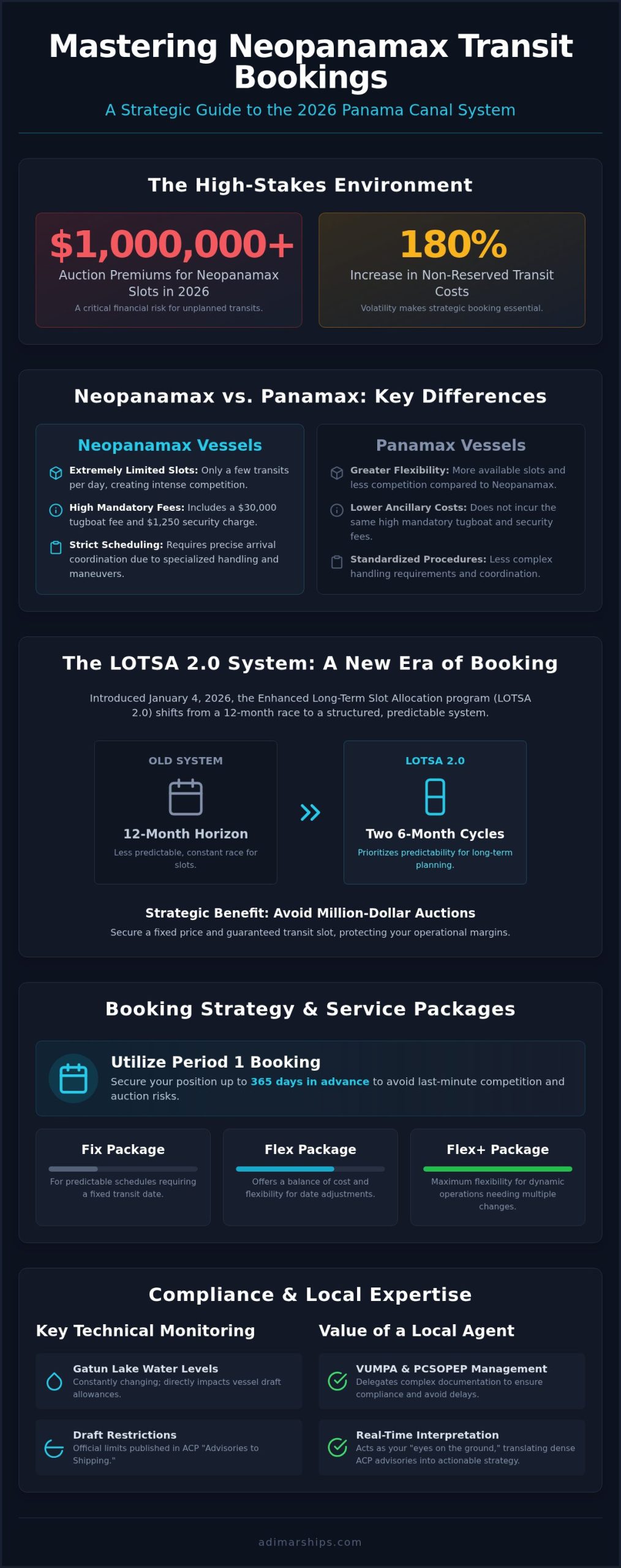
Auction premiums for Neopanamax slots have exceeded $1 million in 2026, representing a 180% increase for non-reserved transits since last year. This volatility makes understanding how to book Neopanamax transit Panama Canal slots more than a logistical task; it’s now a critical financial strategy. We know the stress of watching operational margins evaporate while waiting for a slot or facing unpredictable draft restrictions. It’s frustrating to manage complex regulatory shifts like LOTSA 2.0 from thousands of miles away while the stakes continue to rise.
This guide helps you master the complexities of the Neopanamax reservation system to ensure your vessel transits without delay or excessive auction costs. You’ll gain a clear understanding of the 2026 booking cycles and the new two-part allocation window. We will break down how to utilize the Fix and Flex service packages for long-term planning and provide a roadmap to reduce your transit costs through expert local coordination. By the end of this article, you’ll have a strategic framework to secure your position in the locks with confidence.
Key Takeaways
- Understand the transition to the LOTSA 2.0 system, which replaces 12-month windows with two distinct 6-month cycles for more predictable long-term planning.
- Discover how to book Neopanamax transit Panama Canal slots during Period 1 to secure your position up to 365 days in advance and avoid the risk of million-dollar auction bids.
- Learn how to monitor Gatun Lake water levels and draft restrictions to ensure your booking remains valid under the latest 2026 technical requirements.
- Identify the strategic benefits of delegating VUMPA and PCSOPEP documentation to a local agent acting as your vigilant eyes on the ground in Panama City.
- Master the nuances of the Fix, Flex, and Flex+ service packages to align your booking strategy with your vessel’s specific operational needs and budget.
Understanding the Neopanamax Transit Reservation Framework
The Neopanamax reservation system functions as an elite, high-demand tier within the Panama Canal’s operational structure. This framework was established following the Panama Canal expansion project, which introduced the Cocoli and Agua Clara locks to accommodate much larger vessels. Unlike the smaller Panamax locks, the Neopanamax system manages ships with significantly larger dimensions that require specialized handling and stricter scheduling. Learning how to book Neopanamax transit Panama Canal slots requires a shift from traditional logistics to a high-stakes strategic approach.
Digital coordination through the Maritime Single Window, known as VUMPA, acts as the digital backbone for these transactions. It streamlines documentation between the Panama Canal Authority and other national entities. Since 2024, the system has evolved to prioritize transparency and digital efficiency. However, the underlying competition for space has only intensified. By 2026, the ACP has refined these standards to manage increasing cargo volumes while balancing environmental draft restrictions. Understanding the nuances of how to book Neopanamax transit Panama Canal transits is now a matter of financial survival for global carriers.
Neopanamax vs. Panamax: Key Booking Differences
Booking a Neopanamax transit isn’t simply a larger version of a Panamax reservation. The daily lockage slots for Neopanamax vessels are far more limited, often restricted to just a few transits per day. This scarcity drives up competition and financial risk. While Panamax vessels might have more flexibility, Neopanamax operators face a mandatory tugboat fee of $30,000 and a vessel security charge of $1,250. These costs, combined with higher reservation fees, mean that a single missed window can result in massive financial losses. Larger hulls also demand a higher ratio of pilots and specialized tugboat maneuvers, making arrival coordination incredibly precise.
The Role of the Panama Canal Authority (ACP)
Oversight for the entire waterway falls to the Panama Canal Authority. They issue “Advisories to Shipping” that serve as the official record for draft limits, slot availability, and regulatory changes. These documents are often technical and dense. Relying solely on raw data without local context can lead to costly errors in your booking strategy. We act as your vigilant eyes on the ground, interpreting these advisories in real-time to ensure your vessel remains compliant. Because the ACP functions as a regulatory body and not a service agent, having a dedicated partner to navigate the VUMPA system is essential for maintaining operational freedom.
The LOTSA 2.0 System: Long-Term Slot Allocation for 2026
January 4, 2026, marked a significant shift in how the Panama Canal Authority manages long-term capacity. The Enhanced Long-Term Slot Allocation program (LoTSA 2.0) replaced the old 12-month horizon with two distinct 6-month cycles. This tiered model prioritizes predictability, which is a massive advantage for LNG and containership liners. Learning how to book Neopanamax transit Panama Canal slots through LOTSA 2.0 allows fleet managers to lock in schedules without the constant threat of daily slot shortages. It’s no longer a race to click a button; it’s a structured allocation based on historical usage and vessel segment needs.
How to Qualify for LOTSA 2.0 Allocation
Eligibility for the 2026 cycles depends heavily on maintaining a strong vessel ranking and customer code history. The ACP evaluates your past performance to determine priority during the allocation rounds. You’ll need to submit detailed technical documentation through a trusted ship agency in Panama to verify vessel dimensions and PCSOPEP authorized person status. Since daily long-term slots for Neopanamax hulls were reduced to three, the competition is intense. Missing a submission deadline can disqualify a vessel for an entire 6-month window. We manage these deadlines with precision to ensure your fleet remains in good standing with the Authority.
Strategic Benefits of Long-Term Booking
The primary goal for any operator is avoiding the million-dollar auction bids that have become common in 2026. By using the long-term allocation, you secure a fixed price and a guaranteed arrival window. The system offers “Fix,” “Flex,” and “Flex+” packages. The “Fix” package is particularly useful for container liners with rigid schedules, while “Flex” options provide a safety net for cargo with variable loading times. You can use data from the ACP annual report to align your fleet’s movements with projected traffic trends. Adimar Shipping, Inc. provides the specialized coordination needed to navigate these complex cycles. It’s about turning a difficult regulatory change into a clear financial advantage for your company.
Strategic Booking: Navigating Periods, Tiers, and Auctions
Securing a transit slot is a high-stakes game of timing. The Panama Canal Authority divides the reservation calendar into three primary booking periods. This structure dictates how to book Neopanamax transit Panama Canal slots based on your vessel’s operational urgency and financial flexibility. Period 1 represents the strategic gold standard. It opens 365 days before the transit date and remains active until 31 days prior. For scheduled liners and long-term charter agreements, this window provides the most stability and the lowest standard reservation fee of $100,000.
As the transit date approaches, the environment becomes more volatile. Period 2 covers the 21-day to 4-day window. Period 3 acts as the final opportunity for vessels that didn’t secure space earlier. These later windows are often the only choice for spot-market vessels. However, they carry a significantly higher risk of slot unavailability. If your vessel arrives without a reservation, you face the prospect of indefinite delays or the extreme costs of the auction market. We monitor these windows closely to help you decide when to commit and when to wait.
Comparing Neopanamax Booking Windows
Understanding the trade-offs between each window is essential for route planning. Period 1 is ideal for long-term planning. It allows for fixed operational costs and predictable arrival times. In contrast, Period 2 and 3 require constant monitoring. They are best suited for flexible cargo that can absorb higher last-minute fees, which can increase to $200,000 for Neopanamax hulls. The cost-benefit reality is simple: booking early in Period 1 ensures a slot at a known price point. Waiting for Period 3 often forces operators into the auction system where prices are dictated by the highest bidder in the room.
Winning the Neopanamax Auction
Daily auctions serve as the final safety valve for vessels requiring immediate transit. In 2026, these auctions have become incredibly competitive due to global trade shifts and draft restrictions. Auction premiums for Neopanamax slots reached $425,000 in May 2026, with some bids exceeding $1 million during peak congestion. The process is fast-paced and requires immediate decision-making. You must set a maximum bid threshold based on your vessel’s daily operating cost versus the premium price of the slot. You don’t want to overpay, but you can’t afford to miss the window.
Success in this environment depends on real-time intelligence. A Panama Canal ships agent is vital for managing these bids effectively. We monitor the competition and provide the local oversight needed to execute a winning strategy. We act as your vigilant representative, ensuring you don’t lose a slot simply because of a timing error in the bidding portal. Our goal is to secure your transit while protecting your bottom line from the worst excesses of the auction market.
Technical Compliance and Draft Management for Neopanamax
A Neopanamax booking is only as valid as the vessel’s compliance with real-time draft restrictions. If your ship arrives at the locks exceeding the maximum authorized draft, your reservation is void. This results in immediate slot forfeiture and significant financial penalties. In 2026, managing water levels in Gatun Lake has become a primary operational challenge due to a strengthening El Niño event. For example, the ACP has set the maximum authorized draft at 48.0 feet effective August 26, 2026, with a further reduction to 47.5 feet scheduled for September 3, 2026. These changes happen quickly; staying informed is the only way to protect your transit window.
Securing a slot through the methods discussed earlier is only half the battle. You must also ensure your vessel meets all environmental and safety standards. This is where the role of a PCSOPEP authorized person becomes indispensable. This representative ensures your Panama Canal Shipboard Oil Pollution Emergency Plan is fully compliant, protecting you from delays during pre-arrival inspections. We act as your vigilant eyes on the ground, ensuring every technical detail meets the Authority’s rigorous standards.
Managing Draft Restrictions
Vigilant monitoring of ACP advisories is the only way to avoid losing a hard-won slot. If a vessel exceeds the draft limit on the day of transit, the Authority will deny entry to the Neopanamax locks. In these cases, operators often face two difficult choices: discharging cargo at a local terminal or arranging for lightering services. Both options are expensive and time-consuming. We provide real-time updates on Gatun Lake levels so you can adjust your cargo intake before leaving the load port. This proactive approach is a core part of learning how to book Neopanamax transit Panama Canal slots without risking operational failure.
Essential Husbandry and Compliance
Technical readiness extends beyond the hull and cargo. Coordinating husbandry services alongside your booking ensures that crew changes, bunkering, and spare parts delivery happen without disrupting the transit schedule. Non-compliance with environmental regulations or inspection failures doesn’t just cause immediate delays. It also negatively impacts your vessel’s future ranking within the ACP system, making it harder to secure slots in future LOTSA cycles. We handle the VUMPA documentation and coordinate with ACP inspectors to ensure a smooth entry into the locks. To protect your investment and ensure total compliance, you can rely on our specialized husbandry and coordination services.
Adimar Shipping, Inc.: Your Strategic Partner for Neopanamax Transits
Adimar Shipping, Inc. acts as your vigilant local office in Panama City, bridging the gap between global headquarters and the Canal Authority’s operational center. While the reservation system is increasingly digital, the high-stakes environment of the Neopanamax locks still requires an experienced human touch. We simplify the complexities of the VUMPA documentation process and ensure every technical detail is verified before your vessel arrives at the Pacific or Atlantic terminals. Learning how to book Neopanamax transit Panama Canal slots with confidence means having a partner who can anticipate bottlenecks before they disrupt your schedule.
We believe that expert coordination is the only way to navigate the 2026 regulatory landscape without unnecessary stress. By delegating the heavy lifting of transit clearance and slot management to us, you gain the operational freedom to focus on your core business. Our role is to provide a sense of security in a region where draft restrictions and booking cycles shift rapidly. We don’t just follow the rules; we interpret them to protect your vessel’s ranking and financial interests.
Expert Coordination and Communication
Our team provides 24/7 monitoring of your vessel’s ETA and reserved slot status to prevent the costly forfeiture of Period 1 or Period 2 bookings. We maintain a direct, real-time liaison with ACP pilots, tugboat captains, and port authorities on the ground. This level of local oversight eliminates the confusion often found in automated reporting systems. You’ll receive clear, direct, and timely updates that allow for precise fuel and crew management. We act as an extension of your own team, ensuring that every communication is actionable and accurate.
Securing Your 2026 Transit
Ship owners and charterers trust Adimar Shipping, Inc. because we prioritize their vessel’s safety and their company’s bottom line. We understand the unique pressures of protecting Owners and Charterers interests in a market where auction prices can be unpredictable. Our commitment to ethical standards and transparent agency fee structures ensures you never face hidden costs or administrative surprises. We manage the LOTSA 2.0 allocation and husbandry needs with the same vigilance we apply to our high-value transit coordination.
Getting started with Adimar Shipping, Inc. for your next Panama Canal transit is a straightforward process designed for busy professionals. We handle the technical compliance and PCSOPEP authorized person requirements, allowing you to transit the Neopanamax locks with total peace of mind. Contact our Panama City office today to begin building a strategic booking plan that secures your fleet’s position for the remainder of 2026.
Securing Your Competitive Advantage in the Neopanamax Locks
The 2026 maritime environment has transformed from a logistical challenge into a high-stakes financial strategy. Success now depends on moving beyond reactive decision-making and embracing the multi-tiered allocation models we have explored. By prioritizing Period 1 windows and maintaining absolute technical compliance, you protect your vessel from the extreme volatility of the spot market. Mastering how to book Neopanamax transit Panama Canal slots is no longer just about securing a date; it’s about safeguarding your fleet’s operational freedom and long-term profitability.
Adimar Shipping, Inc. provides the vigilant oversight and regional expertise necessary to execute these complex maneuvers. As an authorized PCSOPEP representative with a deep history of local presence in Panama City, we act as your trusted eyes on the ground. We eliminate the frustration of administrative confusion and ensure your vessel meets every Authority standard before arrival. Don’t leave your transit to chance in this increasingly competitive waterway.
Secure your Neopanamax transit with Adimar Shipping, Inc.
We look forward to providing the expert coordination your fleet deserves for a seamless 2026 season.
Frequently Asked Questions
What is the LOTSA 2.0 system for the Panama Canal?
LOTSA 2.0 is the Enhanced Long-Term Slot Allocation program implemented on January 4, 2026. It replaces the 12-month booking horizon with two distinct 6-month cycles. This system provides a more predictable tiered allocation model, moving away from simple first-come, first-served methods. It allows operators to secure slots months in advance, which is critical for maintaining fixed schedules and avoiding the volatile daily auction market where prices often fluctuate wildly.
How many Neopanamax slots are available daily in 2026?
The Panama Canal Authority has reduced the number of daily long-term slots for Neopanamax vessels from four down to three in 2026. This reduction increases competition significantly for each window. While total daily transits vary based on water levels and operational conditions, the limited reservation capacity means that early planning is essential. Understanding how to book Neopanamax transit Panama Canal slots within these tight constraints requires precise coordination with a local agent.
Can I book a Neopanamax slot without a ship agent?
No, the Panama Canal Authority requires all vessels to be represented by a licensed ship agent to manage the booking process. Agents handle the complex VUMPA digital documentation and act as the official liaison for all financial transactions and scheduling adjustments. Beyond compliance, a specialized agent provides the local oversight needed to navigate real-time draft changes and auction bidding, which automated systems cannot manage effectively on their own in 2026.
What happens if my vessel misses its reserved transit time?
Missing a reserved transit time results in the immediate cancellation of your slot and the forfeiture of your reservation fee. Your vessel will be moved to the arrival queue, which can lead to indefinite delays of several days or even weeks. In addition to the lost fee, you may face late arrival penalties. To avoid these massive financial losses, we provide 24/7 monitoring of your vessel’s ETA to ensure arrival within the required window.
How do Panama Canal auctions for Neopanamax vessels work?
Auctions occur daily for non-reserved slots or slots that become available due to cancellations. Bidding is conducted through an online portal where the highest bidder wins the right to transit. In 2026, these auctions have seen bids exceeding $1 million during peak congestion. Minimum bids typically start at high thresholds, and the process is fast-paced. We manage these bids for our clients to ensure they secure transit without overpaying unnecessarily. While the canal’s system is unique to maritime logistics, you can find out more about how other high-value assets are traded in public auction formats.
Maximum authorized draft limits change frequently based on Gatun Lake water levels. As of August 26, 2026, the limit is set at 48.0 feet (14.63m), with a further reduction to 47.5 feet (14.48m) effective September 3, 2026. If your vessel exceeds these limits upon arrival, your booking is voided. We monitor these ACP advisories in real-time to help you adjust cargo loads and protect your transit validity throughout the year.
Are Neopanamax reservation fees refundable?
Standard reservation fees are generally non-refundable if a vessel cancels or misses its window. However, a percentage may be recovered if the cancellation occurs well in advance, depending on the specific booking period and ACP regulations. Fees are typically forfeited entirely for last-minute cancellations or technical non-compliance, such as exceeding draft limits. We help you manage these risks by ensuring all documentation and technical requirements are met long before arrival at the locks.
How does the PCSOPEP requirement affect my booking?
Every vessel transiting the canal must have a valid Panama Canal Shipboard Oil Pollution Emergency Plan (PCSOPEP) and a designated authorized person. Without this certification, the ACP will not approve your transit request. As an authorized PCSOPEP representative, we ensure your plan is current and compliant with all environmental standards. This status is a prerequisite for learning how to book Neopanamax transit Panama Canal slots and avoiding inspection-related delays during the 2026 season.