

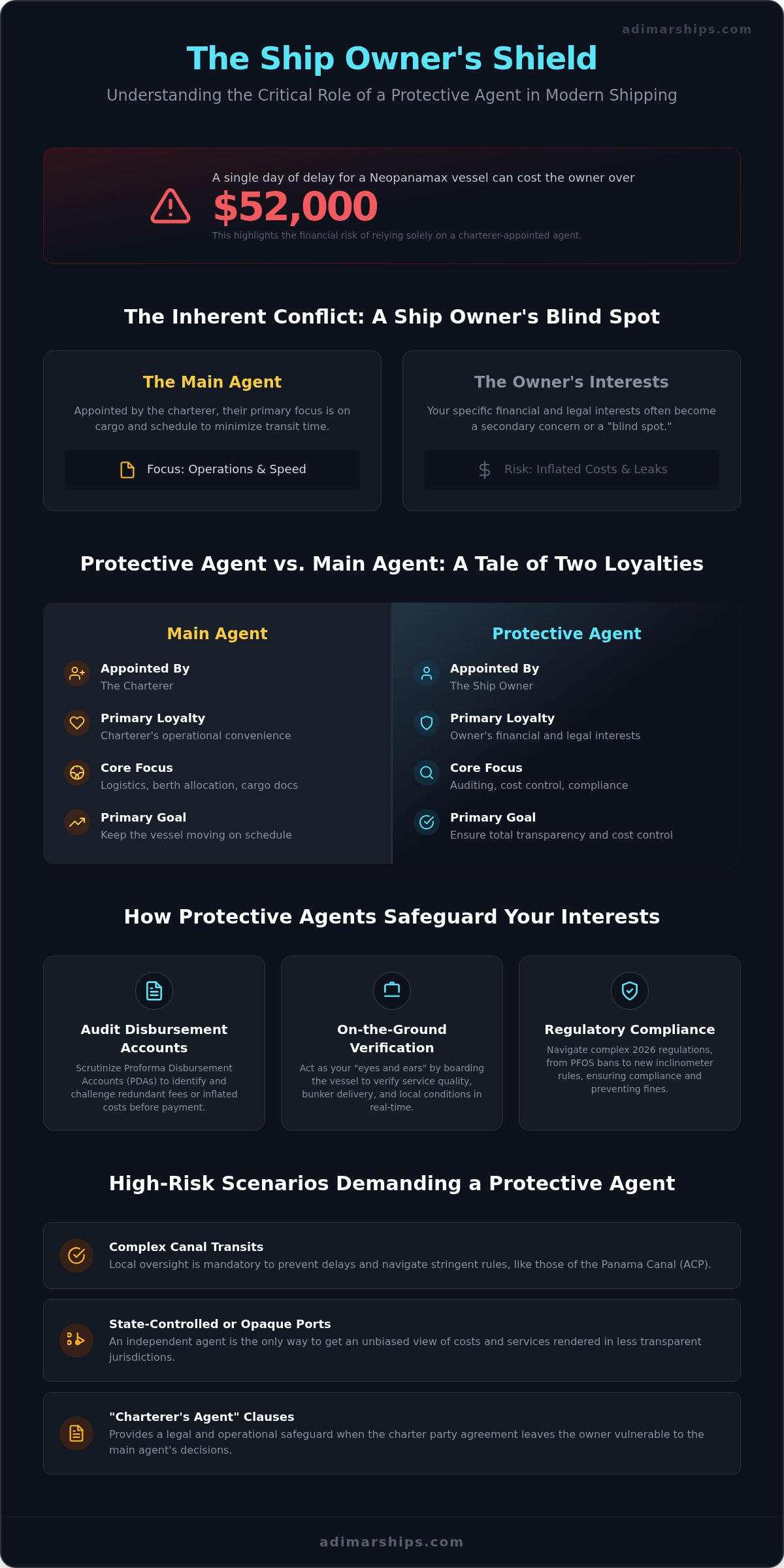
A single day of delay for a Neopanamax vessel in the Panama Canal can drain over $52,000 from your bottom line. While the charterer-appointed agent focuses on cargo and schedule, your specific vessel interests often fall into a blind spot. You’ve likely felt the frustration of inflated husbandry costs or a lack of transparency during complex port calls. If you’re asking what is a protective agent shipping experts trust, it’s the independent advocate who stands between your budget and hidden financial leaks.
We understand that delegating vessel oversight to a party you didn’t choose is a recipe for operational anxiety. It’s common to worry about redundant fees or poor local coordination when your ship is thousands of miles away. This 2026 guide reveals how a protective agent acts as your vigilant auditor and on-the-ground representative. You’ll discover how to secure total financial transparency and ensure that new 2026 maritime regulations, from PFOS bans to inclinometer requirements, don’t cause unnecessary delays. We’ll break down why this role is your most effective tool for reclaiming control over every port call.
Key Takeaways
- Understand what is a protective agent shipping experts use to decouple vessel interests from charterer-appointed agents, ensuring your loyalty is never compromised.
- Learn how to prevent financial leaks by auditing Proforma Disbursement Accounts (PDAs) and verifying local husbandry costs against official 2026 tariffs.
- Discover the critical role of an independent advocate in navigating 2026 regulatory updates, including new safety requirements and ACP transit rules.
- Identify specific risk scenarios, such as complex canal transits, where local oversight is mandatory to prevent operational delays and administrative fines.
- See how a dedicated representative acts as your extended office to provide 24/7 vigilance and ethical transparency during every port call.
Defining the Protective Agent: Your Independent Maritime Advocate
Ship owners often face a difficult reality. When a charterer nominates the main agent, your vessel’s financial health becomes a secondary concern. A protective agent solves this problem by acting as a strategic oversight mechanism for maritime logistics. This secondary agent oversees the primary agent’s performance with a focus on your specific budget and legal standing. By understanding what is a protective agent shipping experts use, you gain an independent partner whose loyalty is never divided. Their core mission is simple. They ensure your interests aren’t sacrificed for the charterer’s operational convenience.
The Legal Premise of Protective Agency
The legal foundation of this role varies depending on the charter party agreement. Often, the PA acts as a nominated auditor or an “agent of necessity.” This relationship is defined by a strict fiduciary duty. Unlike the main agent, who might be balancing multiple interests, the PA is legally bound to your specific instructions. Defining the Protective Agent in a legal sense highlights their role as a safeguard against the “Charterer’s Agent” clause, which often leaves owners vulnerable. They provide a level of transparency that official channels might lack, acting as your local office in foreign territory.
Global jurisdictions handle these roles differently. In some regions, state-controlled agents manage all operational tasks. In these scenarios, a private protective agent is your only way to obtain an unbiased view of local port costs. They offer an essential layer of ethical oversight. This ensures that every dollar spent on husbandry or port fees is verified against actual services rendered, preventing the “padding” of accounts that is common in less transparent zones.
The ‘Eyes and Ears’ in Port: A Vigilance Metaphor
Remote management isn’t sufficient in the high-pressure port environments of 2026. You need physical representation on the ground. A protective agent acts as your “eyes and ears,” boarding the vessel to verify local conditions and services in real time. This presence bridges the critical communication gap between the ship’s master and the main agent. If a master feels pressured to sign off on incomplete services, the PA provides the professional support needed to push back.
By being physically present, the PA can identify discrepancies before they become line items on a final disbursement account. They offer the peace of mind that comes from knowing someone is watching your interests with total vigilance. Whether it’s verifying the quality of bunkers or ensuring that spare parts deliveries aren’t delayed, the PA provides a level of local oversight that standard business language cannot achieve. They don’t just report on the port call; they actively protect your vessel’s interests as if they were their own.
Protective Agent vs. Main Agent: Mapping the Key Differences
A main agent manages the clock; a protective agent manages the cash flow. While both roles are essential for a successful port call, their objectives are often at odds. The main agent handles the vessel’s immediate operational needs. This includes berth allocation, pilotage, and cargo documentation. Their primary goal is to keep the ship moving according to the charterer’s schedule. If you are questioning what is a protective agent shipping experts rely on, it is the independent partner who ensures those operational moves don’t come at your financial expense.
The core difference lies in the reporting structure. The main agent reports to whoever nominated them, which is frequently the charterer. This creates an inherent conflict of interest. The main agent may prioritize the charterer’s desire for speed over the owner’s need for cost control. In contrast, the protective agent reports exclusively to you. They act as a counterweight to the primary agent’s influence, providing an unbiased audit of every action taken in port.
Operational Focus vs. Strategic Oversight
The main agent’s daily tasks are logistical. they liaise with port authorities and coordinate the physical movement of the vessel. However, a protective agent provides strategic oversight. They verify the Statement of Facts (SOF) to ensure that every minute of port time is recorded accurately. This is crucial for preventing unfair demurrage claims. Research into the academic role of the shipping agent indicates that a protective agent is a vital risk-management tool when trust in a counterparty’s nominee is limited. They provide the local expertise needed to challenge inefficient practices that a main agent might overlook.
Financial Transparency and Disbursement Accounts
Financial leaks often start with the Proforma Disbursement Account (PDA). The main agent issues this document based on general port estimates, which can be easily “padded” with hidden fees. A protective agent scrutinizes the PDA to identify overcharging or unnecessary miscellaneous costs. They negotiate directly with local vendors for better husbandry and spare parts rates, often saving owners between 5% and 10% on these expenses. By the time the vessel sails, the PA ensures the Final Disbursement Account (FDA) matches actual services rendered. This level of transparency is difficult to achieve without a dedicated advocate on the ground. For those navigating complex zones, choosing a partner experienced in Panama Canal transit ensures that your financial interests remain the top priority throughout the voyage.
The Core Responsibilities: How Protective Agents Safeguard Your Interests
A protective agent doesn’t just look at numbers; they verify the logic behind them. When asking what is a protective agent shipping professionals prioritize, the answer is detailed financial vetting. They scrutinize the Proforma Disbursement Account (PDA) by cross-referencing every line item against official tariffs and current market benchmarks. This prevents the primary agent from overestimating costs to secure higher pre-payments. By negotiating directly with local vendors, the PA ensures that your budget isn’t drained by inflated service fees or hidden commissions.
Vigilance extends to regulatory compliance. In 2026, new maritime regulations have introduced complex requirements that can lead to heavy fines if overlooked. For example, the revised IMDG Code and the ban on PFOS in fire-extinguishing media became strictly enforceable on January 1, 2026. A protective agent monitors these local shifts and advises the owner proactively. They ensure your vessel meets specific 2026 standards, such as the requirement for electronic inclinometers on larger bulk carriers, preventing administrative delays and penalties before they occur.
During an incident or dispute, the PA acts as your local voice. Whether it’s a medical emergency or a vendor disagreement, they provide a grounded, dependable presence that prioritizes your legal and financial standing over the charterer’s schedule. This crisis management ensures that your interests are defended by a partner with deep local knowledge and no conflict of interest.
Husbandry and Crew Support Oversight
A major part of the PA’s role is managing husbandry services with total transparency. They verify that crew changes, medical visits, and provisions are handled by reputable vendors at fair market rates. This oversight stops the main agent from using high-commission providers that drive up your expenses. By acting as your local office, the PA ensures every service is both efficient and ethically sourced, providing you with the peace of mind that your crew is cared for without unnecessary financial leaks.
Demurrage and Statement of Facts (SOF) Verification
The Statement of Facts (SOF) is often the most contested document in maritime shipping because it dictates demurrage costs. A protective agent validates every entry to ensure that “dead time” isn’t unfairly billed to your account. They track weather delays, port congestion, and equipment failures with precision to ensure the record is accurate. An independently audited Statement of Facts can save tens of thousands of dollars in demurrage disputes by providing an undisputed record of port events. This level of detail is your best defense against unfair claims from charterers or port authorities.
When is a Protective Agent Necessary? Risk Scenarios for Ship Owners
Deciding when to appoint an independent representative is a matter of strategic risk management. While some port calls are routine, others carry high financial stakes that demand local oversight. If you are evaluating what is a protective agent shipping professionals use to mitigate these risks, look at the specific operational variables of your voyage. Certain scenarios create a “perfect storm” for hidden costs and administrative friction.
- Charterer’s Agent Clauses: When the charterer nominates the main agent, your vessel’s interests naturally become a secondary priority for the local office.
- High-Complexity Zones: Transit areas like the Panama Canal require specialized knowledge of local authority structures and shifting 2026 regulations.
- Uncharted Territory: Entering a port where you lack established vendor relationships leaves you vulnerable to “tourist rates” on husbandry and repairs.
- High-Value Operations: Large-scale crew changes or the delivery of critical engine spares require a partner who ensures you aren’t overcharged by local logistics providers.
Charterer-Nominated Agents: The Primary Risk Factor
The most common risk factor is the “Charterer’s Agent” clause in a charter party agreement. In this setup, the main agent’s primary obligation is to the party that pays their fee. This often leads to inflated port dues or “miscellaneous” charges because the agent isn’t incentivized to negotiate on your behalf. You are effectively the second priority in this relationship. Choosing an Owner’s Nominated Agency or a protective agent is the only way to decouple your finances from the charterer’s schedule. It ensures that every dollar spent is audited by someone whose loyalty is strictly yours.
Complex Regulatory Zones and High-Cost Transits
Zones with high operational costs require a vigilant local auditor. For example, navigating the Panama Canal in 2026 involves strict compliance with updated ACP slot booking regulations and N-01 Vessel Requirements. Without a protective agent, you risk arbitrary fines or delays from port authorities. A PA manages these compliance risks by verifying all clearance documents and managing ISPS and PCSOPEP documentation with total precision. They act as your local office, ensuring that your vessel moves through high-cost transits without the burden of surprise expenses or administrative penalties.
If your vessel is operating under a charterer-nominated agent in Panama, you can mitigate your financial risk by partnering with Adimar Shipping for independent oversight and total transparency.
Adimar Shipping, Inc.: Specialized Protective Agency for Panama Canal Transits
Adimar Shipping, Inc. acts as your local office in Panama City, providing 24/7 vigilance during every stage of your vessel’s journey. Navigating the Panama Canal involves more than just physical movement; it requires a deep understanding of shifting 2026 ACP regulations. Understanding what is a protective agent shipping experts trust involves recognizing the value of local expertise. In Panama, this means having a representative who understands the 2026 ACP tariff structures and can audit every proforma disbursement account with precision. We ensure your vessel’s interests are prioritized over the charterer’s operational convenience.
Our expertise in Panama Canal transit ensures all current requirements are met without surprise costs. We provide independent auditing of all canal dues and port expenses. This oversight ensures total financial integrity for your port call. By acting as your independent auditor, we identify potential financial leaks before they impact your bottom line. When you ask what is a protective agent shipping companies rely on for canal transits, the answer is a partner who eliminates confusion and provides total transparency.
The Adimar Advantage: Integrity in the Panama Canal
Our team possesses deep local knowledge of the Panama Canal Authority (ACP). This expertise prevents costly scheduling errors and ensures compliance with 2026 slot booking rules. Adimar Shipping, Inc. is committed to the highest ethical standards. Transparency isn’t just a buzzword; it’s our core brand promise. We’ve frequently identified and disputed inflated miscellaneous port invoices that would have otherwise drained an owner’s budget. Our vigilance ensures that you only pay for services actually rendered at fair market rates.
We also provide specialized support for PCSOPEP authorized person requirements. This includes managing complex crew changes and ensuring all environmental protocols are followed. Our presence on the ground means you don’t have to worry about the logistical complexities of a foreign port. We act as your eyes and ears, providing the security and reliability you need in a high-stakes maritime environment.
Securing Your Interests: Next Steps for Owners
Nominating Adimar Shipping, Inc. is a straightforward process. You can appoint us as your protective agent for any upcoming transit or port call. The onboarding process is efficient and designed to respect your time. We simply need your vessel details and the expected arrival window to begin protecting your interests. We’ll then coordinate with the main agent to ensure a seamless, transparent operation from arrival to departure. Our goal is to provide you with the peace of mind that comes from knowing your vessel is in expert hands.
Contact Adimar Shipping, Inc. to secure your vessel’s interests today.
Securing Your Vessel’s Financial Future in 2026 and Beyond
Navigating the complexities of global trade requires more than just operational speed; it demands financial vigilance and local expertise. You’ve seen how a protective agent acts as a critical auditor, identifying hidden fees and ensuring that your vessel’s interests are never sidelined by charterer priorities. By decoupling your finances from the main agent’s obligations, you gain total transparency and the peace of mind that every port call is optimized for your bottom line.
Understanding what is a protective agent shipping experts trust is the first step toward reclaiming control over your maritime logistics. As 2026 brings stricter safety and environmental regulations, having a dedicated advocate on the ground is no longer a luxury. It is a strategic necessity for any owner transiting complex zones where operational friction can lead to significant delays.
Adimar Shipping has served as an expert Panama Canal agency since 1993. As an authorized PCSOPEP representative, we provide the dedicated local oversight and financial transparency you need to protect your vessel. Secure your vessel’s interests at the Panama Canal; nominate Adimar Shipping as your Protective Agent. We look forward to acting as your local office and ensuring your next transit is a seamless success.
Frequently Asked Questions
Is a protective agent the same as an owner’s nominated agent (ONA)?
A protective agent is a specific type of representative chosen to supervise the counterparty’s nominee. If you’re asking what is a protective agent shipping experts use, it’s a secondary partner that audits the primary agent’s performance. While an Owner’s Nominated Agent (ONA) is the lead agent for a port call, a protective agent is specifically appointed to safeguard your interests when the charterer has already selected the main agent for operational tasks.
Does the charter party agreement allow me to appoint a protective agent?
Standard charter party agreements almost always permit the appointment of a protective agent. Even if your contract includes a “Charterer’s Agent” clause, you retain the inherent right to hire your own independent representative at your own expense. This is a common industry safeguard that doesn’t require the charterer’s approval. Appointing a PA ensures you have a dedicated advocate who focuses exclusively on your financial and legal protection throughout the entire port call.
How much can a protective agent save me on a typical Panama Canal transit?
Savings typically range from 5% to 10% on husbandry and miscellaneous port expenses. By auditing the Proforma Disbursement Account (PDA) against official 2026 ACP tariffs, a protective agent identifies overcharges and negotiates more competitive rates with local suppliers. More importantly, preventing a single day of Neopanamax delay can save over $52,000 in lost hire costs. The PA’s oversight provides an immediate return on investment by eliminating financial leaks and preventing administrative fines.
Can a protective agent handle crew changes and spare parts deliveries?
These tasks are core components of husbandry services. A protective agent manages crew transfers, medical appointments, and the delivery of engine spares to ensure they are handled at fair market rates. We prevent the main agent from using high-commission vendors that would otherwise inflate your costs. This oversight guarantees that your crew and vessel receive the necessary support without being sacrificed for the charterer’s cargo schedule or the main agent’s convenience.
What documents does the protective agent need to audit the main agent?
To perform a thorough audit, the PA needs the Proforma Disbursement Account (PDA), the Statement of Facts (SOF), and all final third-party invoices. They also review the charter party agreement to understand specific cost-sharing liabilities between you and the charterer. By scrutinizing these documents, the protective agent verifies that port dues and pilotage costs match actual services. They ensure that every minute of port time is recorded accurately to prevent unfair demurrage claims.
Will having a protective agent cause conflict with the charterer’s agent?
Professional agency firms recognize that protective agency is a standard risk-management tool. While the PA provides an essential layer of oversight, the relationship is generally cooperative. The PA acts as a local bridge between the ship’s master and the primary agent, which often improves communication. Having an experienced partner like Adimar on the ground helps resolve disputes quickly and ensures that all documentation is accurate, which ultimately benefits the efficiency of the entire port operation.
Is protective agency necessary if I have a long-standing relationship with the main agent?
Even a trusted relationship cannot eliminate the inherent conflict of interest when a charterer nominates the agent. The main agent’s primary duty is to the party paying their appointment fee, which is often the charterer. A protective agent provides an independent audit of all expenses and services. In the complex 2026 regulatory environment of the Panama Canal, having a second set of eyes is a necessary safeguard to ensure total financial transparency and ethical conduct.
How do I nominate a protective agent in the Panama Canal zone?
Nominating a protective agent in Panama is a simple process. You send a formal appointment notice to Adimar Shipping with your vessel’s IMO number and estimated arrival date. We then notify the Panama Canal Authority and the charterer’s agent of our role. This allows us to begin auditing the PDA and managing your PCSOPEP authorized person requirements immediately. Our team acts as your local office to ensure a seamless transit with no hidden financial surprises.