

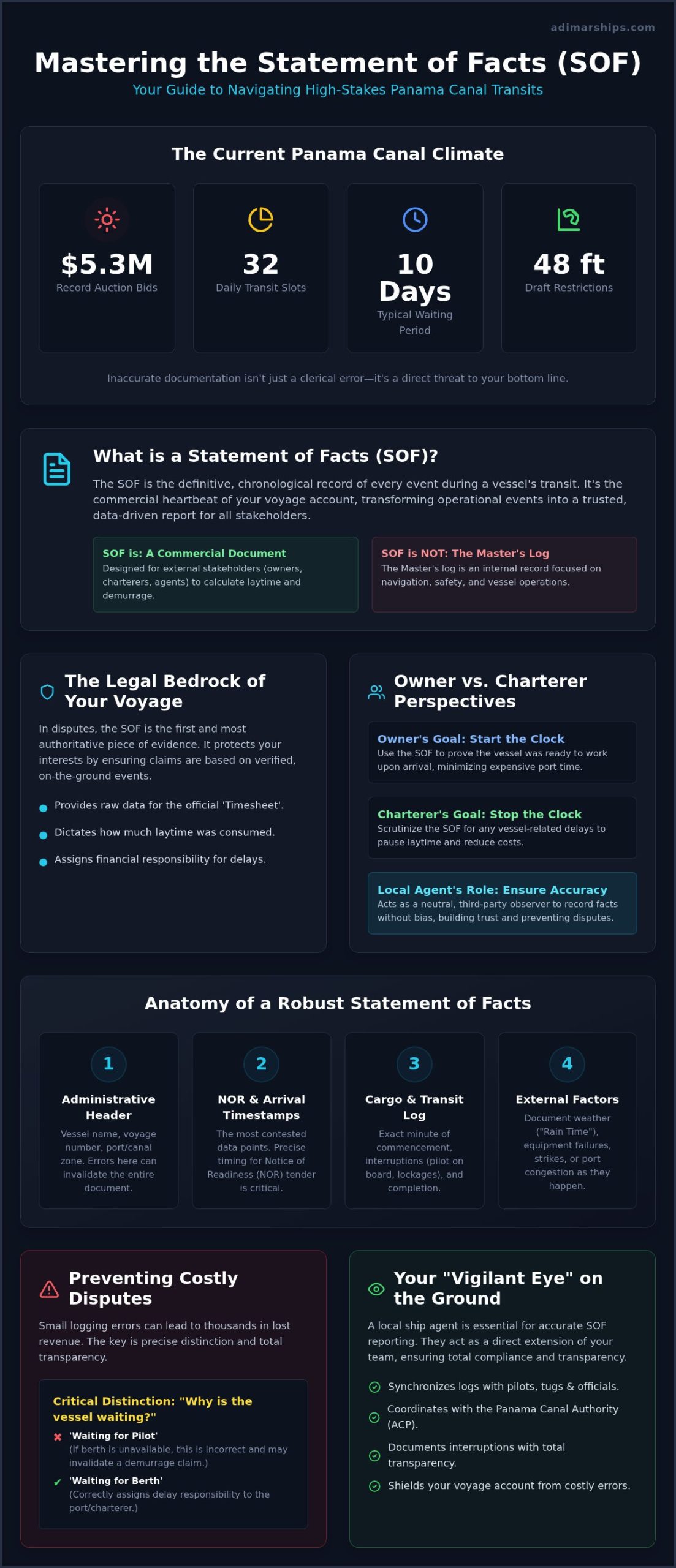
With daily transit slots recently reduced to 32 and auction bids for a single passage reaching a staggering $5.3 million, the margin for error in your statement of facts shipping Panama documentation has vanished. You understand that in the current climate of 48-foot draft restrictions and 10-day waiting periods, an inaccurate log is more than a clerical error; it’s a direct threat to your bottom line. As draft limits tighten and surcharges from major carriers like MSC and CMA CGM climb, every recorded milestone becomes a critical financial pivot point.
We agree that the pressure to maintain a dispute-free voyage account has never been higher for owners and charterers. This 2026 guide will show you how to master SOF complexities to prevent costly laytime errors and ensure seamless transit clearance. You’ll learn how to leverage the SOF as the legal backbone of your financial integrity. We’ll examine the specific milestones your local agent must record as your vigilant eye on the ground, the impact of the latest ACP reporting amendments, and the proactive steps needed to secure accurate calculations. By treating your agent as a direct extension of your team, you can achieve the transparency needed for total legal compliance.
Key Takeaways
- Learn how the Statement of Facts serves as the primary legal evidence for laytime to protect your voyage’s financial integrity.
- Identify the essential components of a robust statement of facts shipping Panama, from administrative headers to precise Notice of Readiness (NOR) timestamps.
- Understand the unique milestones required for Panama Canal transits and why coordination with the ACP is vital for accurate documentation.
- Shield your account from costly demurrage by learning to document “Rain Time” and equipment failures with total transparency.
- Discover how a local ships agent acts as your “vigilant eye” on the ground to synchronize logs with pilots, tugs, and port officials.
What is a Statement of Facts (SOF) in Panama Shipping?
In the high-pressure environment of the Panama Canal, every minute is a financial metric. A statement of facts shipping Panama is the definitive, chronological record of every event that occurs from the moment a vessel enters the Canal Zone until it clears for the open sea. It captures the arrival time, pilot boarding, tug assistance, and every operational pause. While it looks like a simple log, it’s actually the heartbeat of your voyage account. It transforms messy operational realities into a clean, data-driven report that all parties can trust.
A standard Statement of Facts (SoF) documents the vessel’s activities in port or during transit to establish a clear timeline for everyone involved. You shouldn’t confuse this with the Master’s log. The Master’s log is an internal vessel record focused on navigation and safety. The Agent’s SOF is a commercial document designed for external stakeholders. Because Panama serves as a global bottleneck where transit slots can cost millions in auctions, the precision of this document is more vital here than in almost any other maritime hub.
The Legal Significance of the SOF
The SOF provides the raw data needed to build the ‘Timesheet’ used in charter party agreements. It directly dictates how much laytime was consumed and who is responsible for delays. If a dispute arises over ‘dead-time’ or unexpected stoppages in the Canal, lawyers and arbitrators look to this document first. The SOF is the authoritative evidentiary document for all commercial maritime transactions in Panama. It protects your interests by ensuring that financial claims are based on verified, on-the-ground events rather than hearsay or estimates.
Owner vs. Charterer Perspectives
Owners and charterers view the same log through different lenses. Owners use the SOF to prove the vessel was ready to work immediately upon arrival. They want to start the laytime clock as soon as possible to minimize expensive port stays. Charterers, conversely, scrutinize the log to verify that cargo operations were handled efficiently. They look for any vessel-related delays that could stop the clock.
Having an independent, third-party agent like Adimar is essential to maintain integrity. We act as a neutral observer, ensuring the statement of facts shipping Panama reflects reality without bias. This transparency builds trust and prevents the friction that leads to long-term legal battles. By delegating this task to an experienced local partner, you gain an extension of your own team that prioritizes accuracy and ethical standards above all else.
Key Components of a Robust Shipping Statement of Facts
A robust statement of facts shipping Panama begins with a meticulous Administrative Header. This section identifies the vessel name, voyage number, and the specific Port or Canal Zone. While it seems basic, errors here can invalidate the entire document in a legal setting. Following the header, the log must capture precise timestamps for arrival and the Notice of Readiness (NOR) tender. With ships currently waiting up to 10 days to pass through the canal as of September 2026, these initial entries are the most contested data points in any voyage account.
The document must also provide a detailed breakdown of cargo operations. This includes the exact minute of commencement, any interruptions, and the final completion. Don’t forget to include environmental and external factors. Weather conditions, local strikes, or port congestion should be noted as they happen. These specific details serve as the foundation for laytime and demurrage claims, ensuring that your financial interests remain protected against unsubstantiated challenges.
Notice of Readiness (NOR) and Laytime Triggers
Recording the exact moment of NOR tender in Panama waters requires expert oversight. In many cases, the laytime clock only starts once a valid NOR is accepted. You must distinguish between ‘Waiting for Berth’ and ‘Waiting for Pilot’ within the SOF. This distinction is critical; if an agent incorrectly logs a delay as ‘Waiting for Pilot’ when the berth was actually unavailable, the owner may lose the right to claim demurrage for that period. Inaccurate NOR recording can lead to thousands of dollars in lost revenue, a risk that’s magnified by the record-breaking auction prices seen in late 2026.
Operational Milestones and Delays
A complete statement of facts shipping Panama must track every vessel movement. This involves documenting shifting, mooring, and unmooring times. It’s equally important to record non-operational periods clearly. Activities such as crew changes, bunkering, or husbandry services should be logged separately to avoid confusion during the final voyage audit. For a deeper look at managing these port-side requirements, read A Comprehensive Guide to Ship Husbandry Services in Panama.
Our team acts as your vigilant observer on the ground, ensuring every milestone is captured with integrity. You can rely on our ship agency services to provide the transparency your operations deserve.
The Role of SOF During Panama Canal Transit Milestones
Transit through the Panama Canal is not a standard port call; it is a high-stakes movement through a strictly controlled waterway. While a standard port SOF tracks cargo operations, a statement of facts shipping Panama for transit focuses on time and regulatory compliance. With daily transit slots reduced to 32 as of September 15, 2026, and auction prices hitting record highs of $5.3 million, mismanaged timing is a significant financial risk. Your log must be beyond reproach to protect these massive investments.
Our role involves constant coordination with the Panama Canal Authority (ACP). We manage the ‘Transit Slot’ log to ensure your vessel meets every scheduled window. Missing a transit window can lead to heavy fines or the forfeiture of a slot that may have cost millions to secure. For a deeper look at these operational requirements, consult our Panama Canal Transit: The Complete Guide for Ship Operators. By delegating this oversight to an experienced agent, you ensure that every minute of the transit is documented with precision.
Essential Transit Milestones to Record
Accurate transit logs require specific timestamps that standard shipping documents often overlook. These milestones are the primary evidence used to resolve disputes with the ACP or charterers. We record:
- Arrival at the Atlantic (Cristobal) or Pacific (Balboa) breakwater.
- Pilot on Board (POB) and Pilot Disembarked timestamps.
- Exact entry and exit times for the Gatun, Agua Clara, Cocoli, or Miraflores locks.
These data points prove your vessel was ready and compliant with all local regulations. In an environment where draft restrictions are currently capped at 48 feet for Neopanamax vessels, documenting the exact state of the vessel at each milestone is vital for legal and insurance clarity.
Documenting ACP-Related Delays
Delays often stem from factors outside your control, such as tugboat availability or lockage congestion. We document tugboat assistance and lockage wait times meticulously. This statement of facts shipping Panama protects you against ‘misjudged timing’ penalties from the ACP. If the Authority reports a delay, we cross-reference our SOF data with official ACP transit logs to ensure the record is fair. This vigilance ensures you aren’t held financially responsible for systemic delays. We act as your local observer to maintain the integrity of your voyage account at every lock and breakwater.
Preventing Laytime Disputes and Demurrage in Panama Ports
A well-drafted statement of facts shipping Panama acts as your primary shield against unjustified demurrage claims. In the high-stakes maritime environment of Panama, small logging errors often snowball into massive financial losses. The SOF provides the factual foundation for your final Laytime Calculation, also known as the Timesheet. Without a precise log, you’re essentially flying blind during voyage audits. We’ve seen how easily “Rain Time” or “Equipment Failure” can become points of contention if they aren’t documented the moment they occur.
Tropical weather in Panama can halt cargo operations in seconds. If your agent fails to record the exact start and end of a downpour, the charterer might claim the entire shift was non-operational. Similarly, equipment breakdowns on the pier must be noted as shore-side delays to protect the vessel’s interests. The Master should never sign an SOF “clean” if there’s even a minor discrepancy. Signing without reservations often waives your right to challenge the data during final settlement negotiations.
Handling Discrepancies and Reservations
When disagreements arise, the “Signed Under Protest” (SUP) mechanism is your most effective tool. It allows the Master to acknowledge receipt of the document while formally contesting specific entries. We recommend documenting every reservation with supporting evidence. This includes deck logs, independent weather reports, and even time-stamped photos of port congestion or equipment status. These records turn a “he-said, she-said” argument into a clear-cut case for your claims department. Our team ensures that these reservations are filed correctly to maintain the integrity of your voyage account.
The Financial Impact of SOF Accuracy
Precision isn’t just about paperwork; it’s about profit. Consider a scenario where a 15-minute error in recording the Notice of Readiness (NOR) occurs. In a tight market, that quarter-hour can shift the commencement of laytime by an entire day depending on charter party terms. This single mistake can strip thousands of dollars from your total voyage Time Charter Equivalent (TCE). Using the SOF to recover costs is particularly vital in “Owner’s Nominated Agency” scenarios, where we act as your dedicated representative. To understand how to better safeguard your vessel, explore our guide on Owner’s Nominated Agency: A Ship Owner’s Guide.
Protect your bottom line by ensuring your statement of facts shipping Panama is handled by experts. Contact us today to secure our ship agency services for your next Panama port call.
Why a Local Ship Agent is Essential for Accurate SOF Reporting
Generic software platforms often fail because they lack local vigilance. While digital logs can record timestamps, they cannot verify the physical reality at the locks or on the pier. In the high-stakes environment of 2026, where transit slots are limited to 32 daily and auction prices have surged to millions of dollars, you cannot afford to rely on remote voyage management. A valid statement of facts shipping Panama demands on-site verification to ensure that every recorded minute aligns with actual operational progress.
We act as your dedicated representative, coordinating directly with pilots, tug masters, and Panama Canal Authority (ACP) officials. This local presence eliminates the “Confusion and Delay” that typically arises when shore-side managers try to interpret logs from thousands of miles away. By having a professional on the ground, you ensure that your voyage account is consistent, transparent, and ready to withstand the scrutiny of any audit or legal challenge. Personalized service remains the only way to capture the nuances of a complex transit that automated systems simply miss.
Adimar’s Expertise in Panama Operations
With over 20 years of experience in the Canal Zone, our team acts as a seamless extension of your own operations department. We don’t just fill out forms; we interpret local port regulations and ACP requirements to protect your interests. Think of us as the “eyes and ears” of the owner at the locks. We are there to watch the pilot board, to verify the exact moment of lock entry, and to document any external interference that could impact your laytime calculations. This deep local knowledge allows us to anticipate issues before they become expensive disputes, providing you with the security of a veteran partner.
Seamless Coordination and Communication
Effective reporting relies on bridging the communication gap between the vessel crew and shore-based management. Our agents maintain a constant flow of information, providing rapid responses to any operational changes. When the vessel crew is preoccupied with the technical demands of a transit, we take over the burden of administrative accuracy. This proactive approach prevents the small logging errors that lead to thousands of dollars in lost demurrage. We ensure that your statement of facts shipping Panama is a perfect reflection of the voyage, allowing you to focus on your core business while we handle the complexities of the Canal.
Don’t leave your voyage account to chance in a volatile market. Contact Adimar Shipping for expert ship agency services in Panama.
Securing Your Financial Integrity in the Panama Canal
Mastering the statement of facts shipping Panama is no longer just an administrative task; it’s a critical financial necessity. In a landscape defined by record-breaking auction prices and tightening draft restrictions, your log must serve as an unshakeable legal record. By capturing precise transit milestones and documenting every lockage delay, you shield your voyage from costly laytime disputes and ACP penalties. Transparency and integrity in these documents ensure that your account remains dispute-free regardless of operational complexities.
You deserve a partner who acts as a vigilant, on-the-ground extension of your own team. Adimar Shipping brings over 20 years of Panama Canal expertise to every port call, providing the personalized representation required to verify entries that software might miss. As an authorized PCSOPEP person, we offer the security and reliability your operations demand in this high-stakes region. Let us handle the coordination with pilots and officials while you focus on the success of your global fleet.
Secure Your Panama Transit with Adimar’s Expert Agency Services and experience the peace of mind that comes from seasoned local oversight. We look forward to representing your interests at the locks.
Frequently Asked Questions
Who is responsible for preparing the Statement of Facts in Panama?
The local ship agent carries the responsibility for preparing the statement of facts shipping Panama during a vessel’s stay. They act as a neutral third party to record every operational event with total transparency. While the Master maintains the vessel’s deck log, the agent’s SOF serves as the official commercial record for external stakeholders. Having an experienced agent on the ground ensures that all parties receive an accurate and ethically prepared document.
Can a Statement of Facts be used in a court of law for maritime disputes?
Yes, the SOF serves as the primary evidentiary document in maritime courts and arbitration proceedings. It provides the factual timeline required to resolve high-stakes financial disagreements between owners and charterers. Because it captures real-time data on the ground, judges and arbitrators rely on it to determine the validity of demurrage claims. Maintaining a precise log is your best defense against the threat of prolonged and expensive legal battles.
What is the difference between a Statement of Facts and a Laytime Calculation?
The SOF is a chronological record of raw data, while a Laytime Calculation is the financial analysis of that data. You use the SOF to identify exactly when events happened, such as the Notice of Readiness tender. The Laytime Calculation, or Timesheet, then applies your specific charter party terms to those timestamps to calculate costs. Think of the SOF as the evidence and the Laytime Calculation as the final invoice for the voyage.
What should I do if the Master and the Agent disagree on the SOF timestamps?
You should utilize the “Signed Under Protest” (SUP) mechanism if a disagreement occurs between the Master and the agent. The Master signs the document but adds a formal note indicating that specific timestamps are contested. It’s vital to provide immediate supporting evidence, such as deck logs or independent weather reports, to justify the protest. This proactive step preserves your right to challenge the data during final voyage settlements or legal reviews.
How does the Panama Canal Authority (ACP) use the Statement of Facts?
The Panama Canal Authority uses these records to synchronize vessel movements and verify compliance with scheduled transit windows. Accurate reporting is essential to avoid penalties, especially with the 2026 reduction to 32 daily transit slots. Your agent cross-references the statement of facts shipping Panama with official ACP logs to ensure consistency. This coordination protects you from being held financially responsible for systemic delays or lockage congestion outside your control.
Is a digital Statement of Facts legally acceptable in Panama ports?
Digital versions of the SOF are widely accepted in Panama ports and for Canal transits. These digital logs improve efficiency and allow for real-time updates between the vessel and shore-based management. However, the document must still be verified and signed by the local agent to carry full legal weight. Most maritime stakeholders now prefer digital formats because they provide a clear, tamper-evident audit trail that simplifies the final voyage accounting process.
How long should I keep a copy of the Statement of Facts after a voyage?
You should generally retain a copy of the SOF for at least seven years to satisfy legal and insurance requirements. This timeframe aligns with the standard statute of limitations for commercial maritime contracts and tax audits. Keeping these records accessible is vital if a latent dispute arises regarding cargo damage or laytime calculations. Clear documentation provides the security you need to defend your financial interests long after the vessel has cleared the Canal.
Does the SOF include information about PCSOPEP compliance?
Yes, the SOF typically records the arrival and activity of the authorized PCSOPEP representative during the transit. While it isn’t the technical pollution plan itself, logging the presence of these specialists proves your compliance with Panama Canal regulations. As an authorized PCSOPEP provider, Adimar ensures that these critical milestones are captured accurately. This documentation is essential for demonstrating your commitment to ethical standards and environmental safety while navigating the waterway.