
Ballast does not mean toll-free. The impact of new Panama Canal tolls in 2026 depends on the vessel’s category and transit details: under the approved structure, vessels in ballast outside the containership segment are charged 85% of the laden toll, while the simplified tariff structure reduced the number of tariffs from 430 to fewer than 60.
That shift can make the toll framework easier to understand, but it doesn’t create one flat charge for every ship. The structure moves from rates based only on volume to a fixed fee by lock type plus a variable capacity tariff, so vessel type, lock and capacity all matter when estimating a transit. This article explains how the simplified structure may affect ship costs, how ballast tolls apply, and what operators should consider when planning a Panama Canal passage in 2026.
Key Takeaways
- Start a transit estimate with the vessel’s market segment, lock type and capacity; these determine how the tariff is applied.
- Account for revised market categories, including the tanker segment’s divisions and the placement of roll-on/roll-off vessels within the vehicle carrier segment.
- When comparing with 2025, use the approved empty-container charge of $6 per TEU as a reference point for containerships.
- Review small-vessel length adjustments and applicable surcharges as separate cost factors in a 2026 transit budget.
- Factor ballast status into the estimate, while distinguishing full-container vessels from other vessel segments.
Proposed simplified Panama Canal toll structure
The approved simplified structure cut the Panama Canal’s tariff count from 430 to fewer than 60. That consolidation makes the framework less fragmented, but it doesn’t create one universal charge. Operators still need to identify the vessel’s market segment and the lock type before assessing how the tariff applies.
The revised structure changed how tolls are calculated. Rather than relying only on volume-based rates, it uses a fixed fee based on lock type plus a variable tariff based on capacity. To estimate a transit, identify the vessel’s market segment and lock type, then account for the capacity component. These inputs determine how the toll is calculated under the revised structure.
The Panama Canal Authority expanded its market segmentation from eight segments to ten. It divided tankers into three distinct segments and placed roll-on/roll-off vessels within the vehicle carrier segment. The former container/breakbulk segment was eliminated. These changes matter because market segmentation can affect how tolls apply, rather than one rate applying to every vessel.
The original proposal also treated ballast vessels differently by segment. It set ballast tolls at 90% of the laden toll for market segments other than containerships. That was the proposal, not the final approved ballast treatment. The toll schedule included staged implementation: other approved tariffs were planned to take effect gradually from January 2023 to January 2025. The fixed tariff was to remain in place until 2025.
For the toll freeze, Panama’s authorities confirmed that tolls would remain frozen until September 2026. Panama Canal Administrator Ricaurte Vásquez said a consultation process would begin after the freeze and before toll changes took effect. This timing is important when comparing a transit within the freeze period with one planned after September 2026.
How do 2026 Panama Canal tolls compare with the Suez Canal and alternative routes? A reliable comparison must account for each route’s toll rules, vessel category, distance, fuel use and schedule. The Panama Canal tariff structure alone doesn’t establish which route costs less for a particular voyage. For organizations evaluating overall distribution networks alongside maritime corridors, Warenous connects cargo owners with vetted third-party logistics providers worldwide.
What is the estimated cost of a Panama Canal transit under the 2026 toll schedule? The toll depends on the vessel’s market segment, lock type and capacity, with ballast status affecting applicable treatment. Those details shape the estimate; the simplified structure does not set one charge for all ships.
Vessel-in-ballast tolls
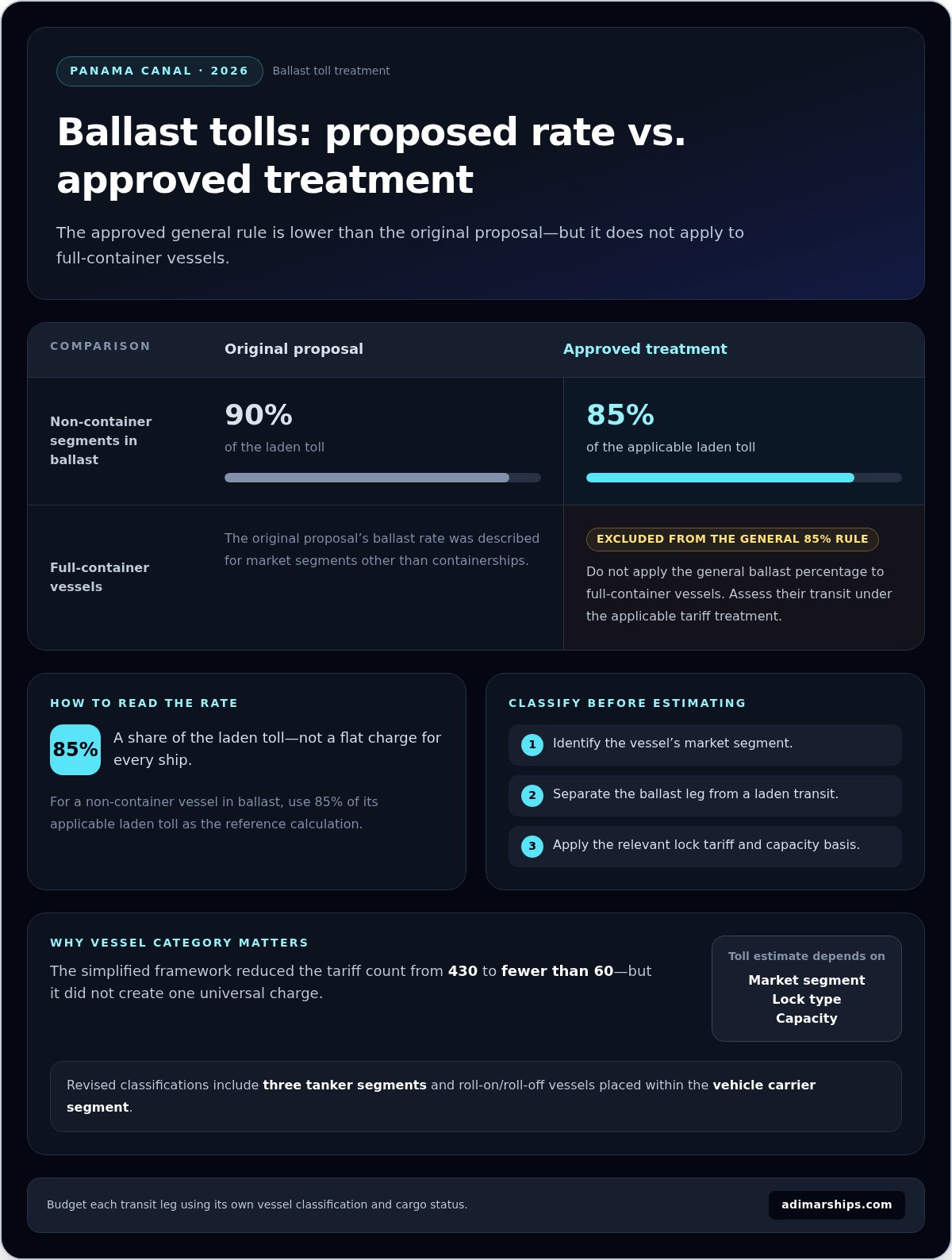
Ballast status changes how operators should estimate a Panama Canal transit. According to the Panama Canal Authority, vessels in ballast generally pay 85% of laden tolls, but this treatment does not apply to full-container vessels. The distinction matters when a vessel sails without cargo on one leg and carries cargo on another. A sound estimate should classify each transit leg separately, then apply the relevant vessel segment and tariff treatment.
The 85% figure is a share of the laden toll, not a universal charge for every vessel. For example, a non-container vessel in ballast uses 85% of its applicable laden toll as the reference calculation. A full-container vessel cannot use that same general ballast treatment. Operators should therefore establish the vessel’s market segment before using a ballast percentage in voyage budgets or comparing laden and ballast legs.
What rules, discounts, or exemptions apply to Panama Canal tolls in 2026? The general ballast rate is 85% of the laden toll, with full-container vessels excluded from that treatment. Container and LNG return-voyage loyalty incentives were scheduled to end by January 2023, while the simplified container loyalty program was phased out by 2025.
Classification is the key first step. Confirm whether the vessel falls within the containership segment or another market segment, then distinguish its ballast leg from a laden transit. Tankers also sit within a revised segmentation that divides the tanker category into three distinct segments. That division makes the correct market classification important before applying a laden-toll comparison or assessing the ballast treatment.
How will 2026 Panama Canal tolls affect container ships, tankers, and LNG carriers? Full-container vessels do not receive the general 85% ballast treatment, while tanker ballast tolls fall under the general 85% rule. LNG return-transit loyalty discounts ended on January 1, 2023, so operators should not include that former incentive in a 2026 estimate.
For practical budgeting, compare the same vessel across its laden and ballast legs, using its applicable segment and lock tariff. Keep container vessels separate from other vessel types, and don’t carry historical return-voyage discounts into a 2026 calculation. The impact of new Panama Canal tolls in 2026 depends on these classifications, not ballast status alone. A clear transit worksheet can record the vessel segment, cargo status, lock type, capacity basis, and relevant tariff treatment for each passage.
For container operators, the proposed simplified Panama Canal container-vessel loyalty program would apply to customers deploying more than 1.5 million TEU per year. That threshold describes the customer’s deployment, so operators should not treat the proposal as a general ballast adjustment or assume it changes the vessel’s applicable laden-toll comparison. Keep any eligibility review separate from the vessel’s market segment and cargo status when preparing a transit estimate.
Keep in regular contact with your ship agent about Panama Canal booking slots and their status, including whether they are being bought, auctioned, or reassigned. In your voyage worksheet, record the slot status alongside the vessel’s classification and whether the leg is laden or in ballast. Verify updates with the agent before relying on the planned transit.
What are the 2026 Panama Canal toll rates by vessel type and size?
There isn’t one Panama Canal toll for every ship in 2026. The charge depends on the vessel’s market segment, lock type and capacity. The revised tariff structure applies a fixed fee by lock type, alongside a variable capacity tariff. To estimate a transit, identify those three factors first, then apply the tariff for the vessel’s category.
The toll changes cover general cargo, dry bulk, tankers, chemical tankers, LPG carriers, vehicle carriers, roll-on/roll-off vessels, and other vessel types. Under the revised market structure, roll-on/roll-off vessels are grouped with vehicle carriers, while tankers are divided into three distinct segments. The vessel’s category determines the applicable tariff before lock type and capacity are taken into account.
Historical changes help explain why 2026 comparisons need a careful baseline. Tanker and chemical-sector toll rates for Panamax and NeoPanamax locks were set to increase by 22% on January 1, 2023. Further increases of 11% were set for January 1, 2024, and January 1, 2025. These staged adjustments concerned tanker and chemical sectors; they aren’t a single percentage to apply across all vessel types in 2026.
For an operational estimate, build the calculation in a consistent order:
- Classify the vessel. Distinguish, for example, a dry bulk carrier from a chemical tanker or vehicle carrier.
- Identify the lock type. Establish whether the transit uses Panamax or NeoPanamax locks.
- Apply capacity. Use the relevant capacity basis for the vessel’s market segment.
- Separate additional charges. Keep applicable surcharges distinct from the base toll.
Following this sequence helps prevent a toll change for one category from being mistakenly applied to another.
At the time of the announced restructuring, the remaining vessel segments and the price per TEU for containers carried onboard a vessel remained unchanged. That distinction is useful for container operators: a containership’s toll structure and the charge for containers carried onboard are not interchangeable measures. Empty-container charges also changed on a separate schedule, reaching $6 per TEU in 2025. Treat that per-TEU amount as a specific charge, not as the total canal toll.
For 2026 budgeting, compare like with like: same vessel segment, lock type, capacity basis and cargo status. A tanker’s scheduled historical increases don’t establish a universal 2026 rate for every tanker size. Likewise, a container charge per TEU doesn’t replace the vessel’s transit toll. Recording each tariff component separately gives operators a clearer basis for comparing voyage scenarios and reviewing how the new structure affects total canal charges.
What new fees or surcharges apply to ships transiting the Panama Canal in 2026?
For a 2026 transit estimate, separate the base toll from surcharge components. The Panama Canal’s revised toll framework affects the variable portion of the freshwater surcharge, so toll changes can alter that part of the overall charge. The surcharge should therefore be considered alongside the vessel’s applicable toll, not treated as a substitute for it.
Small vessels need a separate assessment. The Panama Canal revised small-vessel tolls according to vessel length, incorporating adjustments that were not previously considered. Record the vessel’s measured length and applicable category before estimating canal charges. Do not use a larger vessel’s tariff as a substitute.
Full-container vessels have a separate historical change to account for. Before implementing the new tolls, the Panama Canal planned to eliminate the visibility charge applied to full-container vessels. This was a planned removal tied to implementation of the new tolls, not a new visibility fee. For a 2026 cost worksheet, distinguish this announced change from charges that remain relevant to the vessel’s transit.
Operators can organize the review into three cost lines:
- Base toll: Identify the vessel segment, lock type and capacity basis.
- Freshwater surcharge: Include its variable portion, which is affected by Panama Canal tolls.
- Small-vessel adjustment: Apply the relevant length-based treatment for a small vessel.
Separating these items prevents surcharge effects from disappearing inside a single total. It also makes comparisons clearer if the vessel’s category or transit plan changes.
A small vessel and a full-container vessel, for example, require different assessments. Length is relevant to toll adjustments for the small vessel, while the full-container vessel’s visibility charge was identified for elimination before the new tolls took effect. Assess both separately from the variable component of the freshwater surcharge. Combining them under a generic “extra fee” line can hide what is driving the calculation.
When preparing a 2026 estimate, use a consistent sequence: identify the vessel type, establish whether small-vessel length treatment applies, calculate the base toll, then account for the variable freshwater surcharge. Record the visibility-charge change separately as a historical implementation measure. This approach gives operators a clearer view of how the Panama Canal’s toll structure interacts with surcharges, without treating every vessel as subject to the same additions.
The Panama Canal said that 55 percent of total tonnage transited through its Neopanamax locks, a traffic mix worth noting when reviewing vessel-specific transit charges.
How do 2026 tolls compare with Panama Canal rates in 2025?
The clearest stated 2025 comparison point is the approved empty-container charge for containerships: $6 per TEU. This is a charge per empty container unit, not the complete toll for a vessel’s transit. Keep it separate from the vessel’s base toll when reviewing year-to-year budgets. A per-TEU charge and a transit toll describe different cost components.
For a useful 2025-to-2026 comparison, match the same vessel category, lock type, capacity basis and transit condition. A tanker should be compared with the same tanker segment, not with a dry bulk carrier. A containership comparison should separate the vessel toll from charges tied to containers carried onboard. This keeps unlike tariff components from being treated as a single rate.
Timing also matters. Panama’s authorities confirmed a toll freeze until September 2026. Panama Canal Administrator Ricaurte Vásquez said consultation would begin after the freeze and before any toll changes take effect. Therefore, the transit date belongs in the comparison alongside vessel and tariff details. Separate a planned transit during the freeze from one scheduled after it.
Build a comparison worksheet with separate lines for each relevant item:
- Vessel segment: Record the tariff category used for each year.
- Transit profile: Note lock type, capacity basis and laden or ballast status.
- Container charges: Track empty-container charges per TEU separately from vessel tolls.
- Timing: Mark the transit date relative to the September 2026 toll freeze.
This format shows which input explains a cost difference, rather than attributing every change to the headline toll adjustment.
The approved tariff changes followed a staged schedule through January 2025. For tanker and chemical sectors using Panamax and NeoPanamax locks, the scheduled increases were 22% on January 1, 2023, then 11% on January 1, 2024, and 11% on January 1, 2025. Those dated increases provide historical context, but they should not be added again as a new 2026 increase. They applied to the named sectors and dates.
For an operator, the practical step is to compare the actual tariff components for the intended transit, not simply compare annual totals. A structured review of Panama Canal passage costs can help align the estimate with the ship’s operating plan. Discuss your Panama Canal transit planning when local coordination is part of the next step.
Adimar Shipping: Ship Agency Services
Adimar Shipping, Inc. coordinates Panama Canal transits for vessel owners and charterers through its Ship Agency Services. A local ship agent can help align toll classification, transit arrangements, and vessel requirements within one operational plan. Adimar coordinates communication around the passage, while the vessel operator remains responsible for selecting the appropriate transit and tariff information.
Owners can appoint Adimar as their Owner’s Nominated Agency, while charterers can use its Charterer’s Nominated Agency service for nominated representation. Husbandry Services can address vessel needs alongside transit coordination, helping keep relevant parties informed as the passage is arranged.
For support with a Panama Canal transit, contact Adimar Shipping, Inc. or visit adimarships.com.
Plan Your Next Canal Transit With Confidence
Use the impact of new Panama Canal tolls in 2026 as a prompt to strengthen the planning process for each voyage. Clear coordination between owners, charterers and vessel representatives helps keep transit arrangements aligned with operational priorities as schedules and tariff considerations evolve.
Adimar Shipping, Inc. provides Ship Agency Services, including Owner’s Nominated Agency and Charterer’s Nominated Agency. This is a practical next step when you need local representation to coordinate communication and passage arrangements in Panama. Adimar gives your team a clear point of coordination as you make decisions about the vessel’s route and operating plan.
Contact Adimar Shipping, Inc. about canal tolls to discuss agency support for your next Panama Canal transit. With a well-organized plan and the right local coordination, your team can move forward with greater clarity.
Frequently Asked Questions
What Panama Canal toll changes take effect in 2026?
The 2026 toll picture is shaped by the approved simplified tariff structure and the toll freeze confirmed until September 2026. The freeze does not mean every vessel pays an identical charge; the applicable tariff still depends on its category and transit details. After the freeze, Panama Canal Administrator Ricaurte Vásquez said consultation would begin before toll changes take effect. For planning, distinguish existing tariff components from any later changes following that process.
How are Panama Canal tolls calculated in 2026?
Estimate the transit by matching the vessel’s market segment, lock type, and capacity basis to the applicable tariff. Keep relevant surcharges as separate cost lines instead of folding them into the base toll. For a containership, for example, distinguish vessel tolls from charges calculated per TEU. Record cargo status as well, since ballast treatment differs between full-container vessels and other segments.
When were Panama Canal toll changes for 2026 announced, and where can operators find official rates?
The simplified toll proposal was issued on April 1st, 2022, and its public hearing took place in Panama on May 20, 2022. Panama’s authorities also confirmed a toll freeze until September 2026. Operators can find official tariff schedules and notices through the Panama Canal Authority, the authority responsible for the Canal’s toll structure. Use its current published schedule for the vessel category and transit date, rather than treating the 2022 proposal as a 2026 rate notice.
How do 2026 Panama Canal tolls compare with the Suez Canal and alternative routes?
A reliable comparison accounts for each route’s toll rules, vessel category, distance, fuel use, and schedule. The Panama Canal tariff alone does not show which route will cost less for a particular voyage.
What is the estimated cost of a Panama Canal transit under the 2026 toll schedule?
There is no single toll for every ship. The estimate depends on the vessel’s market segment, lock type, and capacity, while ballast status affects the applicable toll.